

How to Use Retrieval Practice for A-Level Maths
How to use retrieval practice for A-Level Maths: replace passive rereading with recall, feedback and a practical weekly plan for lasting exam readiness.

A student can spend an hour rereading notes on differentiation and finish with a reassuring sense of familiarity. Then the textbook closes, the question changes slightly, and the method disappears. Learning how to use retrieval practice for A-Level Maths means replacing some of that passive review with deliberate attempts to recall facts, choose methods and solve questions without prompts.
The essential process is simple: learn a topic, close the notes, retrieve what you know, check your work, correct errors and return to it later. For maths, however, recalling a formula is only the beginning. You must also practise recognising when and how to use it.
Retrieval practice revision at a glance
A useful A-Level Maths retrieval routine has five parts:
- Choose a small topic or connected group of skills.
- Recall definitions, formulae and method cues without notes.
- Answer a few questions from memory.
- Check every answer using solutions or a mark scheme.
- Revisit the material after a gap, using different questions.
You can find material for this process in the free A Level Maths revision hub, including exam-board resources, worksheets, past papers and mark schemes.
What retrieval practice actually means
Imagine a hypothetical student called Sam. Sam normally reads a worked example, highlights two lines and thinks, “That makes sense.” The problem is not that rereading has no value. It can help when meeting an idea for the first time. The problem is that recognition feels easier than recall.
Retrieval practice asks Sam to produce knowledge before seeing the answer. That could mean writing the product rule from memory, sketching the shape of y=exy=e^xy=ex, explaining the conditions for a binomial model, or choosing a suitable method for an integration question.
Research on learning consistently supports practice testing as a way to strengthen long-term memory, particularly when retrieval is spaced and followed by feedback. Repeatedly bringing knowledge to mind makes it easier to access later than repeatedly reading the same material.
But there is an important limit. Evidence is less straightforward for complex mathematical problem-solving than for remembering factual information. Retrieving a formula does not automatically create the insight needed for an unfamiliar proof or modelling problem. Some studies of mathematical word problems and procedural learning have found little advantage over studying worked examples, especially for novices.
The sensible conclusion is not that retrieval practice solves everything. It is that retrieval should sit beside explanation, worked examples and varied problem-solving.
How to use retrieval practice for A-Level Maths
Retrieve knowledge before solving questions
Begin with a blank page. Give yourself three to five minutes to write everything you can remember about a topic. For trigonometry, that might include identities, graph features and common equation strategies. For differentiation, it might include the chain, product and quotient rules.
Do not copy beautifully organised notes. The effort of recalling is the useful part. Afterwards, compare your page with your specification, textbook or revision lesson and add omissions in another colour.
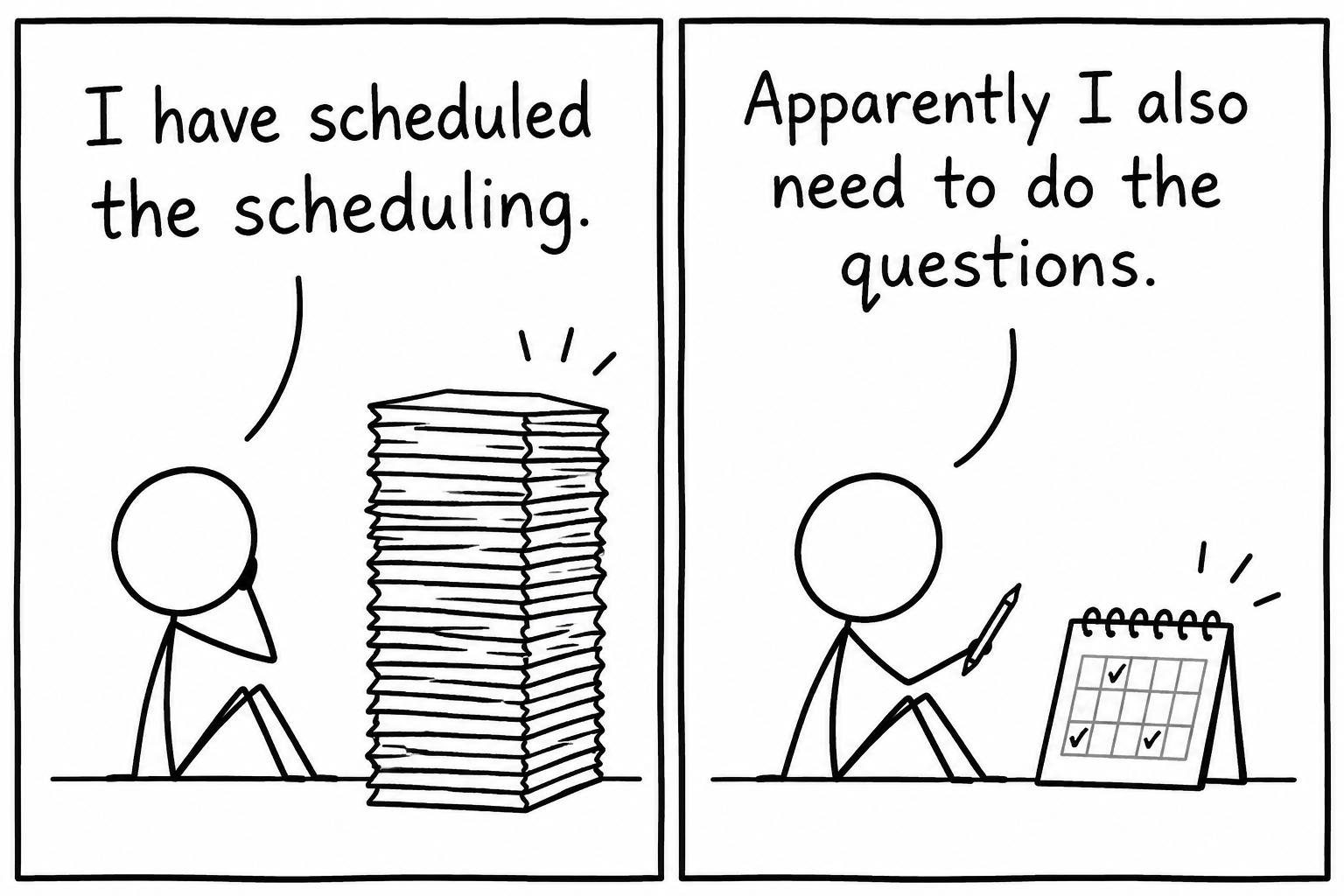 A stick figure discovers that making a revision timetable is not the same as answering questions
Retrieve the decision, not only the formula
A-Level Maths questions rarely announce the method you need. Your retrieval prompts should therefore include decisions:
- What feature suggests logarithms will help?
- When is integration by parts appropriate?
- Which assumptions are required for a binomial model?
- How can a normal vector help with a line or plane?
- What would show that an iterative sequence converges?
This turns retrieval practice revision into mathematical thinking rather than a collection of formula flashcards.
Attempt questions without support
After recalling the method, answer two or three questions without notes. Start with a familiar form, then introduce variation. For differentiation, you might move from finding the derivative of x2exx^2e^xx2ex to using the derivative to locate a stationary point.
If the topic is still new, study one complete worked example first. Then cover it and reproduce the reasoning. Later, use an unseen question. The Edexcel A Level Maths resources and AQA A Level Maths resources provide structured material for moving from topic practice to exam-style questions.
Check immediately and record the cause
Retrieval without feedback can reinforce an error. Mark the attempt while your reasoning is still fresh, using a reliable solution or mark scheme.
Do not record only whether the answer was right. Classify the problem:
- Knowledge gap: a formula or definition was missing.
- Method gap: you knew the content but chose the wrong approach.
- Execution error: the method was correct, but algebra or arithmetic failed.
- Communication issue: reasoning was not clear enough for the mark scheme.
Each category suggests a different response. A knowledge gap may need another short recall prompt. A method gap may require comparing worked examples. An execution error needs careful practice, while a communication issue needs full solutions written under exam conditions.
A sample week of retrieval practice
Sam replaces five rereading sessions with the following plan. Each session is short enough to fit around lessons, homework and other subjects.
| Day | Retrieval task | Follow-up |
|---|---|---|
| Monday | Recall differentiation rules and method cues from a blank page | Check notes, then answer three focused questions |
| Tuesday | Recall key probability definitions and model assumptions | Complete a short mixed set and mark it |
| Wednesday | Return to Monday’s topic without reviewing first | Correct errors and attempt one less familiar question |
| Thursday | Explain a mechanics method aloud, including units and assumptions | Compare the explanation with a worked solution |
| Friday | Complete a mixed mini test without notes | Classify every lost mark |
| Saturday | Answer part of a past paper under timed conditions | Use the mark scheme and update the error log |
| Sunday | Review the error log and retrieve the week’s weakest ideas | Choose topics to revisit next week |
The spacing does not need to follow a perfect formula. A practical pattern is to retrieve a topic the next day, later that week and again in a future mixed test. The guide to stopping forgotten maths content explains the same spacing principle, while the one-month maths revision plan offers a broader planning structure that can be adapted to A Level workloads.
If setting up this rotation feels like another revision task, use the Revision Planner to give your retrieval sessions a place in the run-up to your examinations.
Turn topic practice into exam retrieval
Topic-by-topic recall builds accessibility, but examinations mix pure maths, statistics and mechanics. Once a skill is reasonably secure, interleave it with other topics. A mixed set forces you to identify the method before applying it.
Past papers are useful here because they retrieve several things at once: content, method selection, notation, timing and written communication. Use mark schemes to understand where marks are awarded, then revisit weak topics through revision lessons and practice questions. The short structure in the 20-minute maths revision routine can also be adapted for busy A-Level days.
Predicted papers and mini tests can add further mixed practice, but they should not replace official past papers. Keep the cycle consistent: attempt, mark, diagnose, revisit.
Common retrieval practice mistakes
Looking too soon
Opening the notes after a few uncomfortable seconds removes the effort that makes retrieval valuable. Give yourself a genuine attempt, but do not spend an entire session stuck. If nothing comes back, study a concise explanation and try again later.
Using flashcards for every maths skill
Flashcards suit definitions, formulae and short method cues. They are less suitable for lengthy algebra, proof or extended modelling. Retrieve those skills by completing questions and writing full reasoning.
Repeating identical questions
Remembering the route through one question can create false confidence. Change coefficients, representations and contexts. The goal is to recognise mathematical structure, not memorise a page.
Treating mistakes as failure
An incorrect attempt provides information that rereading often hides. What matters is whether you inspect the error, correct it and return to the idea later.
Abandoning explanation and worked examples
Retrieval is most effective when there is something meaningful to retrieve. If you do not yet understand a method, begin with teaching and carefully chosen examples. Retrieval comes afterwards, not instead.
Build retrieval into your revision schedule
Sam’s real improvement is not a dramatic overnight transformation. It is a quieter change: revision now produces evidence about what is remembered, what can be applied and what still needs attention. Knowing the cycle is straightforward; following it across pure maths, statistics and mechanics until fixed exam dates is the harder part.
Build your day-by-day retrieval schedule in the MathsGenie Revision Planner.















