

How to Use Dual Coding for GCSE Maths
How to use dual coding for GCSE maths: combine words, diagrams and exam practice in a realistic weekly routine without making passive notes.
A page of revision notes can look productive without requiring much thought. You copy a formula, underline three words and colour the heading. An hour passes. The page improves, but your ability to answer a question may not.
Learning how to use dual coding for GCSE maths means replacing some of that rereading with a more active process. You connect a concise verbal explanation to a useful visual representation, then test whether you can reconstruct and apply the idea without looking.
Picture a hypothetical student called Sam. Sam has been rereading class notes because it feels familiar and safe. Dual coding changes the task. Instead of reading the same page again, Sam turns each topic into a small set of connected words, equations, diagrams and questions.
The dual coding revision checklist
A practical GCSE maths routine looks like this:
- Choose one focused topic rather than an entire unit.
- Identify the essential method or relationship.
- Pair a short explanation with a relevant visual representation.
- Remove the source and reproduce both from memory.
- Answer exam-style questions without relying on the visual.
- Check the mark scheme and correct misconceptions.
- Return to the topic later rather than repeatedly reviewing it on one day.
The important word is relevant. Dual coding is not the practice of decorating notes. Every arrow, label, table or sketch needs to explain something.
What does the research say about dual coding?
Dual coding is based on the idea that information can be represented verbally and non-verbally. In revision, that might mean connecting an explanation to a graph, labelled diagram, number line, table or geometric sketch.
Research reviews from the Education Endowment Foundation describe dual coding and multimedia learning as promising cognitive science approaches. However, they also urge caution. Classroom evidence is more limited than popular revision advice sometimes suggests, and a strategy that works under controlled conditions does not automatically produce higher exam marks in every classroom.
The safer conclusion is modest: relevant words and visuals can support understanding, particularly when they clarify relationships. They should not be treated as a guaranteed shortcut.
Dual coding also does not mean that some students are fixed “visual learners”. You are not trying to match revision to a learning-style label. You are choosing the representation that makes a mathematical relationship easier to understand.
Most importantly, recognising a polished diagram is not the same as recalling a method. Dual coding revision becomes stronger when it is combined with retrieval and exam practice.
How to use dual coding for GCSE maths
Sam begins with one topic from the appropriate Edexcel GCSE Maths revision course. The same principle applies if you follow AQA, OCR or Eduqas, although you should always use resources matched to your specification.
Reduce the topic to one relationship
Do not attempt to dual code everything on a textbook page. Ask what the central relationship is.
For straight-line graphs, that relationship might be:
y=mx+c y=mx+c y=mx+cA useful revision card could connect:
- mmm with the gradient of the line;
- ccc with the point where the line crosses the yyy-axis;
- a small coordinate grid showing how changing mmm affects steepness;
- arrows linking each symbol to the corresponding feature.
The diagram and explanation do different jobs. The words name the ideas, while the graph shows their spatial relationship.
Choose a visual that fits the mathematics
Different topics need different representations.
| GCSE maths topic | Useful representation |
|---|---|
| Fractions and ratio | Bar model or proportion table |
| Linear graphs | Coordinate grid linked to the equation |
| Probability | Tree diagram, sample-space diagram or Venn diagram |
| Transformations | Coordinate grid with corresponding vertices labelled |
| Trigonometry | Right-angled triangle with known sides and angle marked |
| Sequences | Term-to-term diagram or position-to-term table |
The visual must preserve the mathematics. For probability, branches should be labelled correctly and probabilities leaving a single point should total 111. You can develop this skill with MathsGenie's probability revision lesson and questions, while checking that the page matches your course.
Reconstruct rather than copy
Sam studies the completed representation briefly, covers it and draws it again from memory. Then Sam explains aloud what each component means.
This is where the method stops being note-making and becomes retrieval practice. If Sam cannot remember whether ccc is the gradient or intercept, that difficulty is useful evidence. It identifies exactly what needs correcting.
Keep the reconstruction simple. A clear pencil sketch is enough. Artistic quality earns no marks in a GCSE maths paper unless the question specifically assesses accurate construction or drawing.
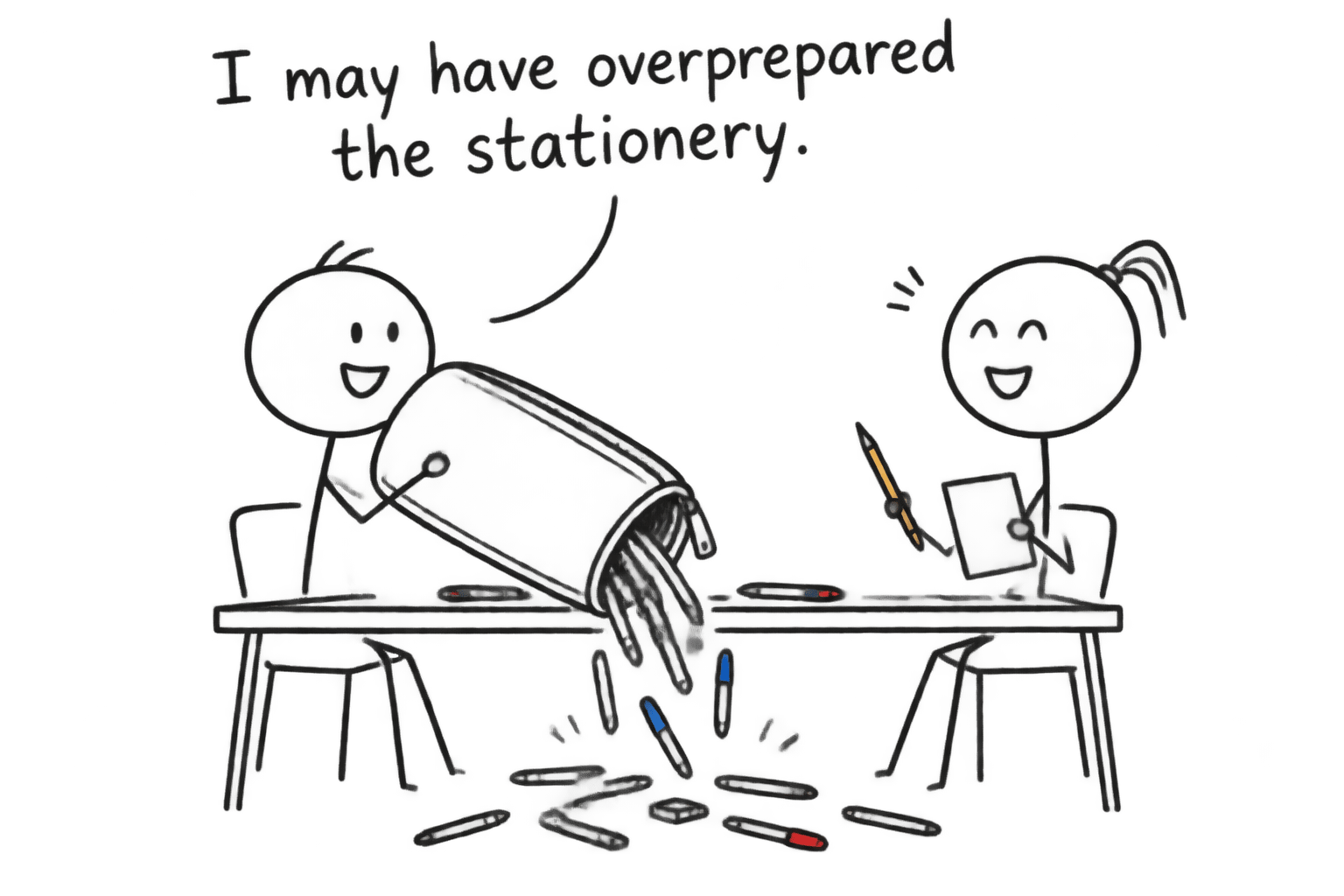 Two GCSE students compare an enormous collection of revision pens with one simple pencil and card
Move from the representation to questions
A visual is a bridge, not the destination. After reconstructing it, answer several questions without looking at the card.
Start with a direct application, then choose a question that changes the wording or combines ideas. Use mark schemes and video solutions to diagnose errors rather than merely recording a score. MathsGenie's GCSE 20-minute maths revision routine shows how lessons, practice questions and checking can fit into a short session.
If you can draw a perfect probability tree but cannot interpret “given that”, more colouring will not solve the problem. You need targeted questions.
A sample week of dual coding revision
This plan keeps sessions focused while revisiting ideas. It can sit inside a broader GCSE maths revision timetable, which acts as the pillar guide for planning revision across the course.
| Day | Dual coding task | Follow-up |
|---|---|---|
| Monday | Turn one linear graphs method into a labelled equation and sketch | Complete three related questions |
| Tuesday | Draw a fraction bar model from memory | Explain each section aloud and answer two questions |
| Wednesday | Reconstruct Monday's graph card without looking | Correct it, then attempt a mixed graph question |
| Thursday | Build a probability tree with concise annotations | Complete exam-style probability questions |
| Friday | Redraw the week's weakest representation | Check errors against a lesson or mark scheme |
| Saturday | Complete a mixed set or part of a past paper | Record whether errors came from recall, method or accuracy |
| Sunday | Rest or briefly organise next week's topics | Choose the next weak area from your error record |
The balance matters. Only part of each session is spent producing a representation. Most of the evidence about what you can actually do comes from retrieval and questions.
If setting up the week feels like another revision task, build the schedule in the MathsGenie Revision Planner rather than continuing to redraw it on paper.
Students with a shorter run-up to an assessment can adapt the structure using the GCSE one-month revision plan. Keep the same sequence: understand, represent, retrieve, practise and revisit.
Common dual coding mistakes
Making decorative notes
Colour can separate categories, but it does not create understanding by itself. If removing a colour changes nothing about the meaning, it was probably decoration.
Copying a diagram without thinking
Copying can create familiarity. Cover the original and reconstruct it, including the explanation of why each feature matters.
Putting too much on one page
Crowded diagrams increase the amount you must search through. Use one main relationship per card and remove details that do not help answer a question.
Replacing exam practice
GCSE maths assesses whether you can select and apply methods in unfamiliar contexts. Dual coding can support that knowledge, but past papers, practice questions and mark schemes reveal whether it transfers. Use your exam board's specification and appropriate tier when choosing questions.
Trusting an inaccurate student-made visual
Creating a representation can expose understanding, but it can also preserve an error. Check labels, scales, notation and relationships against a reliable lesson or worked solution before revising from it later.
Be realistic about what the technique can do
Dual coding cannot replace prerequisite knowledge, careful teaching or sufficient practice. Some topics are naturally visual; others may benefit more from a short chain of algebraic reasoning. Forcing every method into a cartoon wastes time.
It is also possible to become fluent at reproducing one familiar diagram without understanding how to adapt it. That is why Sam's weekly routine ends with mixed questions and occasional past-paper work, not a folder inspection.
Treat dual coding as one GCSE maths study technique within a wider system. Its role is to make relationships clearer and easier to retrieve. Questions then show whether that understanding survives when the wording changes.
Build your dual coding schedule
Sam's useful change is not a prettier notebook. It is moving from repeated reading to a scheduled cycle of representing, recalling, practising and checking. Knowing that cycle is easier than following it consistently, especially when exams have fixed dates and several topics need attention.
Your turn: build your dual coding schedule in the Revision Planner.















