

How to Revise With Your Phone Nearby
How to revise with your phone nearby: use a practical routine to stop notifications, protect focus and keep GCSE or A Level revision on schedule.

A student sits at the kitchen table with a GCSE maths paper open. Their phone is face down beside it. A parent walks past and sees a familiar pattern: one question, one glance at the phone, another question, then a message that somehow becomes ten minutes of scrolling.
The usual advice is simple: put the phone in another room. But that is not always realistic. You may need it for a timer, a video solution, family messages or access to revision resources. So, how to revise with your phone nearby comes down to one practical rule: keep the phone available as a tool, but unavailable as entertainment.
That means silencing interruptions, deciding in advance when you may check it and giving every revision session a specific outcome. You do not need perfect self-control. You need an environment in which the next sensible action is obvious.
The phone-nearby revision checklist
Before starting, spend one minute setting up the session:
- Choose one subject, topic and task.
- Switch on Do Not Disturb or an equivalent focus setting.
- Allow calls only from people who may genuinely need you.
- Put the phone face down and beyond easy reach.
- Use a separate clock or watch if the phone timer tempts you.
- Work until a planned stopping point, not until you feel bored.
- Record questions or messages to deal with during the break.
- Check the phone only when the session finishes.
This approach works for GCSE revision and A Level revision because it separates two activities that otherwise become tangled: learning and checking.
Why nearby is not the same as interrupted
Research into the mere presence of smartphones is mixed. A large 2024 meta-analysis found no significant overall effect from a phone simply being present, although individual students may still feel distracted by seeing it. Evidence about notifications is more useful in practice: alerts can capture attention even when you do not respond to them.
The distinction matters. You do not necessarily need a dramatic digital detox. You do need to stop the phone from making decisions for you.
A silent phone face down on a shelf is different from a phone lighting up beside your answer booklet. The first waits for you. The second repeatedly asks whether its latest interruption is more interesting than completing a quadratic equation.
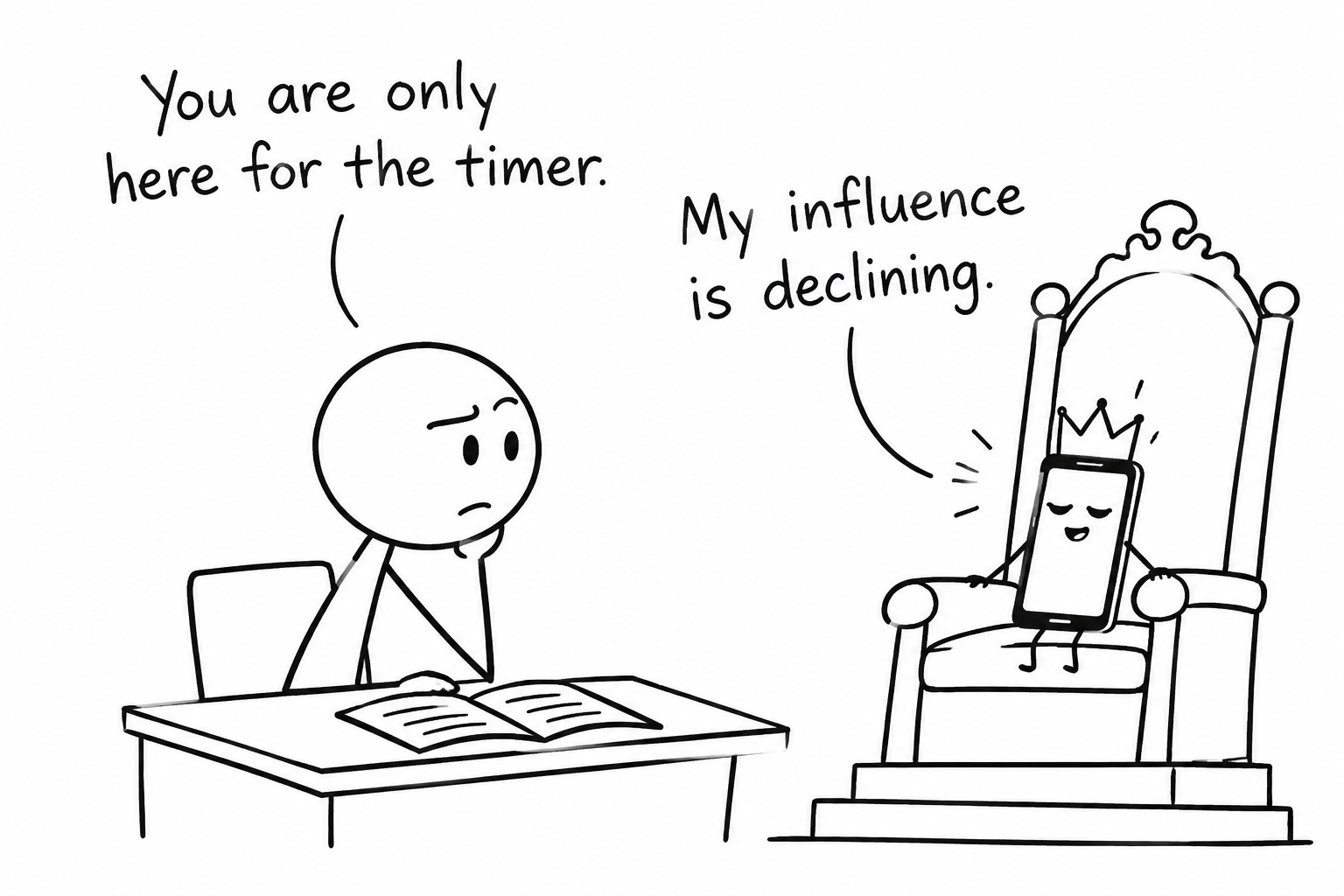 A student reminds a crowned smartphone that it is only present as a revision timer
Use a three-part phone-nearby routine
Imagine the student at the kitchen table restarting the session. Instead of promising not to touch the phone, they use a routine with three clear stages.
Before the session
Write down an outcome that can be checked. “Revise maths” is too vague. Better outcomes include:
- complete ten higher-tier trigonometry questions;
- watch one revision lesson and answer the linked practice questions;
- finish one section of an A Level integration worksheet;
- complete and mark one timed paper section;
- correct every question missed in yesterday’s mini test.
Then prepare everything you need before the timer starts. Open the worksheet, collect paper and a calculator, and load any required video solution. If the phone is providing the resource, open that resource and close social media, messages and unrelated browser tabs.
For wider revision planning, use the GCSE revision timetable guide to decide which subject belongs in each session. The separate guide to daily GCSE revision hours can help you choose a sustainable workload without turning every evening into an endurance test.
During the session
Place the phone far enough away that checking it requires a deliberate movement. A shelf, windowsill or opposite side of the table is usually better than keeping it beside your writing hand.
When you remember something you want to check, do not open the phone. Write it on a small “later list”. This might contain:
- reply to a friend;
- check tomorrow’s lesson time;
- search for an unfamiliar term;
- download another paper.
The list reassures your brain that the thought will not be lost. More importantly, it prevents a useful search from becoming an unrelated scroll.
For maths, make the session active. MathsGenie provides free GCSE and A Level maths revision through revision lessons, practice questions, mini tests, past papers, predicted papers, mark schemes and video solutions. The phone may help you access these materials, but the learning happens when you attempt a question, expose a gap and correct it.
If setting up subjects and sessions already feels like another revision task, let the MathsGenie Revision Planner turn your exam dates into a day-by-day schedule.
After the session
Stop at the planned point and mark the work. Do not judge the session by how long you sat there. Judge it by what you can now do.
Use a simple record:
- Secure: I can answer this independently.
- Developing: I understand the method but still make errors.
- Priority: I cannot yet start the question confidently.
That record should shape the next session. If trigonometry remains a priority, schedule it again rather than replacing it with a favourite topic. Students following Edexcel can use the GCSE maths past papers to test whether a topic holds up under exam conditions. A Level students can browse A Level maths revision resources across the supported exam boards.
Only after marking and recording the result should you take the planned phone break. The break becomes a boundary, not a leak running through the entire session.
Make revision planning decide when you check
A timetable should settle three questions before you begin:
- What am I revising?
- What will I produce?
- When may I check my phone?
For example, an evening might contain a focused maths task, a short break and then another subject. The exact duration depends on your concentration, schoolwork and other commitments. There is no universal number of minutes that guarantees effective revision.
This is why counting hours can be misleading. Two hours interrupted every few minutes may produce less useful work than a shorter, protected session followed by careful marking. The guide to building a GCSE maths revision timetable explains how to combine lessons, practice questions and papers without trying to do everything at once.
Parents can help by agreeing what counts as an urgent interruption. A student should not have to wonder whether ignoring the family chat will cause an argument. Agree that urgent calls may come through, while ordinary messages wait until the break. Clear rules reduce both distraction and conflict.
When the phone should leave the room
Keeping the phone nearby is a compromise, not a requirement. Move it away when:
- you repeatedly override your focus settings;
- one notification regularly becomes a long break;
- you are completing a timed past paper;
- seeing the phone makes you think about checking it;
- you do not need it for the session.
A full past paper should imitate exam conditions as closely as practical. Put away the phone, use only the equipment permitted for that paper and work within the correct time. Afterwards, bring the phone back if you need a mark scheme or video solution.
For A Level preparation, Edexcel A Level maths past papers offer a structured way to practise complete papers and review errors. The phone can support the review, but it should not sit in the middle of the timed attempt.
Common mistakes when revising near a phone
Relying on willpower
“Do not check it” is not a complete study technique. Remove alerts, increase the physical distance and define the next checking time. Good revision systems make distraction slightly harder before motivation starts to fade.
Using the phone as a timer when it causes distraction
If stopping the timer exposes a screen full of notifications, use a kitchen timer, watch or clock instead. Choose the least distracting tool, not the most sophisticated one.
Watching without practising
A revision video can make a method feel familiar without proving that you can reproduce it. Pause, attempt questions independently and then use the solution to diagnose errors.
Taking unplanned phone breaks
A quick check has no natural finishing point. Decide the length of the break before opening anything, then place the phone back in its revision position when the break ends.
Making parents responsible for every check
Constant monitoring can turn revision into an argument. It is usually better to agree on visible rules: notifications off, phone beyond reach, urgent calls allowed and checking reserved for breaks.
Build a phone-resistant revision schedule
The student at the kitchen table does not need to become someone who never wants to check a phone. They need a plan that tells them what to do before the phone gets a vote. Knowing the routine helps, but following it consistently becomes easier when every session already has a place.
Build your day-by-day schedule in the MathsGenie Revision Planner.















