

How to Revise with ADHD: A Practical Student Guide
How to revise with ADHD: practical GCSE and A Level strategies for starting tasks, managing distractions and building a revision plan you can return to.
Imagine a student sitting down after school with every intention of revising. The books are open, but choosing where to start takes longer than expected. A notification arrives. Half an hour later, the work is untouched and the guilt has started.
How to revise with ADHD starts with making the next action small, visible and easy to begin. Choose one specific task, work for a manageable period, take a planned break and leave yourself a clear restart instruction. Adjust the routine around what helps you concentrate rather than forcing yourself through an idealised timetable.
ADHD affects people differently. These are strategies to test, not a prescription or a measure of how hard you are trying.
Your starting checklist
For your next revision session, prepare:
- One clearly defined task, with the questions or materials already open.
- A short work period and a visible stopping point.
- A workspace with fewer avoidable distractions.
- A planned break with a clear way back.
- A note showing what to do next time.
For the wider subject strategy, MathsGenie’s GCSE maths revision guide explains how practice, feedback and planning fit together. Here, the focus is making that process easier to start and repeat with ADHD.
Make the first action smaller
“Revise maths” leaves several decisions unfinished: which topic, which resource, how much work and when to stop. Each decision can become another obstacle before any revision happens.
Replace it with an instruction such as: “Open the percentages questions and attempt the first three.” For A Level, that might be: “Attempt one differentiation question, then check the first step I could not complete.”
Prepare the page, calculator and pen beforehand if that helps. When starting feels difficult, your minimum task could simply be reading the first question and writing the information you know.
That minimum is an entry point. Once you have begun, decide whether another small step is manageable. Avoid turning every successful start into an unexpectedly long session, which can make starting tomorrow feel less appealing.
Use a short, repeatable revision cycle
You do not need to find the perfect study technique before beginning. Try this sequence and change one part at a time.
Choose, attempt, check, return
Choose a manageable block. Ten minutes of questions followed by a short break is one possible starting experiment, not an ADHD rule. A timer may make time easier to track; if a countdown creates anxiety, use a small question set as the boundary instead.
Attempt something from memory. Close the notes and answer a question, explain a method aloud or recall key facts. For maths, written questions help reveal whether you can use a method independently.
Check promptly. Compare your work with the mark scheme. Identify whether the difficulty was choosing a method, remembering a fact, interpreting the question or making a calculation error. If you watch a video solution, pause it and attempt the next step yourself.
Leave a return instruction. Write something concrete: “Retry this question without the solution on Thursday.” Returning later gives you another chance to retrieve the method, rather than relying on how familiar it feels immediately afterwards.
Build a schedule around these small tasks in the Revision Planner so you have a clear place to return after each session.
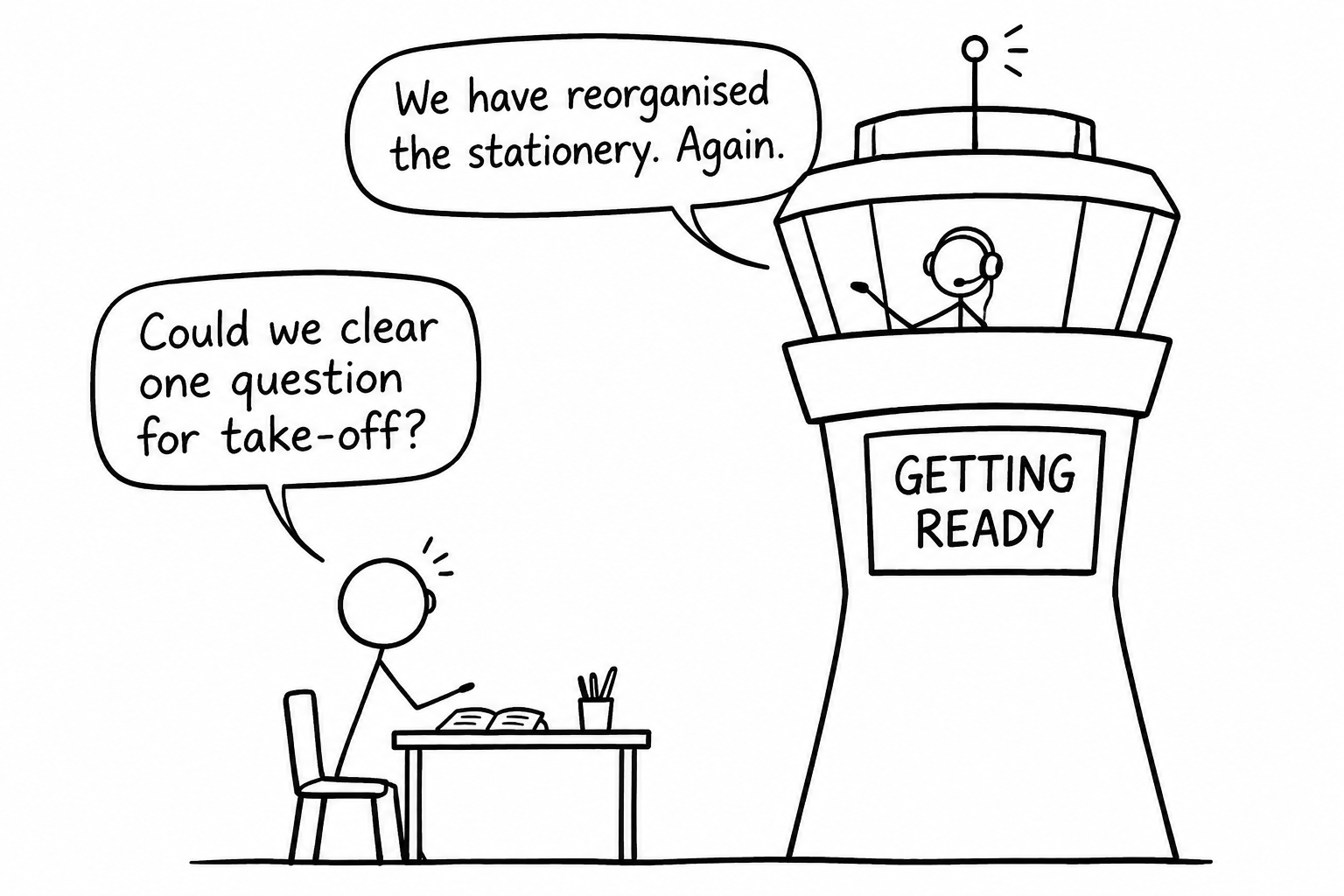 Stick-figure revision comic about spending too long preparing to begin
Adapt revision planning to your actual week
A timetable becomes more useful when it reflects school, travel, meals, sleep and your changing energy. Choose a few realistic revision opportunities before filling every spare space.
Give each opportunity a main task and a smaller fallback. The main task might be a short set of exam questions; the fallback might be correcting one previous mistake. This gives a difficult day somewhere to land without pretending you have unlimited capacity.
Keep one flexible slot for unfinished work. If a session is missed, reassess its priority rather than automatically adding it to tomorrow’s workload.
The broader mechanics belong in the GCSE maths revision timetable guide. Likewise, the guide to GCSE revision hours covers time allocation. With ADHD, use the amount you can repeatedly complete as planning evidence, alongside your subjects, deadlines and support needs. Another student’s total is not a personal target.
Adjust distractions and movement
NHS guidance for ADHD learners supports short, regular movement breaks. Try stretching, walking for water or moving around between tasks. Decide how you will restart before leaving the desk: keep the next question visible and use a reminder if helpful.
Test your environment rather than assuming complete silence suits everyone. You might compare a quiet room with steady background sound. Put your phone out of reach if notifications repeatedly interrupt you, and keep only the resources needed for the current task open.
Some students find quiet company useful. You could ask someone to work nearby or agree a brief check-in afterwards. Keep it optional and assess whether it helps you complete the task.
Choose resources before the session
Searching for materials can consume the attention you meant to spend using them. Save the relevant page beforehand.
MathsGenie’s free GCSE maths resources and A Level maths resources bring revision materials, past papers and mark schemes together by exam board. Check your qualification and, for GCSE, your foundation or higher tier before choosing questions.
Use revision lessons to address a specific gap, then practise independently. A short question set can establish what needs attention before you attempt a full paper. Record one useful correction rather than copying an entire solution.
Common mistakes and helpful support
Planning more than practising. Stop arranging the week once tomorrow’s first task is clear. Improve the plan using what you actually complete.
Making breaks difficult to end. If scrolling regularly stretches a short pause into a long one, try a different break activity with a clearer endpoint.
Treating a missed session as failure. Resume with the next small action. A plan needs a restart route as well as a starting time.
For parents, ask what support would help: preparing materials, reducing interruptions or providing a quiet presence. Agree check-ins together rather than monitoring every minute.
If difficulties are significantly affecting learning, speak to school or college. Ask the SENCo or learning support team about support and exam access arrangements early. An ADHD diagnosis does not automatically guarantee extra time; arrangements depend on assessed needs and the relevant evidence.
Build a plan you can return to
Your goal is a routine that helps you begin, learn from mistakes and restart after interruptions. The gap between knowing the method and following it is often having a specific next task ready when you sit down. Build your schedule for small, manageable revision sessions in the Revision Planner.















