How to Revise GCSE Maths Formulas: A Simple Plan
How to revise GCSE Maths formulas using retrieval, spaced practice and exam questions. Build a realistic plan that turns recall into confident exam use.
A page of neatly copied formulas can look like progress. The harder question is whether you can use them when an exam question gives you no obvious starting point.
The answer to how to revise GCSE Maths formulas is to combine retrieval with application: recall each relationship, explain its symbols, practise using it and revisit it after a gap. Check your exam board’s formula sheet so you know what information will be available.
Formula revision means recognising when a relationship is useful and applying it accurately under pressure.
Your formula revision checklist
Build your routine around five tasks:
- Check the formulas relevant to your exam board and tier.
- Sort them by how confidently you can use them.
- Retrieve their meaning without looking.
- Practise selecting, substituting and rearranging.
- Revisit mistakes after increasing gaps.
Fit these tasks into your GCSE Maths revision timetable. A short session with questions and feedback gives you clearer evidence of progress than another page of copied notes.
Start with your exam board’s formula sheet
Check the current formula sheet and arrangements for your specification, exam year and foundation or higher tier. Use the official material supplied by your school or exam board, whether you follow Edexcel, AQA, OCR or Eduqas.
A provided formula still requires understanding. You must identify the relevant relationship, interpret its symbols and decide whether rearrangement is necessary.
For Pythagoras’ theorem,
a2+b2=c2,a^2+b^2=c^2,a2+b2=c2,you need to recognise a right-angled triangle and identify ccc as the hypotenuse. Knowing the symbols without those conditions leaves the formula difficult to use.
Compare your sheet with class notes and topic questions. The Edexcel GCSE Maths revision hub connects revision lessons with practice questions, videos and mini tests.
Sort formulas by evidence
Divide your formulas into three groups:
- Secure: you can explain, select and use the formula independently.
- Developing: you recognise it but make substitution or rearrangement errors.
- Weak: you cannot identify when or how to use it.
Test yourself before choosing a group. Explain each symbol, answer a direct question, then try one that does not name the formula. Familiarity with a page is not enough evidence of confidence.
Spend most of your time on developing and weak formulas, while checking secure ones occasionally. Move formulas between groups whenever your answers suggest that your confidence has changed.
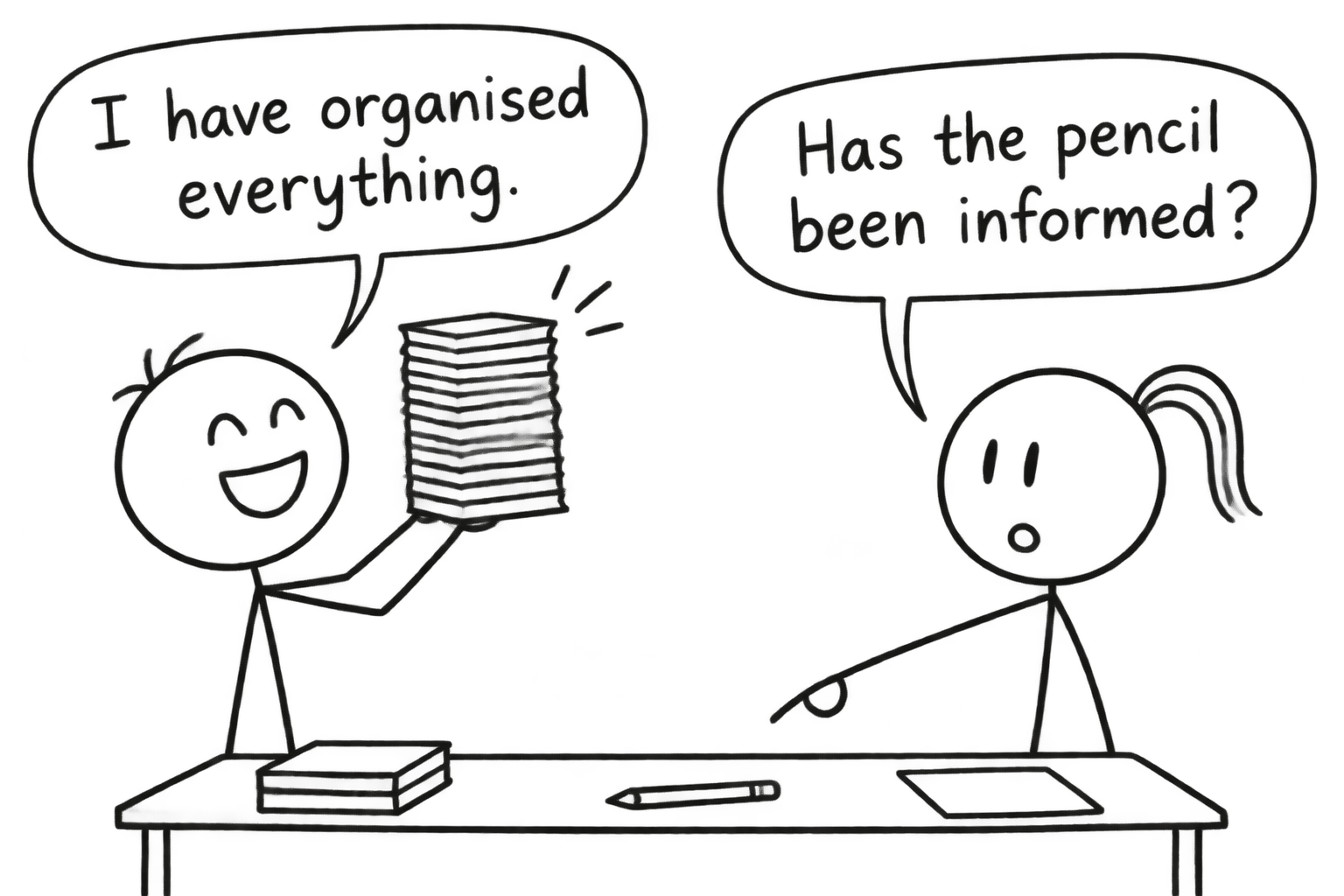 A student discovers that organising revision is not the same as doing it
Use four steps: retrieve, decode, apply, select
Retrieve the relationship
Cover the formula and write it from memory. If it appears on your exam sheet, also test whether you remember its purpose and can locate it quickly.
Check immediately afterwards. Correct an error before repeating it, then try again later without the prompt.
Decode the symbols
Explain what every letter represents, including conditions and units. For the area of a trapezium,
A=12(a+b)h,A=\frac{1}{2}(a+b)h,A=21(a+b)h,aaa and bbb represent the parallel sides, while hhh is their perpendicular separation. A sloping side does not automatically give the height.
Attach each formula to a sketch or description so that the letters retain their meaning.
Apply it carefully
Answer a direct question with the formula visible. Write the relationship first, substitute values with brackets where necessary, and check units before calculating.
If replacing letters with values causes difficulty, use the GCSE substitution lesson and questions. Strengthening that skill helps across many formula topics.
Select it independently
Now attempt a question that does not tell you which formula to use. Identify the given quantities, the unknown quantity and the relationship connecting them.
Mark your answer and record the precise error. “Used the sloping side as the height” tells you what to fix next time.
Space your reviews across the week
A formula can feel secure immediately after practice because it is still fresh. Reviewing after a gap tests whether you can retrieve and use it independently.
Try this starting schedule:
- Day 111: learn the meaning and answer direct questions.
- Day 333: retrieve it and complete another question.
- Day 777: include it in mixed practice.
- Day 141414: attempt a timed question.
- Day 282828: revisit it in a mini test or paper.
These gaps are a practical starting point, not a fixed rule. Return sooner after errors and extend the gap after accurate, independent answers.
Use the MathsGenie Revision Planner to organise reviews. Keep the workload manageable alongside other subjects; the guide to daily GCSE revision time can help.
Turn formula knowledge into marks
Progress from topic practice to mixed questions, then past papers and predicted papers. Mixed practice removes the topic heading that might otherwise reveal the method.
Write your formula, show any rearrangement, substitute carefully and avoid rounding too early. Finish by checking units and whether the answer is sensible.
Use mark schemes and video solutions to identify whether an error came from selection, algebra or arithmetic. If exams are close, adapt the one-week GCSE Maths revision plan around those findings.
Common formula revision mistakes
Copying without testing: close the notes before recalling a formula or explaining its purpose.
Only practising substitution: include questions requiring selection and rearrangement.
Ignoring the formula sheet: practise finding information on the correct version before exam day.
Calling every error a memory problem: check units, brackets, calculator entry and algebra separately.
Planning too much: begin with a few weak formulas and repeat the routine consistently.
Parents can help by asking what each symbol means and which step caused the last mistake. Keep the conversation calm and let marked questions guide the next session.
Build a routine you can repeat
Choose a weak formula today. Explain it, answer a question, check your working and schedule another attempt.
Use MathsGenie’s free revision lessons, practice questions and video solutions to address the difficulty you uncover. Add reviews to your planner, then test your progress with mixed questions. Each session should leave you knowing what to practise next.