How to Get Grade 8 GCSE Bengali: Revision Habits
How to get grade 8 GCSE Bengali with a focused plan for vocabulary, speaking, listening, writing, past papers, feedback and stronger exam technique.
A student can understand Bengali at home, speak confidently with relatives and still find the GCSE unexpectedly difficult. The problem is rarely a lack of language. It is usually the gap between everyday communication and what an examination rewards.
If you are wondering how to get grade 8 GCSE Bengali, the short answer is this: prepare for the Higher tier, practise all four language skills, learn vocabulary through recall rather than rereading, get precise feedback and turn every past-paper mistake into a future revision task.
A Grade 8 is not created by one heroic weekend. It usually grows from small corrections repeated until accurate Bengali still appears when the clock is running.
Your Grade 8 revision checklist
Use this as a quick audit before building your plan:
- Confirm your exam board, specification and Higher-tier entry with your school.
- Understand how listening, speaking, reading and writing are assessed.
- Test your current level in every skill rather than revising from guesswork.
- Recall vocabulary from memory in both directions.
- Practise standard written Bengali, including accurate spelling and script.
- Record yourself answering unfamiliar speaking questions.
- Complete timed reading, listening and writing tasks.
- Mark work using the official mark scheme and examiner guidance.
- Keep an error log and revisit mistakes after a short gap.
- Protect time for your other GCSEs, including maths.
Know the GCSE Bengali assessment first
Before changing your revision, check the current specification used by your school. Pearson Edexcel GCSE Bengali assesses listening, speaking, reading and writing through separate components, with Foundation and Higher-tier routes. A Grade 8 requires access to the Higher-tier grade range.
The four skills carry equal weight in the Pearson qualification. That creates an important strategic lesson: excellent speaking cannot fully compensate for neglected writing, and fluent reading at home does not guarantee success in a timed listening paper.
Grade boundaries are not permanently fixed percentages. They can change between examination series, so an old boundary should be treated as historical information rather than a target for the next paper. Aim instead to produce Grade 8-quality work consistently across the assessment objectives.
Ask your teacher to confirm:
- the qualification and specification code;
- your tier of entry;
- the permitted preparation arrangements for speaking;
- the latest paper timings and instructions;
- which dictionaries, if any, are allowed in each assessment.
This first step feels administrative. It is actually protective. Revision becomes much easier once you know the exact contest you are entering.
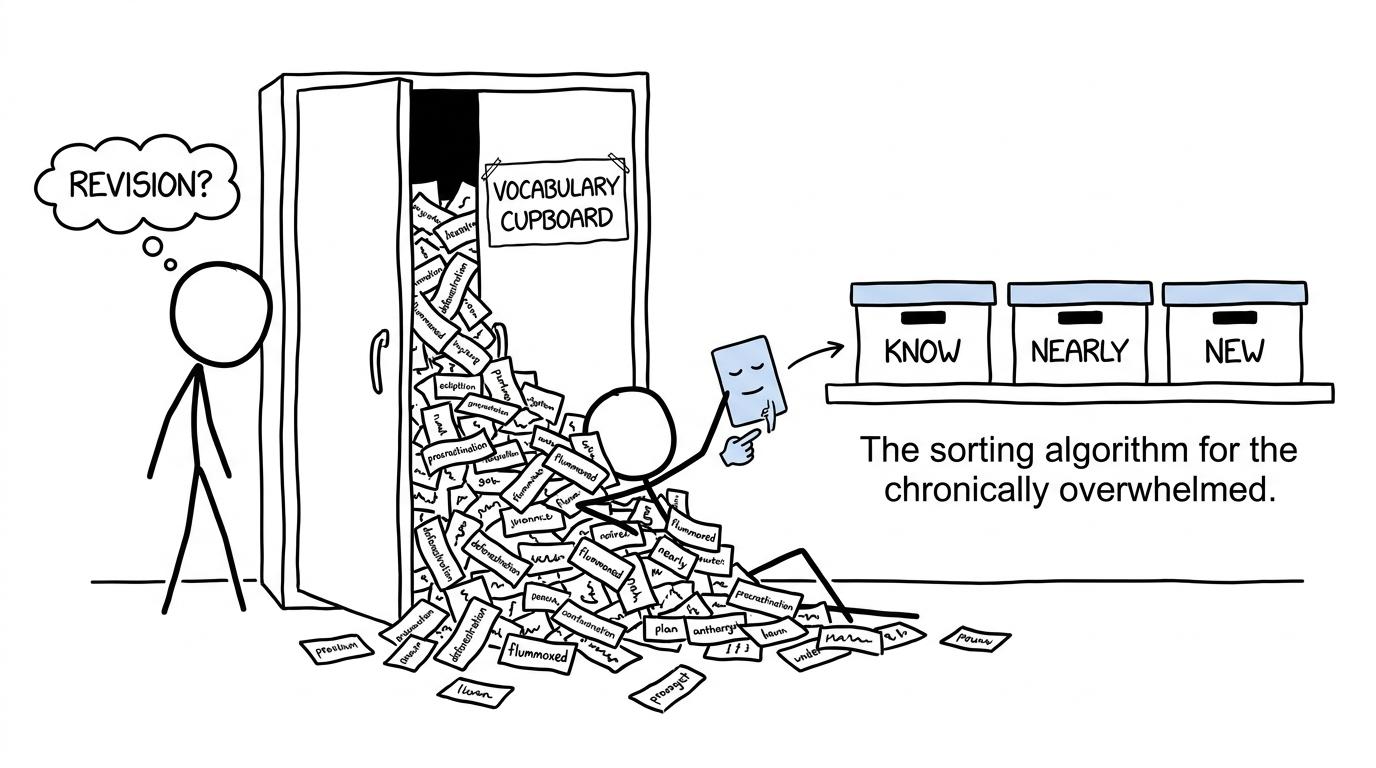 A student organises an avalanche of vocabulary cards into three useful groups
Replace passive revision with retrieval
Reading a vocabulary list produces familiarity. Unfortunately, familiarity can disappear the moment a blank page asks you to supply the word yourself.
Grade 8 preparation should rely on retrieval practice. Look at the English meaning and produce the Bengali word from memory. Reverse the direction as well. Then use the word in a sentence, say it aloud and return to it later without looking.
Divide vocabulary into three groups:
- Secure: recalled quickly and spelt correctly.
- Developing: recognised but not produced reliably.
- New: not yet understood or used.
Spend most of your time on the developing group. Secure words need occasional maintenance, while a huge collection of completely new words can become overwhelming.
Organise vocabulary by the themes in your specification, but also group words by purpose: giving opinions, justifying ideas, comparing experiences, describing different time frames and expressing uncertainty. These language functions improve several topics at once.
Turn home fluency into examination fluency
Some Bengali candidates already communicate comfortably outside school. That is a genuine advantage, but it can hide weaknesses in formal register, spelling, grammatical control or standard written Bengali.
Everyday conversation may include regional vocabulary, abbreviated structures or words borrowed from English. The examination is not asking you to reject the Bengali used by your family. It is asking you to recognise when a formal, standard and clearly written response is required.
Build a personal comparison list from teacher feedback. Record expressions that feel natural in conversation alongside the standard forms expected in assessed work. Do not try to erase your spoken identity; learn to switch register deliberately.
Reading regularly also matters. Use age-appropriate Bengali articles, stories and informational texts to meet vocabulary in context. After reading, summarise the main message without copying phrases. This trains comprehension and written control together.
Train all four skills differently
Each skill needs its own method. Simply spending more time with Bengali is not enough if that time never resembles the decisions made in the examination.
Listening
Practise hearing Bengali only once before checking, then repeat the recording to identify what you missed. Listen for negatives, time references, opinions, changes of mind and contrasts. These small words often control the meaning of an entire answer.
Keep a listening error log. Distinguish between words you did not know, words you knew but failed to recognise at speed, and questions you misread. Each type needs a different fix.
Speaking
Record short responses to unpredictable prompts. Listen back for clarity, pronunciation, hesitation, development and grammatical variety. A strong answer is not merely long; it responds directly and adds relevant detail.
Avoid memorising enormous scripts. A rehearsed paragraph can collapse when the question changes slightly. Prepare flexible building blocks instead: opinions, reasons, comparisons, past experiences and future intentions. Ask your teacher to challenge you with follow-up questions so that spontaneity becomes normal.
Reading
Read the question before hunting for evidence, but do not match words mechanically. Examiners may paraphrase the text, and familiar vocabulary can appear inside a sentence whose overall meaning is different.
Practise extracting the main point, identifying precise details and inferring attitude from context. Where translation is assessed, preserve the meaning of the whole sentence rather than replacing each word separately.
Writing
Plan briefly before writing. Check that the response covers every bullet point and uses the requested time frames. Leave time to inspect verbs, agreement, spelling, script and repeated vocabulary.
Complexity only helps when it remains controlled. Several accurate, developed sentences are more valuable than an ambitious structure whose meaning becomes unclear. Build sophistication gradually through feedback rather than inserting memorised phrases everywhere.
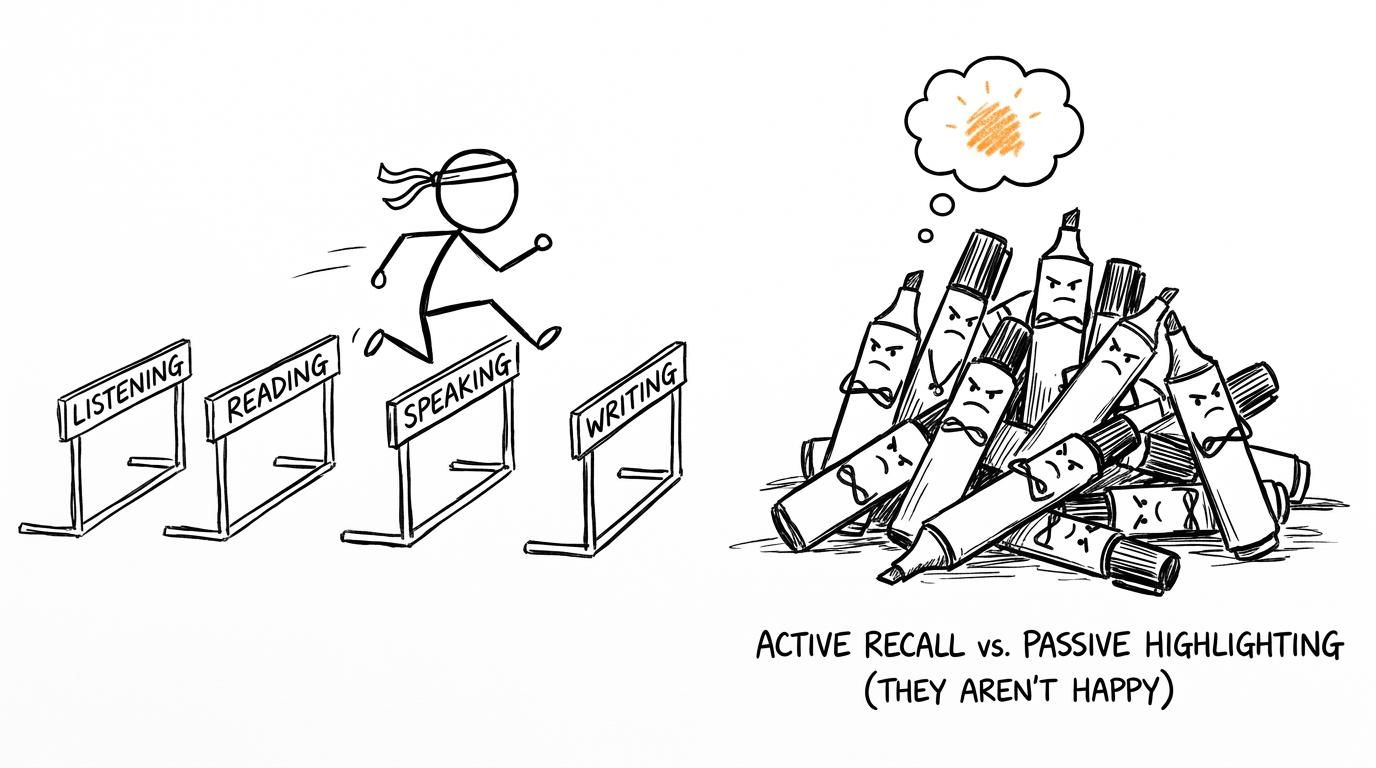 A revision athlete clears four language-skill hurdles while unused highlighters watch
Use a paper, feedback and retry cycle
Past papers reveal what revision notes cannot: whether your knowledge survives time pressure.
The most useful cycle is:
- complete a task under realistic conditions;
- mark it with the official mark scheme;
- identify why each mark was lost;
- revise the smallest underlying weakness;
- retry the task or a similar one without notes;
- test the skill again several days later.
MathsGenie explains this process clearly in its guide to using Edexcel GCSE past papers properly. The examples are mathematical, but the principle transfers: a paper only improves you when its mistakes change your next session.
Do not exhaust the newest Bengali papers too early. Start with individual sections, then move towards complete timed components. The same staged approach is discussed in when to start GCSE past papers.
Build a weekly routine that can survive busy weeks
A sustainable plan is better than an impressive plan abandoned after three days. Across a normal week, include:
- two short vocabulary retrieval sessions;
- one focused listening session;
- one recorded speaking session;
- one reading or translation task;
- one timed writing task or paragraph;
- one feedback and error-log review.
Short sessions should have visible outcomes. “Revise Bengali” is vague. “Recall vocabulary from the school topic, record two speaking responses and correct last week’s spelling errors” tells you exactly when the work is complete.
Balance Bengali with your other subjects. MathsGenie’s free GCSE and A Level maths revision hub can reduce the time spent searching for maths resources, while the guide to revising GCSE maths without wasting time offers a useful model for focused, repeatable sessions.
Keep an error log that changes behaviour
An error log should not become a museum of disappointing marks. Every entry needs an action.
Use four headings: skill, exact error, correction and retry date. For example, the issue might be missed listening vocabulary, inaccurate spelling, an undeveloped speaking answer or failure to address a writing bullet point. This is diagnosis, not self-criticism.
Review the log weekly and choose the few patterns costing the most marks. Maths students can use Edexcel GCSE Maths past papers and mark schemes in exactly the same way, making the routine consistent across subjects.
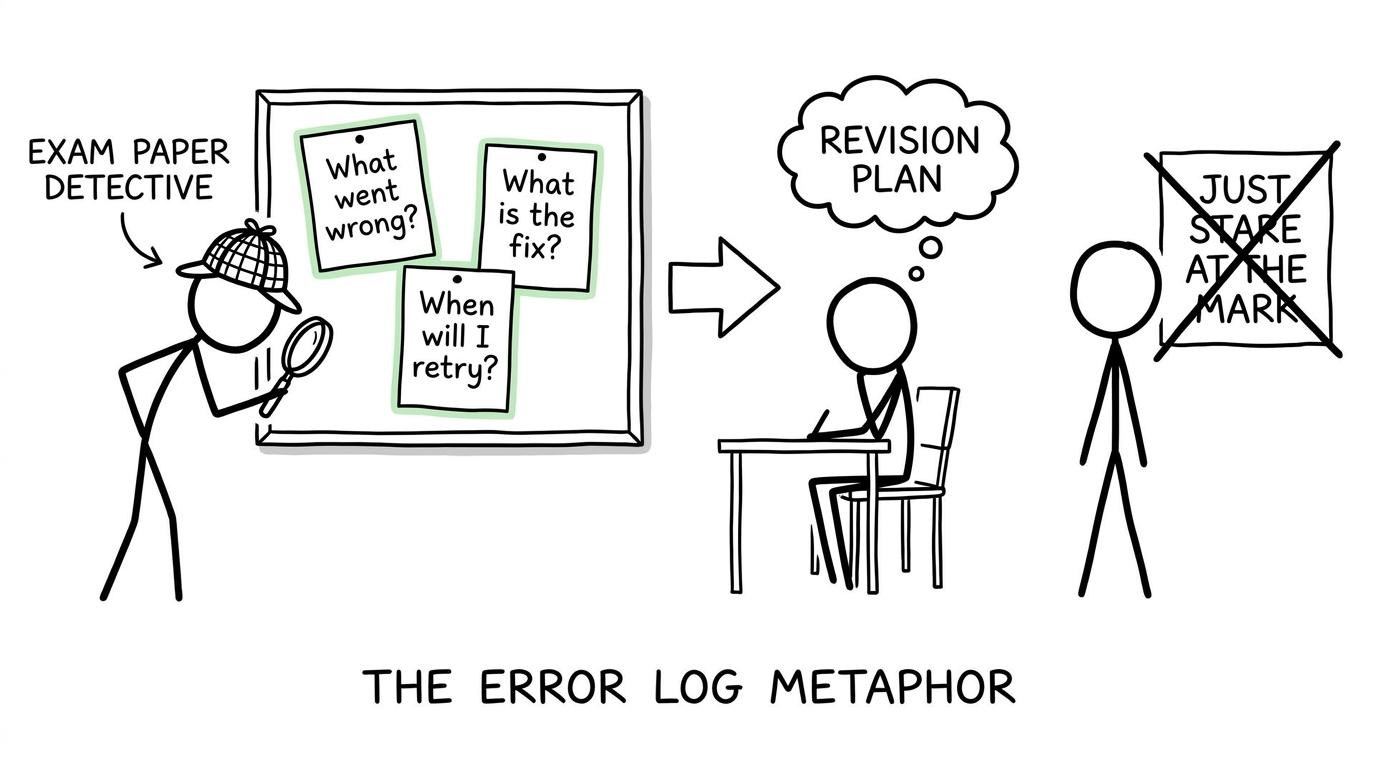 An exam-paper detective investigates mistakes instead of staring at the mark
Common mistakes that block a Grade 8
Revising only the strongest skill
Students often return to the activity that feels comfortable. Track time across all four components so that speaking confidence does not conceal a weak reading or writing score.
Assuming spoken fluency guarantees accurate writing
Conversation and formal written accuracy are related but different. Submit regular writing for correction and maintain a list of recurring spelling and grammar issues.
Memorising answers instead of learning flexible language
A memorised response may not answer the question actually asked. Practise adapting ideas to unfamiliar wording and follow-up prompts.
Treating the mark scheme as the final step
Marking is the middle of the process. Correction and delayed reattempt are what turn feedback into improvement.
Using past papers without timing or review
Untimed practice is valuable while learning, but eventually every skill must work under examination conditions. MathsGenie’s article on making GCSE papers feel more manageable explains why the loop should be paper, diagnosis, targeted revision and another test.
Chasing a fixed percentage
Grade boundaries can vary. Use past boundaries for context, not as a promise. Concentrate on raising accuracy and consistency across the full specification.
Make the next session specific
The route to Grade 8 is less mysterious once every mistake has somewhere to go. Vocabulary gaps return to retrieval cards. Weak spontaneous answers return to recorded speaking. Misread questions return to timed comprehension. Inaccurate writing returns to correction and another attempt.
Start today by confirming your specification, assessing all four skills and choosing one weakness to repair. Use official Bengali papers and mark schemes supplied by your exam board or school for subject-specific practice.
For maths alongside your Bengali preparation, make MathsGenie your free revision base. Use the GCSE maths topics by exam board and tier to find appropriate revision lessons, then move through practice questions, mini tests, past papers, predicted papers, mark schemes and video solutions. A calm revision system cannot guarantee a Grade 8. It can, however, make every session more likely to move you towards one.