

How to Get Grade 7 GCSE Biblical Hebrew
How to get grade 7 GCSE Biblical Hebrew: build stronger vocabulary, translation, grammar and literature habits with a focused revision plan for both papers.

A translation can feel secure until one unfamiliar verb changes the direction of an entire sentence. A literature answer can contain plenty of knowledge yet miss marks because it never quite explains the evidence. Those small leaks often separate a promising performance from a consistently strong one.
If you are wondering how to get grade 7 GCSE Biblical Hebrew, the practical answer is to balance four things: accurate vocabulary recall, confident grammatical analysis, regular unseen translation and evidence-based knowledge of the set texts. You must then practise combining those skills under timed conditions.
A grade 7 does not come from memorising more pages indiscriminately. It usually comes from making fewer repeated mistakes.
Your grade 7 revision checklist
Use this as the backbone of your preparation:
- Confirm the current Pearson Edexcel specification and set texts.
- Divide revision evenly between Language and Literature.
- Retrieve vocabulary from memory rather than repeatedly reading lists.
- Analyse verbs, suffixes and sentence structures every week.
- Translate unseen passages into natural, precise English.
- Know the narrative, context and literary features of both set texts.
- Answer the exact command word and support interpretations with evidence.
- Complete timed sections, mark them and keep an error log.
- Revisit recurring weaknesses within a few days.
This resembles the revision cycle used throughout MathsGenie's GCSE revision resources: learn, practise, mark, repair and retest. The subject is different, but the habit is just as powerful.
Understand what the Biblical Hebrew GCSE assesses
The current Pearson Edexcel GCSE Biblical Hebrew qualification, code 1BH0, has two externally examined components. Component 1 is Language and Component 2 is Literature. Each paper is worth 100100100 marks, lasts 222 hours and contributes 50%50\%50% of the qualification.
Language assesses comprehension and translation from unseen Biblical Hebrew. Students also follow their centre's chosen optional route: grammatical analysis or translation of short English sentences into pointed Biblical Hebrew.
Literature tests knowledge, understanding, translation, analysis and evaluation of the prescribed texts. Across the complete qualification, the official assessment-objective weighting is:
- AO1 language knowledge and understanding: 50%50\%50%
- AO2 literature knowledge and understanding: 25%25\%25%
- AO3 analysis, evaluation and response: 25%25\%25%
That balance matters. A student who only learns vocabulary leaves half of the literature challenge untouched. Equally, excellent narrative knowledge cannot compensate for fragile translation.
For examinations from 2026 to 2028, Pearson specifies Genesis chapters 414141 to 434343, concerning Joseph's rise to power, and Kings chapters 444 to 777, covering the miracles of Elisha. Students must study both selections. Always check the current specification and your school's instructions because prescribed texts and examination arrangements can change.
Build vocabulary that survives the pressure of an unseen passage
Vocabulary cards are useful, but only if the answer begins hidden. Looking at a word beside its meaning creates familiarity; retrieving its meaning without help creates usable knowledge.
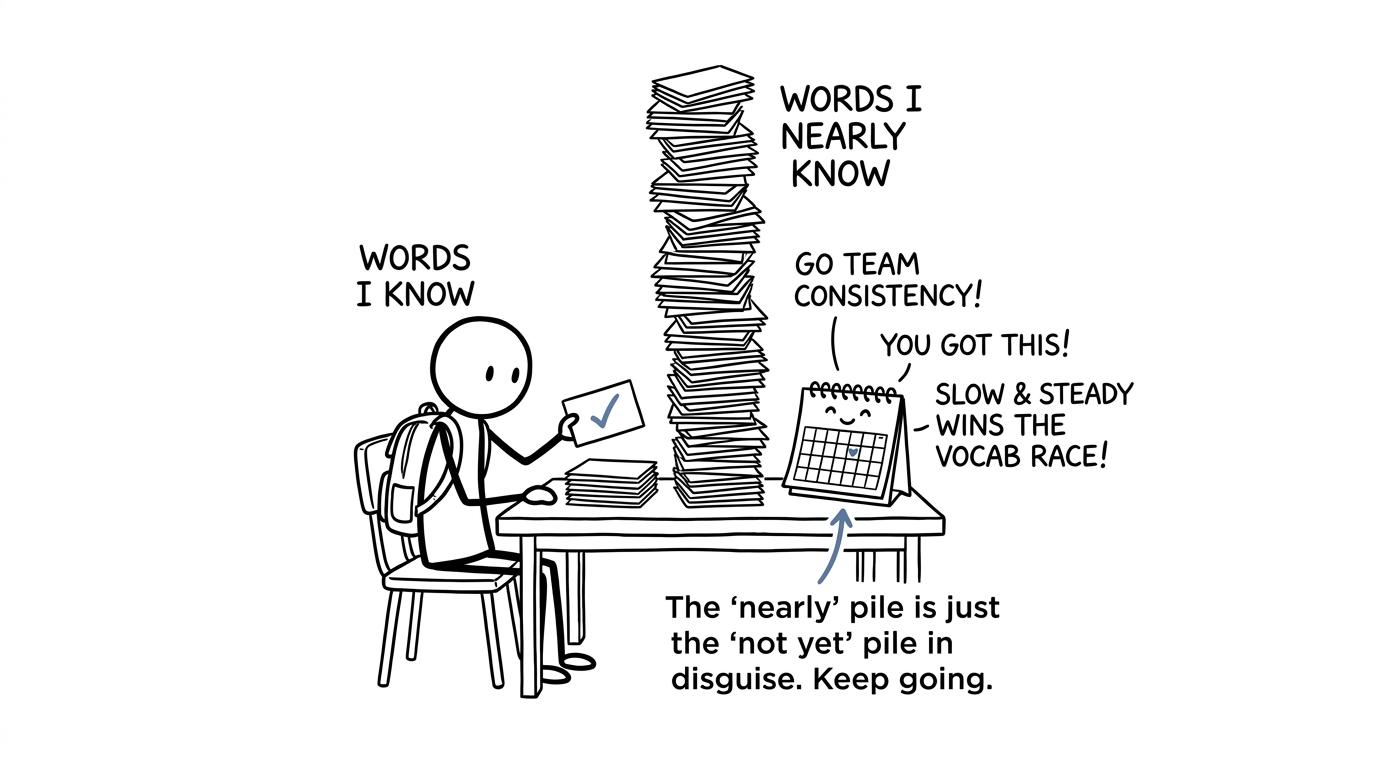 A student steadily tackles a towering pile of nearly known vocabulary
Sort vocabulary into three groups:
- secure words recalled immediately;
- hesitant words recalled slowly or imprecisely;
- unknown words.
Most revision time should go to the second and third groups. Test both directions where appropriate, revisit difficult words after a short gap and record easily confused roots together. Include particles, prepositions and common connecting words, not merely nouns and dramatic verbs. Small words often control the logic of a sentence.
Context also matters. Knowing one English gloss is not the same as knowing which meaning fits a passage. Keep a short record of words that you technically knew but translated poorly in context. That record is more valuable than another untouched vocabulary list.
The retrieval principles in MathsGenie's guide to stopping forgotten GCSE content transfer well here: attempt recall first, check second and return to the same material on another day.
Make grammatical analysis automatic
A grade 7 response should not depend on a vague sense of what a form probably means. Train yourself to notice the features carrying grammatical information.
For verbs, practise identifying the root, binyan, person, gender, number and aspect required by your course. For nouns and attached forms, pay attention to construct relationships, prefixes, suffixes and whether a form is singular, plural or dual. Revise how word order, negatives, particles and the vav conversive affect meaning.
Past Pearson examiner feedback has highlighted mistakes involving vav conversives, binyan recognition, suffixes, dual forms and roots that look similar. It also warned that Modern Hebrew instincts can mislead students when Biblical Hebrew grammar works differently. The lesson is not to fear these features. It is to make them visible in every practice passage.
Create a grammar-error list with precise labels such as:
- recognised the root but missed the binyan;
- treated the suffix as the wrong person;
- translated a plural as singular;
- noticed the vav but did not explain its effect;
- supplied a possible meaning rather than the contextual meaning.
A label tells you what to practise. “Grammar was bad” does not.
Improve unseen translation through deliberate practice
Translation improves when you practise decisions, not when you simply compare your finished version with a polished answer.
Begin by locating the principal verbs and their subjects. Then establish how clauses are connected. Identify attached pronouns, negatives and construct phrases before polishing the English. Your final translation should communicate the whole meaning clearly rather than imitate Hebrew word order so closely that the English becomes unnatural.
Work with short sections regularly. An occasional full passage is useful for stamina, but shorter passages allow more careful diagnosis. After marking, classify each lost mark as vocabulary, morphology, syntax, omitted detail or unclear English. Translate the difficult sentence again without looking at the answer.
This is the same reason a maths past paper only becomes productive after it is reviewed. MathsGenie's guide to using GCSE past papers properly describes the transferable loop: attempt, mark, diagnose, fix and retest.
If your optional route is English-to-Hebrew composition, practise the exact required conventions. Accurate verb forms, pointing and block Hebrew matter. Do not assume fluency in Modern Hebrew automatically provides the Biblical forms expected by the specification.
Turn set-text knowledge into literature marks
Knowing the story is the floor, not the ceiling. Literature questions can require translation, contextual understanding, grammatical or literary comment, comparison and a reasoned response supported by the prescribed material.
For every section of each set text, prepare five layers of knowledge:
- what happens;
- who is speaking or acting;
- what immediately precedes and follows the extract;
- which words, structures or literary features are significant;
- how the evidence supports a wider interpretation.
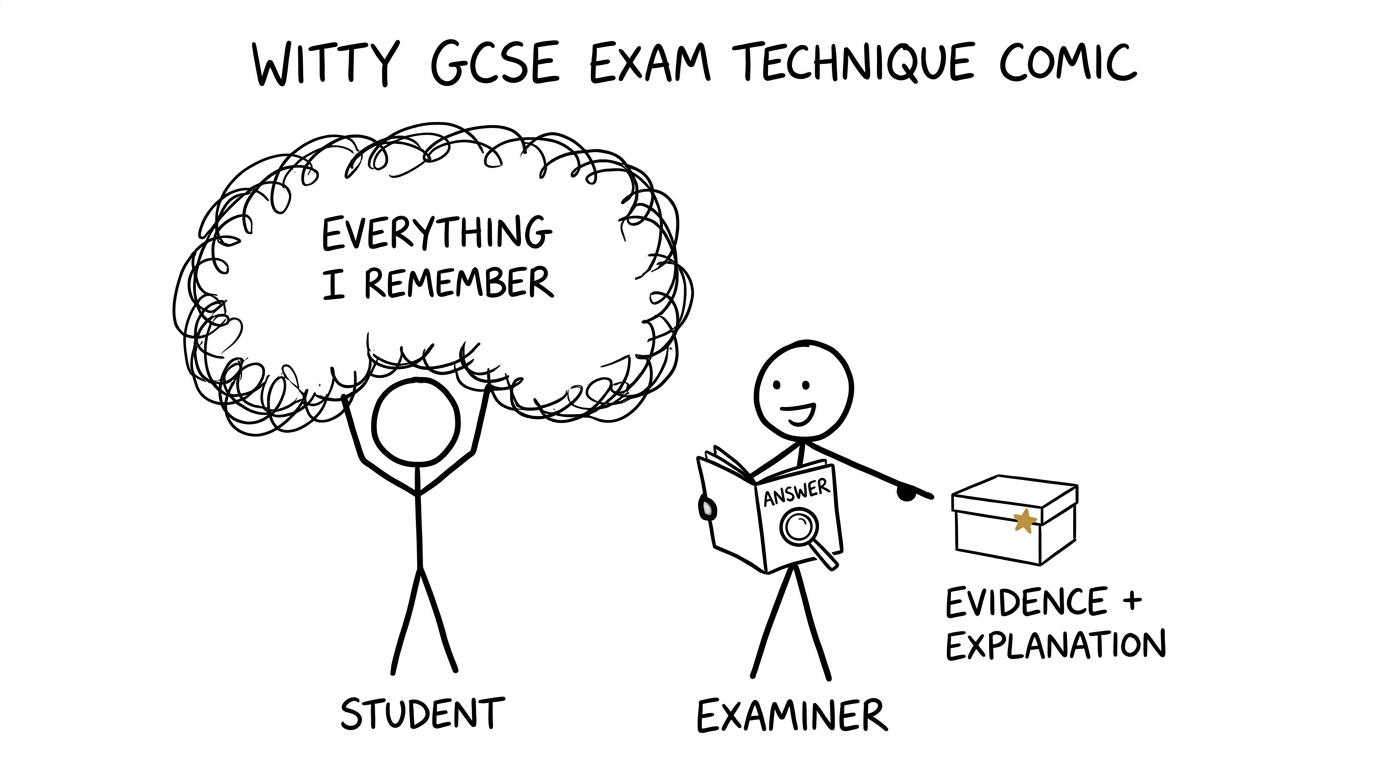 An examiner prefers a neat box of evidence and explanation to a cloud of everything remembered
Build an evidence bank organised by theme and character rather than relying only on chapter order. For the current texts, your teacher may direct you towards themes emerging from Joseph's rise and the Elisha narratives. Keep every conclusion anchored to what the prescribed texts actually show.
In an analytical answer, naming a feature is rarely enough. Explain what the chosen word, repetition, contrast, speech, action or narrative arrangement reveals and why it matters to the question. A concise chain works well:
claim: textual evidence: explanation: link to the question
Do not unload everything you remember. Selection is part of analysis.
Use timed practice without wasting papers
Do not wait until you feel completely ready. Start with individual sections, then progress to complete papers. Timing should be introduced gradually so that accuracy is built before pressure becomes dominant.
After every marked task, record:
- the question or skill;
- the mark lost;
- the precise reason;
- the corrective action;
- the date for a retest.
MathsGenie's guide to finding your weakest GCSE topics explains why this evidence-led approach is better than revising whatever feels comfortable. For short tests, the principle behind MathsGenie's mini tests is equally useful: isolate one weakness, test it quickly and obtain immediate feedback.
Ask your teacher for current Pearson papers, mark schemes and permitted examination materials. Mark schemes reveal how precise an answer must be, while examiner reports identify recurring misunderstandings. Grade boundaries vary between examination series, so do not build your plan around one assumed raw-mark target. Aim instead for a secure margin in both components.
A weekly routine that can move you towards grade 7
A sustainable week might contain:
- two short vocabulary and grammar retrieval sessions;
- one unseen translation session;
- one set-text translation or context session;
- one literature plan or timed response;
- one review session devoted entirely to old errors.
Short sessions are effective when each has a measurable outcome. “Revise Hebrew” is too broad. “Recall hesitant vocabulary, analyse ten verb forms and correct last week's suffix errors” gives the session a finish line.
If you are balancing Biblical Hebrew with maths, English and science, use a simple schedule rather than relying on mood. MathsGenie's one-month GCSE revision plan and 20-minute revision routine show how focused blocks can fit around a crowded timetable.
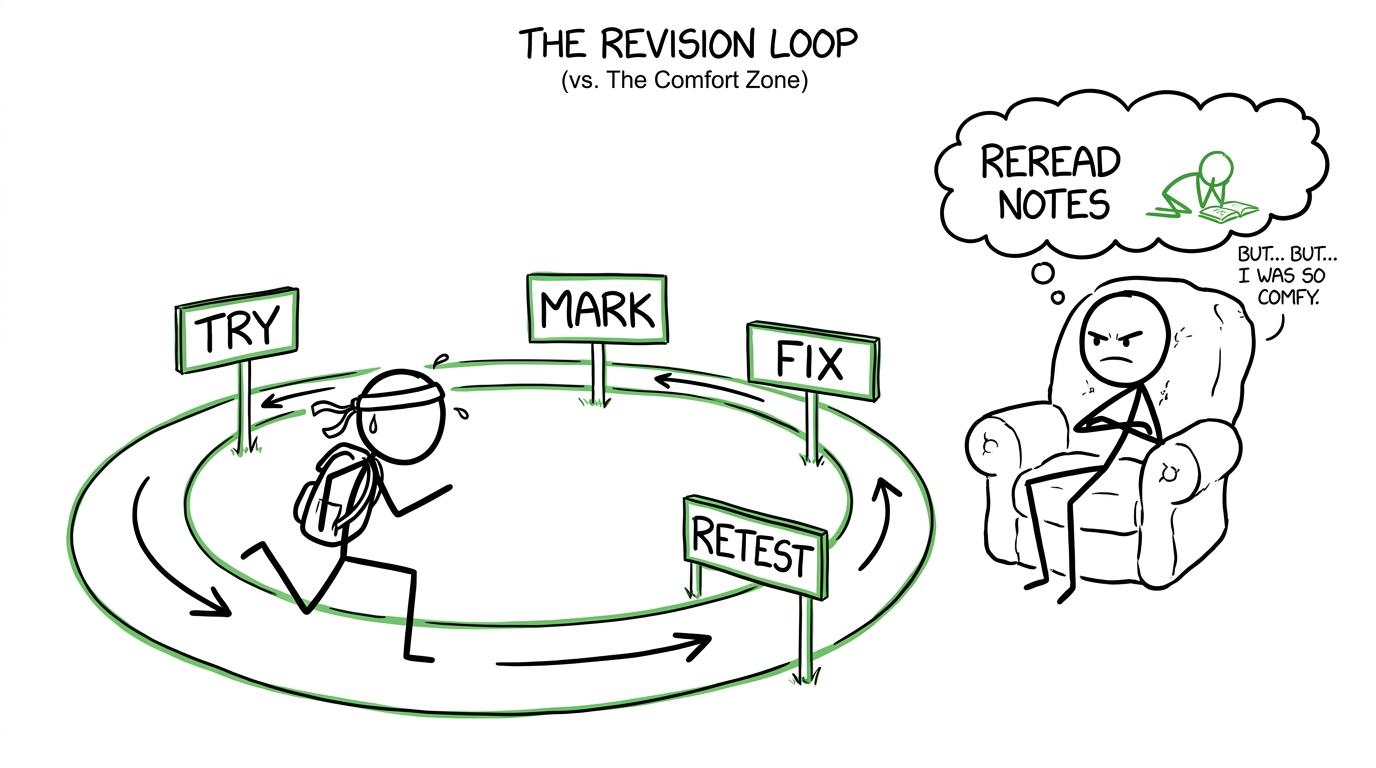 A student runs the try, mark, fix and retest loop while the rereading sofa looks offended
Common mistakes that hold students below grade 7
Rereading instead of retrieving
Recognition feels reassuring but may disappear when the answer is hidden. Close the book, recall the word, form or passage, and then check.
Translating one word at a time
This can obscure clause structure and produce unnatural English. Identify verbs, subjects and relationships before polishing the complete meaning.
Giving an incomplete grammar label
If a question asks for a form and its effect, merely naming the feature may not earn the available credit. Answer every part precisely.
Knowing the plot but not analysing the writing
Narrative summary demonstrates some knowledge, but higher-level literature answers select evidence and explain its significance.
Ignoring the weaker paper
Because Language and Literature each contribute 50%50\%50%, concentrating almost entirely on your preferred component creates unnecessary risk.
Completing papers without repairing errors
A score is information, not improvement. The improvement happens when you identify the cause, practise that exact weakness and test it again.
Make the next revision session count
Getting a grade 7 in GCSE Biblical Hebrew is less about one heroic burst of revision than a reliable sequence of small corrections. Learn the vocabulary you hesitate over. Analyse the form rather than guessing it. Translate regularly. Know the set texts as language and literature. Then make timed practice tell you what to do next.
Start today with one short unseen passage or literature question. Mark it carefully and choose the two errors most worth fixing. For the maths side of your GCSE timetable, use the free MathsGenie past-paper library alongside revision lessons, practice questions, mini tests, predicted papers, mark schemes and video solutions. A strong revision system should reduce guesswork in every subject and make the next mark easier to earn.










