

How Stressful Is GCSE Bengali Compared to Others?
How stressful is GCSE Bengali? Compare its workload, speaking pressure and results with maths, sciences and other GCSEs, plus plan calmer revision.
A speaking assessment can make ten quiet minutes feel much longer than a full written paper. Meanwhile, a familiar conversation at home can suddenly feel unfamiliar when spelling, formal vocabulary and a mark scheme enter the room.
So, how stressful is GCSE Bengali compared with other GCSEs? For a confident speaker who can also read and write Bengali accurately, it often feels less stressful than content-heavy subjects such as sciences, history or GCSE maths. For a student whose spoken Bengali is stronger than their literacy, or who dislikes speaking under assessment, it can be moderately to highly stressful.
There is no reliable national league table placing Bengali at an exact stress rank. Student discussions tend to focus on speaking nerves, unfamiliar formal vocabulary, reading speed and limited school support. The fairest conclusion is that Bengali usually sits in the low-to-middle stress range for well-prepared heritage speakers, but can move towards the high-stress group when writing, reading or spontaneous speaking is weak.
GCSE Bengali stress at a glance
Before comparing subjects, ask which version of the course you are actually taking. AQA GCSE Bengali and Pearson Edexcel International GCSE Bangla are different qualifications with different assessment structures.
For the current AQA GCSE Bengali specification:
- listening, speaking, reading and writing are each worth 25%25\%25%;
- students take either Foundation or Higher tier for all four skills;
- dictionaries are not permitted in the assessments;
- the qualification is linear, so the assessments are completed in the same exam series;
- speaking includes a role-play, photo-card task and conversation.
Your likely stress level depends mainly on five things:
- whether you speak Bengali regularly;
- whether you can read the script fluently;
- whether you can write accurately without relying on phonetic guesses;
- how comfortable you are responding spontaneously;
- whether your school provides regular teaching, feedback and mock practice.
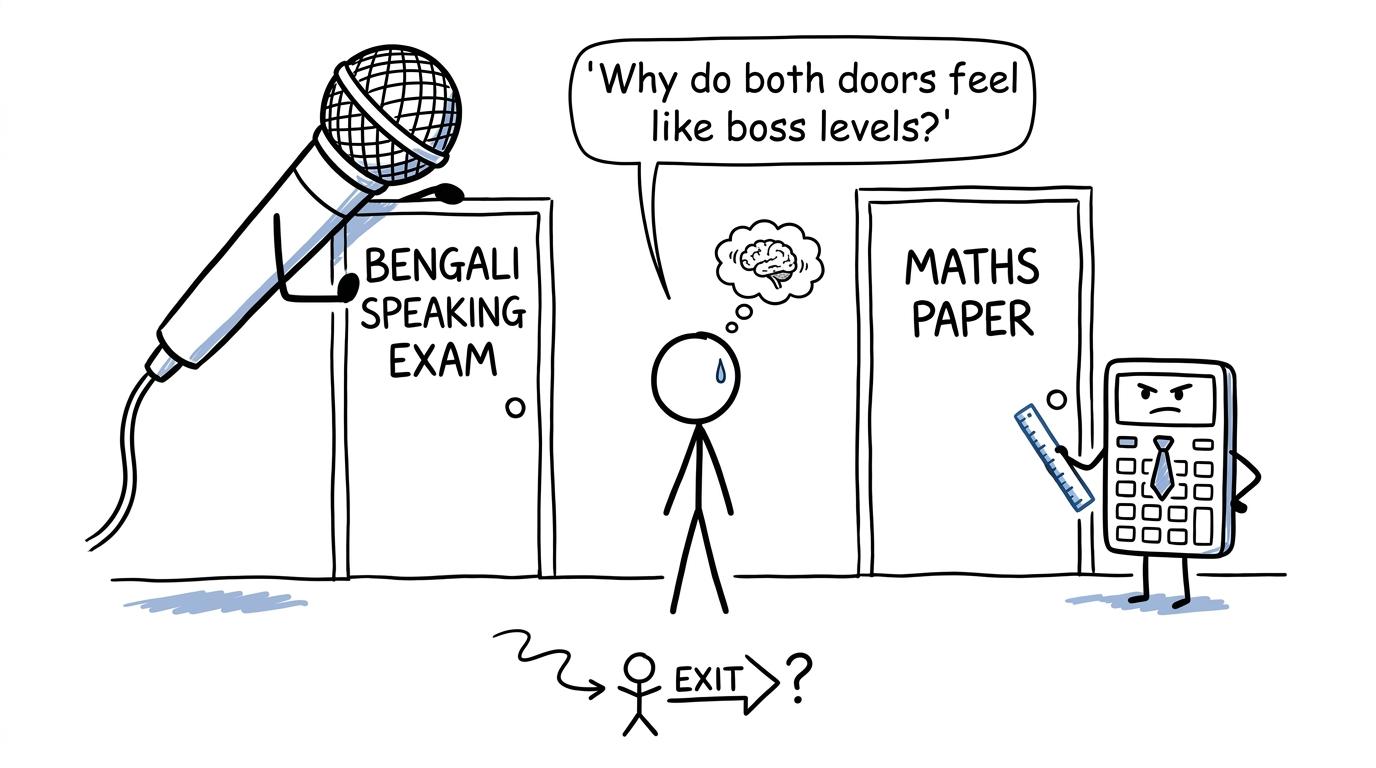 A student choosing between two intimidating GCSE exam doors
Where GCSE Bengali tends to rank for stress
Based on the limited student reports available, GCSE Bengali is not commonly named among the most stressful GCSEs overall. Broader student surveys and forum analyses more often place sciences, computer science, design and technology, ancient languages, English or maths near the top. Bengali rarely appears in those lists, partly because it has a much smaller entry cohort.
That does not prove Bengali is easy. It means there is not enough comparable evidence to assign it a precise position.
A sensible, qualified ranking looks like this:
- Lower stress: fluent speakers who read and write confidently and understand the exam format.
- Low-to-moderate stress: fluent speakers who need to strengthen formal writing, translation or spelling.
- Moderate stress: students with uneven skills, such as strong speaking but slow reading.
- High stress: students learning substantial vocabulary and grammar independently, with little feedback or speaking practice.
In June 2025, AQA reported 392392392 GCSE Bengali entries. Of those candidates, 80.4%80.4\%80.4% achieved grade 4 or above and 17.1%17.1\%17.1% achieved grade 9. Those outcomes look strong, but pass rates are not the same as stress levels or inherent difficulty. The cohort may contain many heritage speakers, and students choosing a less widely taught language are not directly comparable with the much larger, more varied cohorts taking compulsory maths or English.
The numbers describe outcomes. They do not tell us how anxious candidates felt, how much preparation they needed or how strong they were before beginning the course.
Why Bengali can feel less stressful than other GCSEs
Existing language knowledge reduces the starting distance
A student who uses Bengali with family may already understand common vocabulary, natural sentence patterns and everyday speech. That can make the subject feel more familiar than learning a language almost entirely from the beginning.
Familiarity also reduces the mental effort needed to understand ordinary listening passages. In contrast, a science or history course may require a large amount of new factual content regardless of what a student encounters at home.
But speaking fluently is only one part of the qualification. Informal conversation does not automatically produce accurate formal writing, quick reading or precise translation.
The assessment areas are clearly defined
AQA divides the course evenly across four language skills. That makes the revision target visible: a student can identify whether listening, speaking, reading or writing is causing the difficulty.
This can feel more manageable than a subject in which many topics and techniques are mixed together unpredictably. GCSE maths, for example, combines number, algebra, ratio, geometry, probability and statistics. The GCSE maths topic and exam-board guide shows how broad that content becomes across Foundation and Higher tier.
A visible structure does not remove the work, but it makes the work easier to organise.
Why GCSE Bengali can become stressful
Speaking is immediate
Written exams allow you to pause, return to a question and edit an answer. Speaking feels different. Silence is noticeable, and students may worry that one forgotten word has ruined the assessment.
Student discussions about language GCSEs repeatedly describe speaking as the most anxiety-provoking component. That is anecdotal evidence rather than a national Bengali-specific survey, but the pattern is understandable: the task combines recall, pronunciation, listening and performance in real time.
Preparation should therefore include spontaneous answers, not only memorised paragraphs. A polished response is useful, but it needs to survive an unexpected follow-up question.
Heritage speaking can hide literacy gaps
This is one of the most important sources of stress. A student may understand family conversations easily but read slowly, miss spelling distinctions or lack formal vocabulary.
The gap often remains invisible until timed practice begins. Then a supposedly familiar subject can feel surprisingly demanding. The solution is not to conclude that you are bad at Bengali. It is to name the narrower weakness: script recognition, spelling, translation, formal register or writing speed.
That is the same diagnostic habit used in effective maths revision. MathsGenie's guide to finding your weakest GCSE topics explains why a precise weakness is much easier to repair than a vague belief that an entire subject is difficult.
Support and resources may be limited
Bengali is taken by a relatively small national cohort. Some students receive specialist teaching; others prepare through weekend classes, family support or independent revision. Limited access to regular marking can make it harder to know whether writing meets the assessment criteria.
This is different from GCSE maths, where most schools offer frequent lessons, mocks and intervention sessions. It is also why you should confirm your exact qualification and tier with your school rather than using materials labelled simply “Bengali GCSE”.
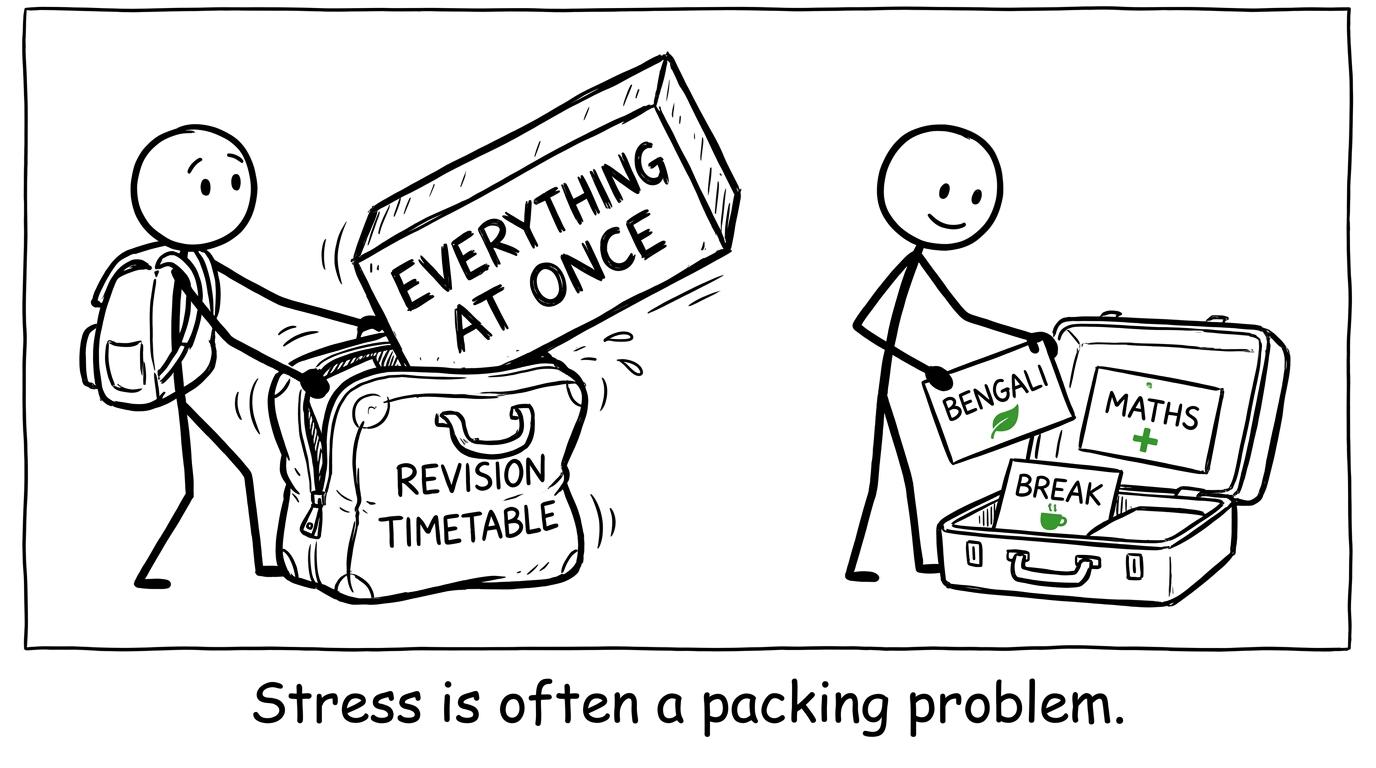 A calm student repacking an overloaded revision timetable
Bengali compared with maths and other GCSEs
Compared with GCSE maths
Maths usually creates stress through breadth, cumulative knowledge and unfamiliar problem-solving. A weakness in fractions can reappear inside algebra, ratio or probability. Bengali stress is more likely to come from live speaking, language accuracy and the difference between conversational and exam-standard language.
For many heritage speakers, Bengali requires fewer total revision hours than maths. However, that advantage disappears if reading and writing have been neglected.
Students balancing both subjects should keep maths active through short, regular practice. The free GCSE maths revision hub contains revision lessons, exam questions and resources for Edexcel, AQA, OCR and Eduqas. Short GCSE mini tests are particularly useful when Bengali needs the larger revision block that day.
Compared with sciences and humanities
Biology, chemistry, physics, history and geography can carry a substantial content load. Bengali may involve less factual memorisation for an experienced speaker, but it demands continued skill practice. Vocabulary cannot compensate fully for slow reading or weak sentence construction.
Humanities often create pressure through long written responses and detailed evidence. Bengali writing is language-focused, while the speaking assessment creates a kind of pressure that written humanities exams generally do not.
Compared with other language GCSEs
The assessment skills are broadly familiar: listening, speaking, reading and writing. The crucial difference is the student's starting point. A heritage speaker may find Bengali more accessible than a language learned mainly at school. A beginner or less literate speaker may not.
Comparing grade distributions across languages can also mislead because candidature differs. A high pass rate may reflect who enters the subject, not a less demanding paper.
A calm revision plan for Bengali and maths
Stress grows when every subject appears to demand attention at once. A timetable turns one large worry into several small appointments.
Use this weekly pattern:
- give Bengali separate sessions for reading, writing, listening and speaking;
- practise speaking aloud with a timer rather than reviewing answers silently;
- complete short writing tasks and obtain feedback where possible;
- keep maths moving with two or three focused topic sessions;
- use one timed maths section or mini test each week;
- protect rest time rather than treating exhaustion as evidence of effort.
The MathsGenie GCSE revision timetable can help you build a repeatable week. If exams are close, use the more focused one-month maths revision plan.
For maths, follow a simple cycle: learn, practise, mark, fix and retest. Use AQA GCSE maths past papers if that is your board, or select the correct board from the main hub. Do not use predicted papers as a substitute for learning weak topics; use them later to rehearse timing and decision-making.
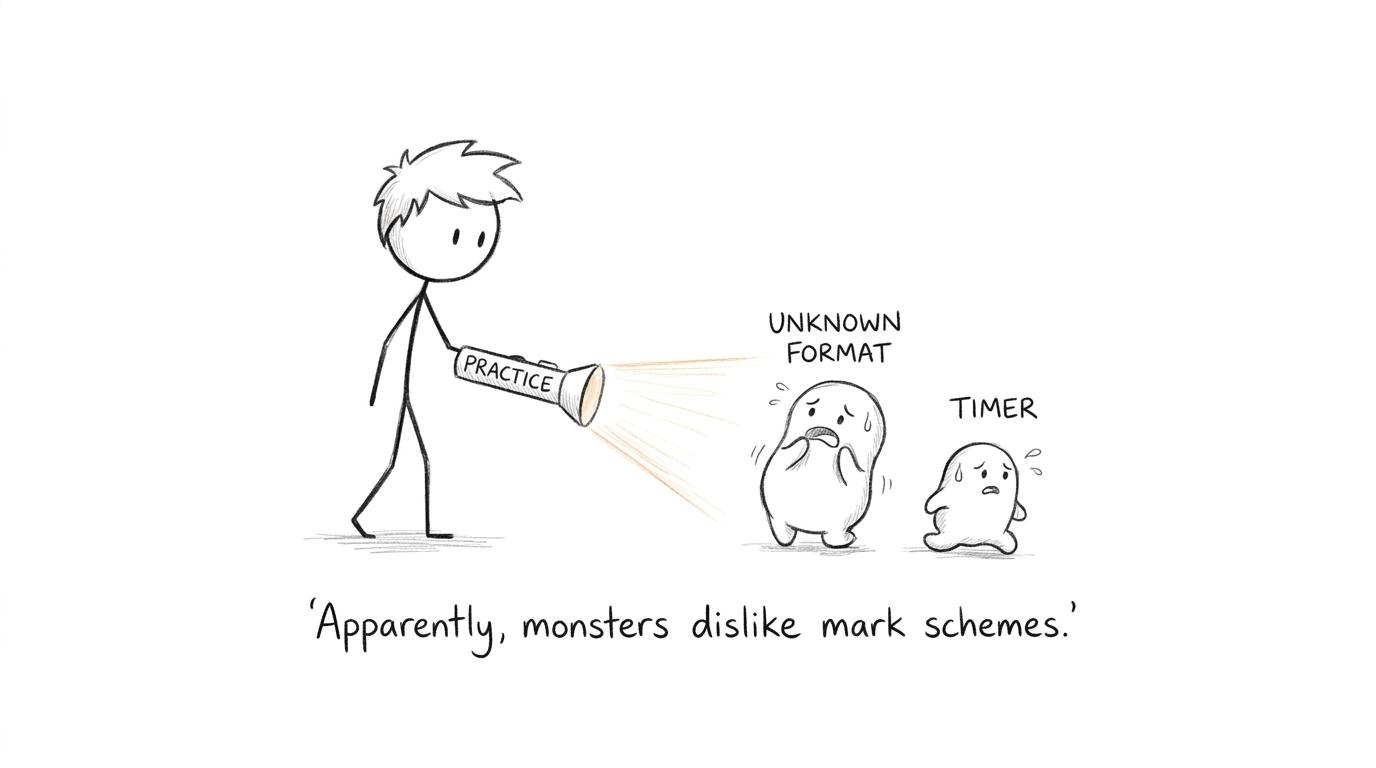 Practice shrinking two cartoon exam-stress monsters
Common mistakes that increase GCSE Bengali stress
Assuming fluent speech guarantees a high grade
Speaking at home is valuable, but the qualification also tests reading, writing, listening, translation and formal accuracy. Diagnose all four assessment areas early.
Memorising without practising flexibility
A memorised response can collapse when the question changes. Prepare reusable vocabulary and structures, then practise adapting them to different prompts.
Ignoring the exact specification
AQA GCSE Bengali is not the same as Pearson Edexcel International GCSE Bangla. Check your board, qualification, tier, assessment structure and permitted materials with your centre.
Treating strong results as proof that the exam is easy
The June 2025 AQA outcomes came from a small, self-selecting cohort. They cannot predict an individual student's result or emotional experience.
Dropping maths completely for several weeks
Maths fluency fades when it is left untouched. Even during a Bengali-heavy week, a short lesson, practice set or mini test can preserve confidence. When full-paper practice begins, follow MathsGenie's guide to using GCSE past papers properly so every lost mark creates a clear next action.
The honest conclusion
GCSE Bengali is not automatically one of the easiest or hardest GCSEs. For a confident heritage speaker with secure reading and writing, it often falls below maths, sciences and content-heavy humanities for stress. For someone with limited literacy, little specialist support or strong speaking anxiety, it can be considerably more demanding than outsiders assume.
The most useful question is not where Bengali ranks nationally. It is which component raises your stress and what practice would make that component more predictable.
Keep that same precision in maths. Start at the MathsGenie GCSE maths revision hub, choose your board and tier, and combine free revision lessons with practice questions, mini tests, past papers, predicted papers, mark schemes and video solutions. When revision becomes specific, stress has less room to invent problems of its own.










