

How Schools Release A-Level Results: The Process
How schools release A-Level results, from exam boards and embargoed files to collection, UCAS updates and calm next steps for parents on results day.
The hours before results arrive can feel strangely uncertain for parents. The exams ended weeks ago, universities may be waiting, and yet one envelope or portal login seems to hold everything.
Understanding how schools release A-Level results makes the morning less mysterious. In short, exam boards send confidential results to schools and colleges the day before results day. Staff check and prepare them under embargo, then release them to students from the nationally agreed time. UCAS updates university application decisions separately.
For A Levels in England, Wales and Northern Ireland, results day in 2026 is Thursday 13 August. Candidates cannot receive their results before 08:0008{:}0008:00, although each centre decides its own collection or online-access arrangements.
A-Level results day process at a glance
- Exam boards complete marking, awarding and quality checks.
- Schools receive secure results files under restricted release.
- Authorised staff check and prepare candidate results.
- The embargo lifts at 08:0008{:}0008:00 on results day.
- Students receive a provisional results statement from their centre.
- UCAS shows university decisions, but not the student’s actual grades.
- Schools advise students about places, Clearing and post-results services.
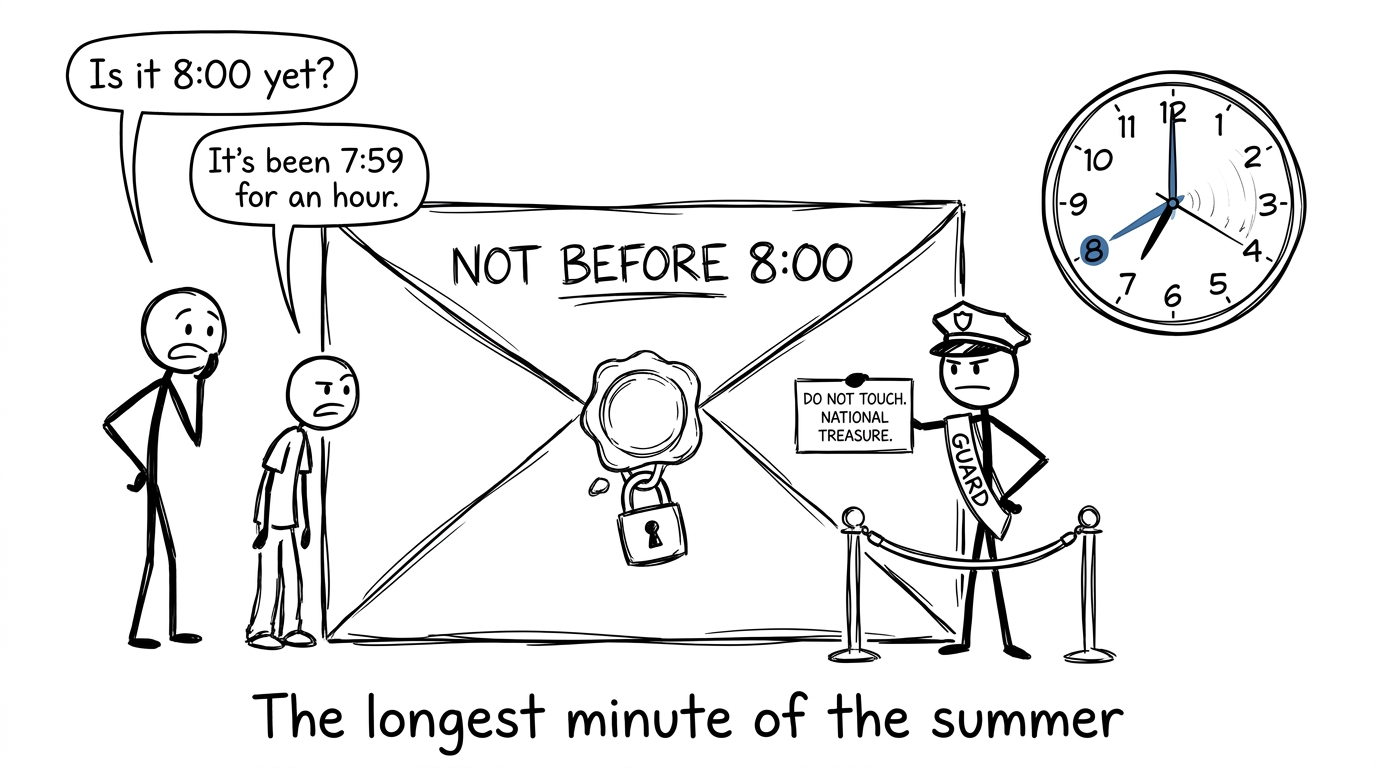 An exams officer guarding an embargoed results envelope while time moves slowly
The timeline from exam board to student
Before results week: exam boards produce the grades
Once papers have been marked, awarding organisations such as AQA, Pearson Edexcel, OCR and WJEC Eduqas complete checks and establish grade boundaries through their awarding processes. The school does not choose a student’s grade, and a teacher cannot adjust it before release.
Boundaries can change between exam series because they reflect the demand of that year’s assessments. Previous A-Level grade boundaries for Edexcel can provide context, but they do not predict a future boundary.
Students considering A-Level Maths can see the wider journey through MathsGenie’s free A-Level Maths revision hub, which includes resources for AQA, Edexcel, OCR, WJEC and CCEA.
Wednesday 12 August 2026: restricted release to centres
For the June 2026 series, schools and colleges can access AS and A-Level results from 00:0100{:}0100:01 on Wednesday 12 August. Results are normally delivered through awarding bodies’ secure systems or approved data-transfer services.
This early access is practical, not ceremonial. Exams officers need time to download files, identify missing or pending results, prepare statements and organise support for students. Access is restricted to the head of centre, examinations staff and authorised senior staff.
The information remains confidential. Staff must not reveal grades, boundaries or clues about outcomes to students or parents during the embargo. Releasing anything early may be treated as malpractice.
Results day from 08:00: schools can release results
At 08:0008{:}0008:00 on Thursday 13 August, the embargo lifts. Schools may then provide results through:
- in-person collection;
- a secure student portal;
- email or another approved electronic system;
- an authorised collection arrangement for an absent student.
The precise opening time and identification requirements are set by the individual school or college. Parents should therefore check the centre’s instructions rather than assume the building or portal will open at exactly 08:0008{:}0008:00.
The document students receive is a statement of provisional results. Results remain provisional while post-results services are available; the later certificate is the formal record.
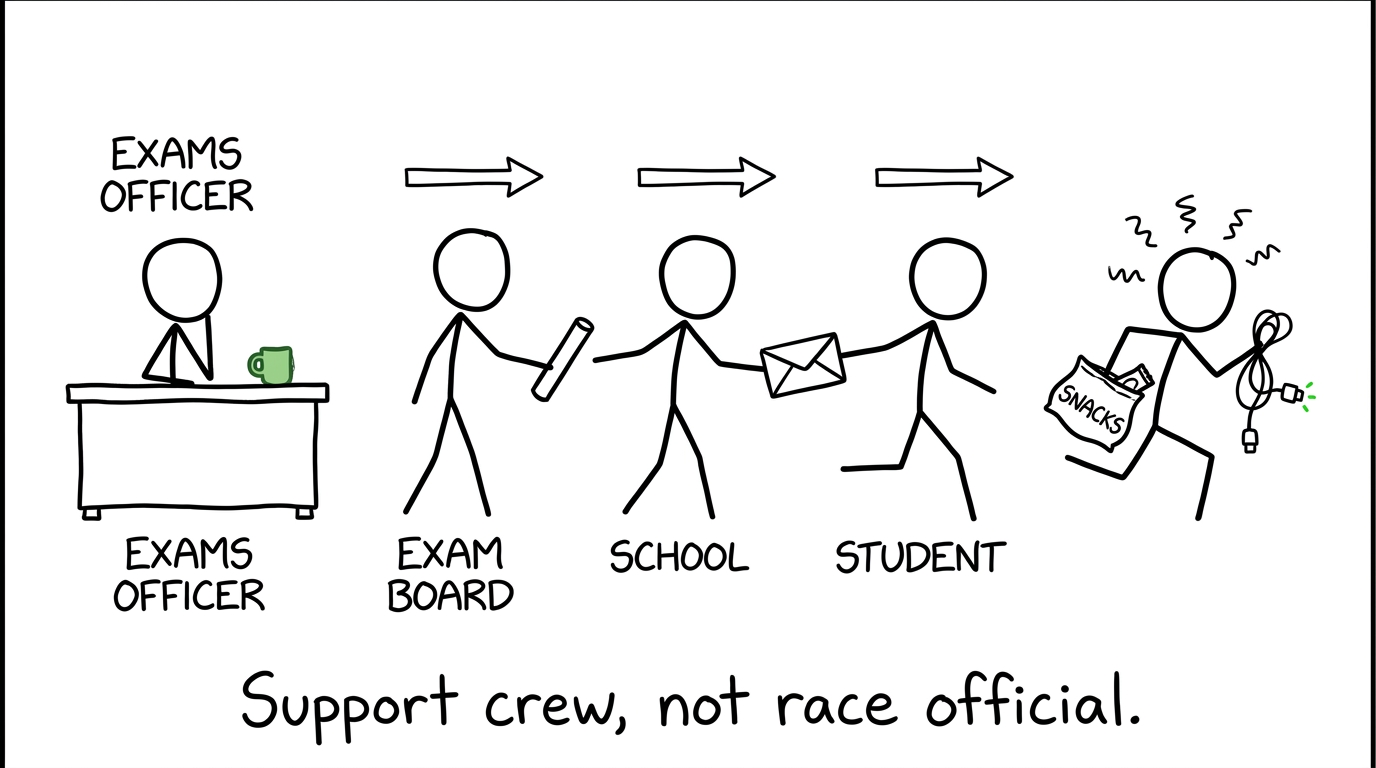 A results relay from exam board to school to student, with a parent acting as support crew
The same morning: UCAS updates applications
UCAS receives many qualification results and passes them to universities and colleges so they can make Confirmation decisions. The UCAS Hub may show that a firm or insurance place is confirmed, that a decision is pending, or that the applicant is eligible to explore Clearing.
A crucial distinction is that UCAS does not display the A-Level grades themselves. Students still need their results from their school or college. An application may also remain undecided temporarily while a university reviews it, so a delayed status is not automatically a rejection.
After release: advice and post-results choices
School staff can help students interpret their results and decide what to do next. Depending on the outcome, this may include contacting a university, considering Clearing or discussing a review of marking with the exams officer.
Parents are most useful here as calm support. Encourage the student to gather the facts before making an irreversible decision, and let them lead conversations about their application.
For younger students preparing for this journey, the GCSE Maths revision hub brings together foundation and higher-tier lessons, practice questions, past papers and mark schemes. A realistic GCSE revision timetable can make the eventual results day feel much less dependent on chance.
Common mistakes parents and students make
Expecting the exam board to provide results directly
Candidates normally receive results through the school, college or examination centre that entered them. Contact the centre first if access details are missing.
Assuming UCAS contains the grades
UCAS shows the application decision, not the complete results statement. Check both the UCAS Hub and the school’s release system.
Treating previous grade boundaries as a forecast
Old boundaries are useful historical information, but each exam series is awarded separately. Avoid turning last year’s thresholds into a promise.
Making decisions before speaking to the centre
A surprising result may involve several possible next steps. The exams officer can explain available post-results services, relevant deadlines and any fees before a request is submitted.
From GCSE preparation to a calmer results day
Results day is a short event built on a long process. The board awards the result, the centre releases it securely, and the student decides what comes next.
Parents supporting GCSE students can begin that process now. Explore the MathsGenie results-day and revision guidance, then use free GCSE Maths past papers and revision resources to turn uncertainty into a routine: learn through revision lessons, practise questions, check mark schemes and video solutions, then build confidence with mini tests and predicted papers.











