How Many Students Take GCSE Panjabi Each Year?
How many students take GCSE Panjabi? See the latest entry figures, recent trends and what the subject's small cohort really means for grading.
A subject can feel enormous when it is written across your timetable, revision notes and exam calendar. Nationally, though, some GCSEs are taken by surprisingly small groups. So, how many students take GCSE Panjabi each year? The latest published AQA results statistics show that 935935935 candidates entered GCSE Panjabi in summer 2025.
That is a small cohort beside subjects such as maths and English, but small does not mean insignificant, easier or unfairly graded. It means the statistics need to be read carefully. This article looks at recent entry figures, explains what they tell us and explores how GCSE Panjabi is graded when fewer than 1,0001{,}0001,000 candidates take it.
GCSE Panjabi numbers at a glance
Here is the short answer based on published JCQ and AQA data:
- Summer 2025: 935935935 candidates
- Summer 2024: 964964964 entries
- Summer 2023: 976976976 entries
- Summer 2022: 820820820 entries
- Summer 2019: 865865865 entries
- The subject is assessed at foundation and higher tier
- Listening, speaking, reading and writing each contribute approximately 25%25\%25% of the qualification
- A small entry does not change the meaning or national standard of a GCSE grade
The figures for 2019 to 2024 come from JCQ's published breakdown of other modern foreign languages. The 2025 figure comes from AQA's results statistics for specification 868386838683. Figures for 2020 and 2021 are not included in the comparison because alternative assessment arrangements operated during the pandemic.
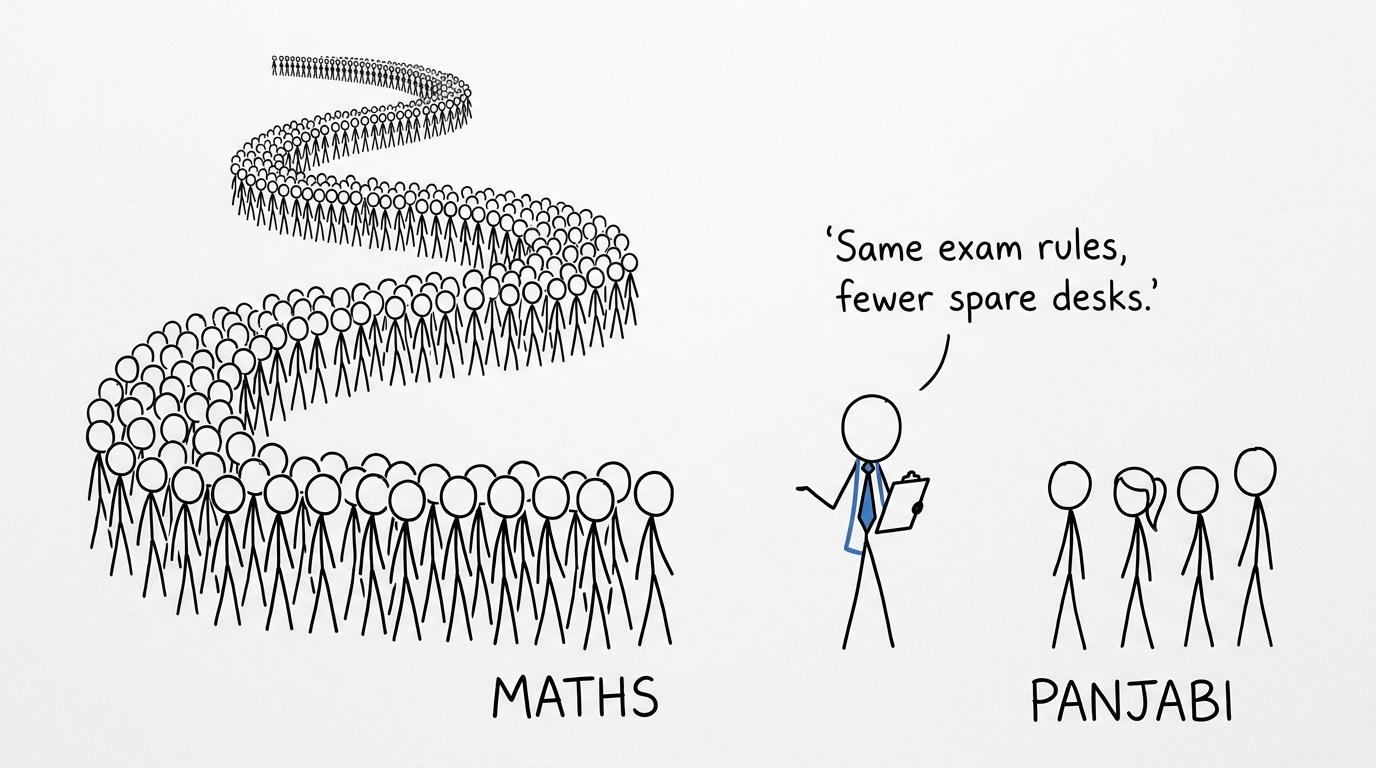 A tiny Panjabi exam queue beside a much larger maths queue
How many students take GCSE Panjabi in a typical year?
Recent evidence suggests that the usual annual figure is somewhere around 800800800 to 1,0001{,}0001,000 candidates. Entries have moved within that range rather than rising or falling in a perfectly straight line.
| Summer series | GCSE Panjabi entries or candidates |
|---|---|
| 2019 | 865865865 |
| 2022 | 820820820 |
| 2023 | 976976976 |
| 2024 | 964964964 |
| 2025 | 935935935 |
The 2025 total was 292929 lower than the 2024 figure. As a percentage change, that is approximately:
935−964964×100≈−3.0%\frac{935-964}{964}\times 100\approx -3.0\%964935−964×100≈−3.0%Yet the longer comparison looks different. There were 707070 more candidates in 2025 than in 2019, an increase of approximately:
935−865865×100≈8.1%\frac{935-865}{865}\times 100\approx 8.1\%865935−865×100≈8.1%This is a useful lesson in data interpretation. A one-year fall can sit inside a longer-term rise. The answer depends partly on the period being compared, something worth remembering when interpreting graphs and statistics in GCSE maths.
It is also important to distinguish entries from unique students. National GCSE totals count subject entries, so one student taking eight GCSEs contributes eight entries. JCQ reported more than 6.166.166.16 million GCSE entries across all subjects in 2025, not 6.166.166.16 million different pupils. Panjabi's 935935935 candidates therefore represent a very small subject cohort, but it would be misleading to compare that number directly with the total number of GCSE entries and call the result a percentage of students.
For practice interpreting tables, percentages and charts accurately, the GCSE Maths revision hub brings together lessons, questions, mini tests and papers for the main exam boards.
Why is GCSE Panjabi a relatively small subject?
GCSE Panjabi is one of several modern language qualifications outside the much larger French, Spanish and German cohorts. Its national entry depends on more than student interest alone.
A school must be able to offer suitable teaching, organise the speaking assessment and enter candidates through the relevant exam arrangements. Some pupils may learn Panjabi through community provision or prepare outside their normal school timetable. Availability can therefore vary substantially between areas and schools.
The number also reflects who has the language knowledge, literacy and confidence to take all four assessed skills. Speaking a language at home can be valuable preparation, but a GCSE additionally tests formal comprehension, communication, grammar and writing within a published specification. Familiarity is not the same as complete exam readiness.
None of this makes Panjabi less valuable. A cohort of 935935935 is small nationally, yet every candidate is completing a full GCSE governed by regulated assessment requirements.
What GCSE Panjabi assesses
The current AQA GCSE Panjabi specification uses four components:
| Component | Approximate weighting |
|---|---|
| Listening | 25%25\%25% |
| Speaking | 25%25\%25% |
| Reading | 25%25\%25% |
| Writing | 25%25\%25% |
The raw marks for some components are scaled so that each skill contributes equally to the final total. The qualification has a maximum scaled mark of 240240240.
Candidates take either foundation or higher tier and must use the same tier for all four skills. Foundation tier offers grades 111 to 555. Higher tier offers grades 444 to 999, with a narrow allowed grade 333 for candidates who fall just below the grade 444 standard. This is broadly the same tier principle students encounter in GCSE maths and other tiered subjects.
If you are comparing tier arrangements across your subjects, the GCSE maths topics by exam board and tier guide explains what foundation and higher entry mean in maths.
Does a small cohort make GCSE Panjabi easier to grade highly?
No. A GCSE is not graded by simply deciding that a fixed number of candidates must receive each grade. Your result is not determined by where you rank in a room of 935935935 people.
Exam boards set grade boundaries after papers have been marked. They consider the difficulty of that year's assessments, statistical evidence and expert reviews of candidates' work. Ofqual's stated purpose is to maintain the standard represented by each grade from one year to the next. Boundaries can therefore move when paper difficulty changes.
This distinction matters:
- The grade standard describes the quality of work required.
- The grade boundary is the mark needed to demonstrate that standard on a particular set of papers.
- The grade distribution records what the cohort actually achieved.
A high proportion of strong grades does not prove that the qualification was easy. Smaller language cohorts may differ from mass-entry subjects in prior language experience, confidence and selection. Outcomes describe the entered group; they do not measure paper difficulty on their own.
 A student examines a small bar while being reminded that small does not mean easy
What the 2025 grade figures actually show
AQA reported the following cumulative outcomes among the 935935935 GCSE Panjabi candidates in June 2025:
- 5.9%5.9\%5.9% achieved grade 999 or above
- 52.9%52.9\%52.9% achieved grade 777 or above
- 88.3%88.3\%88.3% achieved grade 444 or above
- 97.0%97.0\%97.0% achieved grade 111 or above
The word cumulative is essential. The 52.9%52.9\%52.9% at grade 777 or above includes grades 777, 888 and 999. These percentages must not be added together.
The outcomes were strong, but they cannot tell us why. The statistics alone do not separate home-language experience, school provision, candidate selection, teaching or individual preparation. They certainly do not show that examiners lower the standard because fewer pupils enter.
For the marks required in a particular series, consult the AQA GCSE Panjabi grade boundaries. In June 2025, for example, boundaries were published separately for foundation and higher tier. Those marks apply to that series only and should not be treated as guaranteed future boundaries.
What this tells maths students about exam statistics
Although the question concerns Panjabi, it offers a sharp lesson for anyone preparing for GCSE maths. Numbers are rarely self-explanatory.
A careful reader asks:
- Is this a count of candidates, entries or results?
- Is the percentage annual or cumulative?
- What is the comparison period?
- Is the sample self-selecting?
- Does correlation justify a claim about cause?
- Has rounding affected the displayed result?
These habits appear throughout statistics and probability questions. They also matter when you interpret your own mock marks. One score provides information, but it does not define your final grade.
Use a paper to diagnose gaps, not to label yourself. MathsGenie's AQA GCSE Maths past papers, Edexcel GCSE Maths past papers and OCR GCSE Maths past papers include mark schemes and worked solutions where available. Marking carefully turns a total into useful evidence about methods, accuracy and timing.
Common mistakes when interpreting GCSE Panjabi data
Treating entries as the entire student population
A national total across all GCSE subjects counts each qualification entry. It is not a count of unique pupils. Always check what the unit represents before calculating a proportion.
Assuming a small subject must be easier
Cohort size and assessment demand are different ideas. GCSE Panjabi still tests four language skills against regulated standards.
Reading cumulative percentages as separate groups
A grade 777-and-above figure already includes grades 888 and 999. Adding cumulative percentages produces a meaningless total.
Treating one year's boundary as a target forever
Grade boundaries can change because the difficulty of papers changes. Use past boundaries as context, not as a promise.
Comparing 2020 or 2021 directly with normal exam years
Those years used different assessment arrangements. JCQ omitted them from its recent individual-language comparison for that reason.
Inferring cause from outcomes alone
A high grade distribution cannot prove that an exam was easy or that one factor caused the result. It only describes the performance of the entered cohort.
 A revision path leads forward while the comparison path loops in circles
The number matters less than your next action
The clearest current answer is that 935935935 candidates took GCSE Panjabi in summer 2025, following totals of 964964964 in 2024 and 976976976 in 2023. It remains a small-entry GCSE, usually attracting roughly 800800800 to 1,0001{,}0001,000 candidates in the recent comparable years.
That tells us something about availability and the shape of the cohort. It does not tell us that grades are easier to obtain. Grade boundaries are set to reflect the standard of work on that year's assessments, while each candidate is judged through the same specification and mark scheme.
For maths revision, apply the same discipline to your own evidence. Begin with the free GCSE Maths revision resources, learn one weak topic through a revision lesson, complete practice questions and check the mark scheme. Then build towards mini tests, video solutions, past papers and Edexcel GCSE Maths predicted papers. A national statistic may satisfy your curiosity; a focused revision cycle is what changes your marks.