How Many Students Take GCSE Further Maths?
How many students take GCSE Further Maths? Around 35,000 sit AQA's Level 2 certificate. See what the latest entry and grade figures mean for pupils.
A subject can feel enormous when it occupies three lessons a week, a stack of exercise books and most of your thoughts before a mock. Nationally, though, GCSE Further Maths is a relatively small qualification.
So, how many students take GCSE Further Maths? The clearest current answer is that about 35,00035{,}00035,000 candidates sit the AQA Level 2 Certificate in Further Mathematics in a typical recent summer. AQA recorded 35,28935{,}28935,289 candidates in June 202520252025, following 35,30835{,}30835,308 in June 202420242024.
That makes it a well-established option, but not a mass-entry subject like GCSE Mathematics. It also helps explain its unusual grade distribution: the students taking it are usually already strong mathematicians, and the qualification is designed specifically to stretch them.
The answer at a glance
- AQA recorded 35,28935{,}28935,289 candidates for Level 2 Further Mathematics in June 202520252025.
- The equivalent June 202420242024 figure was 35,30835{,}30835,308.
- It is often called GCSE Further Maths, but its official title is the AQA Level 2 Certificate in Further Mathematics.
- It is an additional qualification, not a replacement for ordinary GCSE Maths.
- There is no Foundation or Higher tier: everyone sits the same papers.
- The cohort is highly selected, so high-grade percentages cannot be compared directly with those for the full GCSE Maths population.
If you are preparing for it, begin by making sure your higher-tier foundations are secure through the free GCSE Maths revision hub.
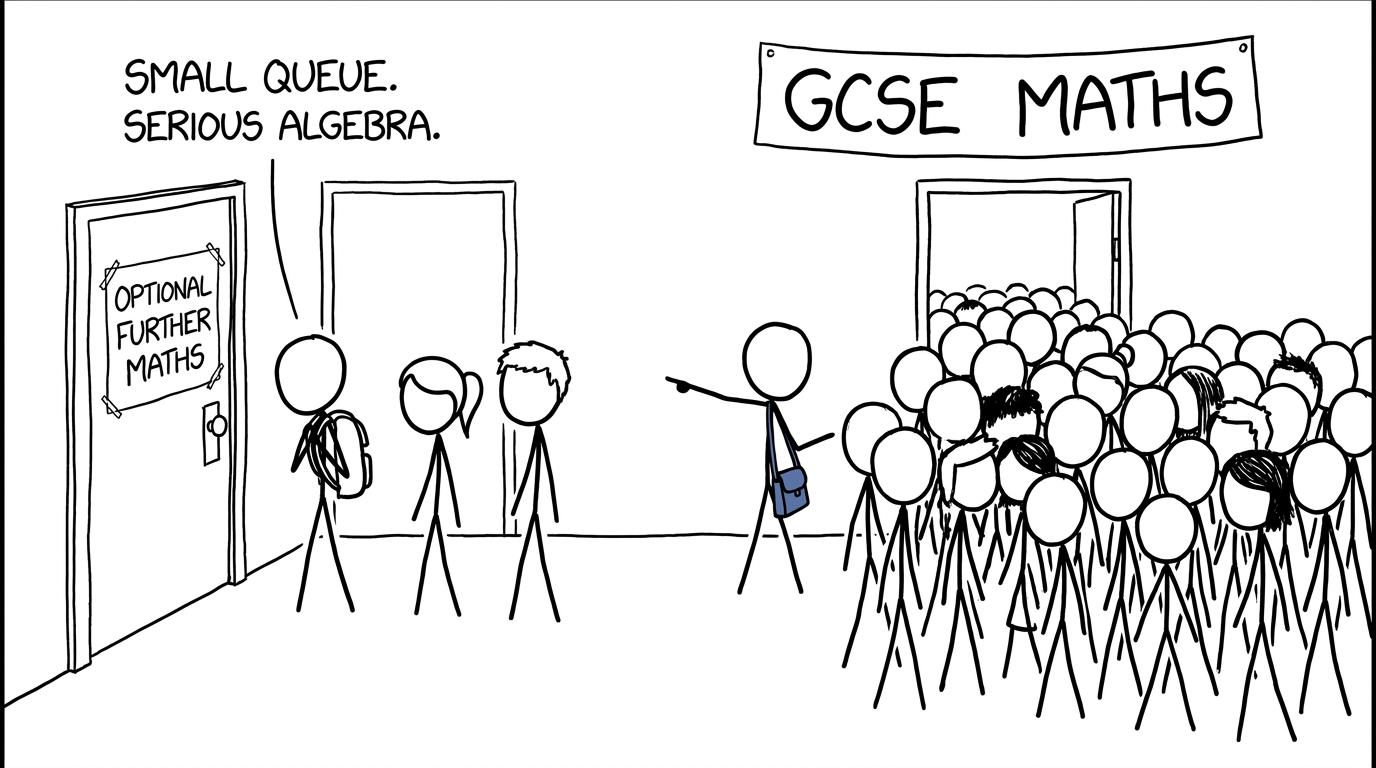 A small queue for optional Further Maths beside a much larger GCSE Maths crowd
Why the exact number needs a little care
The phrase “GCSE Further Maths” is convenient, but it can hide an important detail. The qualification most students mean is AQA's Level 2 Certificate in Further Mathematics, specification 836583658365. It is a Level 2 qualification taken at roughly GCSE stage, although it is not formally titled a GCSE.
Other advanced Level 2 maths qualifications also exist. Schools may offer alternatives such as additional mathematics or extended mathematics qualifications, depending on their exam board and curriculum. This means there is no single clean statistic covering every course that a school might informally describe as “GCSE Further Maths”.
For that reason, AQA's candidate total is the most useful answer to the search question, rather than pretending that every related qualification can be combined into one perfectly comparable national figure.
There is another distinction worth noticing: the published result statistics count candidates who sat the qualification. That is more precise than saying the number of pupils who considered it, started lessons or were originally entered.
How popular is GCSE Further Maths?
A cohort of around 35,00035{,}00035,000 is large enough that the qualification is familiar to sixth forms and maths departments. Yet it remains a minority option because it is not intended for every GCSE pupil.
AQA describes the course as suitable for learners who already have, or are expected to achieve, grades 777, 888 or 999 in GCSE Mathematics and who are likely to progress to A Level Maths, possibly alongside A Level Further Maths.
Schools therefore tend to offer it selectively. Some teach it to an entire top set. Others run an optional class, teach it after school or do not offer it because curriculum time is limited. A capable pupil can consequently have no opportunity to take the qualification simply because their school does not run it.
This matters when interpreting popularity. Entry figures measure access and school decisions as well as student enthusiasm. They do not form a national ranking of who is “good enough” at maths.
For pupils considering the course, the better question is not whether everyone else is taking it. It is whether your algebra, graphs, trigonometry and problem-solving are strong enough for an additional challenge without damaging your preparation for core GCSE subjects. The GCSE mini tests offer a quick way to check higher-tier fluency before adding more advanced material.
What the entry figures reveal about grading
The June 202520252025 AQA results show the following cumulative percentages. A cumulative figure means the percentage achieving that grade or higher.
| Outcome | June 2025 cumulative percentage |
|---|---|
| Grade 999 or above | 22.0%22.0\%22.0% |
| Grade 888 or above | 40.9%40.9\%40.9% |
| Grade 777 or above | 57.4%57.4\%57.4% |
| Grade 666 or above | 74.4%74.4\%74.4% |
| Grade 555 or above | 86.4%86.4\%86.4% |
| Grade 444 or above | 90.8%90.8\%90.8% |
| Unclassified | 9.2%9.2\%9.2% |
At first sight, a grade 999 rate of 22.0%22.0\%22.0% may make the paper look generous. That is the wrong conclusion.
The students entering have usually already been selected for high prior attainment. The qualification is not being attempted by the full ability range found in ordinary GCSE Mathematics. Comparing its grade distribution with the national GCSE Maths distribution is therefore like comparing the finishing times from an athletics final with those from an entire year group: the populations were different before the event began.
High grades are common because the cohort is unusually strong, not because advanced algebra, calculus and matrices are easy.
An unusual grade range
AQA Level 2 Further Mathematics is untiered. Unlike ordinary GCSE Maths, it has no Foundation and Higher papers. All candidates face the same assessment.
The standard awarded grade range is 999 to 555, with an allowed grade 444 available. A result below the grade 444 boundary is unclassified. This structure reflects the course's purpose: it provides additional stretch at the upper end of Level 2 rather than reproducing the full GCSE ability range.
The June 202520252025 grade 999 boundary was 141141141 marks out of 160160160. That figure should not become a permanent revision target, because grade boundaries are set for each exam series and can change with paper demand. Past boundaries describe what happened in a particular series; they do not promise what will happen next year.
What students actually study
Further Maths extends familiar higher-tier ideas and introduces content that many pupils would otherwise first meet later. The AQA specification covers number, algebra, coordinate geometry, calculus, matrix transformations and geometry.
You may encounter deeper work with functions, including notation such as f(x)f(x)f(x) and inverse functions, more demanding manipulation of quadratics, circle equations, differentiation and transformations represented by matrices.
Strong GCSE algebra is therefore not just one topic among many. It is the language holding the course together. Before moving further, use MathsGenie's resources on the quadratic formula, inverse and composite functions and drawing quadratic graphs.
These links support the shared higher-tier foundations. Your teacher's AQA Level 2 specification should still be the final checklist for the additional content you must cover.
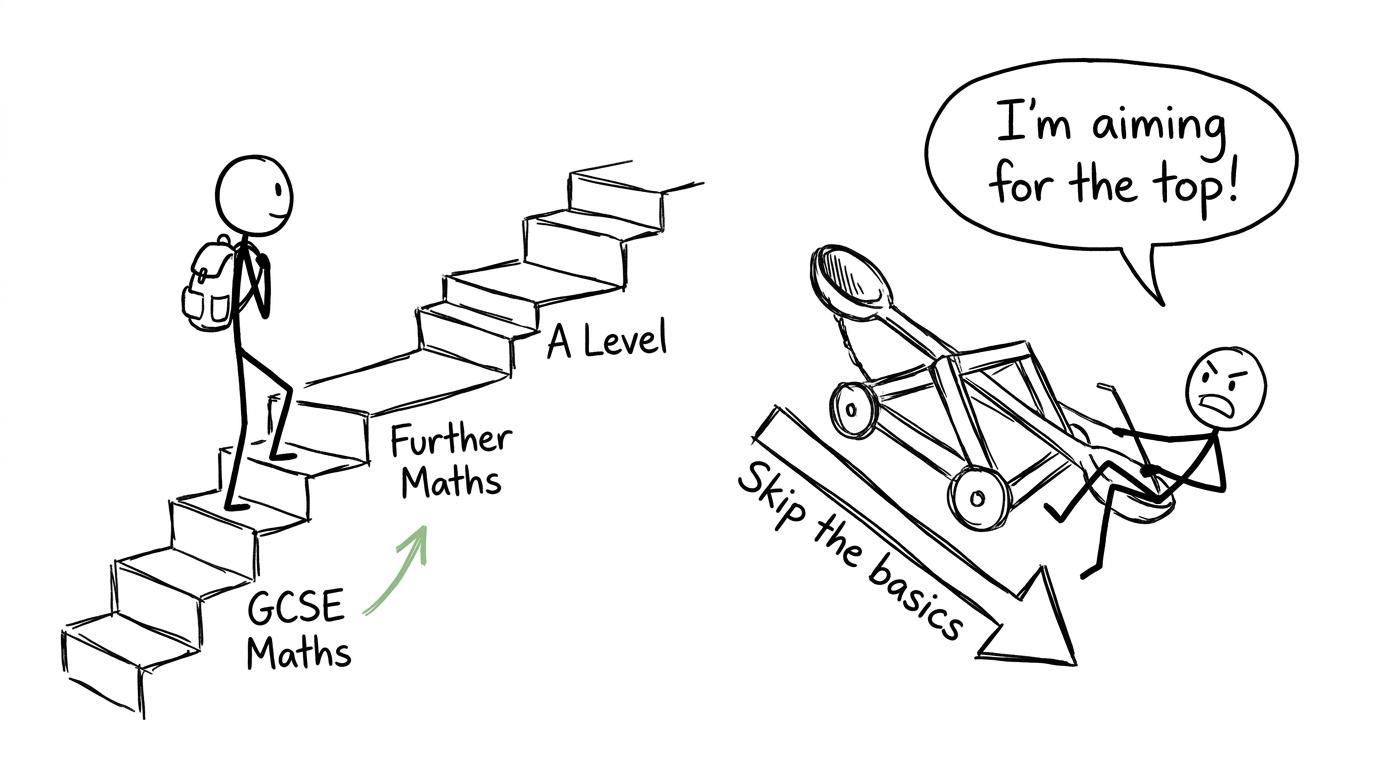 A sensible staircase from GCSE Maths to Further Maths and A Level
How the assessment works
The AQA qualification is linear, so both papers are taken in the same exam series.
| Paper | Conditions | Duration | Marks | Weighting |
|---|---|---|---|---|
| Paper 111 | Non-calculator | 111 hour 454545 minutes | 808080 | 50%50\%50% |
| Paper 222 | Calculator | 111 hour 454545 minutes | 808080 | 50%50\%50% |
Content from any part of the specification can appear on either paper. Revision based on guessing that one topic “belongs” to the calculator paper is therefore risky.
The course is designed to bridge the space between top-end GCSE work and Level 3 study, but it is not a shortened A Level. If you later continue with the subject, the A Level Maths revision resources can help you see how algebra and functions develop after Year 111111.
Should you take Further Maths if your school offers it?
Further Maths may be a sensible option when you enjoy algebraic reasoning, are performing securely on higher-tier material and are considering A Level Maths. It can make the transition to sixth-form mathematics feel more familiar because some advanced notation and ideas are no longer completely new.
But it is not a requirement for A Level Maths, and not taking it does not close the door. Sixth forms understand that access varies between schools. Your GCSE Maths result, algebraic fluency and willingness to practise consistently matter more than collecting an optional qualification at the expense of everything else.
A calm decision checklist is:
- Are you consistently secure on higher-tier GCSE algebra?
- Can you manage the extra lesson and revision time?
- Does the subject support your likely A Level choices?
- Are your core GCSE subjects already receiving enough attention?
- Have you asked your teacher how the course is taught and assessed at your school?
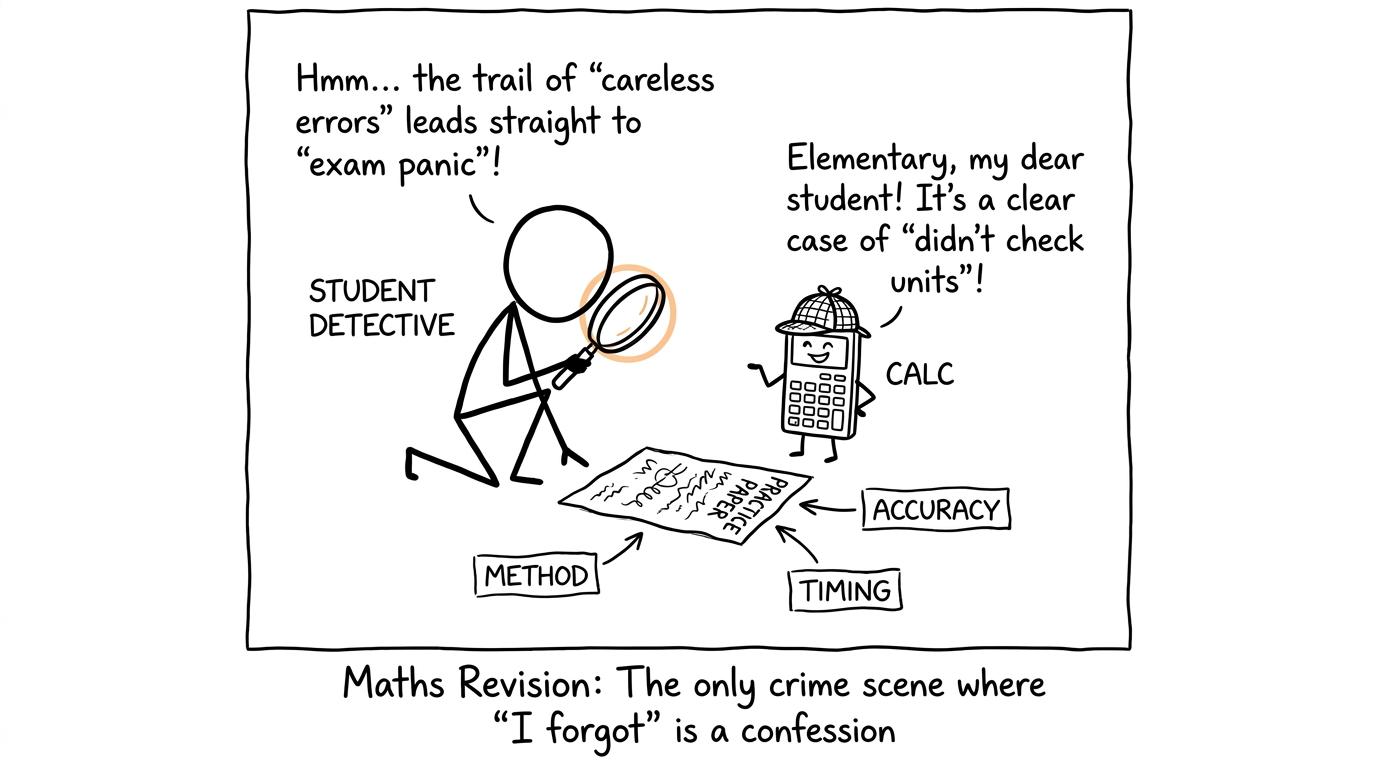 A student detective investigating method, accuracy and timing errors
Common mistakes when interpreting the figures
Calling it a replacement for GCSE Maths
AQA Level 2 Further Mathematics is taken in addition to GCSE Mathematics. It does not replace the standard qualification.
Assuming the high grade rate means an easy exam
The entry group is dominated by higher-attaining mathematicians. Selection changes the grade distribution. Difficulty cannot be judged from percentages without considering who entered.
Treating grade boundaries as fixed targets
The 202520252025 boundaries belong to the 202520252025 papers. Future boundaries may move, so revise the full specification rather than aiming narrowly at an old raw mark.
Comparing unrelated statistics
A Level Further Mathematics, Level 2 Further Mathematics and alternative additional maths qualifications are separate courses. Their entry totals should not be combined casually.
Revising only the new topics
Calculus and matrices may attract attention because they feel novel, but weaknesses in factorising, functions, graphs or trigonometry will affect much of the paper. Secure the GCSE foundations first, then extend them.
A small subject with a clear purpose
Around 35,00035{,}00035,000 candidates recently sat AQA Level 2 Further Mathematics each summer. That is enough to make it an important route into more advanced study, but small enough to remind us what the qualification really is: an optional course for a selected, high-attaining cohort.
Its grade statistics tell the same story. Many candidates receive high grades because the entry group is strong, while the assessment remains demanding and untiered. Your place in that group should never be treated as a verdict on your mathematical potential. School access, curriculum time and readiness all matter.
If you are taking the course, build from secure higher-tier skills rather than rushing towards the newest-looking topic. Use MathsGenie's free revision lessons and practice questions, then test your foundations with AQA GCSE Maths past papers and mark schemes. As the exams approach, add mini tests, predicted papers and video solutions to identify mistakes and turn them into your next revision task.
The entry number tells you how many pupils reached the starting line. What matters now is how deliberately you prepare for the papers ahead.