

How Many Students Take GCSE Biology Each Year?
How many students take GCSE Biology? Explore the latest UK entry figures, separate science trends and what the results reveal about grading.
A subject can feel enormous when it fills your timetable. Yet the national picture may be quite different. If you are wondering how many students take GCSE Biology, the latest completed UK results provide a clear starting point: there were 183,539183{,}539183,539 GCSE Biology entries in summer 202520252025.
That figure covers separate GCSE Biology across England, Wales and Northern Ireland. It does not include every student learning biology because hundreds of thousands more study the subject through Combined Science or another double-award science qualification.
The distinction matters. It explains how popular Biology really is, why entry figures can be misleading, and why its apparently strong grade outcomes do not mean it is automatically easier than other GCSEs.
The quick answer
Here is the essential picture from the Joint Council for Qualifications' final summer 202520252025 UK results:
- Separate GCSE Biology received 183,539183{,}539183,539 entries.
- Entries fell from 194,925194{,}925194,925 in 202420242024, a reduction of about 5.8%5.8\%5.8%.
- Biology was the ninth-largest GCSE full-course subject by entry volume.
- It accounted for approximately 3.0%3.0\%3.0% of all full-course GCSE entries.
- Science Double Award recorded 989,264989{,}264989,264 entries, but JCQ counts the qualification twice because it is worth two GCSEs.
- Combined or double-award science students still study biology, alongside chemistry and physics.
So the honest answer depends on what you mean by “take Biology”. Around 184,000184{,}000184,000 UK entries were made for the standalone qualification in 202520252025, but the number receiving GCSE-level biology teaching was much larger.
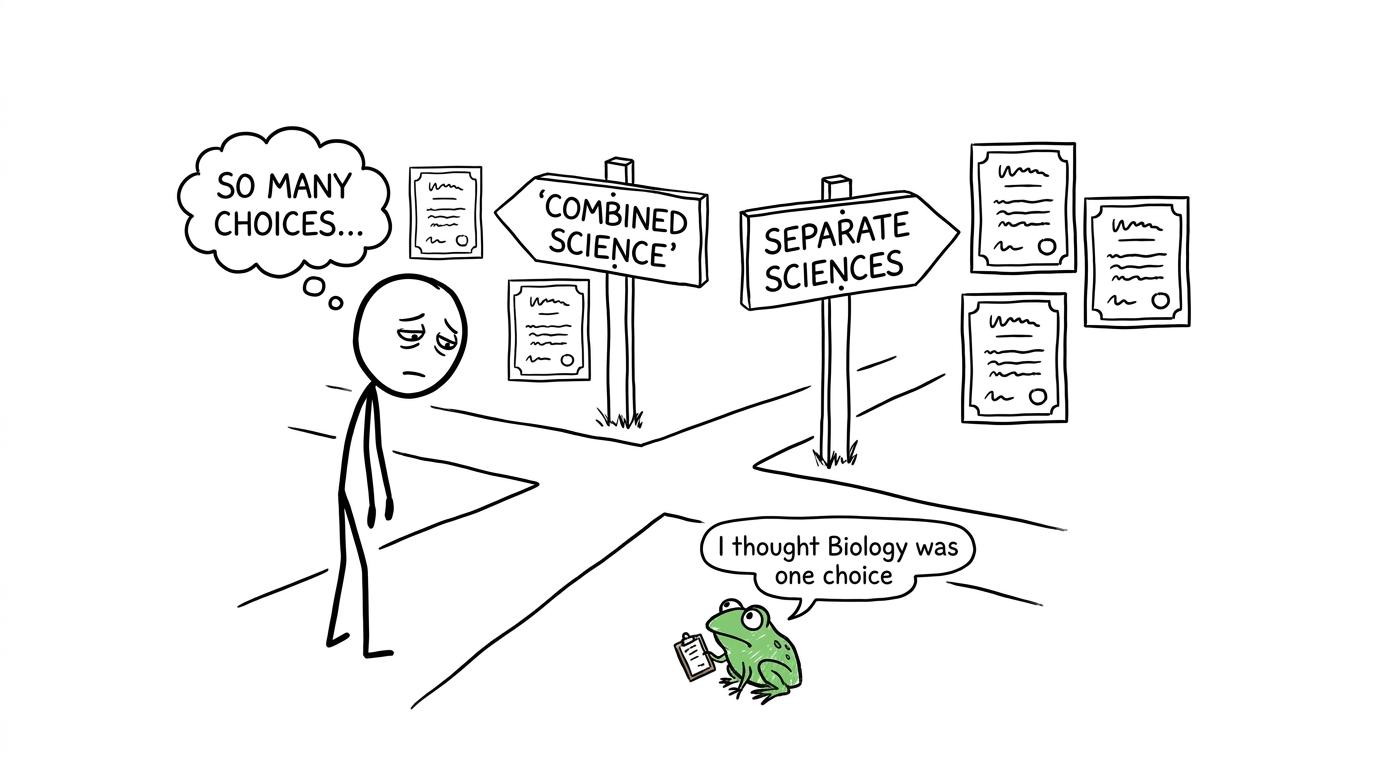 A GCSE student choosing between combined and separate science while a puzzled frog studies the certificates
What counts as a GCSE Biology student?
Official statistics generally count entries, not unique people. For a single qualification such as separate GCSE Biology, one entry normally corresponds to one candidate entered for that qualification. However, “entries” remains the more precise term because a candidate could be outside Year 111111, resitting, or taking the qualification early.
There are also two main science routes to distinguish.
Separate sciences
Students following separate sciences, often called Triple Science, receive three independent GCSE results:
- Biology
- Chemistry
- Physics
The Biology result is based only on the relevant Biology assessments. Depending on the specification, the qualification may be offered at foundation and higher tier. AQA, Edexcel, OCR and Eduqas specifications are not interchangeable, so students should always check their own course and exam board.
For a closer look at how a separate result is calculated, read the guide to GCSE Biology AQA grade boundaries.
Combined or double-award science
Combined Science also includes biology, chemistry and physics, but it is normally worth two GCSEs rather than three. In England, the result is reported as a pair of equal or adjacent grades, such as 777-777 or 777-666.
Those grades do not mean “one Biology grade and one Chemistry grade”. They represent overall performance across the entire Combined Science qualification.
This is why Combined Science candidates do not appear in the standalone Biology entry total. The GCSE Combined Science grade boundaries guide explains the double-grade structure in more detail.
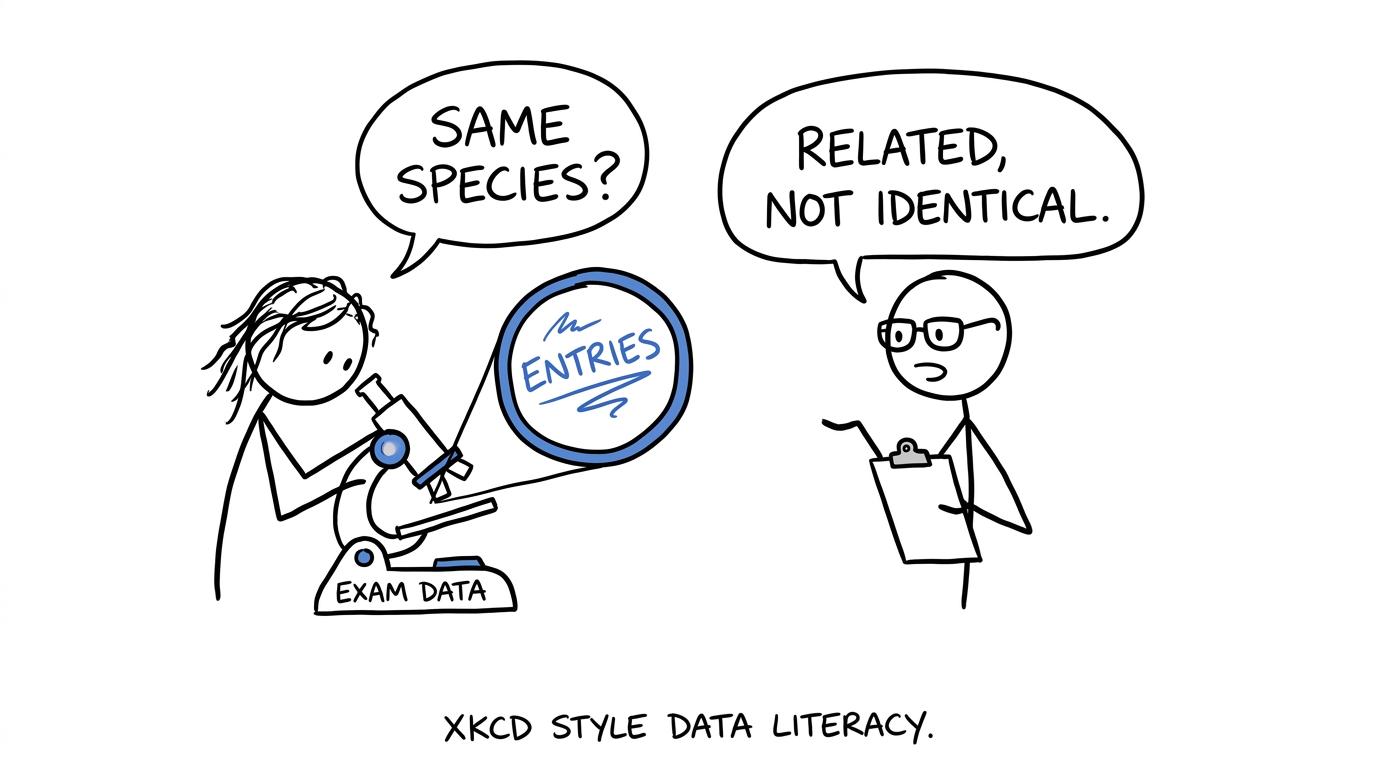 A student discovers that official exam statistics count entries rather than simply counting students
How GCSE Biology entries have changed
England's provisional entry series helps reveal the direction of travel. Separate Biology entries increased gradually from 171,835171{,}835171,835 in 202120212021 to 183,360183{,}360183,360 in 202420242024, before falling to 171,690171{,}690171,690 provisionally in 202520252025.
The final JCQ figures use a wider UK basis and therefore produce different totals: 194,925194{,}925194,925 in 202420242024 and 183,539183{,}539183,539 in 202520252025. The two datasets should not be mixed as though they measure precisely the same population.
What they do show consistently is a 202520252025 shift away from separate Biology, Chemistry and Physics entries and towards double-award science. Ofqual also described this movement when reviewing the summer results.
That does not prove students suddenly liked biology less. Entry patterns can reflect:
- the science pathways schools offer;
- timetable capacity and staffing;
- decisions about separate or combined science;
- changes in the size of the relevant pupil cohort;
- school entry policies and prior attainment requirements.
For many pupils, Triple Science is not a completely free-standing option chosen in the same way as Art or Business. Schools may recommend or allocate pathways, although practices vary. Popularity statistics therefore tell us about institutional decisions as well as student preference.
How popular is Biology compared with Combined Science?
Separate Biology remains one of the ten largest GCSE full-course subjects in the UK. On that measure, it is clearly popular.
Yet Science Double Award was substantially larger. JCQ reported 989,264989{,}264989,264 counted entries in 202520252025 and states that the double award is counted twice. A rough candidate equivalent can therefore be expressed as:
989,2642=494,632\frac{989{,}264}{2}=494{,}6322989,264=494,632This is an interpretation of the counting method, not a separately published headcount. It suggests that roughly half a million candidates followed that double-award route, compared with 183,539183{,}539183,539 entries for standalone Biology.
The bigger lesson is simple: separate Biology is a major qualification, but Combined Science is the more common route through GCSE science.
These comparisons are also an exercise in data literacy. Before comparing figures, check the population, year, geographical coverage and counting unit. Those habits transfer directly to GCSE maths questions involving percentages, frequency tables and misleading graphs. MathsGenie's free GCSE Statistics revision hub is a useful place to strengthen them, while students taking a separate qualification can use the Edexcel GCSE Statistics resources.
What Biology's popularity says about grading
In the UK summer 202520252025 results, approximately 43.5%43.5\%43.5% of separate Biology entries achieved grade 777 or above, while around 89.4%89.4\%89.4% achieved grade 444 or above.
Those are strong outcomes. But they should not be read as proof that Biology is easier to score highly in.
Students entered for separate Biology are not a random sample of all GCSE pupils. Some schools place students on the separate-science pathway using prior attainment, teacher recommendations or timetable considerations. A cohort containing a larger proportion of previously high-attaining students would be expected to produce a larger proportion of high grades.
This is a classic statistical warning:
A difference in outcomes does not, by itself, identify its cause.
Grade boundaries are set for a particular qualification, tier and exam series after the assessments have been taken. Exam boards consider the demands of the papers and statistical evidence during awarding. Boundaries can therefore change from year to year. They are not fixed percentages, and a Biology boundary cannot sensibly be compared with a maths boundary without considering differences between papers and cohorts.
Separate Biology also produces one independent grade. Combined Science pools performance across its science assessments to produce a double grade. Strong Biology performance within Combined Science can support the overall total, but it does not create a separate Biology result.
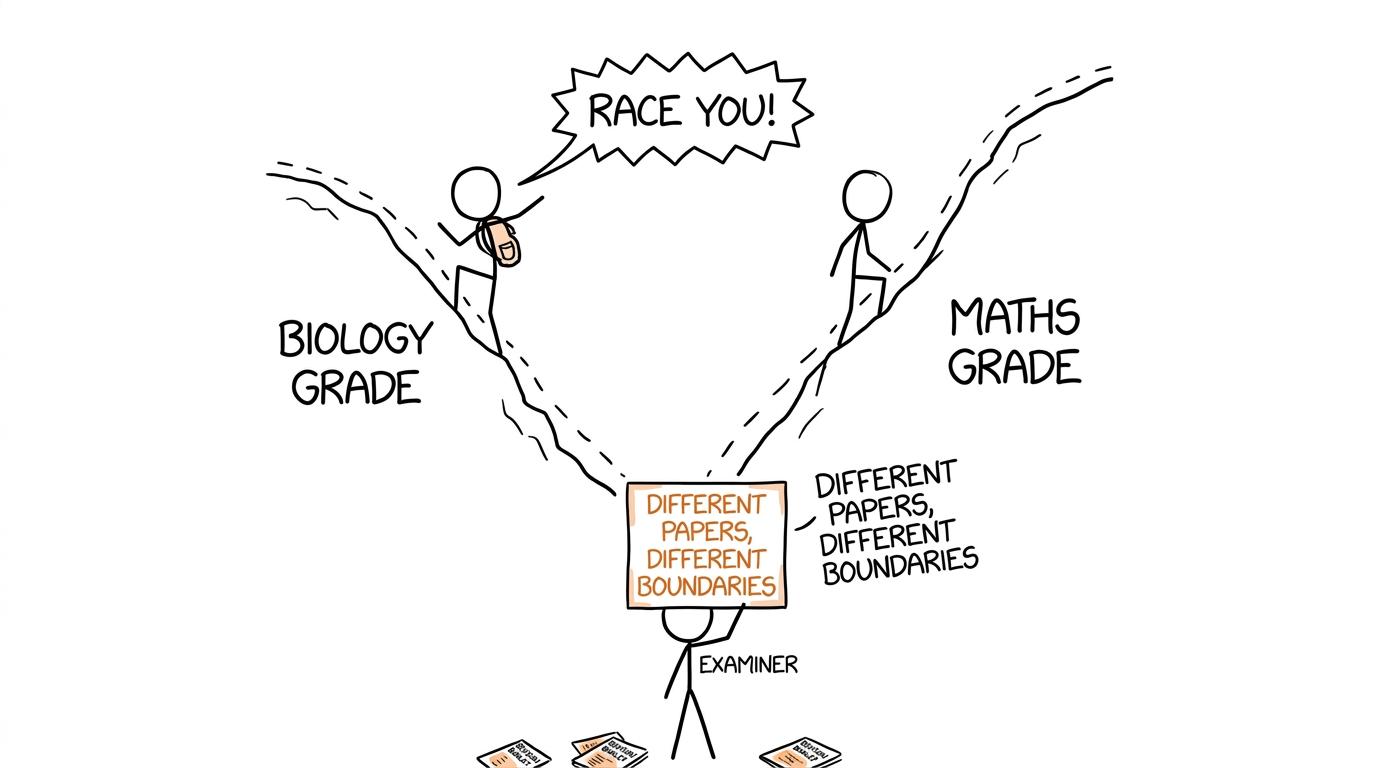 Two students race up different subject hills while an examiner reminds them that the grade boundaries differ
Why maths students should care about these figures
Biology entry statistics contain several ideas that appear regularly in GCSE maths:
- distinguishing a population from a sample;
- converting frequencies into percentages;
- interpreting percentage change;
- checking whether categories overlap;
- recognising when a double award has been double-counted;
- avoiding unsupported conclusions from an association.
These are not only classroom techniques. They are ways of resisting confident but misleading claims.
The same approach improves exam revision. Treat your marks as evidence rather than a verdict. Use a paper to identify what needs attention, then repair the smallest relevant skill. MathsGenie's guide to finding your weakest GCSE topics provides a practical diagnostic method.
You can then move from topic practice to timed assessment. The guide on when to start GCSE past papers explains how to build that transition without waiting until every topic feels perfect.
Common mistakes when interpreting Biology statistics
Treating entries as an exact student headcount
“Entries” is the official counting unit. For separate Biology it is usually close to the number of candidates, but it should not automatically be relabelled as a unique pupil count.
Leaving out Combined Science students
A student can study substantial biology content without being entered for standalone GCSE Biology. Combined Science entries belong in a different qualification category.
Mixing England and UK figures
Ofqual's provisional entry statistics for England and JCQ's final UK results cover different populations and stages of the examination cycle. Their totals should be labelled clearly.
Assuming high grades mean an easy subject
Grade distributions reflect the entered cohort as well as assessment performance. Separate-science candidates may differ systematically from the wider GCSE population.
Treating predicted boundaries as confirmed
Official grade boundaries are not known before awarding. Historical boundaries provide context, not a guaranteed target for a future paper. The same principle applies when using GCSE predicted papers: they are practice tools, not forecasts of exact questions or marks.
Turn the statistic into a better revision habit
The national total tells you how many entries were made. It cannot tell you what you will achieve. That depends more on the quality of your next revision session than on the size of the cohort.
Start with a short diagnostic task. Mark it carefully, identify two or three weaknesses, and use revision lessons and practice questions to repair them. Follow that with a mini test, then return to a full paper when the method is more secure. If the exams are close, the one-week GCSE maths revision plan offers a calm structure for prioritising your time.
The bigger picture
So, how many students take GCSE Biology? The best current answer is that separate GCSE Biology had 183,539183{,}539183,539 UK entries in summer 202520252025. It remained a top-ten GCSE subject, although entries fell from the previous year. Many more pupils studied biology through Combined Science, which was the larger science pathway.
The grading figures tell a subtler story. Separate Biology has a high-performing cohort, but popularity and grade distributions do not prove that one subject is easier than another. They reflect who was entered, which qualification they followed and how performance was awarded in that particular series.
Bring the same careful thinking to your maths revision. Use MathsGenie's free revision lessons, practice questions, mini tests, past papers, predicted papers, mark schemes and video solutions to turn broad concerns into precise next steps. National statistics describe a cohort. Consistent, well-marked practice changes the result that belongs to you.










