

How Many IGCSE Business Studies Papers Are There?
How Many IGCSE Business Studies Papers Are There? Compare Cambridge, Edexcel and OxfordAQA formats, marks and timings, then plan your revision.
The exam timetable can make a manageable course look much larger than it is. Paper codes, regional variants and different exam boards appear in search results, and suddenly it seems as though Business Studies has produced an entire filing cabinet of exams.
So, how many IGCSE Business Studies papers are there? For the current Cambridge IGCSE Business Studies, Pearson Edexcel International GCSE Business and OxfordAQA International GCSE Business specifications, students normally sit two papers. However, the timings, question styles and division of content depend on the awarding body.
The practical answer is simple: identify your board and specification code, then prepare for the exact pair of papers listed there. Do not revise from a resource merely because it says "IGCSE Business" on the cover.
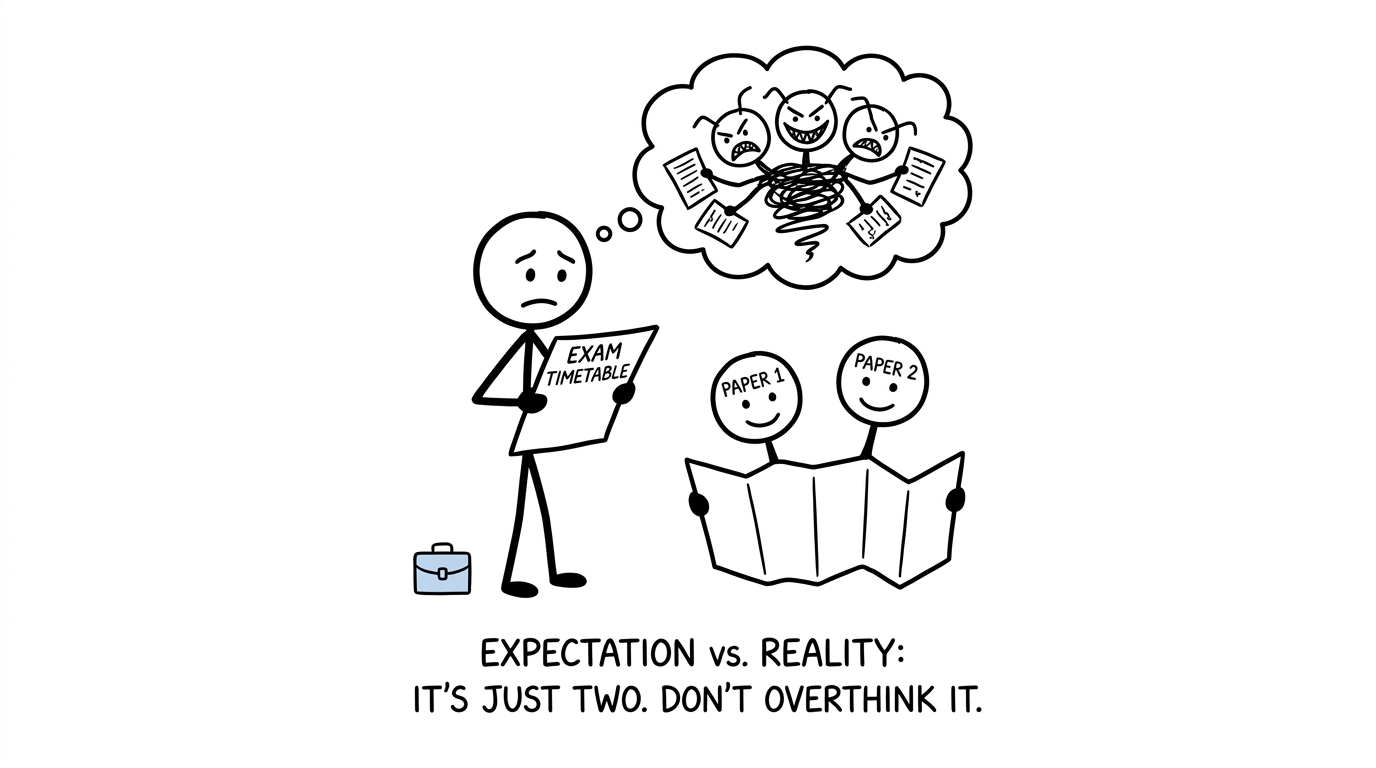 A student discovers that the intimidating exam monster has only two paper heads
IGCSE Business Studies papers at a glance
The following overview reflects official specifications available for the 2026 examination cycle. Always confirm the specification and entry details with your school because awarding bodies can update documents and offer different regional or onscreen versions.
| Exam board and specification | Number of papers | Time per paper | Marks per paper | Weighting |
|---|---|---|---|---|
| Cambridge IGCSE Business Studies 0450 | 222 | 111 hour 303030 minutes | 808080 | 50%50\%50% each |
| Pearson Edexcel International GCSE Business 4BS1 | 222 | 111 hour 303030 minutes | 808080 | 50%50\%50% each |
| OxfordAQA International GCSE Business 9225 | 222 | 222 hours | 909090 | 50%50\%50% each |
Your first checklist should therefore be:
- find the awarding body on your timetable or course documents;
- check the specification code;
- confirm whether you have a standard, regional or onscreen entry;
- learn the content and question format of both papers;
- collect the correct past papers and mark schemes;
- practise each paper under its real time limit.
This small administrative check matters. A perfectly revised answer technique for the wrong paper is still preparation for the wrong exam.
Cambridge IGCSE Business Studies 0450
Cambridge IGCSE Business Studies 0450 has two compulsory externally assessed components. Both papers are worth 808080 marks and contribute 50%50\%50% of the qualification.
Cambridge Paper 1
Paper 1 is Short Answer and Data Response. It lasts 111 hour 303030 minutes and contains four questions. Students answer every question, working through a mixture of short answers and structured data-response tasks.
This paper rewards accurate knowledge, but recall alone is not enough. You need to interpret the information provided, select relevant business concepts and apply them to the organisation or decision in the question.
Cambridge Paper 2
Paper 2 is the Case Study paper. It also lasts 111 hour 303030 minutes, carries 808080 marks and contains four compulsory questions. The questions are based on a case study supplied as an insert with the paper.
The insert may present information through written extracts, tables, graphs or advertisements. Paper 2 places relatively greater emphasis on analysis and evaluation than Paper 1. That makes contextual reasoning especially important: a memorised advantage is only the beginning of an answer, not the finished product.
Across the qualification, Cambridge assesses knowledge and understanding, application, analysis and evaluation. Your revision should therefore move from learning a concept to explaining how and why it matters in a particular business situation.
Pearson Edexcel International GCSE Business 4BS1
Pearson Edexcel International GCSE Business also has two externally assessed papers. Each lasts 111 hour 303030 minutes, is worth 808080 marks and contributes 50%50\%50% of the final qualification.
Edexcel Paper 1
Paper 1 is Investigating Small Businesses, with the code 4BS1/01. Its scenarios concern small businesses, while questions can draw on content from across the specification.
The paper contains four compulsory questions worth 202020 marks each. Sub-questions include multiple-choice, short-answer, data-response and open-ended tasks. This range means that you must be able to switch quickly from precise recall to developed business reasoning.
Edexcel Paper 2
Paper 2 is Investigating Large Businesses, with the code 4BS1/02. It follows the same overall timing, mark total and weighting as Paper 1, but its scenarios focus on large businesses.
The distinction between small and large businesses affects context rather than creating two completely separate subjects. Finance, marketing, operations and people still connect. What changes is how factors such as scale, ownership, communication and access to finance may shape a decision.
MathsGenie's Edexcel GCSE Business revision hub can support overlapping business knowledge and calculation skills. However, GCSE and International GCSE specifications are not interchangeable, so use the hub alongside your official 4BS1 specification rather than as a replacement for it. The Edexcel GCSE Business lessons are particularly useful when a shared topic needs rebuilding from the foundations.
OxfordAQA International GCSE Business 9225
OxfordAQA International GCSE Business 9225 is assessed through two written papers. Each lasts 222 hours, carries 909090 marks and contributes 50%50\%50% of the qualification.
OxfordAQA Paper 1
Paper 1 is Influences of Operations and Human Resources on Business Activity. It assesses business in the real world, influences on business, operations and human resources.
The paper has three sections. Section A uses multiple-choice and short-answer questions. Sections B and C use case-study or data-response material with compulsory short and extended responses.
OxfordAQA Paper 2
Paper 2 is Influences of Marketing and Finance on Business Activity. It assesses business in the real world and influences on business again, this time alongside marketing and finance.
Its three-section structure mirrors Paper 1. Because shared areas can appear across the qualification, treating the two papers as sealed boxes is risky. Broad business understanding still matters, even where particular functional areas have an obvious paper allocation.
Why you may see more than two paper codes
Search results sometimes show codes such as Paper 1R, Paper 2R or onscreen versions. These are alternative versions used for particular regions, time zones or assessment arrangements. They do not normally mean that one student must sit every version.
For example, Pearson's entry information includes standard, regional and onscreen combinations. A student entered for the normal two-paper qualification still completes the appropriate version of Paper 1 and the appropriate version of Paper 2.
Cambridge may also use variant numbers within an examination series. Again, your centre enters you for the relevant variant; you do not complete all variants. Your statement of entry and school timetable are more reliable than a list of every file found online.
What the two-paper structure means for revision
Knowing that there are two exams reduces uncertainty, but it should also change how you organise your work.
Build a paper map
Make one page for each paper. Record its duration, marks, question types, named content and any material supplied in the exam. This turns an abstract specification into two concrete tasks.
Then divide each page into three columns:
- knowledge that must be recalled accurately;
- calculations or data skills that must be practised;
- extended responses requiring analysis or evaluation.
This prevents a common imbalance: spending weeks making definition cards while barely practising the longer questions that require context and judgement.
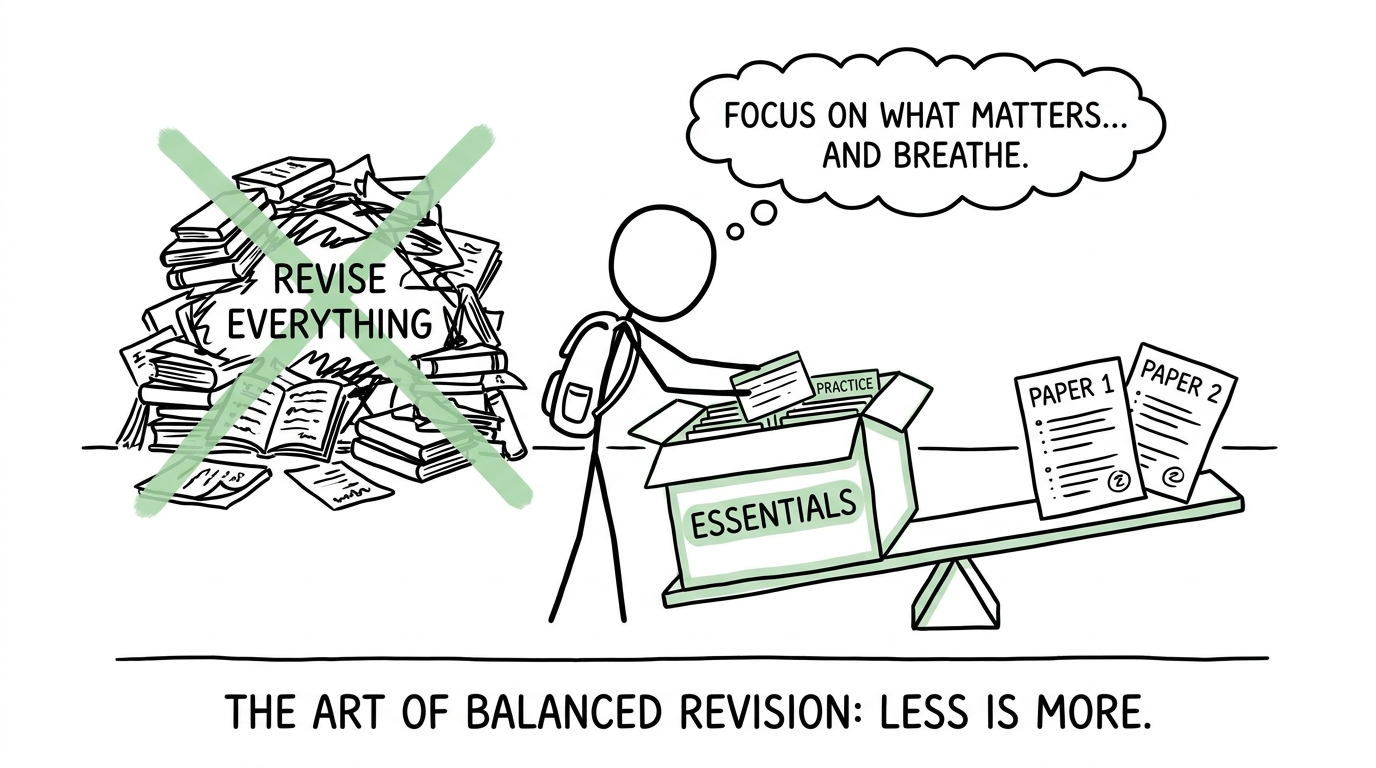 A calm student balances revision between two papers instead of trying to revise everything at once
Practise business calculations accurately
Business papers can include numerical information, so core maths skills remain valuable. Depending on your specification, useful relationships may include:
revenue=selling price×quantity sold\text{revenue}=\text{selling price}\times\text{quantity sold}revenue=selling price×quantity sold profit=revenue−total costs\text{profit}=\text{revenue}-\text{total costs}profit=revenue−total costs market share=business salestotal market sales×100\text{market share}=\frac{\text{business sales}}{\text{total market sales}}\times 100market share=total market salesbusiness sales×100Check the formulae required by your own specification and show your working clearly. Units, percentage signs and the interpretation of a result can all matter.
If percentage calculations are slowing down your business answers, revisit the free MathsGenie percentages lesson. The wider GCSE maths revision hub also provides lessons, question banks and revision guides for numerical skills that transfer across subjects.
Train application, not just memory
A business definition can often be memorised in a minute. Application takes longer because it requires attention to the case.
Use details such as the firm's size, product, objective, workforce, market or financial position. Then explain the chain of consequences. Ask: why does this factor matter here, and what could happen next?
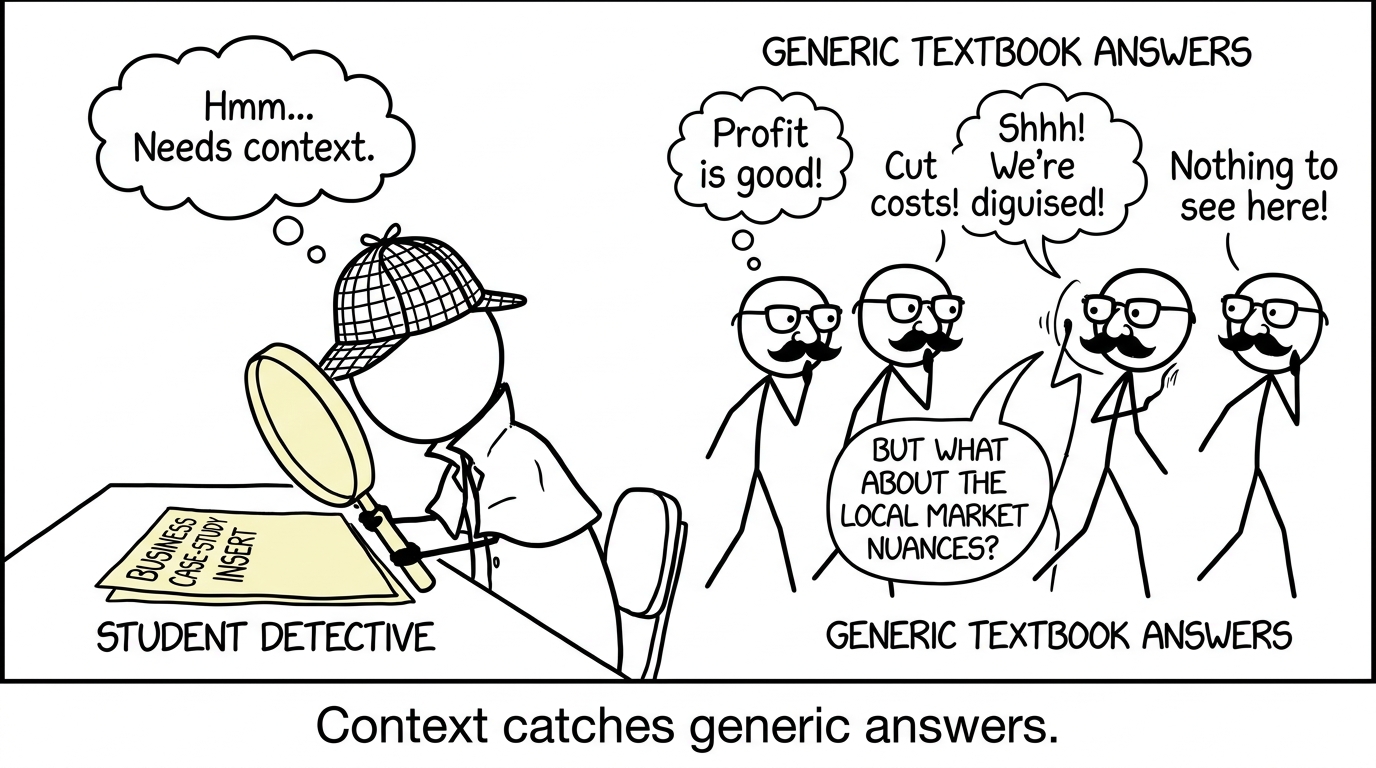 A student detective uses context to catch generic textbook answers
Use papers as diagnosis
A past paper is most useful after it has been marked. Complete it under the correct conditions, use the mark scheme, record each lost mark and classify the cause:
- missing knowledge;
- weak application;
- an incomplete analytical chain;
- unsupported judgement;
- inaccurate calculation;
- poor timing or misreading.
The method in MathsGenie's guide to using GCSE past papers properly transfers well to IGCSE Business: complete, mark, fix and retest. You can also explore the GCSE papers hub to see how past papers, predicted papers and mini tests can fit into a wider revision routine.
Common mistakes when preparing for IGCSE Business papers
Assuming every exam board has the same format
The main boards covered here use two papers, but Cambridge, Edexcel and OxfordAQA divide content and questions differently. Always attach revision advice to a specification code.
Counting variants as extra compulsory exams
Regional and onscreen variants are alternatives, not an instruction to sit four or six papers. Confirm your own entry with your school.
Revising Paper 1 and neglecting Paper 2
For the specifications above, each paper contributes 50%50\%50%. A favourite topic cannot compensate reliably for an entire neglected paper.
Writing generic case-study answers
Repeating theory without using the business context weakens application. Select evidence from the case and explain why it changes the likely outcome.
Completing papers without analysing mistakes
A stack of finished papers can feel productive while hiding repeated errors. Mark every attempt and maintain a short error log. Where GCSE content overlaps, the Edexcel GCSE Business past-paper collection can provide additional question-format practice, but your priority must remain official papers for your exact IGCSE code.
Turn two papers into one clear plan
Most students asking how many IGCSE Business Studies papers there are are really asking something deeper: "What exactly am I preparing for?" In the major specifications covered here, the answer is two papers, but confidence comes from knowing what each one demands.
Check your board, map both papers and alternate focused topic revision with timed exam practice. Mark strictly. Fix one weakness at a time.
Use MathsGenie as your free revision base for supporting business content and numerical skills. Move between revision lessons, practice questions, past papers, predicted papers, mini tests, mark schemes and video solutions. Two papers are not a mystery once each has a place in the plan, and the next useful step is simply to begin with the weaker one.











