How Long to Revise for a GCSE Resit
How long to revise for GCSE resit success, with realistic weekly hours, sample Maths and English schedules, and advice for every starting grade.
A resit creates an awkward question: how much revision is enough when you have already studied the subject once? The practical answer to how long to revise for GCSE resit success is usually 6-12 focused hours per week across Maths and English Language, sustained for as many weeks as possible. Your exact target depends on your starting grade, the time remaining and how effectively you use each session.
Someone close to a grade 444 may need fewer hours than someone rebuilding several years of missing knowledge. Yet hours alone never guarantee progress. A focused 454545-minute session, followed by checked corrections, is worth more than an evening spent copying notes.
Your quick revision checklist
Before building a timetable:
- complete a recent paper or timed assessment in each subject;
- identify your starting grade and weakest areas;
- count the weeks until your first exam;
- choose a realistic weekly target from the guidance below;
- divide that time into short, repeatable sessions;
- check work with mark schemes and correct every useful mistake;
- review progress each week and adjust the plan.
For Maths, begin with the free GCSE Maths revision hub, where you can select your exam board and find relevant resources.
GCSE resit hours by starting grade
The following ranges cover Maths and English Language combined. They are practical planning estimates rather than promises. Your college timetable, additional needs and current knowledge may change what is manageable.
| Starting position | More than 121212 weeks left | 666-121212 weeks left | Fewer than 666 weeks left |
|---|---|---|---|
| Secure grade 333, aiming for grade 444 | 666-888 hours weekly | 888-101010 hours weekly | 101010-121212 hours weekly |
| Grade 222, aiming for grade 444 | 888-101010 hours weekly | 101010-121212 hours weekly | 121212-141414 hours weekly |
| Grade 111 or substantial gaps | 101010-121212 hours weekly | 121212-141414 hours weekly | 141414-161616 hours weekly, with teacher support |
| Grade 444, aiming for grade 555 or above | 666-999 hours weekly | 888-111111 hours weekly | 101010-131313 hours weekly |
If these numbers feel large, remember that 888 weekly hours can be split into eight one-hour sessions. Regularity matters more than heroic weekends.
A student with a strong grade 333 and 101010 weeks remaining might plan:
8 hours per week×10 weeks=80 focused hours. 8\text{ hours per week}\times10\text{ weeks}=80\text{ focused hours}. 8 hours per week×10 weeks=80 focused hours.That is not a required total or a guarantee of a grade. It is simply a useful way to make the available time visible.
How to adjust revision time per week
Your starting grade is only the first clue. Look at the marks behind it.
If your performance is uneven, perhaps secure in number but weak in algebra, targeted work can improve marks more efficiently than restarting the whole course. Use GCSE revision guides and topic-by-topic GCSE worksheets to concentrate on genuine gaps.
Increase your weekly time gradually when:
- you have major gaps in foundational topics;
- you cannot yet finish papers within the allowed time;
- your written English responses regularly remain incomplete;
- your practice marks are static for several weeks;
- the exam is approaching and you can add time without sacrificing sleep.
Reduce or redistribute it when tiredness is damaging concentration. Ten exhausted hours are not automatically better than seven alert ones. Revision should be demanding, but it must also be repeatable.
A balanced weekly schedule for both resits
Here is a realistic 888-hour plan for a student balancing college, work or other subjects.
| Day | Maths | English Language |
|---|---|---|
| Monday | 454545 minutes on one weak topic | 454545 minutes analysing a reading extract |
| Tuesday | 454545 minutes of exam questions | Rest |
| Wednesday | Rest | 606060 minutes planning and writing a response |
| Thursday | 454545 minutes reviewing earlier topics | 454545 minutes of language or structure practice |
| Friday | Rest | Rest |
| Saturday | 909090 minutes on a timed paper section | 606060 minutes on a timed paper section |
| Sunday | 454545 minutes correcting mistakes | 454545 minutes correcting and improving answers |
This totals 444 hours for each subject. A student needing 121212 hours could add two further 606060-minute sessions per subject, rather than making every existing session longer.
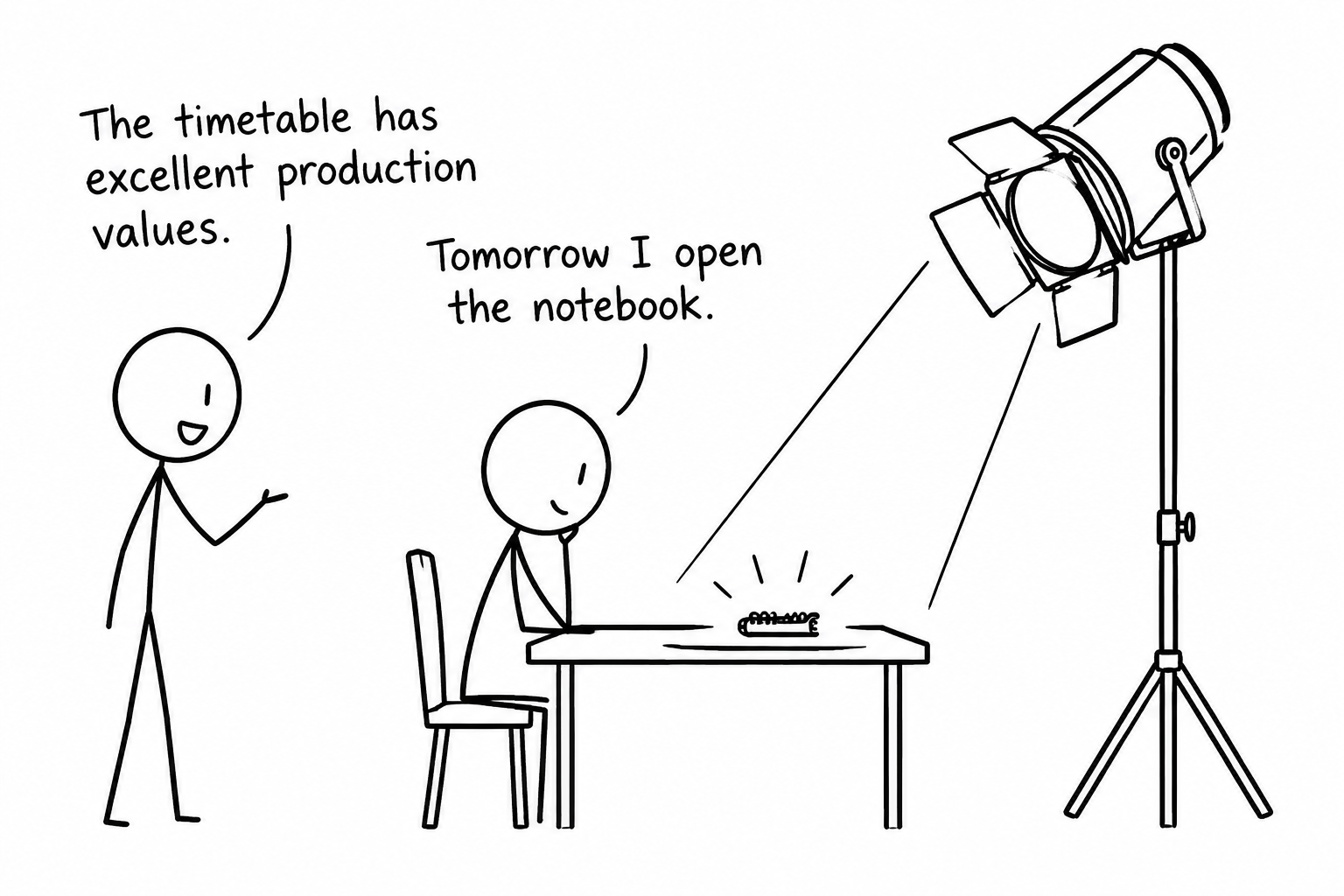 Stick figures joke about designing a revision timetable instead of beginning revision
What to do during each Maths session
A useful Maths session has a small, visible purpose. For example:
- Learn: watch a topic video and review the method.
- Practise: answer questions without copying the example.
- Check: use the answers or mark scheme.
- Correct: redo missed questions independently.
- Retrieve: return to the topic several days later.
MathsGenie provides videos and worksheets organised by grade as well as exam-board resources. If you take Edexcel, the Edexcel GCSE Maths revision page separates Foundation and Higher content and includes past-paper support.
Past papers become increasingly valuable as the exam approaches, but do not just count the mark and move on. Classify each lost mark: missing knowledge, incorrect method, arithmetic error, misunderstood wording or poor timing. That diagnosis tells you what tomorrow's session should contain.
How to use the time for English Language
English Language revision should also involve active work. Reading model answers can help, but improvement depends on writing, receiving feedback and redrafting.
Divide English time between:
- understanding what each question asks;
- selecting precise evidence from unseen texts;
- explaining language and structural choices;
- planning clear responses quickly;
- practising transactional and creative writing;
- checking punctuation, spelling and paragraph control;
- completing timed sections under closed-book conditions.
Use materials from your own exam board because question wording and assessment structure vary. Ask your teacher to mark selected responses. A mark scheme is useful, but expert feedback can reveal whether an explanation is genuinely developed and convincing.
How your plan should change near the exam
With more than 121212 weeks left, spend most sessions rebuilding knowledge and skills. Add short retrieval tasks so that older work does not disappear as new topics arrive.
During the final 666-121212 weeks, combine targeted revision with timed sections. This is where MathsGenie's free GCSE Maths resources can help you move between individual topics and complete exam papers.
In the final few weeks, full or substantial paper practice should become more frequent. Use official mark schemes carefully, review errors and revisit the topics costing the most accessible marks. A structured one-month GCSE Maths revision plan can help if time is short.
Do not turn the final week into an endurance contest. Keep practising, but protect sleep, meals and the routines that let you think clearly.
Common mistakes when planning GCSE resit hours
Counting passive time as revision. Sitting beside an open book is not the same as answering, recalling or writing.
Repeating comfortable topics. Familiar work feels productive because it goes smoothly. Your mark usually improves when you spend more time at the edge of what you can currently do.
Completing papers without corrections. A paper identifies problems. The improvement comes from understanding and fixing them.
Using the wrong tier or specification. Confirm your Maths tier and exam board before selecting materials. For both subjects, practise the paper structure you will actually sit.
Planning every free hour. An overloaded timetable tends to collapse after one disrupted day. Leave some spare capacity and set a minimum session you can still complete when the week becomes difficult.
Ignoring support. If your grade is not moving, more solitary hours may not solve the problem. Bring recurring errors to a teacher or tutor and ask for a precise next step.
Build a plan you can keep
The best answer to how long you should revise is not the largest number you can tolerate once. It is the amount of focused work you can sustain, review and improve.
Choose your weekly range, put the sessions into a calendar and start with one diagnosed weakness. Then use MathsGenie's free GCSE Maths revision resources, practice questions, videos, worksheets, past papers and mark schemes to turn each hour into evidence of progress. A resit is not a replay of the first attempt. With a clearer plan, it can be a better one.