Home-Schooled GCSE Astronomy: How to Sit the Exam
Home schooled GCSE Astronomy explained: find a private exam centre, complete mandatory observations, meet entry deadlines and prepare for both papers.
The night sky may be open to everyone, but an examination room is not. For families researching home schooled GCSE Astronomy, the difficult part is often not learning about stars, planets or cosmology. It is finding an approved centre willing to make the entry and confirm the compulsory observations.
The short answer is yes: a home-schooled student can sit Pearson Edexcel GCSE Astronomy as a private candidate. The student must enter through an approved exam centre, complete at least one unaided and one aided astronomical observation, and sit both written papers in the same May/June examination series. Finding a centre early is the practical priority.
Home schooled GCSE Astronomy checklist
Before buying resources or planning observations, establish the following:
- The qualification is Pearson Edexcel GCSE Astronomy, specification code 1AS0.
- It is an untiered GCSE graded from 999 to 111.
- The candidate must sit two externally examined papers in one May/June series.
- At least one unaided and one aided observation must be completed.
- An approved centre must enter the student and submit Pearson's Observation Statement.
- The family's deadline is the centre's internal deadline, which may be earlier than Pearson's published entry deadline.
- Fees can include the awarding-body entry fee, centre administration, invigilation and any additional arrangements.
- Access arrangements must be discussed before the entry is finalised.
That list is short. Each item, however, needs to be agreed with the centre rather than assumed.
Which GCSE Astronomy qualification can private candidates take?
The current qualification is Pearson Edexcel GCSE Astronomy, code 1AS0. Pearson's published information confirms that it is available to private candidates, including in the June 2027 series.
GCSE Astronomy is not divided into foundation and higher tier. Every candidate studies the same specification and takes the same papers. This differs from GCSE Maths courses offered by Edexcel, AQA, OCR and Eduqas, where tier decisions often shape revision. Students balancing both subjects can compare that structure using MathsGenie's GCSE maths topics by exam board and tier.
The Astronomy qualification has two papers:
- Paper 1: Naked-eye Astronomy, lasting 111 hour 454545 minutes and worth 100100100 marks
- Paper 2: Telescopic Astronomy, lasting 111 hour 454545 minutes and worth 100100100 marks
Each paper contributes 50%50\%50% of the qualification. Questions can include multiple-choice items, calculations, short answers, graphical work and extended responses. Calculators are permitted.
There is no coursework or controlled-assessment mark. That does not mean practical observation is optional. The observations are a mandatory course requirement, while the knowledge and skills developed through them are assessed in the written examinations.
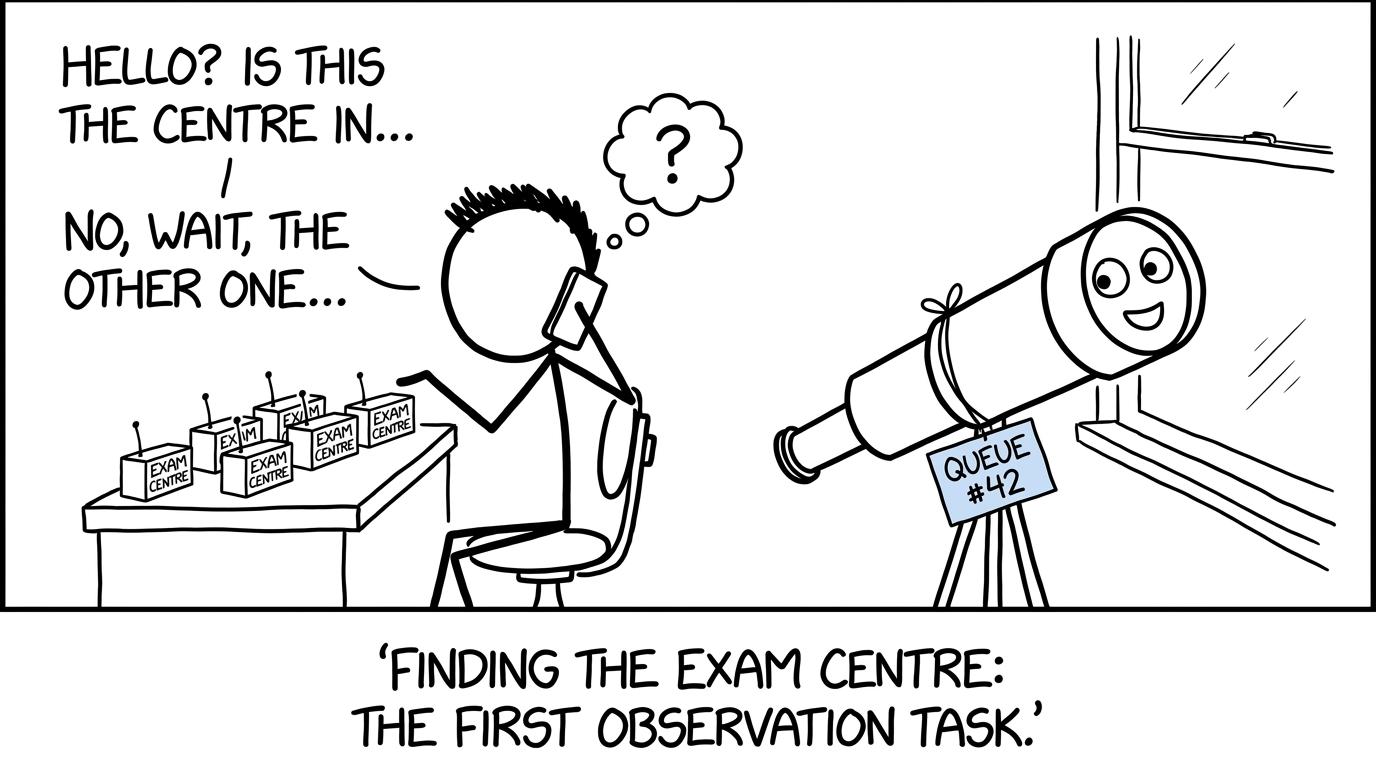 A student phones exam centres while a telescope waits with a queue ticket
How to find an exam centre
A private candidate cannot enter directly with Pearson and then arrive at an arbitrary venue. An approved school, college or examination centre must make the entry.
Start with the Joint Council for Qualifications private-candidate centre finder. Search for centres accepting GCSE candidates and Pearson qualifications, then contact each centre directly. A listing is a starting point, not a guarantee that the centre offers Astronomy or has space.
Astronomy needs a more specific conversation than an ordinary written-only subject. In the first email, provide:
- the student's full name and date of birth
- the intended examination series
- Pearson Edexcel GCSE Astronomy 1AS0
- confirmation that both written papers are required
- whether observations have already been started
- whether access arrangements may be needed
- a request for the total fee and internal deadline
Ask explicitly: Will you accept a private candidate for 1AS0 and submit the required Astronomy Observation Statement?
A centre may accept private candidates for Pearson GCSE Maths but decline Astronomy because it is unwilling or unable to handle the observation declaration. Contact several centres rather than waiting for one reply before trying the next. It may also be necessary to travel beyond the nearest town.
Once accepted, the centre will explain its registration requirements. These may include identification, previous candidate details, evidence of observations and payment. Check the resulting statement of entry carefully, including the student's name, qualification code and examination series.
Entry deadlines and fees
There are two deadlines to understand. Pearson sets an official entry deadline for centres, but each centre can impose an earlier internal deadline for private candidates. The internal date is the one a family must meet.
For the June 2026 series, Pearson's standard UK-centre entry deadline was 21 February 2026. Late fees applied from 22 February, and high late fees from 22 April. Those dates illustrate the annual pattern, but they should not be copied into a future plan. Pearson publishes new dates for each academic year, and centres may close their books weeks or months earlier.
A sensible approach is to begin contacting centres during the autumn before the summer examinations. Ask for the precise deadline in writing and complete registration well before it. Waiting for the awarding body's final date risks finding that the centre is full, its internal deadline has passed or its late-entry charge has begun.
Pearson's published 2025/26 awarding-body fee for GCSE Astronomy was £50.40. That was not necessarily the amount paid by a private candidate: centres can add administration, invigilation and other costs, and Pearson does not control those additional charges. Always request a complete quotation and ask what is refundable if the candidate withdraws.
Completing the mandatory observations
Every candidate must undertake at least one unaided and one aided observation during the course.
An unaided activity could involve observing with the naked eye or simple equipment such as a shadow stick. An aided activity may use binoculars, a telescope, a camera or a robotic telescope. The official specification offers possible observational tasks, but the chosen activities should allow the student to experience the full cycle of:
- designing the observation
- making and recording observations
- analysing the results
- evaluating the method and suggesting improvements
Keep a clear observation record. It should normally identify the date, time, location, conditions, equipment, method, observations, analysis and evaluation. If clouds or equipment problems affect the result, record that honestly. Evaluating limitations is part of astronomical thinking, not evidence that the task failed.
Most importantly, agree the evidence requirements with the exam centre before carrying out the final observations. The centre must take reasonable steps to confirm that its entered candidates completed the required activities. A family should not assume that a notebook assembled independently will automatically satisfy every centre's process.
The centre submits Pearson's online Observation Statement. Pearson states that the deadline is 15 April for the relevant summer series. This is a centre responsibility, but the candidate must provide whatever evidence the centre needs early enough for it to make that declaration.
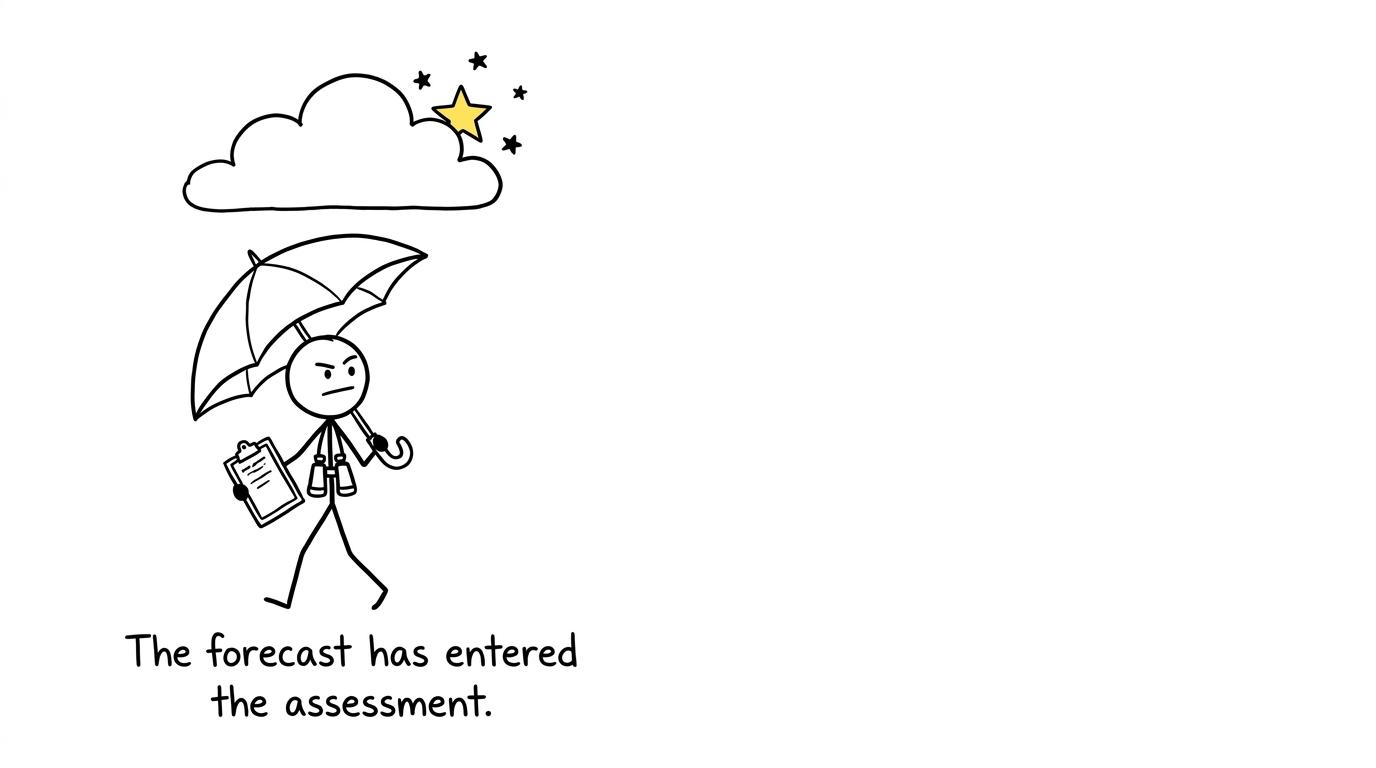 An astronomy student prepares for a tiny cloud with an enormous umbrella
What maths is needed for GCSE Astronomy?
Astronomy is a science GCSE with a meaningful mathematical component. Students should be comfortable selecting information, substituting into formulae, rearranging equations, interpreting graphs and working with very large or very small quantities.
Useful GCSE Maths areas include:
- standard form and powers of 101010
- ratios and proportional reasoning
- angles and scale diagrams
- graphs and gradients
- trigonometry
- units, conversions and significant figures
- averages and the interpretation of observational data
For astronomical distances, values are often written as
a×10n,1≤a<10.a \times 10^n, \qquad 1 \leq a < 10.a×10n,1≤a<10.That makes standard form revision and practice particularly useful. Trigonometric reasoning can support work involving angles, scale and position, so students can also strengthen their foundations through MathsGenie's GCSE trigonometry revision.
The goal is not to learn unrelated maths for its own sake. It is to remove the small calculation errors that can hide otherwise sound astronomical understanding.
Planning preparation alongside GCSE Maths
Once the entry and observations are secure, divide preparation into three strands: specification knowledge, observational understanding and examination technique.
Read the complete Astronomy specification and track every topic. Learn how observations are designed and evaluated rather than memorising polished conclusions. Then use official Astronomy papers from Pearson to understand the subject's command words, calculation style and extended responses.
For the supporting maths, use a repeatable routine:
- learn or revisit one skill through a MathsGenie revision lesson
- answer targeted practice questions
- check the mark scheme or video solution
- record the precise reason for each lost mark
- retest the skill several days later
MathsGenie's guide to the best order for learning GCSE maths topics can help if algebra, graphs or geometry need rebuilding. Students preparing several subjects may also benefit from a realistic one-month GCSE maths revision plan.
Use GCSE maths past papers to build calculation accuracy and stamina. Near the maths examinations, GCSE predicted papers can provide fresh practice, but they should supplement rather than replace official past papers.
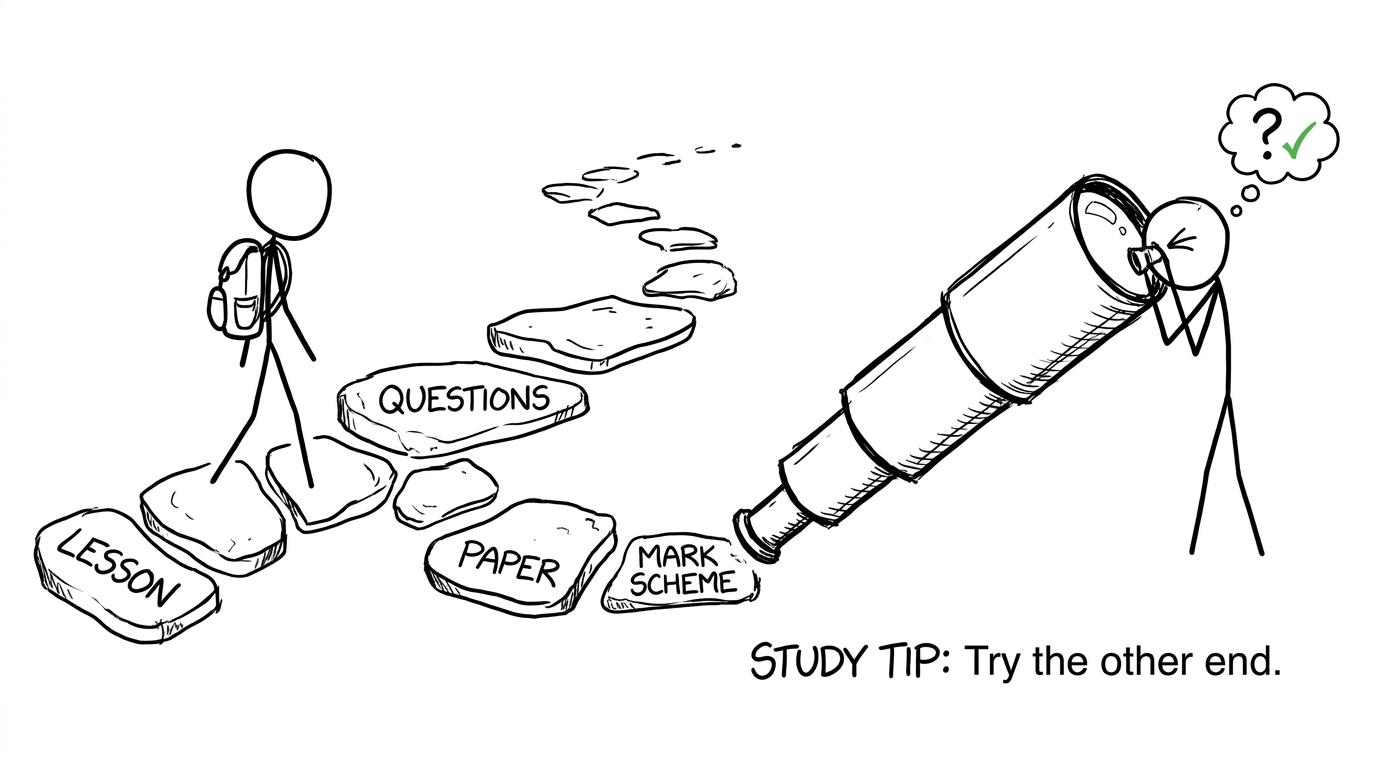 A student follows revision stepping stones while a telescope looks the wrong way
Access arrangements for private candidates
Candidates who may need extra time, supervised rest breaks, a reader, a word processor or another arrangement should tell prospective centres in the first enquiry.
The centre is responsible for processing and implementing approved arrangements. It may need evidence, an assessment and time to establish the candidate's normal way of working. An arrangement previously granted elsewhere should not simply be assumed to transfer automatically.
This is another reason to find a centre early. Leaving the conversation until the examination timetable arrives can be too late for the necessary process.
Common mistakes to avoid
Assuming any private-candidate centre offers Astronomy
A centre accepting GCSE entries may not accept specification 1AS0 or manage its observation requirement. Obtain explicit written confirmation.
Treating the observations as optional coursework
They do not contribute a separate coursework mark, but they remain compulsory. The centre must submit an Observation Statement.
Working towards Pearson's deadline instead of the centre's
Centres set their own registration and payment dates. These can be considerably earlier than the awarding-body deadline.
Completing observations without agreeing the evidence
Ask the centre how it will verify completion before finalising the activities. Keep dated, organised records throughout.
Revising astronomy while ignoring the calculations
Knowing the science is not enough if standard form, graphs, units or formulae cause lost marks. Use targeted MathsGenie GCSE revision to repair these skills before beginning full papers.
A clear route from curiosity to the examination room
A home-schooled student can sit GCSE Astronomy, but the administrative work deserves the same early attention as the academic work. Confirm specification 1AS0, find an approved centre, agree how observations will be evidenced, register before the centre's deadline and check the statement of entry.
Then the focus can return to where it belongs: understanding the sky and communicating that understanding accurately.
Alongside the official Astronomy specification and papers, make MathsGenie your free base for the supporting mathematics. Use revision lessons to rebuild methods, practice questions and mini tests to develop accuracy, and mark schemes, video solutions, past papers and predicted papers to make examination conditions familiar. Secure the centre first. Then build the skills, one honest revision session at a time.