Have I Revised Enough for GCSE Further Maths?
Have I revised enough GCSE Further Maths? Use timed papers, topic checks and an error log to judge readiness through evidence, not exam-season anxiety.
There is a peculiar moment in revision when doing more no longer makes you feel better. Your notes are full. Your desk is crowded. Yet the question remains: have I revised enough GCSE Further Maths?
The realistic answer does not come from counting hours or waiting to feel completely confident. You have revised enough when several pieces of evidence agree: you have covered your specification, can retrieve methods without prompts, perform consistently on unseen questions, work within the correct time and repair mistakes when they reappear.
Anxiety asks, “Could the exam contain something difficult?” It probably will. Readiness asks a better question: “Can I collect the marks available to me, even when a question feels unfamiliar?”
The quick readiness checklist
You are approaching exam readiness when you can honestly say:
- I know exactly which qualification and specification I am taking.
- Every specification area has been learnt and tested at least once.
- I can begin most standard questions without notes or examples.
- I have completed more than one unseen paper or substantial mixed set.
- My marks are reasonably consistent rather than dependent on familiar questions.
- I can finish, or sensibly manage, work under the correct time limit.
- I use mark schemes to identify lost method marks as well as wrong answers.
- Previously weak topics improve when I retest them later.
- My mistakes are increasingly slips or difficult extensions, not whole missing topics.
- I know the small number of weaknesses that deserve my remaining time.
This is not an official exam-board test or a promise of a particular grade. It is a practical standard for deciding whether more revision is still productive.
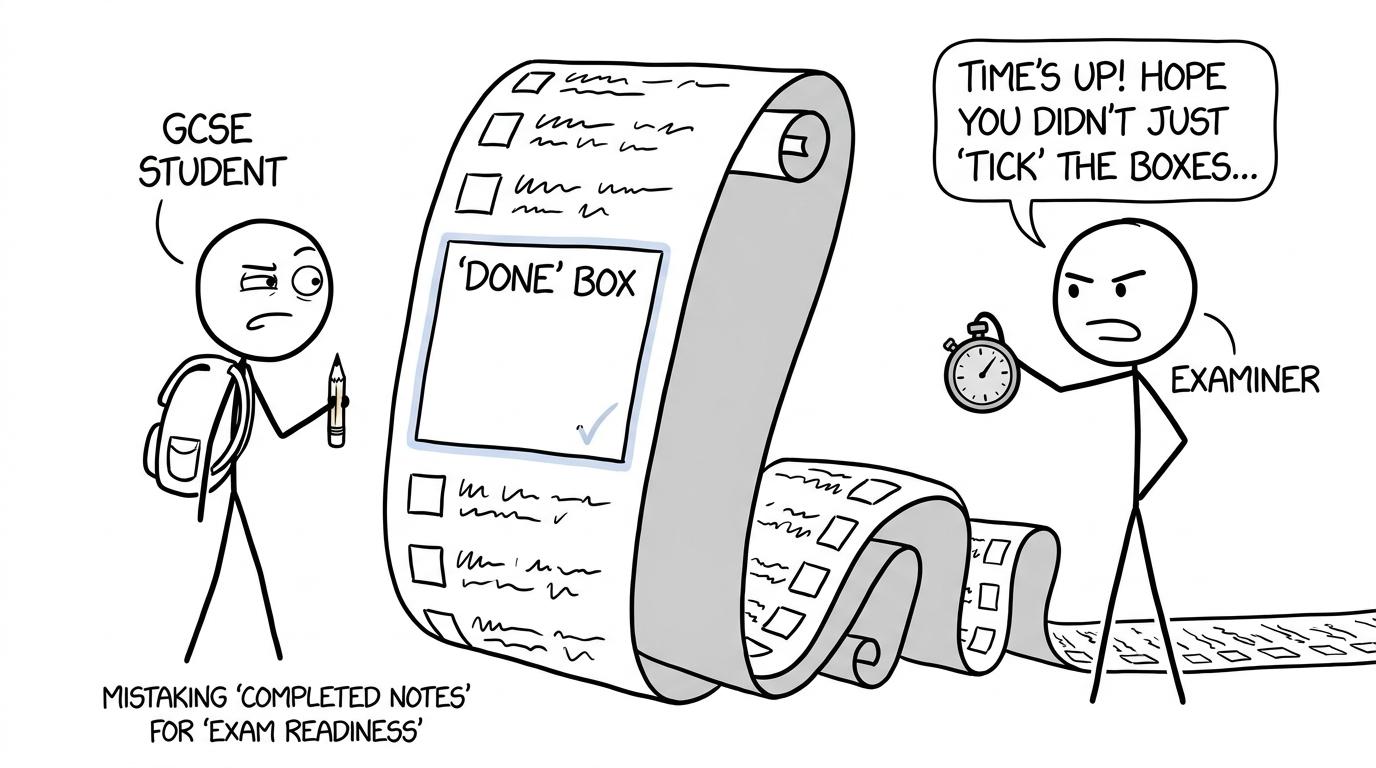 A student discovers that ticking a revision box is not the same as being exam-ready
First, confirm what “GCSE Further Maths” means for you
Schools use “Further Maths” and “Additional Maths” for several qualifications. They are not interchangeable. Before judging your readiness, check the qualification title, exam board, specification code, paper structure and calculator rules with your teacher or exam-entry information.
A common route is the AQA Level 2 Certificate in Further Mathematics, specification 836583658365. AQA describes it as an additional, untiered qualification for learners expected to achieve grades 777 to 999 in GCSE Mathematics. It extends algebra and geometry while introducing areas including calculus and matrix transformations. Its current assessment structure has two papers: one non-calculator paper and one calculator paper, each lasting 111 hour 454545 minutes and worth 808080 marks.
OCR’s Level 3 FSMQ Additional Mathematics is a different qualification, with different content and assessment arrangements. Other schools may use another course. Do not build your checklist from a friend’s specification simply because both courses are casually called Further Maths.
If you take AQA, begin with the AQA GCSE Further Maths revision hub, where lessons, questions, papers and mark schemes are organised around the course. Keep ordinary Higher GCSE skills secure too, using the GCSE Maths revision hub when a Further Maths error is really a weakness in algebra, surds, graphs or trigonometry.
Measure coverage, not pages of notes
Revision can look complete while remaining untested. Reading every chapter once proves that your eyes reached the final page. It does not prove that you can choose and carry out a method independently.
For AQA Level 2 Further Mathematics, your audit should cover the official content areas:
- number;
- algebra;
- coordinate geometry in two dimensions;
- calculus;
- matrix transformations;
- geometry.
Break these broad headings into the exact skills listed in your specification. A label such as “algebra done” is too vague. You need to distinguish between skills such as manipulating expressions, working with functions, solving equations and reasoning with polynomial relationships.
Give each skill one of three evidence-based labels:
- Secure: I can answer unfamiliar exam-style questions without notes.
- Developing: I understand the method but still need prompts or make repeated errors.
- Untested: I have only read, watched or copied the method.
“Untested” is not the same as “bad”. It simply tells you what to do next. The MathsGenie revision planner can turn those developing and untested areas into scheduled sessions instead of leaving them as a worrying mental list.
Use independent retrieval as the first real test
Recognition is generous. A method can appear obvious when it is already written in front of you. Exams remove that support.
For each topic, close your notes and ask whether you can:
- identify the relevant method from the wording;
- write a sensible first mathematical step;
- complete the process accurately;
- explain why the method applies;
- check whether the result is reasonable.
Further Maths particularly rewards connections. A coordinate-geometry problem may require confident algebra. A calculus question may depend on manipulating powers correctly. A matrix transformation still requires careful interpretation of geometry. Knowing each method in isolation is therefore only the beginning.
Use short, closed-book question sets first. Then return to the topic after a gap and try different questions. A method that survives delayed retrieval is more secure than one repeated immediately after a lesson. The guidance in Stop Forgetting GCSE Maths Content explains how retrieval, spacing and exam questions can work together.
Let unseen papers answer the question
Topic practice asks, “Can I use this method when I know the topic?” A paper asks, “Can I recognise the method when nobody tells me what chapter this is?”
That difference matters.
Use papers matching your actual qualification and current specification. Sit them without notes, hints, messages or pauses. Follow the stated calculator rules and time limit. If your course includes calculator and non-calculator assessment, test both forms rather than assuming strength in one transfers automatically to the other.
One strong score is encouraging but not decisive. It may reflect familiar questions or topics that happened to suit you. Several unseen attempts provide better evidence. Look for a stable range of marks and, more importantly, stable behaviour:
- Do you start questions more reliably?
- Are fewer marks lost through unfinished working?
- Can you move on when stuck and return later?
- Are the same topics repeatedly responsible for lost marks?
- Does your accuracy survive the final part of the paper?
Do not treat an old grade boundary as a permanent target. Grade boundaries can vary between exam series because they are set after papers have been taken. Use official boundaries only for the relevant series, and treat raw marks primarily as a trend in your own performance.
MathsGenie’s Further Maths hub includes AQA Further Maths past-paper practice. For a disciplined attempt-mark-repair cycle, follow the approach in How to Use Past Papers Properly.
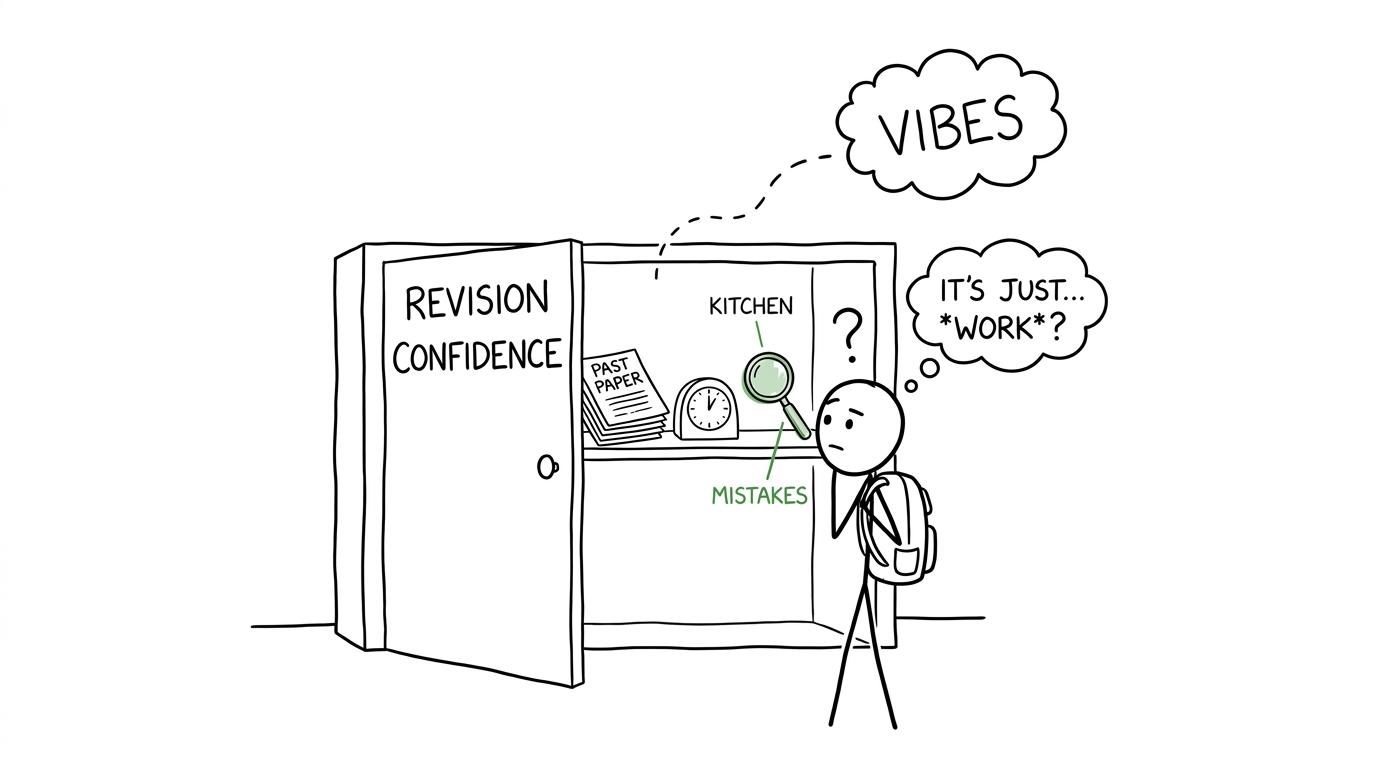 Revision confidence is built from papers, timing and mistakes rather than vibes
Track the quality of lost marks
A total mark tells you how the paper went. An error log tells you what to revise tomorrow.
For every lost mark, record the topic and classify the cause:
- Knowledge: you did not know the fact or method.
- Selection: you knew several methods but chose the wrong one.
- Execution: your plan was correct but algebra, arithmetic or signs went wrong.
- Communication: insufficient working, weak notation or an unsupported conclusion cost marks.
- Timing: you could have completed the question but did not reach it.
This classification changes the repair. A knowledge gap needs a revision lesson and focused practice. An execution error needs slower, carefully checked questions. A timing problem needs mixed work under controlled conditions.
You can monitor the proportion of available marks earned using
mark rate=marks earnedmarks available×100%.\text{mark rate} = \frac{\text{marks earned}}{\text{marks available}} \times 100\%.mark rate=marks availablemarks earned×100%.However, do not reduce readiness to one percentage. Compare the mark rate across several attempts alongside the number of recurring knowledge gaps. A rising score with the same uncorrected weakness is less reassuring than a stable score accompanied by fewer topic gaps and better timing.
After repairing a mistake, retest it on another day with a different question. If it remains fixed, the revision has worked. If it returns, it belongs back on the planner. The guide to finding your weakest GCSE topics offers a useful structure for turning lost marks into targeted practice.
Apply the three-paper readiness test
When the exam is getting close, use three substantial unseen attempts under realistic conditions. They need not all happen in one week, and this is a practical check rather than an exam-board rule.
Paper evidence
Your marks should sit within a reasonably consistent range. A sudden low result is not a disaster, but investigate whether it came from content, timing, fatigue or an unusually difficult paper.
Topic evidence
Across the attempts, you should not discover whole areas that you have never learnt. Some difficult questions will remain, but standard questions should usually offer a recognisable route.
Repair evidence
Errors identified after the first attempt should become less frequent in later work. This is the most important sign. Revision is not proved by finding weaknesses; it is proved by closing them.
If all three forms of evidence are positive, more hours may bring diminishing returns. Shift towards light retrieval, selected weak-topic practice and preserving sleep. If they are not, you still have a precise plan rather than a vague reason to panic.
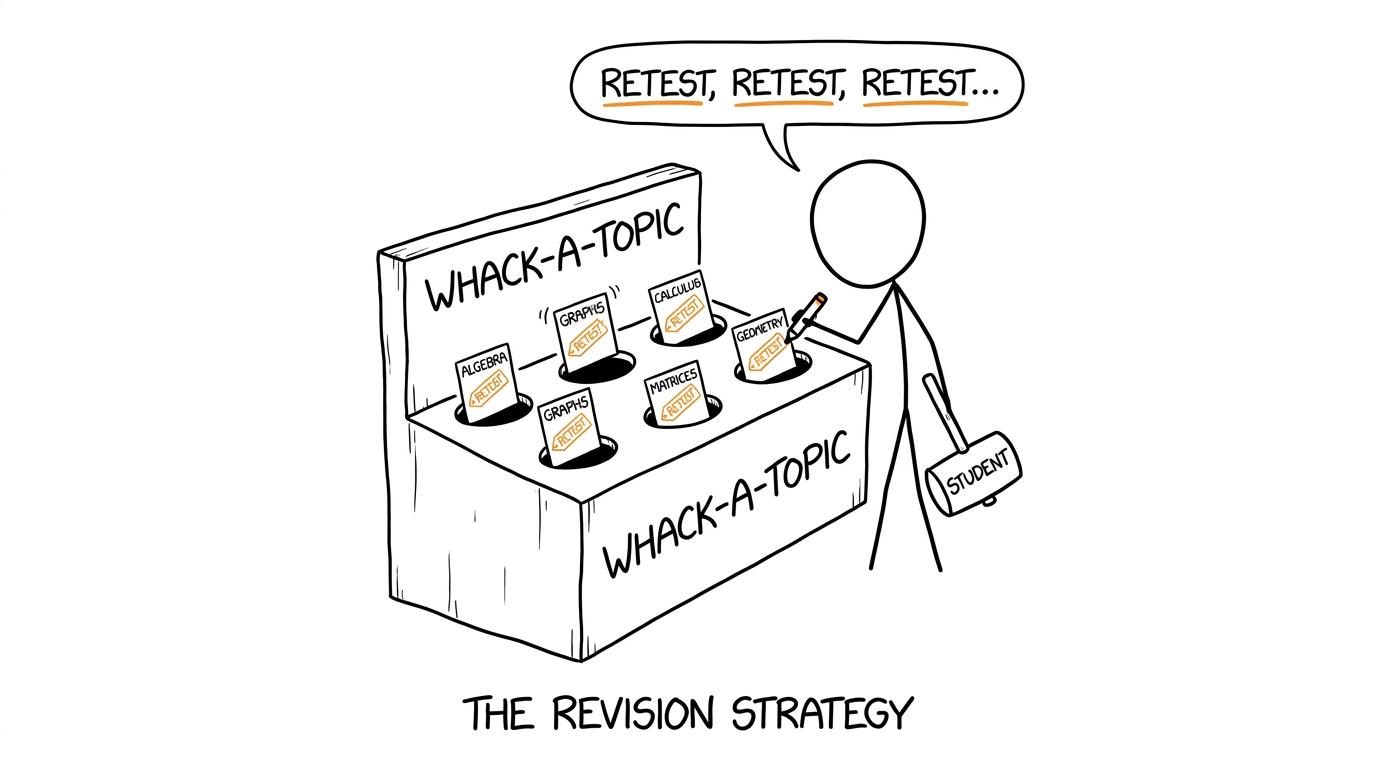 A calm student retests topics instead of playing revision whack-a-mole
Common mistakes when judging whether you have revised enough
Counting hours instead of outcomes
Three distracted hours can produce less evidence than one focused timed set followed by careful marking. Track questions attempted, weaknesses repaired and retest results.
Repeating comfortable topics
Familiar algebra can create the pleasant feeling of progress while calculus, matrices or geometry remain untouched. Let the specification and error log choose your sessions.
Marking only final answers
Further Maths questions often reward method and reasoning. Use the mark scheme line by line. Notice where valid working earns marks and where notation or justification matters.
Using papers as endless tests
Completing paper after paper without repair merely measures the same weaknesses repeatedly. The useful cycle is paper, mark, learn, practise and retest.
Depending on predicted content
Predicted papers can provide valuable unfamiliar practice, but they cannot guarantee what will appear. Every assessable specification area remains relevant. Use predictions as rehearsal, never as permission to abandon topics. MathsGenie’s discussion of predicted topics without guessing explains this distinction.
Waiting to feel fearless
You may still feel nervous when the evidence says you are prepared. That is normal. The aim is not to remove every uncertain feeling; it is to make your performance less dependent on those feelings.
Your final decision: continue, narrow or stop
After reviewing your evidence, choose one of three actions.
Continue broad revision if parts of the specification remain unlearnt or untested.
Narrow your revision if coverage is complete but a small group of topics, error types or timing problems repeatedly costs marks.
Stop heavy revision when your paper performance is stable, repaired topics stay repaired and further sessions are mostly creating fatigue. At that stage, brief recall, a few selected questions, equipment checks and proper rest are more useful than a late attempt to relearn everything.
Enough does not mean knowing that every answer will come easily. It means having covered the course, tested your knowledge honestly and built a reliable response when a question does not immediately cooperate.
Open the AQA GCSE Further Maths revision hub, choose one unseen set and let the evidence begin. Use MathsGenie’s free revision lessons and practice questions to repair gaps, then return to past papers, predicted papers, mark schemes and video solutions to confirm that the repair holds. Revision feels endless when it has no finish line. A specification audit, an error log and consistent timed evidence give it one.