Hate GCSE Geography? How to Revise When It Won't Click
Hate GCSE geography? How to revise using short sessions, active recall, case-study cards and exam practice, without sacrificing your GCSE maths time.
Sometimes the hardest subject to revise is not the most difficult one. It is the subject that makes you close the book before you have really begun.
If you have typed “hate gcse geography how to revise” into a search bar, the immediate answer is this: do not wait until you feel motivated. Make the first task so small and specific that you can start without motivation. Then use active recall, exam questions and quick feedback instead of spending hours rereading notes.
You do not need to fall in love with geography. You need a system that helps you collect marks while leaving enough time and energy for GCSE maths and your other subjects.
Your quick geography revision checklist
When the subject is not clicking, keep the plan deliberately simple:
- Check your exam board and specification.
- Divide the course into small topics, case studies and skills.
- Choose one precise task for each session.
- Recall information before looking at your notes.
- Practise real question styles and command words.
- Mark your answer and record one improvement.
- Revisit weak material after a gap.
- Keep geography inside a balanced revision timetable.
The same principles support effective maths revision. MathsGenie's GCSE maths revision hub organises lessons, questions and papers by exam board, helping you move from learning to practice without wasting time deciding what to open.
Stop trying to make yourself like the whole subject
Disliking geography can feel like one large problem, but it is usually a collection of smaller frustrations. You may dislike memorising case studies, writing extended answers, interpreting unfamiliar resources or remembering fieldwork methods. Those are different problems and need different solutions.
Write down the parts you resist most. Be precise. “Geography is awful” gives you nothing to act on. “I cannot remember evidence for the urban case study” gives you a revision target.
This is similar to diagnosing weak areas in maths. A student rarely struggles with every part of algebra; the real difficulty might be expanding brackets or rearranging formulae. The process in MathsGenie's guide to finding your weakest GCSE topics can be adapted directly: gather evidence, label the weakness and practise the smallest skill that could fix it.
Motivation often becomes easier after the task becomes clear. A named problem feels finite. A whole hated subject does not.
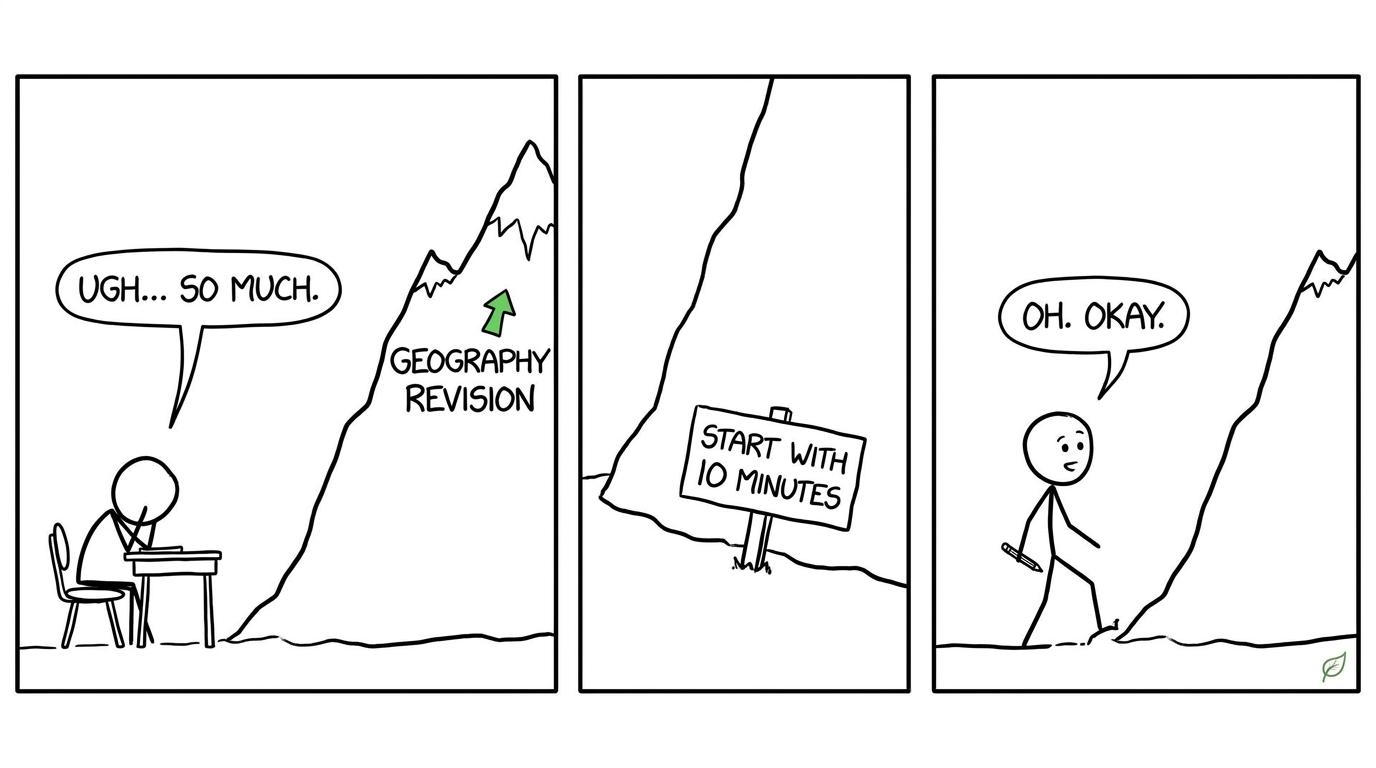 A student taking one small step towards the geography revision mountain
Make revision too small to avoid
A plan such as “revise geography tonight” creates too many decisions. Where do you begin? How long should you work? What counts as finished?
Replace it with a closed task:
- Recall five facts about one case study.
- Label one process diagram from memory.
- Answer one extended-response question.
- Review one fieldwork method and its limitations.
- Mark one answer and improve its conclusion.
A short completed task is more useful than an ambitious session that never starts. If starting is your main obstacle, borrow the structure from the twenty-minute GCSE revision routine: set up quickly, retrieve what you know, complete an exam-style task and finish with feedback.
On a particularly difficult day, set a minimum that feels almost unimpressive. Open the correct page, put your phone away and work until the timer ends. You may continue, but you do not have to. The purpose of the minimum is to remove the argument you have with yourself before starting.
Revise actively instead of making geography look tidy
Highlighting, copying and rereading can feel safe because they do not expose what you have forgotten. Unfortunately, recognising a fact on a page is not the same as retrieving it in an exam.
Government teaching guidance and Education Endowment Foundation material support regular retrieval, purposeful practice, spacing and feedback. The important point is not that one revision technique solves everything. It is that memory improves when you repeatedly attempt to recall material, check it and return to it later.
Use a recall-first routine
For each small topic:
- Close your notes.
- Write or say everything you can remember.
- Check against your class materials or specification.
- Add missing details in another colour.
- Test yourself again on a different day.
This routine works well for definitions, processes, locations, examples and case-study evidence. Flashcards can help, but only if you answer before turning the card over. Simply reading both sides is still passive.
MathsGenie's guide to stopping yourself forgetting GCSE content explains the same learn, retrieve, space and test cycle for maths. The subject changes; the memory problem does not.
Build compact case-study cards
Do not copy every page your teacher gave you. Give each case study a limited structure:
- location and context;
- causes or processes;
- social, economic and environmental effects;
- responses or management;
- a small selection of accurate supporting details;
- one judgement about effectiveness or significance.
Use the examples required by your own course rather than downloading a random list. AQA, Edexcel, OCR and Eduqas specifications are not interchangeable, and schools may teach different permitted case studies.
Your goal is flexible knowledge. You should be able to use the same case study to answer more than one possible question, rather than memorising a paragraph that only fits one wording.
Learn what geography questions are asking
GCSE Geography is not assessed through factual recall alone. Across regulated specifications, students also apply understanding, interpret information, analyse issues, make judgements and use geographical skills. Fieldwork and unfamiliar resources therefore deserve revision time alongside named examples.
Command words tell you what kind of response is required. The exact wording and mark tariffs vary by exam board, so use your board's specification, past papers and mark schemes. In general:
- Describe asks for relevant characteristics or patterns.
- Explain requires reasons, processes or developed links.
- Compare requires direct similarities or differences between both items.
- Assess or evaluate requires evidence and a supported judgement.
- Calculate requires a numerical result, normally with suitable working.
Practise identifying the command word before writing. Then look at the marks available and plan a response of suitable depth. A long answer does not automatically become a strong answer; relevance, development, evidence and judgement matter more.
After marking, write one correction that can change your next response. “Do better” is useless. “Use evidence from the resource before giving my judgement” is actionable.
Balance geography with GCSE maths revision
When you dislike one subject, it can distort your timetable in two opposite ways. You may avoid it completely, or give it an enormous block because guilt has built up. Neither approach is especially sustainable.
A better timetable gives geography regular, contained sessions and protects separate time for maths. The GCSE maths revision timetable guide shows how to prioritise weaknesses, revisit topics and leave room for school and rest. Apply the same planning logic across your subjects.
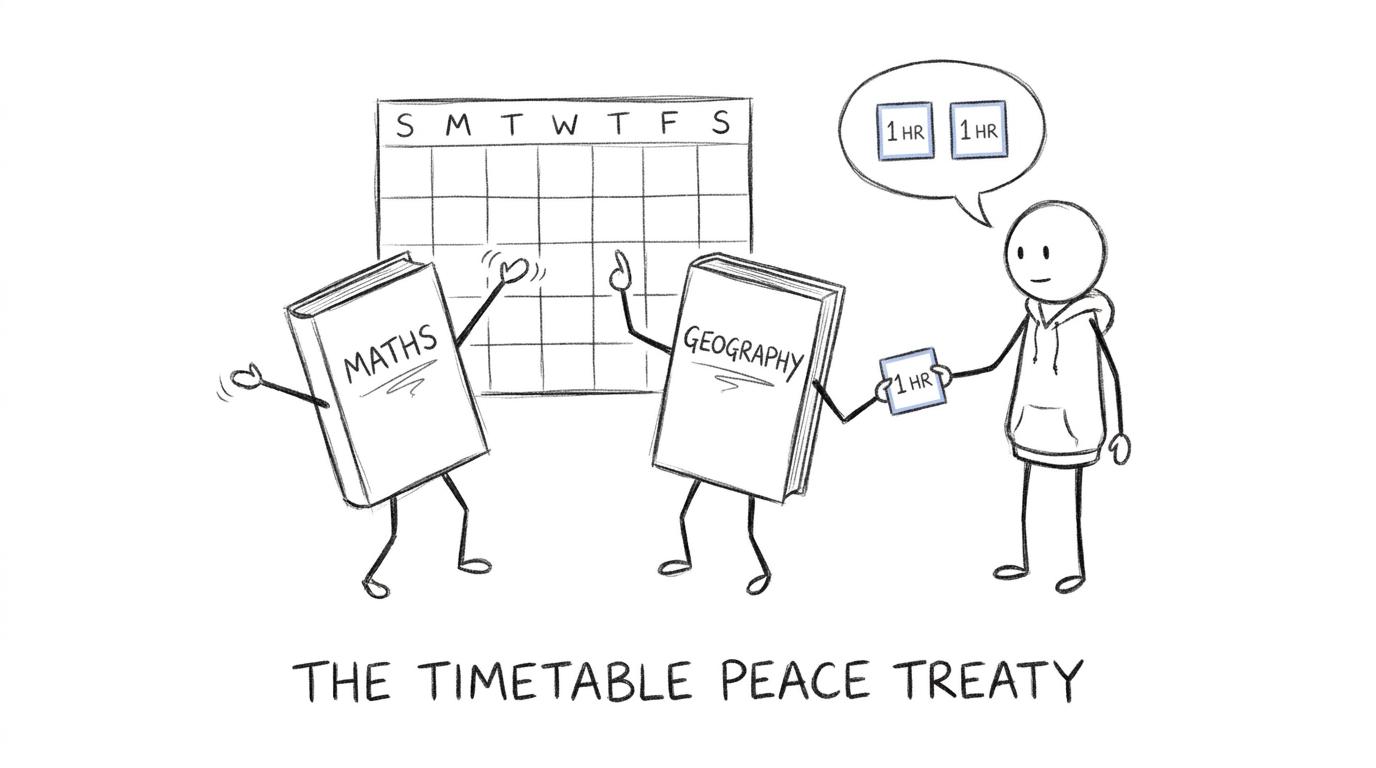 Maths and geography agree to a timetable peace treaty
Try pairing subjects by energy rather than punishment. A short geography recall session could be followed by focused maths questions, but geography should not become the price you must pay before doing a subject you prefer. Both sessions need a clear purpose.
If exams are close, use the structure in MathsGenie's one-month GCSE revision plan: diagnose weaknesses, practise actively, revisit material and gradually introduce timed work. Use a revision planner to see the whole week rather than making decisions based on that evening's mood.
Use past papers without turning them into punishment
Do not begin with a full paper if you currently struggle to complete ten minutes of geography. Start with individual questions or one section. Build stamina gradually.
Use this loop:
- Choose a question matching your exam board.
- Answer it without notes.
- Mark it using the official mark scheme or teacher guidance.
- Identify whether the problem was knowledge, application, structure or timing.
- Repair that specific weakness.
- Attempt another relevant question later.
Past papers are diagnostic tools, not verdicts on your ability. MathsGenie's guide to using GCSE past papers properly makes an important distinction: much of the improvement happens after the paper, when mistakes are marked, repaired and retested.
Keep a simple error log for both subjects. In geography, entries might concern vague evidence, a missed command word or an unsupported conclusion. In maths, they might identify a missing method or calculator slip. If you take Edexcel maths, the free Edexcel GCSE Maths past papers include official mark schemes and worked solutions where available.
Common mistakes when revising a subject you hate
Waiting for the right mood
The right mood may never arrive. Decide the time, place and first tiny action in advance. Starting is a practical step, not an emotional test.
Revising favourite topics repeatedly
Comfort creates the impression of progress. Use questions, teacher feedback and your specification to find the content that is actually costing you marks.
Making beautiful notes without testing yourself
Notes can organise information, but they do not prove that you can retrieve or apply it. Every note-making session should lead to recall or question practice.
Memorising case studies as fixed essays
Exam questions may ask you to use knowledge in unfamiliar ways. Learn adaptable evidence and causal links rather than one rehearsed paragraph.
Ignoring fieldwork and geographical skills
Official GCSE Geography requirements include fieldwork outside the classroom and school grounds on at least two occasions. Revise your enquiries, methods, results, limitations and possible improvements, alongside maps, graphs, data and unfamiliar resources.
Letting geography consume your maths time
A difficult subject needs consistency, not ownership of the entire timetable. Protect regular maths sessions for lessons, practice questions, mini tests and papers.
You do not need enthusiasm to make progress
Hating GCSE Geography does not prevent you from revising it effectively. Shrink the task, retrieve before rereading, practise the questions your exam board sets and use feedback to choose the next session. Your aim is not to transform your personality. It is to make the subject manageable enough that avoidance stops deciding for you.
Then bring the same disciplined rhythm back to maths. Start with the free MathsGenie GCSE hub, use revision lessons to rebuild weak methods, practise with exam questions and mini tests, and develop exam confidence through past papers, predicted papers, mark schemes and video solutions.
Choose one small geography task and one small maths task today. Completion creates the evidence that you can begin again tomorrow.