

Hate GCSE Further Maths? How to Revise It
Hate GCSE Further Maths? How to revise with short sessions, targeted questions, honest marking and a realistic plan that works on difficult days.
Some revision advice assumes you already want to begin. That is not much help when opening a Further Maths book feels like negotiating with a wall.
If you have searched “hate GCSE Further Maths how to revise”, the practical answer is this: make each session short, specific and measurable. Learn one method, attempt a few questions, mark them honestly and stop at the planned time. You do not need to enjoy the subject before you can improve at it. Often, motivation arrives after a little progress rather than before it.
This guide will help you build that progress without pretending Further Maths is suddenly your favourite subject.
Your Further Maths survival checklist
Use this as your default plan:
- Confirm the exact qualification and specification you are taking.
- Choose one small topic rather than saying, “I will revise Further Maths.”
- Set a minimum session of just ten or twenty minutes.
- Attempt questions without looking at the solution first.
- Mark immediately and record why each mark was lost.
- Return to the same skill after a gap.
- Introduce timed papers only after some topic repair.
- Ask for help when you cannot identify the next step.
MathsGenie brings the main parts of this cycle together. The AQA GCSE Further Maths revision hub contains revision materials, questions and papers so that less energy is wasted deciding where to start.
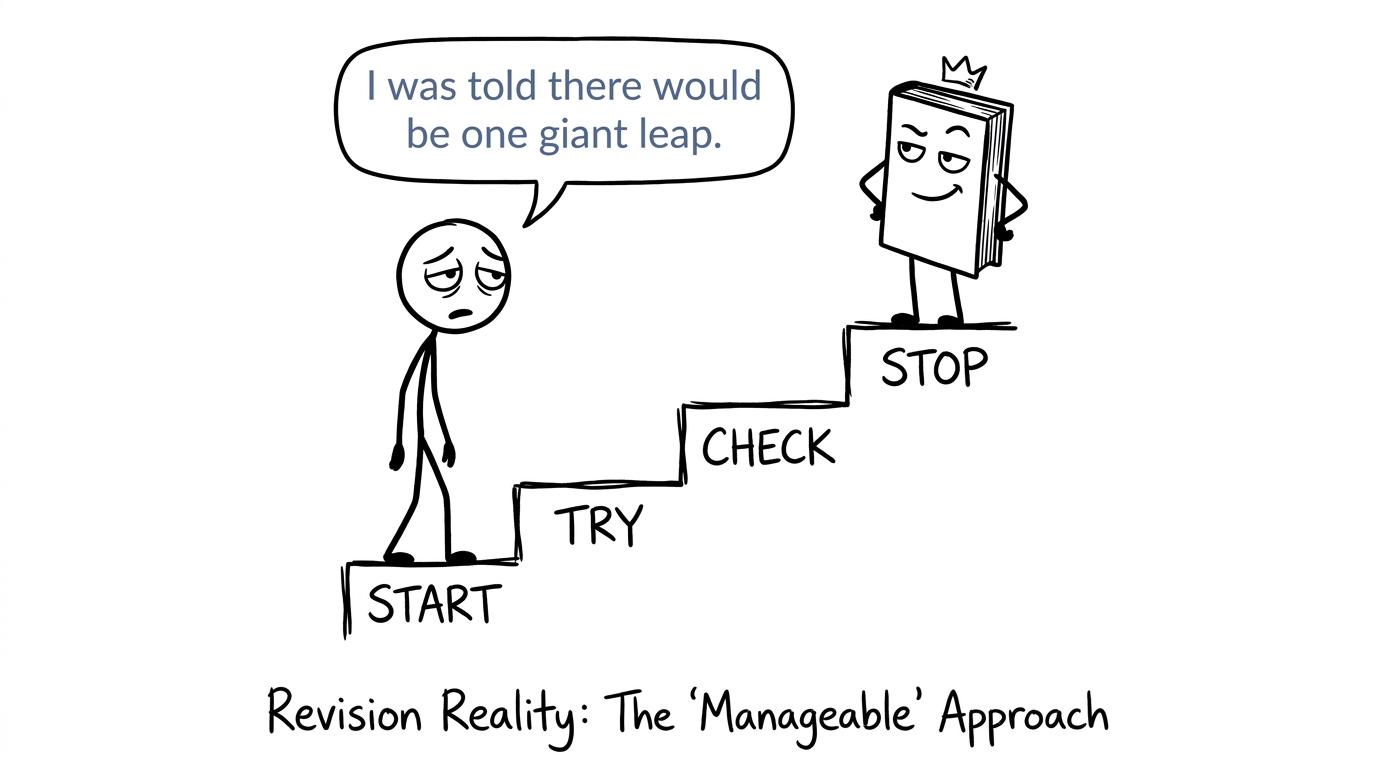 A student choosing small revision steps instead of one giant leap
First, identify what you actually hate
“I hate Further Maths” may be true, but it is not yet a useful diagnosis. The feeling can have several causes:
- the notation looks unfamiliar;
- ordinary GCSE algebra is not secure enough;
- lessons move too quickly;
- questions feel impossible to start;
- mistakes seem to appear from nowhere;
- the qualification feels less urgent than your other GCSEs;
- you associate revision with long, exhausting sessions.
Each cause needs a different response. If algebraic manipulation is the problem, repair that foundation. If starting questions is the problem, practise identifying the topic and writing a first step. If exhaustion is the problem, make the session shorter rather than making another ambitious timetable you will avoid.
A useful sentence to complete is: “Further Maths becomes difficult for me when…” Be precise. “When I have to manipulate algebraic fractions” gives you somewhere to go. “When there are letters” does not.
You can compare your underlying knowledge with the GCSE Maths topics organised by exam board and tier. Further Maths often feels unbearable when a Higher GCSE skill underneath it is still uncertain.
Check which Further Maths qualification you take
“GCSE Further Maths” is often used as a convenient general name, but schools can enter students for different qualifications. You must revise the specification printed on your course information or confirmed by your teacher.
For example, AQA’s Level 2 Certificate in Further Mathematics is an additional qualification rather than a replacement for GCSE Maths. Its content includes number, algebra, coordinate geometry, calculus, matrix transformations and geometry. The assessment consists of a non-calculator paper and a calculator paper, with content from across the specification available on either paper.
OCR’s FSMQ Additional Mathematics is different. It is a Level 3 qualification with its own content and assessment structure, including areas such as algebra, calculus, trigonometry, numerical methods, enumeration, and exponentials and logarithms.
Do not revise from a generic online topic list and assume it matches your paper. Check the exam board, qualification title and specification code. Edexcel, AQA, OCR and Eduqas resources for ordinary GCSE Maths are not interchangeable with a Further Maths or Additional Maths course simply because some topics overlap.
Stop waiting to feel motivated
Motivation is unreliable because it asks you to predict how work will feel before you begin. Difficult maths usually looks worst from the outside.
Instead, create a starting rule. For example:
At the agreed time, I will open one topic, put my phone away and attempt questions for ten minutes.
Ten minutes may sound insignificant. That is why it works. The aim is to reduce the emotional cost of beginning. Once started, you can continue if your concentration is good, but the minimum still counts on a difficult day.
The 20-minute GCSE maths revision routine can be adapted for Further Maths: brief recall, focused questions, immediate marking and one written target for the next session.
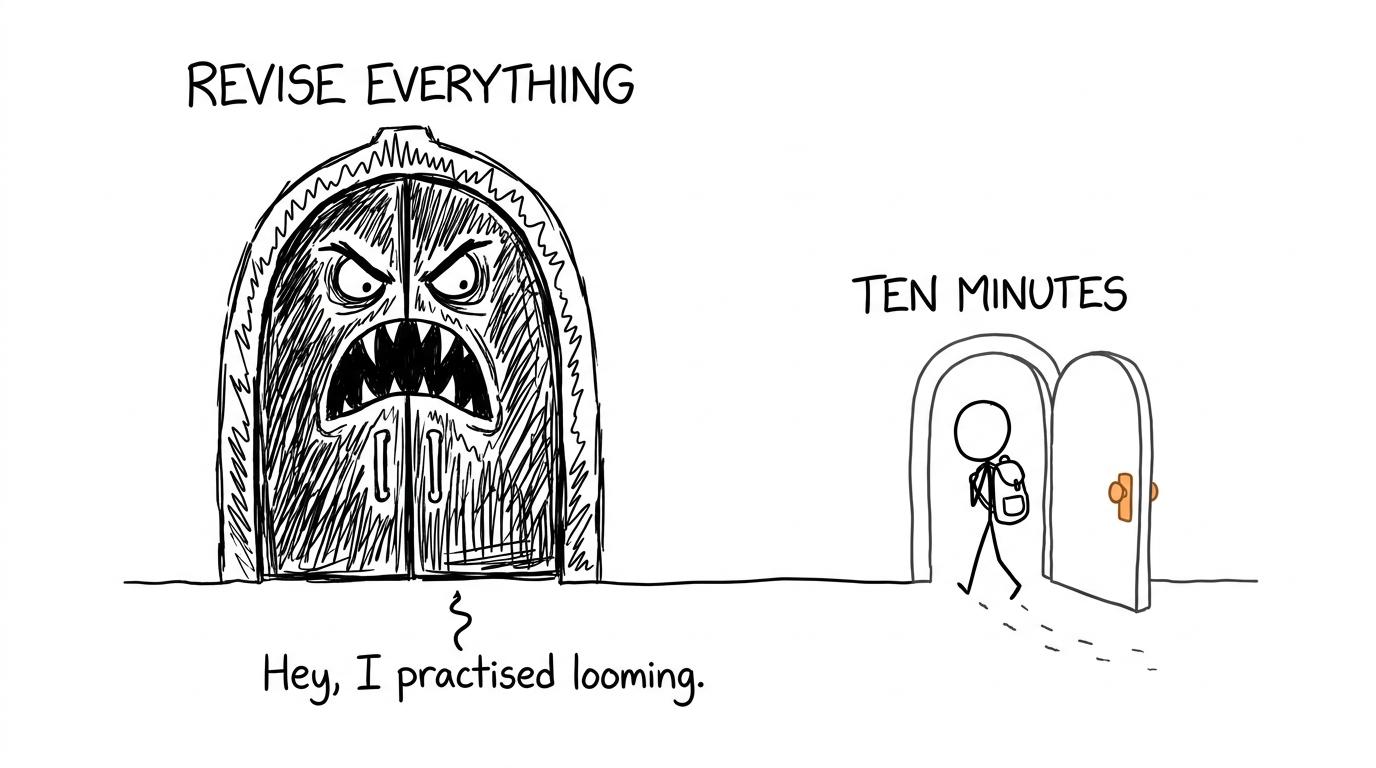 A student choosing the friendly ten-minute revision door
Revise one micro-topic at a time
“Calculus” is too broad for one reluctant revision session. “Differentiating terms involving powers” is manageable. “Algebra” is enormous. “Using the factor theorem to test a possible factor” is specific.
Depending on your specification, useful micro-topics might include:
- simplifying surds;
- manipulating algebraic fractions;
- composite and inverse functions;
- polynomial division;
- the factor theorem;
- equations of circles and tangents;
- differentiation of powers;
- stationary points;
- basic integration;
- 2×22 \times 22×2 matrix transformations;
- trigonometric identities.
This is not a universal specification checklist. It shows the right level of detail for a session. Your exam board’s specification remains the final authority.
If you are unsure which micro-topic deserves attention, use a short diagnostic set and record the marks lost. MathsGenie’s guide to finding your weakest GCSE topics explains how to turn marked work into a practical priority list.
Use a revision loop that produces evidence
A strong Further Maths session has four stages.
Learn the smallest necessary idea
Use a concise revision lesson or video solution. Do not spend the entire session watching explanations. The purpose of an explanation is to prepare you to attempt something independently.
Attempt questions from memory
Close the notes and try the questions. This matters because recognising a method on a screen is not the same as retrieving and applying it yourself.
Research into retrieval practice supports making an active attempt to remember, followed by feedback. Re-reading may feel smoother, but smoothness can hide uncertainty.
Mark immediately
Use the mark scheme while your reasoning is still fresh. Distinguish between:
- a knowledge gap;
- an algebra or arithmetic error;
- a misread instruction;
- missing working;
- an answer that was not given in the required form.
A mark scheme is not simply a final judgement. It shows where your method stopped earning marks.
Re-test after a gap
Return to the same skill with different questions. Metacognitive revision means planning, monitoring and evaluating your learning rather than assuming time spent equals progress. The question is not “Did I revise this?” but “Can I now do it without support?”
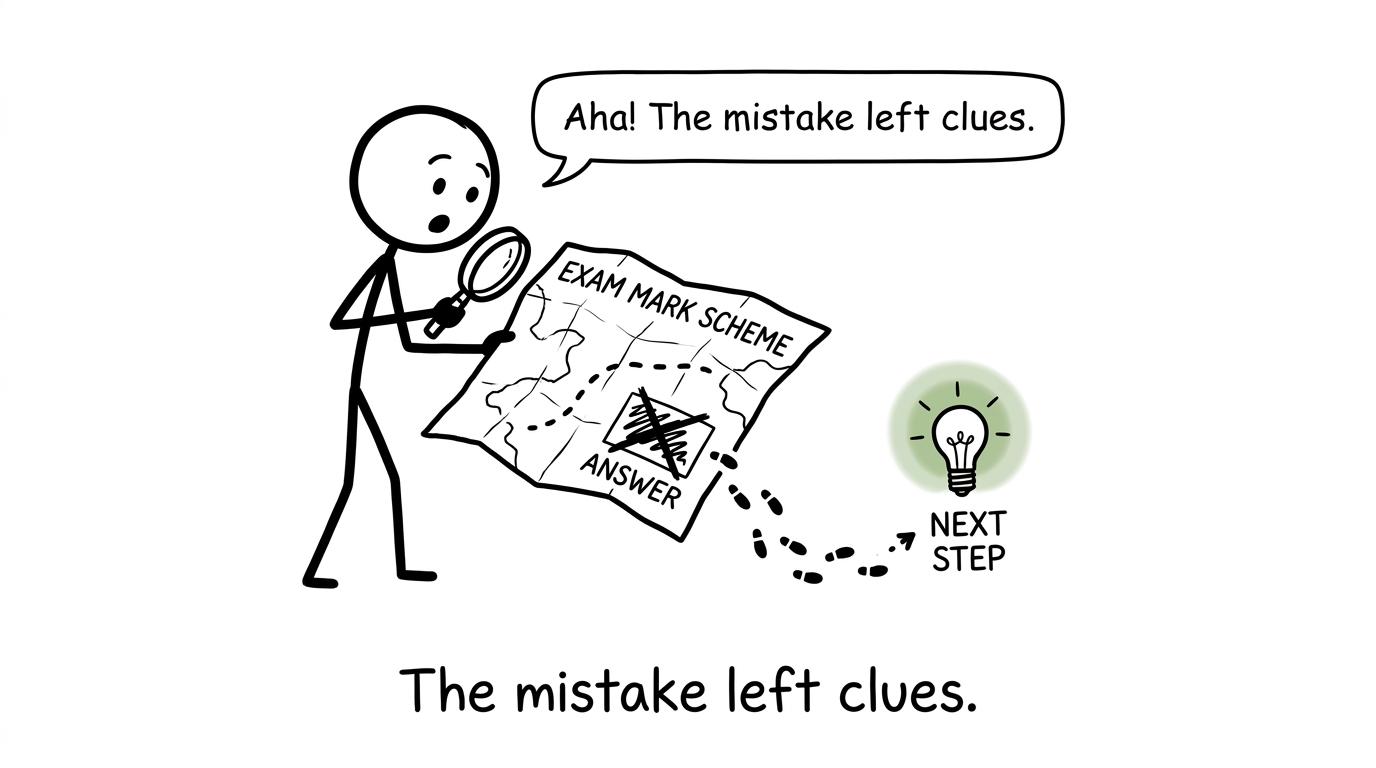 A mark scheme acting as a detective map for a mistake
Build a routine for days when you still hate it
A routine should survive low motivation. Try this weekly rhythm:
- Monday: learn one micro-topic and attempt a short question set;
- Tuesday: revisit Monday’s topic without notes;
- Wednesday: repair one Higher GCSE skill underneath it;
- Thursday: study a second Further Maths micro-topic;
- Friday: complete a mixed mini test or several mixed questions;
- Weekend: mark, redo errors and choose next week’s priorities.
A full revision plan can include other subjects while keeping the same simple rhythm. The one-month GCSE maths revision plan offers a useful framework for balancing focused topic work with paper practice.
Do not measure success only by hours. A session in which you identify and correct two recurring errors may be more valuable than an unfocused evening of copying notes.
Use past papers at the right time
Starting with a complete Further Maths paper can confirm every fear you already have. If several topics are unfamiliar, the score tells you little beyond “there are gaps”. Begin with topic questions and shorter timed sections.
Move towards full papers when you can attempt most of the content. Then use them to practise:
- choosing an opening method;
- showing enough working;
- moving on when stuck;
- managing calculator and non-calculator demands;
- checking exact values and required forms;
- maintaining concentration across the paper.
The guide to when you should start GCSE past papers explains how paper practice can progress from diagnosis to full exam conditions. When appropriate, shorter resources such as GCSE Maths mini tests can also help rebuild prerequisite skills without the burden of a complete paper.
Protect your concentration rather than punishing yourself
Hating a subject can tempt you into two extremes: avoiding it completely or forcing yourself through an exhausting session. Neither is efficient.
Use a realistic schedule, take regular short breaks and keep some physical activity in your day. NHS exam guidance also recommends manageable revision chunks, past-paper practice, breaks and asking someone you trust for support when stress becomes difficult.
Sleep is not time stolen from revision. Tiredness makes demanding algebra and multi-step reasoning harder to manage. Set a finishing time, put your materials ready for tomorrow and stop. Consistency beats a late-night rescue mission followed by two days of avoidance.
If the problem is more than dislike, for example, you feel panicked, persistently overwhelmed or unable to cope, speak to a parent, carer, teacher, pastoral lead or another trusted adult.
Common Further Maths revision mistakes
Revising what already feels comfortable
Comfortable topics create reassuring marks in practice, but they do not repair your largest gaps. Keep some familiar questions for confidence, then spend most of the session on a specific weakness.
Watching solutions without attempting questions
A solution can look obvious once somebody else has supplied the key idea. Pause before it begins and make a genuine attempt first.
Writing “careless mistake” in your error log
That label is too vague. Record the exact event: copied a negative sign incorrectly, expanded a bracket inaccurately, rounded before the final step or failed to state a conclusion.
Attempting full papers too soon
Paper practice is valuable, but it cannot replace learning missing methods. Use topic work first, then timed sections, then complete papers.
Using resources for the wrong qualification
AQA Level 2 Further Mathematics and OCR FSMQ Additional Mathematics are not the same course. Confirm your board and specification before building a checklist.
Making the plan too ambitious
A timetable requiring enthusiasm every evening is not a plan. It is a wish. Set a minimum you can complete even when school has been tiring.
You do not have to love Further Maths to move forward
The turning point is rarely a dramatic burst of motivation. It is usually quieter: one short session completed, one mistake understood, one question that looks slightly less hostile the second time.
Start with the MathsGenie AQA Further Maths revision area if that matches your qualification. Use revision lessons to understand individual methods, practice questions to build independence, and mark schemes or video solutions to investigate errors. As the exam approaches, add mini tests, past papers and suitable predicted papers to develop timing and stamina.
You are not required to become a person who loves every topic. Your task is smaller and more realistic: open one lesson, choose one micro-topic and complete the next ten minutes properly. MathsGenie can take you from there.










