

Hate GCSE English Language? How to Revise Anyway
Hate GCSE English Language? How to revise with short, practical routines that build reading, writing and exam confidence without forced motivation.
If you have searched “hate GCSE English Language how to revise”, the honest answer is not to wait until you enjoy it. Make revision smaller, more predictable and more connected to marks. Practise one exam skill, check what worked, record one improvement and stop at the planned time.
That may sound less inspiring than suddenly discovering a love of language analysis. It is also more realistic.
For many maths-minded students, English Language feels uncomfortable because answers are not reduced to one neat result. Yet the exam is not an invitation to write anything you like. It assesses identifiable reading and writing skills. Once you treat those skills as a collection of repeatable processes, the subject can become less vague, even if it never becomes your favourite.
Your quick revision checklist
When motivation is low, use this sequence:
- Check your exam board and exact specification.
- Identify one question type that is costing you marks.
- Set a short session with a visible finishing time.
- Attempt a real question rather than rereading notes.
- Compare your response with the mark scheme and teacher guidance.
- Write down one specific change for next time.
- Revisit the skill on another day.
This resembles the learn, practise, mark and fix cycle used across the MathsGenie GCSE Maths revision hub. The content is different, but the discipline is transferable.
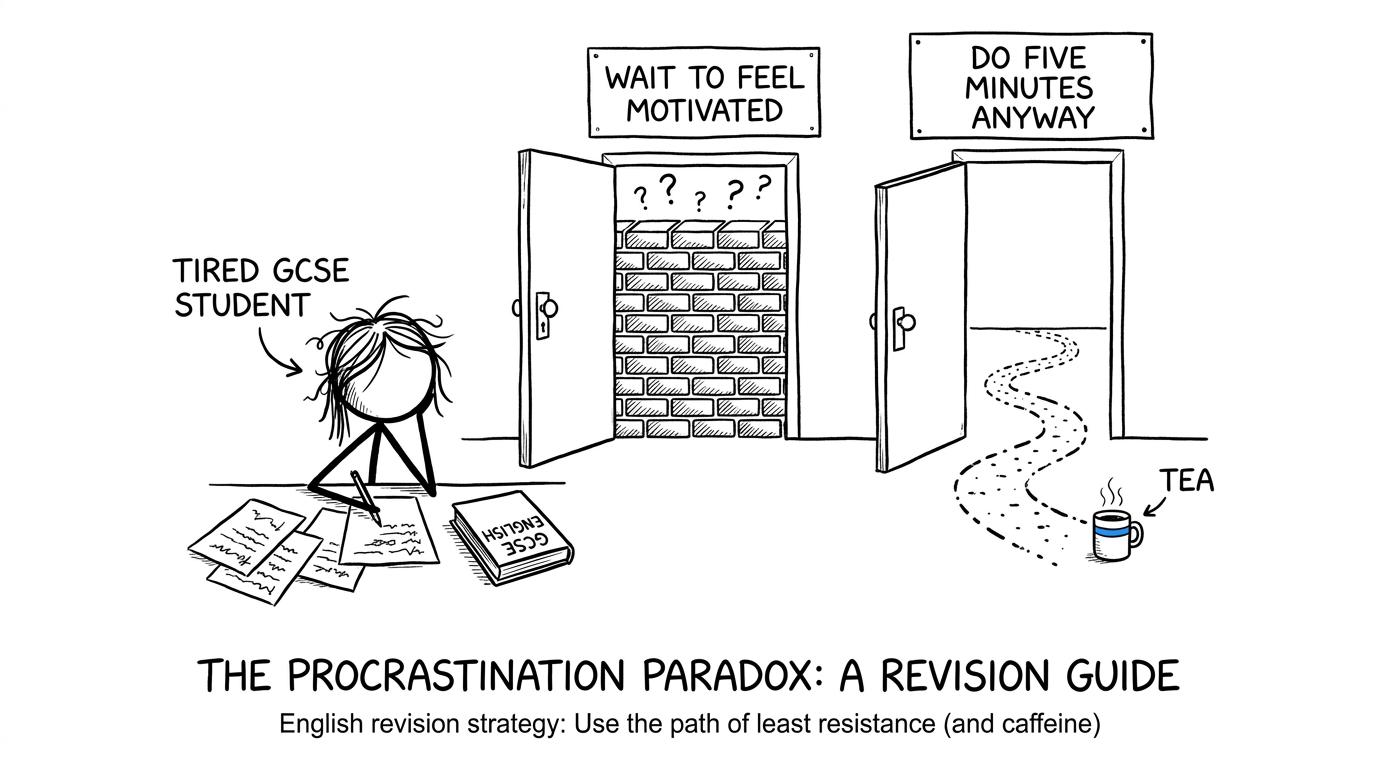 A student chooses five minutes of action instead of waiting for motivation
Stop trying to manufacture motivation
Disliking a subject creates a familiar loop. You expect revision to feel unpleasant, so you delay starting. The delay creates guilt, and the guilt makes the subject feel even larger.
The practical escape is action before motivation. Decide in advance that you will complete one small task, regardless of how enthusiastic you feel. Your target might be annotating one short extract, planning one writing response or improving one paragraph from an earlier answer.
A useful minimum is deliberately modest: ten focused minutes or one question. You can continue if concentration arrives, but you have still succeeded if you complete the minimum and stop.
This is the same principle behind the twenty-minute GCSE revision routine: reduce the decisions required to begin. A repeatable routine is usually more dependable than a dramatic burst of effort.
Know what GCSE English Language actually assesses
The subject feels less mysterious when you look at its assessment objectives. Across GCSE English Language qualifications in England, reading and writing each account for half of the examination assessment.
Reading objectives cover skills such as:
- identifying explicit and implicit information;
- analysing language and structure;
- comparing ideas and perspectives;
- evaluating a text and supporting a judgement with references.
Writing objectives cover clear, effective communication, organisation, tone, vocabulary, sentence construction, spelling and punctuation. Technical accuracy under AO6 makes up 20%20\%20% of the qualification marks overall. Spoken Language is reported separately and is not weighted towards the final numerical grade.
The exact paper structure, question order and timings depend on your specification. AQA, Pearson Edexcel, OCR and Eduqas do not arrange every task identically. Use materials for the board your school has entered you for, and ask your teacher if you are unsure.
Unlike GCSE maths, English Language is not divided into foundation and higher tier. Do not waste time searching for a tier that does not exist.
Turn the subject into a set of small skills
“Revise English” is too large to be useful. It gives your brain no clear starting point. Replace it with a task you can finish and assess.
Separate reading skills
Do not revise every reading objective at once. Choose one focus:
- selecting relevant evidence;
- explaining an inference;
- analysing a writer’s word choice;
- discussing structure;
- comparing perspectives;
- evaluating a statement using textual references.
Attempt a question, then ask whether your answer did the precise job named by the assessment objective. A paragraph can sound intelligent while failing to answer the question. Relevance matters.
Separate writing skills
Writing improves more easily when you isolate decisions rather than repeatedly completing full responses. Practise planning, openings, paragraph order, tone, sentence control, punctuation or endings in separate sessions.
This is not a reason to avoid full answers forever. It is a way to repair weak components before combining them under timed conditions.
The approach resembles using short GCSE maths mini tests before attempting a complete paper. Small tests expose a specific weakness without demanding maximum stamina every day.
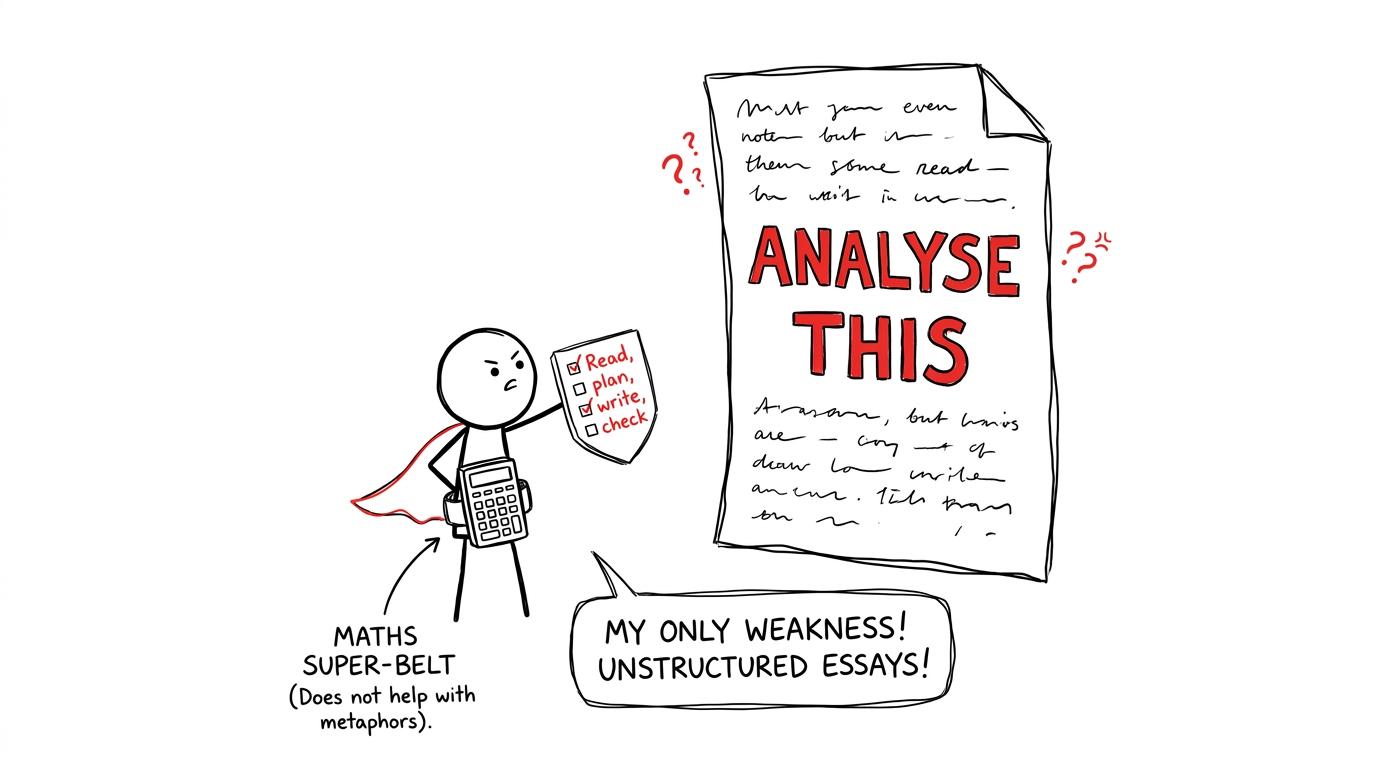 A maths-minded student faces an English paper with a simple process checklist
Revise like a maths student
If you prefer maths, borrow the habits that make maths revision feel clearer.
Treat the question as a set of instructions
In maths, missing a command word can send you towards the wrong method. English is similar. Underline the focus, identify the relevant assessment objective and notice whether the question asks you to explain, compare, analyse or evaluate.
Do not begin writing merely because the clock has started. A short plan can prevent several minutes of unfocused prose.
Use mark schemes as feedback
A mark scheme is not a model paragraph generator. It describes the qualities examiners reward. Read it alongside marked responses and your teacher’s feedback, then translate it into a short checklist you understand.
After each attempt, record:
- the question type;
- the mark or level achieved;
- what limited the response;
- one action for the next attempt.
“English is bad” is not a diagnosis. “My evidence was relevant, but I did not explain its effect” gives you something to practise.
The same principle drives effective paper review in MathsGenie’s guide to using past papers properly. Completing a paper reveals the problem; reviewing and correcting it creates the improvement.
Measure completion, not mood
Track behaviours you control: sessions completed, questions marked and weaknesses revisited. Do not score a session according to whether it felt enjoyable.
Educational evidence on self-regulated learning supports planning, monitoring and evaluating your work. Crucially, these strategies are most useful when attached to actual subject content. A beautiful timetable cannot replace analysing a text or producing a response.
Build a routine you can tolerate
A workable week does not need daily full papers. Try a simple pattern:
- Session one: one reading question, followed by marking and correction.
- Session two: planning and producing part of a writing response.
- Session three: one timed section or a longer response.
- Review: revisit the mistake that appeared most often.
Keep the sessions short enough that you can repeat them. Space them across the week rather than compressing everything into one exhausting evening.
If English avoidance is damaging your maths preparation, give both subjects defined spaces. The MathsGenie GCSE revision timetable guide explains how to prioritise weaknesses while leaving room for school, rest and other subjects. A timetable should protect attention, not fill every available minute.
Make starting almost automatic
Friction is often mistaken for laziness. If every session begins with finding a paper, choosing a question and searching for the mark scheme, avoidance has several opportunities to win.
Before finishing today, prepare tomorrow’s task:
- put the correct paper and mark scheme in one folder;
- write the question number on a note;
- leave a pen and timer ready;
- put your phone elsewhere;
- decide exactly when the session ends.
You can also pair English with a subject you prefer. Complete a short English task first, take a genuine break, then move to maths. The enjoyable subject becomes a clear next step rather than an excuse to avoid English indefinitely.
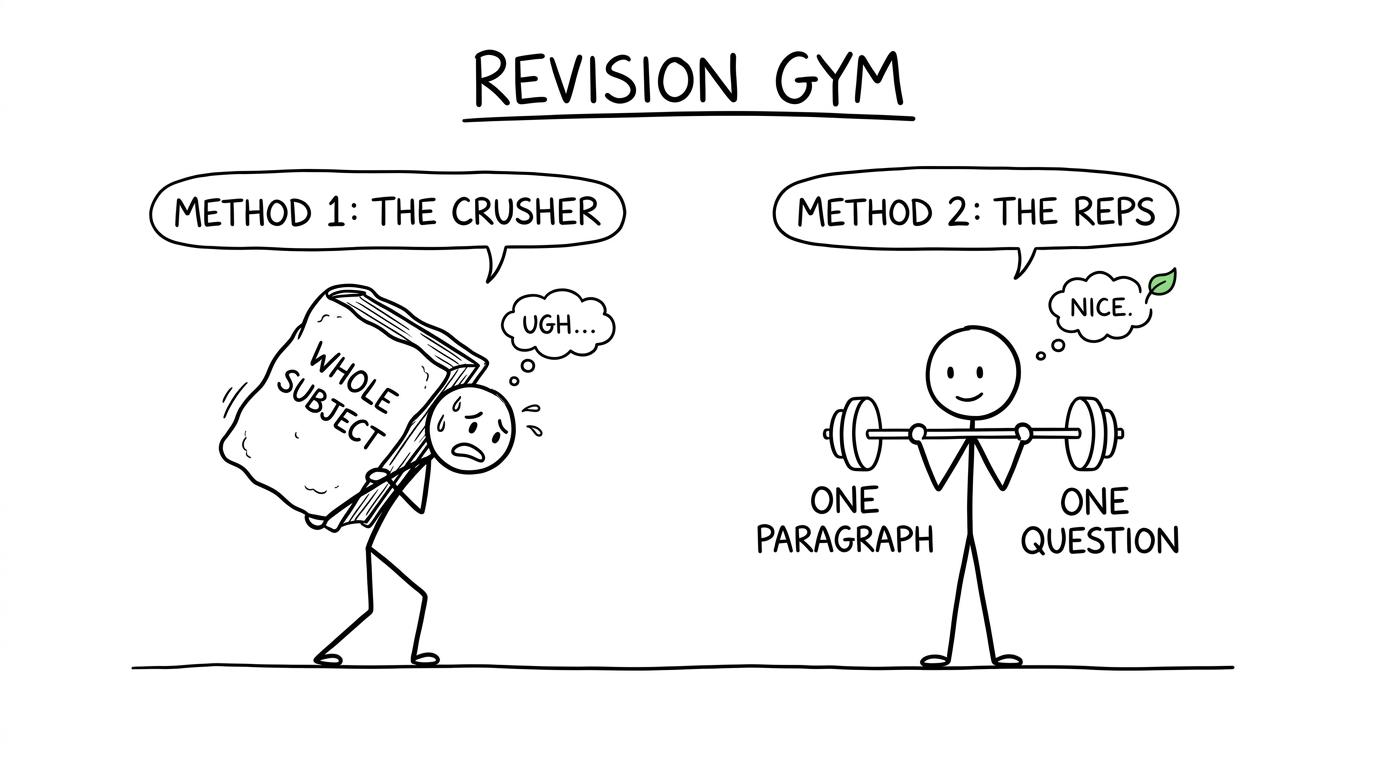 One student lifts the whole subject while another trains with one paragraph at a time
What to do when nothing is clicking
Sometimes the problem is not motivation. You may genuinely not understand what a successful answer requires.
At that point, doing more unsupported questions can rehearse the same mistake. Take one marked response to your teacher and ask a narrow question, such as which part is preventing it from reaching the next level. Then practise only that part.
Use a simple three-column error log:
| What happened | Likely cause | Next action |
|---|---|---|
| I ran out of time | The plan or opening took too long | Time the planning stage separately |
| My analysis became repetitive | I kept naming techniques without developing effects | Explain how one precise choice shapes meaning |
| My writing lost focus | I had no clear audience or purpose | Add audience, form and purpose to the plan |
| I made frequent accuracy errors | I did not leave checking time | Reserve a final proofreading window |
You can apply the same diagnostic thinking to maths with MathsGenie’s guide to finding your weakest GCSE topics. Improvement begins when a general frustration becomes a specific, repairable problem.
Common mistakes when revising a subject you hate
Rereading instead of producing an answer
Notes can make the subject feel familiar without proving that you can respond under exam conditions. Spend more time retrieving ideas, planning and writing than highlighting.
Completing full papers too early
Full papers are useful for timing and stamina, but they can be overwhelming when several question types remain unclear. Repair individual skills first, then combine them.
Copying elaborate model answers
A polished model may be useful for identifying structure and quality. Memorising impressive phrases without understanding their purpose is less reliable because the examination texts are unseen and tasks vary.
Ignoring spelling and punctuation
Technical accuracy is not a decorative extra. AO6 accounts for 20%20\%20% of the qualification overall, so proofreading and sentence control deserve deliberate practice.
Revising the wrong specification
A video or paper for another exam board may arrange questions differently. Confirm your board and use its current specification, past papers and mark schemes.
Abandoning maths because English feels urgent
One difficult subject should not swallow the timetable. Keep maths active through short revision lessons, practice questions and mini tests. The one-month GCSE maths revision plan can help you maintain a balanced routine.
You do not have to love it to improve
There is a quiet advantage in accepting that English Language may never click in the way algebra does. You can stop negotiating with your feelings and start building a process.
Choose one question. Attempt it. Mark it. Name one weakness. Revisit that weakness later. Then repeat.
For maths, keep that same dependable rhythm with MathsGenie. Start at the free GCSE revision hub, use revision lessons and practice questions to repair gaps, then build towards mini tests, past papers and predicted papers. Mark schemes and video solutions turn every lost mark into a useful next step.
You do not need perfect motivation for either subject. You need a next action small enough to begin today.










