

Grade A* A-Level Maths Meaning: What Next?
Grade A* A-level maths meaning explained, with clear results-day options for university, Clearing, gap years, reviews and realistic resit planning.
Results day can compress two years of work into one small character on a screen. If you are searching for the grade A∗A^*A∗ A-level maths meaning, the immediate answer is simple: you achieved the highest available A-level grade in the subject. It is an exceptional result, but it does not make every decision for you.
Your next step depends on your full results, university offer and long-term plans. Check UCAS Hub, read the conditions of your offer carefully, and resist the temptation to make a hurried decision simply because the result feels significant.
 Student discovers that an outstanding result still comes without instructions
Your results-day checklist
Before celebrating, changing course or considering a resit, work through this short list:
- Confirm all your subject grades with your school or college.
- Check your application status in UCAS Hub.
- Read the complete conditions of your firm and insurance offers.
- Save any emails from universities and follow their enrolment instructions.
- Speak to your school if a result looks unexpected.
- Avoid declining a confirmed place until you have researched the alternative.
For 2026 entry, A-level results day is Thursday 13 August. Your school or college provides your grades, while UCAS Hub shows what has happened to your university application. These are related, but they are not the same thing.
What does an A-level maths grade A* mean?
A grade A∗A^*A∗ is the highest grade awarded at A level. It shows that your overall performance met the top grade boundary set for your exam series and specification.
It does not mean you achieved full marks, nor does it correspond to one fixed percentage every year. Grade boundaries are set after the papers have been taken and marked. They may vary between exam boards such as Edexcel, AQA, OCR and Eduqas, and between different exam series, because papers are not identical in difficulty.
A grade A∗A^*A∗ at A level is worth 565656 UCAS Tariff points. However, many university offers are expressed as grades rather than a total Tariff score. An offer such as A∗AAA^*AAA∗AA therefore depends on your complete set of relevant results, not only your maths grade.
The deeper meaning is less numerical. You have demonstrated sustained strength across pure mathematics and the applied content in your specification, including statistics and mechanics where applicable. You have also shown that you can select methods, connect topics and communicate reasoning under examination pressure.
What next after grade A* maths?
Your firm university place is confirmed
If UCAS Hub confirms your firm choice, the academic decision is largely complete. Read the university's instructions about enrolment, accommodation, student finance and any preparatory work.
If your course contains substantial mathematics, keeping your skills active is sensible. The free A Level Maths revision hub provides revision guides, questions, videos and papers across several exam boards. A short review of algebra, functions, trigonometry and calculus before term begins can make the transition less abrupt.
You have been accepted by your insurance choice
This usually means your firm choice was not confirmed but your insurance university accepted you. Pause before treating that as failure. Your insurance choice was selected because it offered a worthwhile route.
Review the course modules, location, accommodation and career opportunities. If it remains a good fit, continue with the practical arrangements. If you no longer want the place, investigate Clearing before declining anything. Giving up a confirmed place creates risk, because a preferred Clearing place is not guaranteed.
You want to use Clearing
A grade A∗A^*A∗ in maths may strengthen your academic profile, particularly for courses that value mathematical reasoning. But Clearing decisions are made using your complete application, the course requirements and the places still available.
For 2026 entry, UCAS Clearing runs from 2 July to 19 October, although availability changes throughout that period. Research each course, contact the university and obtain an offer before adding a Clearing choice through UCAS Hub.
Do not choose a course only because its entry requirements look impressive. Course content matters more than the emotional pull of receiving a high grade.
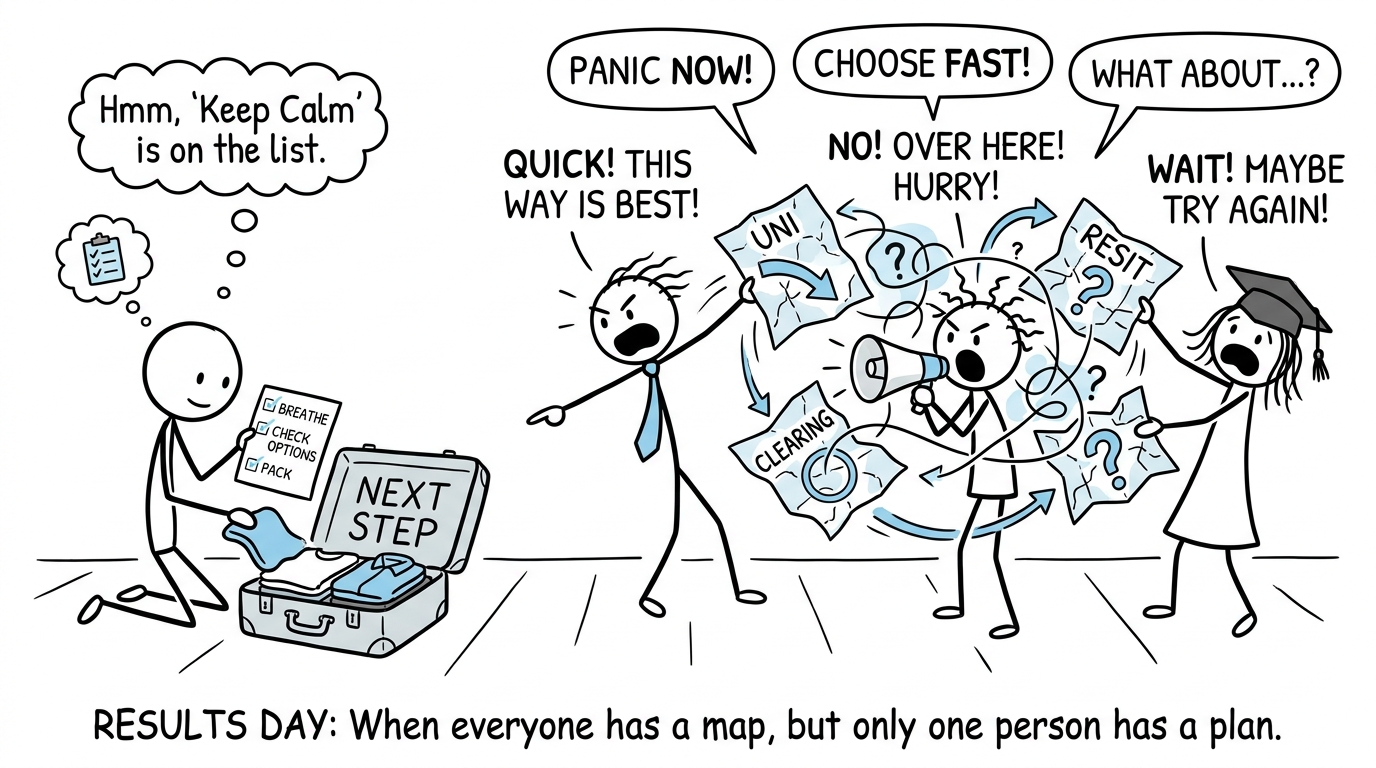 A calm checklist defeats three competing results-day maps
You are considering a gap year
An A∗A^*A∗ can give you confidence when applying with achieved grades, but a gap year should have a purpose. You might work, travel, gain relevant experience, strengthen another subject or reconsider which course fits you best.
Check whether your preferred universities accept deferred applications and whether competitive courses expect particular preparation. Keep your mathematical fluency alive through occasional topic practice or an exam paper rather than assuming it will remain unchanged for a year.
You are thinking about a resit
Resitting A-level maths after achieving A∗A^*A∗ would normally offer no academic improvement because you already hold the highest grade. The more realistic question is whether you need to resit another subject to satisfy an offer or prepare a stronger future application.
Speak to your school, college or an approved examination centre about entry arrangements, fees and any non-exam assessment requirements. A-level resits are generally taken in the next summer examination series, so build your plan around the relevant exam board's current deadlines.
For structured preparation, use the Edexcel A Level Maths revision resources, OCR A Level Maths revision resources or the wider topic-by-topic A Level archive. Edexcel A Level predicted papers can add timed practice once the underlying topics are secure.
Should you request a review of marking?
A review of marking checks whether the agreed mark scheme was applied correctly. It is not a fresh attempt to award extra marks. Following a review, a mark and grade can rise, remain unchanged or fall.
If you already have A∗A^*A∗ in maths, a review is rarely useful because the subject grade cannot improve. If another result is unexpectedly low and affects a university place, speak to your school immediately. Priority services and deadlines may apply, and your centre must explain the possible outcomes before obtaining your consent.
Common mistakes after receiving an A*
- Assuming one grade confirms the offer: universities consider every condition attached to the offer.
- Declining a place too quickly: research Clearing alternatives before surrendering a confirmed option.
- Confusing UCAS Hub with the results slip: Hub shows application decisions, not necessarily your detailed marks.
- Treating a review as free extra marking: marks can move down as well as up.
- Stopping maths completely: a long break can make the start of a mathematical degree harder.
- Resitting without a clear benefit: check whether the new result would genuinely change your available options.
What GCSE students can learn from this result
If you are reading ahead while preparing for GCSEs, the route to A-level success begins with reliable foundations rather than early calculus. Algebra, graphs, indices, surds, quadratics and trigonometry all return in more demanding forms.
The GCSE to A Level curriculum guide explains how the difficulty develops. For current preparation, use the GCSE Maths revision hub for lessons and topic questions, followed by GCSE predicted papers when you are ready for exam-style practice.
Turn the result into a thoughtful next step
A grade A∗A^*A∗ in A-level maths is worth celebrating. It represents excellent performance, but its practical value comes from what you do next: confirming your place, choosing Clearing carefully, planning a purposeful gap year or making a precise resit decision.
Start with the facts, then give yourself enough space to choose well. MathsGenie can support the next stage with free revision guides, practice questions, mini tests, past papers, predicted papers, mark schemes and video solutions. Open the A Level Maths revision hub, choose the resource that matches your exam board or future course, and keep the habits that earned the grade working for you.











