Grade 5 GCSE Engineering: Enough for Sixth Form?
Grade 5 GCSE engineering sixth form guidance: check whether your result meets entry requirements for A Levels, T Levels and Level 3 engineering.
A results sheet can make one number feel like a verdict. It is not. If you are searching for grade 5 GCSE engineering sixth form guidance, the short answer is encouraging: a grade 555 in GCSE Engineering may be enough for many sixth-form or college engineering courses, but it does not guarantee entry by itself.
Providers set their own entry requirements. Many Level 333 engineering courses ask for grade 555 in GCSE Maths and Science, while some accept grade 444 and others require grade 666 in Maths. They may also look at English Language, your overall GCSE profile, an interview or a relevant Level 222 qualification. Your GCSE Engineering grade can strengthen your application, but Maths and Science are often the grades that decide whether the door opens.
The sensible next step is not to guess whether your result is “good”. It is to compare your complete results with the published requirements for the exact course and year you want to enter.
The quick answer and checklist
Use this checklist before accepting or rejecting a course in your mind:
- Check the provider's general sixth-form or college requirements.
- Check the subject-specific requirements for engineering.
- Separate your GCSE Engineering grade from your GCSE Maths and Science grades.
- Confirm whether the course is an A Level programme, a Level 333 vocational qualification, a T Level or a Level 222 transition route.
- Ask whether grade requirements apply at application, enrolment or both.
- Check whether an interview, portfolio, practical task or aptitude assessment is used.
- Compare several local providers because their thresholds can differ.
- If Maths is the obstacle, begin targeted revision rather than assuming the entire engineering route is closed.
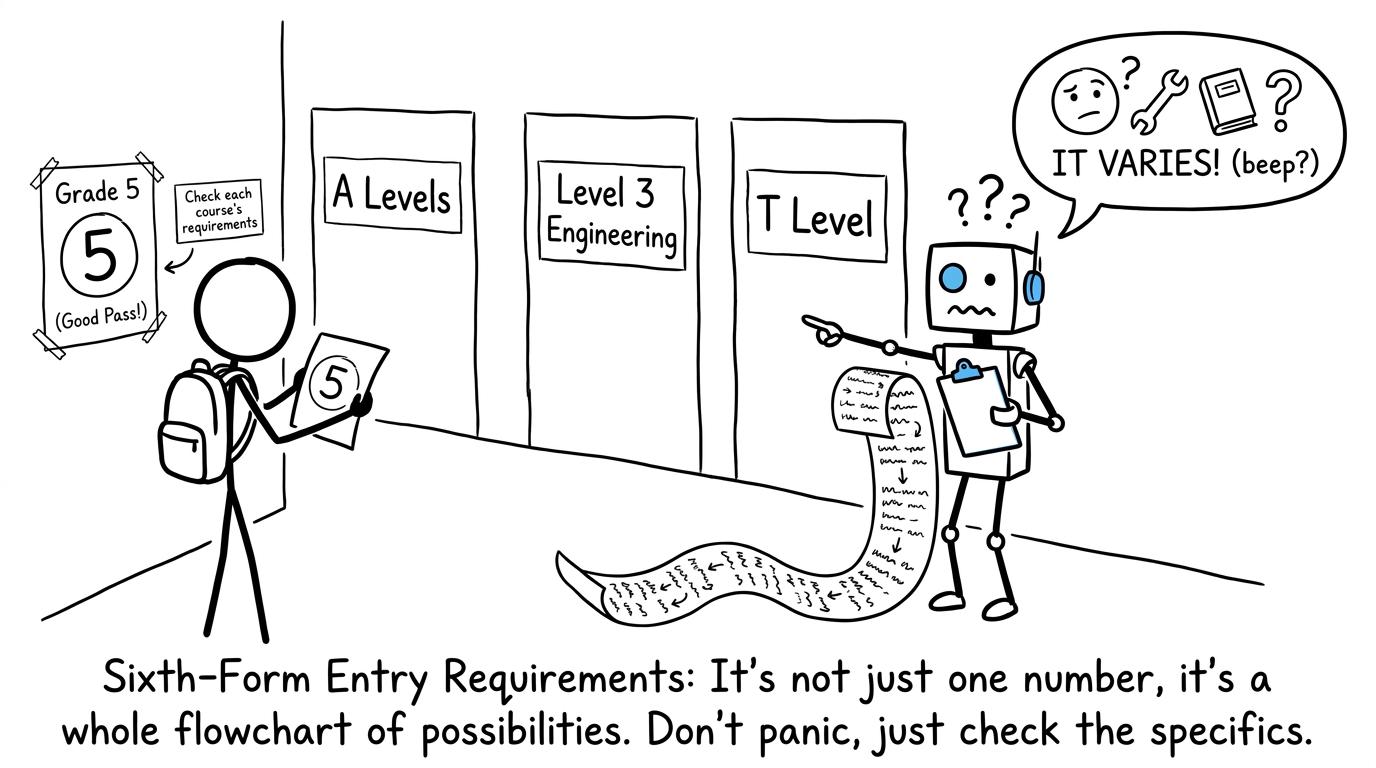 A student choosing between sixth-form engineering routes while a robot struggles with the entry-requirements clipboard
Is a grade 5 in GCSE Engineering considered good?
A grade 555 is a respectable GCSE result. It sits above grade 444, which is commonly described as the standard-pass benchmark in England. It shows that you have demonstrated meaningful knowledge and application within the qualification.
For AQA GCSE Engineering, assessment includes a written paper and non-exam assessment. The current specification gives the written paper a weighting of 60%60\%60% and the non-exam assessment a weighting of 40%40\%40%. The course covers engineering principles, processes, problem-solving, modelling, manufacturing and evaluation. Mathematical applications include areas such as force, density, area, volume, resistance and factors of safety.
That means a grade 555 is evidence of more than remembering definitions. It suggests that you have met a credible standard across written and practical work. However, admissions teams must judge whether you are prepared for the next course, so they frequently examine the supporting subjects as well.
A strong GCSE Engineering result cannot always compensate for a Maths grade below the stated threshold. Equally, a grade 555 in Engineering is unlikely to block you if the course mainly requires particular results in Maths, Science and English.
What different sixth-form engineering routes require
The phrase “sixth-form engineering” can describe several quite different pathways. The right interpretation of your grade depends on which one you mean.
Level 3 vocational engineering
Level 333 engineering qualifications are offered by many sixth forms and further education colleges. Published requirements differ, but recent course information commonly asks for grade 555 in GCSE Maths and grade 555 in Physics or Combined Science. Some providers use grade 444 in one supporting subject; others expect grade 666 in Maths or a minimum overall GCSE profile.
Prior GCSE Engineering is not always compulsory. This can work in your favour: your grade 555 demonstrates relevant experience even where applicants without the subject are considered.
Read the wording carefully. “Five GCSEs at grades 999 to 444 including Maths” is not the same as “grade 555 in Maths and Science”. You must satisfy both the general and subject-specific conditions when both are listed.
Engineering T Levels
T Levels are two-year Level 333 programmes broadly equivalent in size to three A Levels. Engineering and manufacturing pathways combine classroom learning with a substantial industry placement. National information confirms that entry requirements are set by the individual school or college, rather than through one universal GCSE threshold.
This is why one provider may accept grade 555 in Maths while another asks for grade 666. Science and English requirements can also vary. A grade 555 in GCSE Engineering is relevant evidence, but it must be checked alongside every named subject condition.
T Levels suit students who want a substantial technical course and workplace experience. They are not simply an easier version of A Levels; they demand sustained technical, mathematical and practical work.
A Levels leading towards engineering
Some sixth forms do not offer an engineering qualification. Instead, students take subjects such as A Level Maths, Physics, Further Maths, Computer Science or Design and Technology before applying for engineering at university.
Here, your GCSE Engineering result may support your application, but GCSE Maths is usually more decisive. Many sixth forms require grade 666 or 777 for A Level Maths, and Physics may require strong Maths and Science grades. Requirements vary, so check the precise prospectus rather than relying on another school's rules.
This distinction matters because many university engineering degrees require A Level Maths, and numerous courses also require Physics or another specified science. If university engineering is your long-term aim, work backwards from several possible degree courses before choosing your post-161616 subjects.
You can explore the next mathematical stage through the free A Level Maths revision resources, but first make sure your chosen sixth-form subjects preserve the routes you may want later.
Level 2 and transition routes
If you miss a Level 333 entry requirement, that does not necessarily end the journey. Some colleges offer Level 222 engineering or transition programmes for students with a mixture of grades 333 and 444, sometimes alongside GCSE Maths or English resits.
Progression is less direct, but it can provide the foundation needed to move onto Level 333. Ask the college what progression is available, what result you must achieve and whether moving up is automatic or competitive.
Why your Maths grade may matter more
Engineering turns physical situations into quantities that can be measured, compared and modelled. That is why admissions pages repeatedly emphasise Maths.
Useful GCSE skills include:
- rearranging formulae;
- ratio and proportional reasoning;
- unit conversion;
- area, surface area and volume;
- graphs and gradients;
- standard form;
- accuracy, bounds and tolerances;
- speed, density and pressure.
These are not detached classroom tricks. They form the language through which engineering decisions are communicated. A relationship such as
density=massvolume\text{density}=\frac{\text{mass}}{\text{volume}}density=volumemassconnects measurements to a material property. Similarly,
pressure=forcearea\text{pressure}=\frac{\text{force}}{\text{area}}pressure=areaforceshows why algebra, substitution and units matter in technical work.
If these topics feel uncertain, use the GCSE Maths revision hub to select your exam board. Edexcel students can begin with the Edexcel GCSE Maths revision course, while the wider hub supports AQA, OCR and Eduqas routes too.
For engineering-focused skills, revise changing the subject of a formula, speed and density and standard form. Choose resources matching your own board where available.
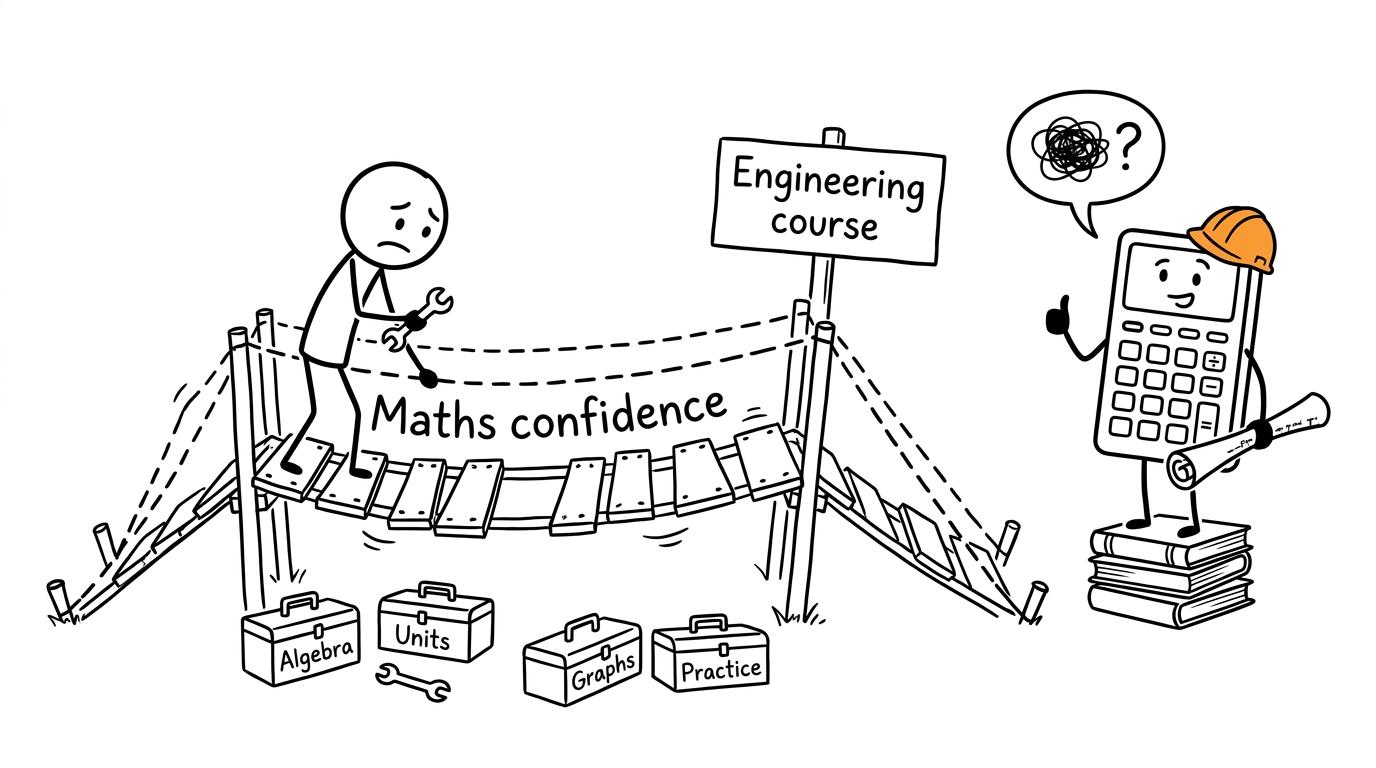 A calculator in a hard hat supervising a student repairing a bridge of maths confidence
How to check whether your grade is enough
Read the current course page
Search for the exact course title and entry year. Requirements can change between cohorts, so an old screenshot or a friend's experience may no longer apply.
Write down three separate categories:
- general college requirements;
- subject-specific grades;
- additional selection conditions.
Do not treat predicted grades as confirmed entry. A conditional offer usually depends on the results and conditions stated by the provider.
Contact admissions with specific information
If the wording is unclear, give the admissions team your relevant predicted or achieved grades and ask a precise question. For example, ask whether grade 555 in GCSE Engineering satisfies any subject requirement, or whether the named Maths and Science grades remain essential.
Also ask what happens if you miss one requirement by one grade. Some providers consider applications individually; others apply thresholds firmly. Never assume that flexibility exists until the provider confirms it.
Compare the course with your destination
A course can accept you without being the best route towards your goal. If you are considering university, check whether likely degree courses accept the Level 333 qualification and subject combination you plan to take. Some engineering degrees insist on A Level Maths even when they accept an additional vocational qualification.
If you prefer an apprenticeship, investigate the employer's requirements as well as the college component. The most useful pathway is the one that meets both your current profile and your intended next step.
A practical plan if Maths is holding you back
Start with diagnosis, not random revision. Complete a suitable mini test or paper, mark it and list the precise skills costing you marks. “Algebra” is too broad; “rearranging formulae with fractions” is actionable.
Use this cycle:
- learn one method through a revision lesson;
- complete focused practice questions;
- check the mark scheme or video solution;
- record the exact reason for each lost mark;
- repeat the skill without notes;
- test it later within a mixed paper.
The MathsGenie resources centre brings together mini tests, predicted papers and other practice material. When you need a longer plan, the one-month GCSE Maths revision plan helps turn broad intentions into manageable sessions.
Common mistakes when judging your options
Looking only at GCSE Engineering
Your engineering grade is only one part of the decision. Maths, Science, English and the total number of qualifying GCSEs may all matter.
Assuming every college uses the same threshold
There is no single national admissions rule saying that grade 555 must be accepted for every engineering course. Requirements are provider-specific.
Confusing a standard pass with automatic progression
A passing grade confirms achievement of the GCSE. It does not compel a sixth form to offer a place on a particular Level 333 programme.
Ignoring the type of engineering course
A T Level, vocational qualification and A Level combination have different structures and progression possibilities. Compare course content as well as entry grades.
Waiting until results day to investigate alternatives
Apply to realistic options and understand their conditions early. A first choice, a close alternative and a transition route provide far more control than one all-or-nothing plan.
Your grade is information, not your destination
A grade 555 in GCSE Engineering can be good enough for sixth form, particularly for courses that value relevant technical experience. But the decisive answer lives in the exact entry requirements: often grade 555 or above in Maths and Science, sometimes a higher Maths threshold, and usually a broader set of GCSE conditions.
Check each provider, ask direct questions and choose a route that supports your longer-term goal. Then strengthen the part you can still influence. With MathsGenie, you can use free revision lessons, practice questions, mini tests, past papers, predicted papers, mark schemes and video solutions to turn a vague worry about Maths into a clear improvement plan.
Open the GCSE Maths revision hub, select your exam board and begin with the topic that is most likely to unlock your next step.