Grade 4 GCSE Old Maths: Enough for Sixth Form?
Grade 4 GCSE old maths sixth form entry explained: learn which courses may accept it, where higher grades apply, and how to improve before results day.
A single number can feel as though it controls an unreasonable amount of your future. You open a prospectus, find several different entry rules and wonder whether the course you actually want is still within reach.
Here is the short answer to the grade 4 GCSE old maths sixth form question: a grade 444 is often enough to meet a basic maths requirement for sixth form or college, but it does not guarantee admission. Providers set their own overall and subject-specific requirements, and courses involving substantial maths frequently ask for a grade 555, 666 or 777.
In England, a grade 444 also means that you have reached the level generally required to avoid compulsory post-161616 maths study under the Department for Education's condition-of-funding rules. That is important, but it is separate from whether a particular sixth form will admit you.
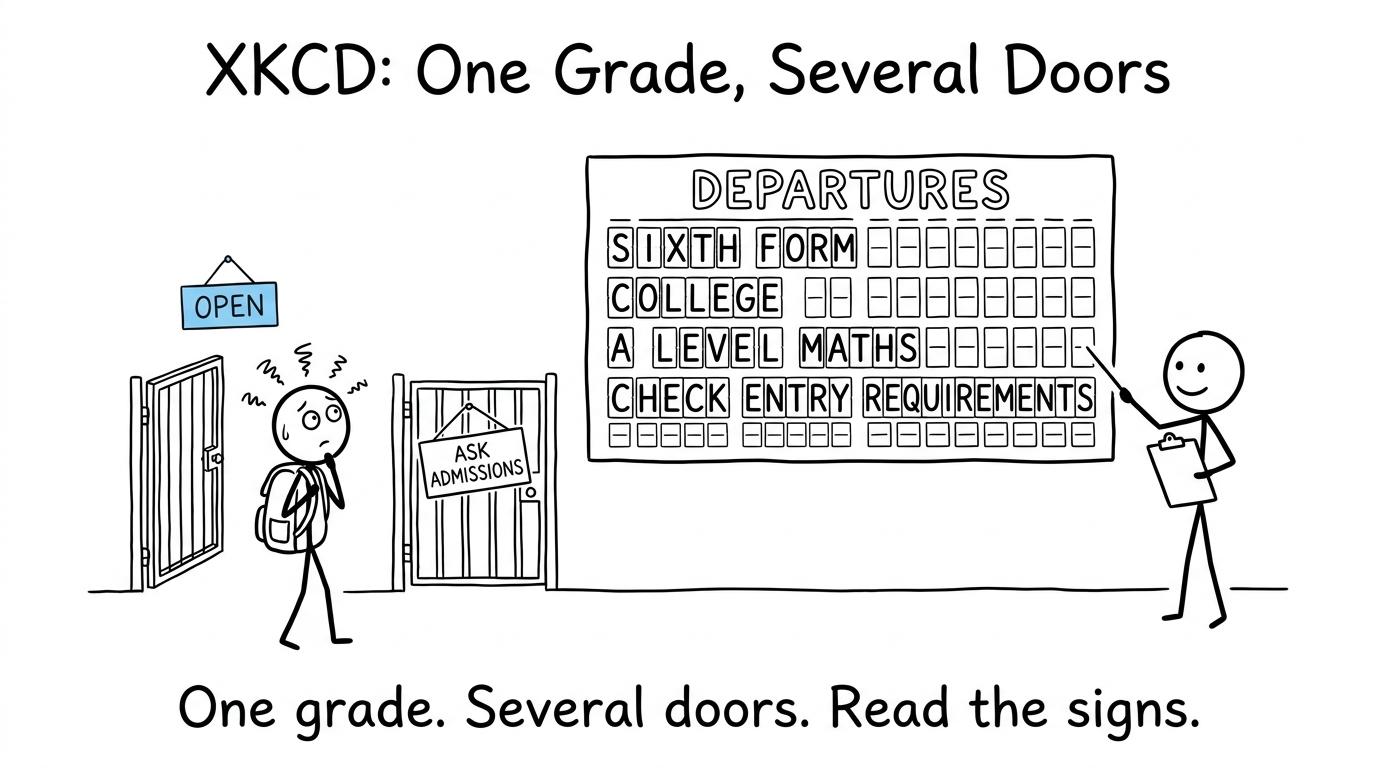 A student choosing between sixth-form routes
The quick sixth-form entry checklist
Before deciding that your grade is either "good enough" or a disaster, check these five things:
- The provider's general entry requirement: some sixth forms accept grade 444 in maths, while others require grade 555.
- The entry requirement for your chosen course: this can be higher than the general requirement.
- Your complete GCSE profile: admission is rarely decided by maths alone.
- Whether the requirement is fixed or advisory: some providers consider individual circumstances, but you should never assume that they will.
- The latest admissions information: use the prospectus for your intended year of entry and confirm uncertain details with the admissions team.
A grade is evidence. It is not a universal admissions ticket.
What does a grade 4 in GCSE maths mean?
Under the current GCSE grading system used in England, grades run from 999 to 111. A grade 444 is commonly described as a standard pass, while grade 555 is described as a strong pass in school performance measures.
You may also hear people say that grade 444 is the same as an old grade C. That is a useful shorthand, but it is not a perfect one-to-one conversion. When the numbered system was introduced, the boundary for grade 444 was aligned broadly with the lower part of the old grade C range. Grade 555 was positioned higher.
If "old maths" means that you took an older GCSE specification rather than the current grades 999 to 111 course, ask the sixth form how it treats that qualification. Admissions teams may also need to assess international qualifications, Functional Skills or other equivalents separately.
For current students, the practical point is simpler: grade 444 is a recognised level 222 pass. It shows that you have secured an important qualification, but individual courses may still demand a stronger mathematical foundation.
Is grade 4 enough to enter sixth form or college?
It can be. Many sixth forms and colleges use grade 444 in GCSE maths and English as part of their minimum entry criteria, particularly for some vocational or mixed programmes. Others require grade 555 in both subjects for an A Level pathway.
The wording matters. A prospectus might require:
- a certain number of GCSEs at grades 999 to 444;
- a certain number at grades 999 to 555;
- grade 444 or 555 in both English and maths;
- higher grades in subjects related to your chosen programme.
Meeting the maths rule does not necessarily mean meeting the whole offer. A student could have grade 444 in maths but fall short of the required number of GCSE passes. Equally, a student with grade 444 in maths might be eligible for one pathway but not another at the same institution.
This is why the phrase "sixth-form entry requirement" can mislead. There are usually at least two sets of requirements: one for joining the sixth form and another for joining each course.
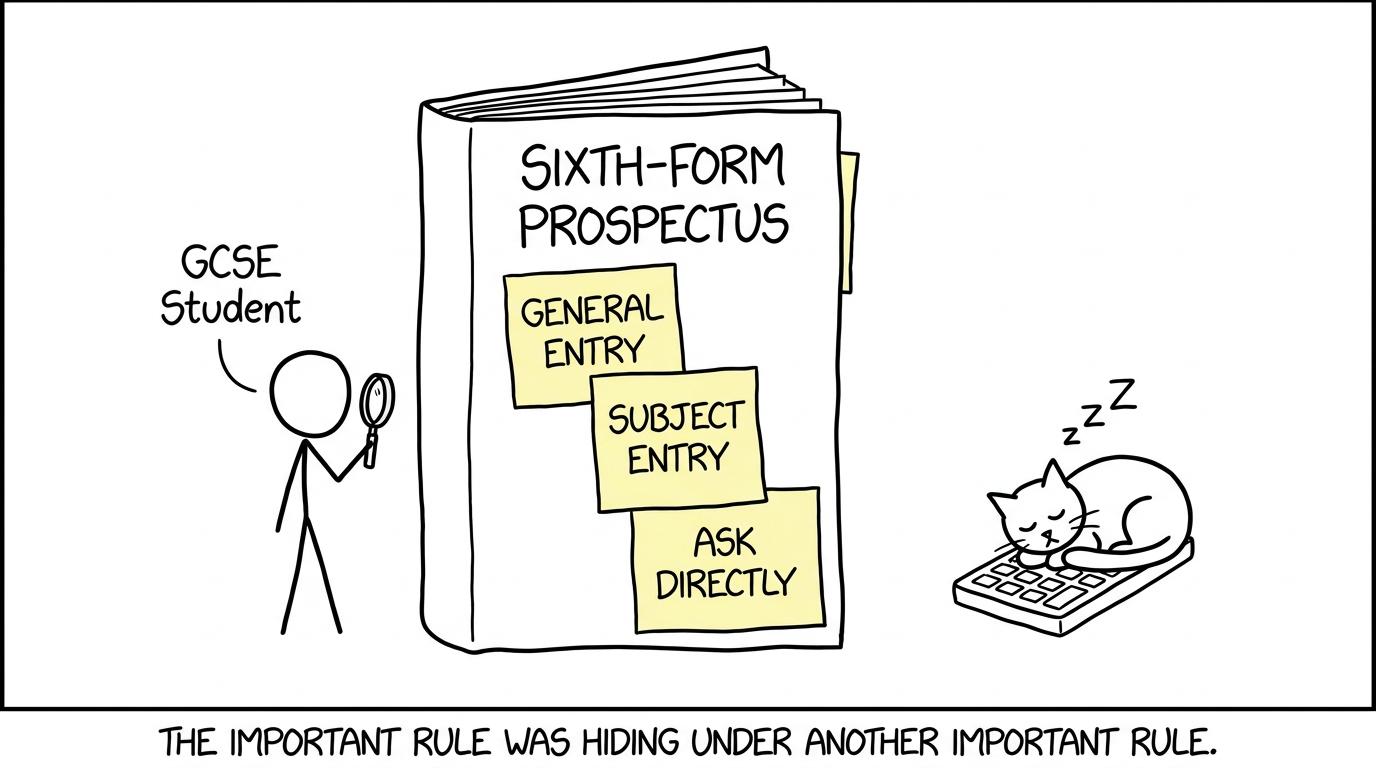 A student searching a prospectus for the important rule
Will a grade 4 get you onto the course you want?
The honest answer depends on the course.
A Level Maths and Further Maths
A grade 444 will not normally be enough for A Level Maths. Current sixth-form requirements vary, but grade 666 or 777 is common because A Level Maths develops GCSE algebra, graphs, trigonometry and problem-solving at a much faster pace.
Further Maths usually has an even higher threshold, often grade 777 or 888, and students normally take it alongside A Level Maths. Check the exact rule rather than choosing a course from a typical requirement.
If A Level Maths is your goal, treat grade 444 as a sign that the underlying GCSE skills need more work. Start with the free GCSE maths revision hub, where you can select your exam board and find lessons, questions and papers for foundation or higher tier.
Sciences, economics and computer science
Courses such as physics, chemistry, economics and computer science can contain significant mathematical work. Some providers therefore ask for grade 555 or 666 in GCSE maths, even when the general sixth-form requirement is only grade 444.
The precise requirement varies by provider and subject. Do not assume that passing maths automatically makes every science or numerate course available. Look at each subject separately.
Humanities, arts and languages
For subjects such as history, English literature, art or languages, grade 444 may satisfy the maths component of the entry criteria. The provider is more likely to focus on your English grade or performance in the relevant GCSE subject.
There can still be an overall grade profile to meet. The key distinction is that maths may be a general condition rather than the deciding subject-specific condition.
Vocational and mixed programmes
Some Level 333 vocational pathways accept students with grade 444 in maths, provided that they also meet the other GCSE requirements. Requirements can differ between programmes such as business, health and social care, engineering or applied science.
The name of the qualification does not tell you the admissions rule. Engineering, for example, may need stronger maths than another vocational course at the same college.
The three questions to ask admissions
Prospectuses are useful, but one direct conversation can remove days of uncertainty. Ask the sixth form or college:
- "Does grade 444 in GCSE maths meet your general entry requirement?"
- "What maths grade is required for each of my chosen courses?"
- "What alternatives are available if I miss a subject requirement by one grade?"
Ask in writing if possible, particularly when a requirement is unclear. Do not rely on a rule remembered from an older sibling's application. Entry criteria can change between admissions years.
You should also distinguish a minimum requirement from a typical successful profile. Reaching the published minimum may make an application eligible, but it does not automatically create a place if courses are full or other admissions conditions apply.
Do you have to resit maths with a grade 4?
In England, eligible students who have not achieved grade 444 or above in GCSE maths must normally continue to study an approved maths qualification during their post-161616 programme. A student who already has grade 444 has met that national level 222 threshold and is not required to resit merely because of the condition-of-funding rule.
However, a grade 444 does not force a sixth form to accept you for a course requiring grade 555 or 666. National funding rules and local admissions rules answer different questions.
You might still choose to improve the grade if it would strengthen a future application, but speak to the college first. If a resit is appropriate, the GCSE maths resit revision plan explains how to diagnose lost marks and rebuild weak topics.
Rules outside England are not identical, so students in Wales, Scotland and Northern Ireland should check the arrangements applying to their qualification and provider.
How to move beyond a grade 4 before results day
The gap between grade 444 and the next grade is rarely one enormous missing idea. It is usually a collection of smaller leaks: a percentage question not started, an algebra step written unclearly, an incorrect unit conversion or several marks lost through rushed arithmetic.
Begin with evidence. The guide to finding your weakest GCSE maths topics shows how to turn paper errors into a focused revision list. If you feel stuck around the pass boundary, use the strategies in GCSE maths revision at a pass grade.
A reliable revision cycle is:
- complete a short timed set or paper section;
- mark it carefully with the mark scheme;
- label each lost mark by topic and cause;
- use a revision lesson to repair the method;
- answer fresh practice questions;
- retest the topic without notes.
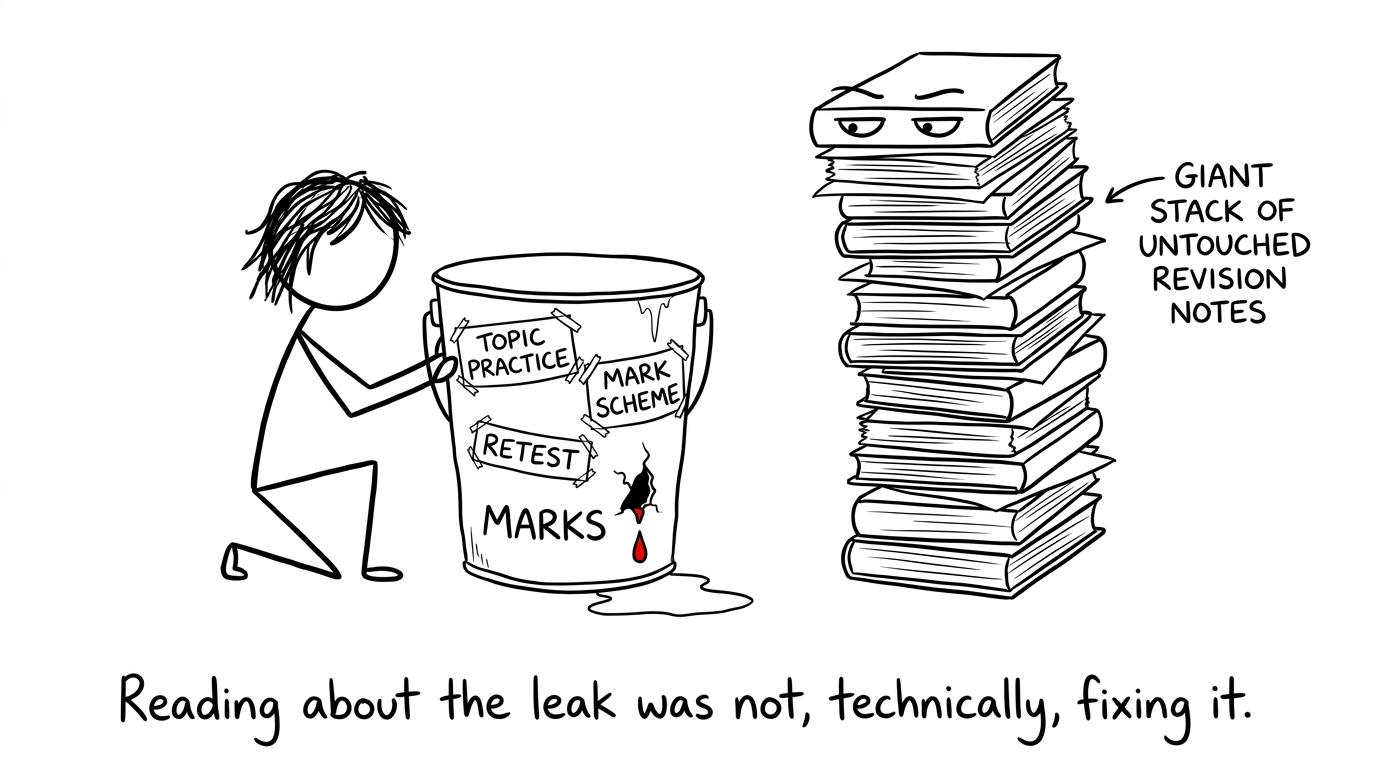 A student repairing a bucket of leaking marks
Past papers become valuable when they change what you do next. Read when to start GCSE past papers, then use MathsGenie's mark schemes and video solutions to understand why marks were lost. Nearer the exams, GCSE predicted papers can provide fresh exam-style practice, but they should support rather than replace official past papers.
If time is short, follow the one-week GCSE maths revision plan. It is better to repair a small number of recurring weaknesses than to skim every topic and remember little.
Common mistakes when judging whether grade 4 is enough
Looking only at the general entry rule
A sixth form may accept grade 444 in maths generally while requiring grade 666 or 777 for a particular subject. Check both layers.
Assuming every sixth form uses the same grades
There is no single universal admissions profile. Requirements differ between schools, colleges, pathways and application years.
Treating a standard pass as automatic admission
Grade 444 is a meaningful qualification, but admission may also depend on English, your wider GCSE results, subject grades and available places.
Using an old prospectus
A previous year's information can point you in the right direction, but it cannot confirm your offer. Always find the criteria for your planned year of entry.
Revising without diagnosing mistakes
Reading notes can feel productive while leaving the same weaknesses untouched. Use questions, mark schemes and retesting. The GCSE night-before revision plan is also useful for keeping final preparation selective and calm.
Your grade is a threshold, not a verdict
A grade 444 may be enough for sixth form, but the course you want decides the real answer. Check the provider's general rules, check every subject requirement and contact admissions wherever the wording leaves room for doubt.
Then focus on the part you can still influence. MathsGenie gives you a free route from uncertainty to action: revision lessons to rebuild methods, practice questions and mini tests to find weak spots, past papers for exam realism, and predicted papers, mark schemes and video solutions for focused improvement.
Open the MathsGenie GCSE maths revision hub, choose your exam board and tier, and begin with one honest diagnostic set. A grade boundary may be fixed on exam day. Your preparation before it is not.