Grade 4 GCSE Bengali and Sixth Form Entry
Grade 4 GCSE Bengali sixth form entry depends on the provider and course. Learn what counts, what to check and why your GCSE maths grade still matters.
A results sheet can make every grade feel like a separate verdict. In reality, sixth-form admissions work more like a set of connected conditions: your overall GCSE profile, English and maths grades, and the subjects you want to continue all matter.
The short answer to grade 4 GCSE Bengali sixth form questions is encouraging: a grade 444 is an awarded GCSE grade and may count towards a provider's general entry total. However, it does not automatically secure admission. Your chosen sixth form or college may require five or six GCSEs at particular grades, specific results in English and maths, and higher grades for individual A Level or Level 333 courses.
So, is it good enough? It can be. But the course you actually want determines whether it is enough.
The quick sixth-form entry checklist
Before making assumptions about your Bengali result, check all five parts of the admission criteria:
- General entry threshold: How many GCSEs are required, and at which grades?
- English and maths: Does the provider require grade 444, grade 555 or higher?
- Course-specific grades: What must you achieve for each A Level, T Level or vocational course?
- Accepted qualifications: Does GCSE Bengali count within the required GCSE total?
- Your complete profile: Does the provider use your best grades, an average GCSE score or a particular combination?
Always use the current prospectus or admissions policy for your year of entry. Requirements vary between institutions and can change from one admissions cycle to another.
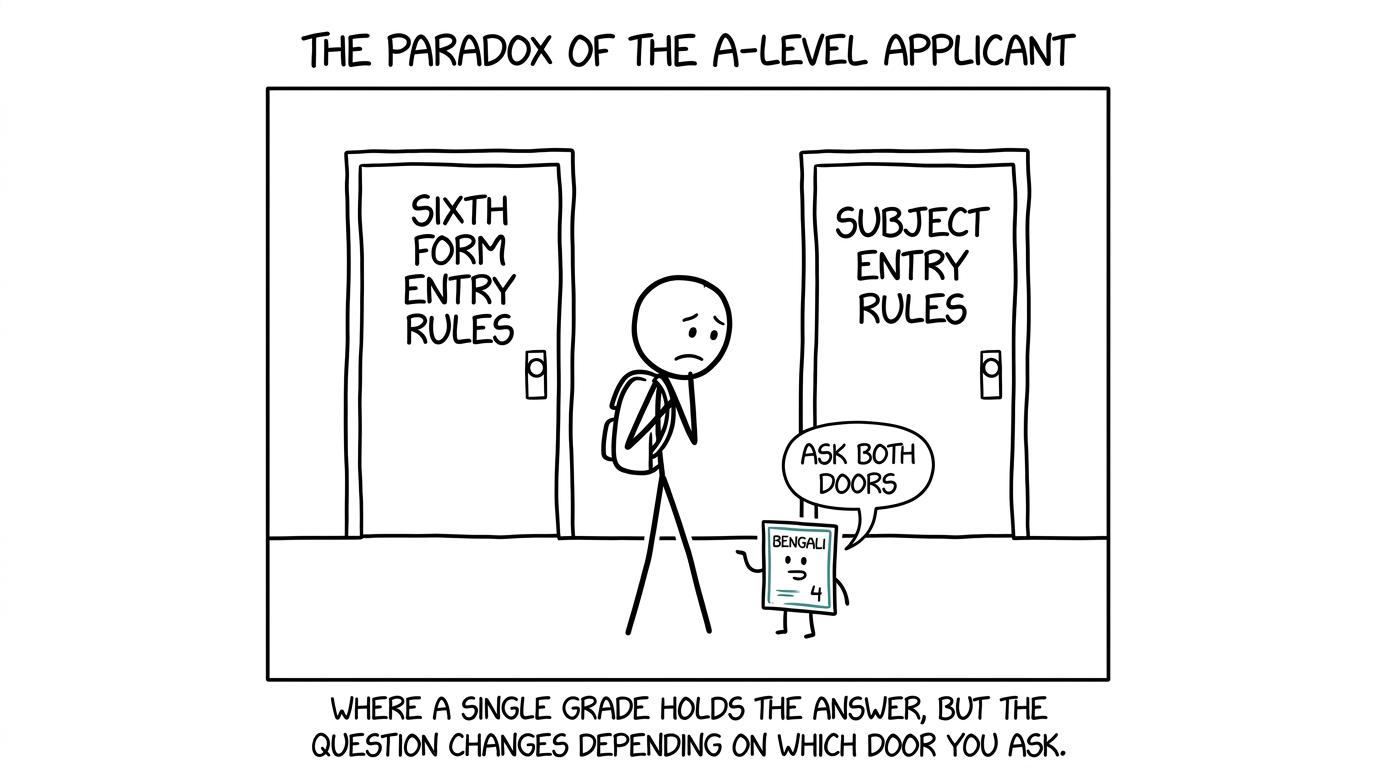 A student deciding which sixth-form entry rules to check
What does a grade 4 in GCSE Bengali mean?
Under the GCSE grades 999 to 111 system, grade 444 is commonly described as a standard pass. The current AQA GCSE Bengali specification uses foundation and higher tiers. Foundation awards grades 111 to 555, while higher normally awards grades 444 to 999, with an allowed grade 333 in limited circumstances.
A grade 444 has the same status whether it was achieved through foundation or higher tier. The tier is not printed on the GCSE certificate, and a provider should not treat a foundation grade 444 as a different grade from a higher grade 444.
That means the result can potentially count when a sixth form asks for something such as five GCSEs at grades 999 to 444. It demonstrates that you have completed and passed a regulated GCSE involving listening, speaking, reading and writing.
But the phrase potentially count matters. Some providers specify which qualifications are included, whether full-course GCSEs are needed, or how many vocational qualifications they will accept. Ask admissions directly if the published policy is unclear.
Is a grade 4 in GCSE Bengali enough for sixth form?
A grade 444 in Bengali may help you satisfy the overall GCSE count, but it is rarely the only condition considered.
Current sixth-form entry requirements show considerable variation. Some providers ask for five GCSEs at grade 444 or above, including English and maths. Others expect five or six results at grade 555 or above. More selective programmes may use an average GCSE score or require several grades at 666 or higher.
This creates three possible situations.
It counts and you meet every other requirement
Suppose your chosen programme requires five GCSEs at grades 999 to 444, including English and maths. If Bengali is accepted as one of those GCSEs and your other results meet the conditions, grade 444 may be entirely sufficient for that part of the offer.
It counts, but another grade blocks the course
Your Bengali result might satisfy the general total while your maths, English, science or subject-specific result falls below the required grade. In that case, Bengali is not the problem. The missing course condition is.
This distinction is especially important for maths students. A provider might accept grade 444 Bengali within the general total but require grade 666 or 777 in GCSE Maths for A Level Maths.
The programme expects a stronger overall profile
If the sixth form requires five GCSEs at grade 555 or above, a grade 444 Bengali will not count towards that particular threshold. It remains a GCSE achievement, but it may sit outside the set of grades used for admission.
The useful question is therefore not simply, “Is grade 444 good?” It is, “Does this grade satisfy one of the conditions attached to my chosen programme?”
Why GCSE Maths may matter more for your next step
For students preparing for maths exams, this is the part worth acting on now. Sixth forms frequently name English and maths separately within their entry rules. A grade 444 in Bengali cannot normally replace a required grade in GCSE Maths.
In England, the current condition-of-funding rules also mean that many students aged 161616 to 191919 who have not achieved grade 444 or above in GCSE Maths or English must continue working towards approved qualifications in those subjects. This national rule concerns maths and English specifically, not Bengali.
Your maths grade can also determine access to individual courses:
- A Level Maths often requires a substantially higher GCSE Maths grade than the provider's general entry minimum.
- Further Maths usually has an even higher requirement.
- Physics, chemistry, economics and computer science may specify particular maths grades.
- Some vocational and applied courses accept grade 444 in maths, while others ask for grade 555 or above.
There is no single national admissions grade for these courses. Always check the individual subject page rather than relying on a friend's offer from another school.
Start by identifying your current level through the free GCSE Maths revision hub. It brings together exam-board resources for Edexcel, AQA, OCR, Eduqas, WJEC and CCEA, allowing you to revise the course you are actually taking.
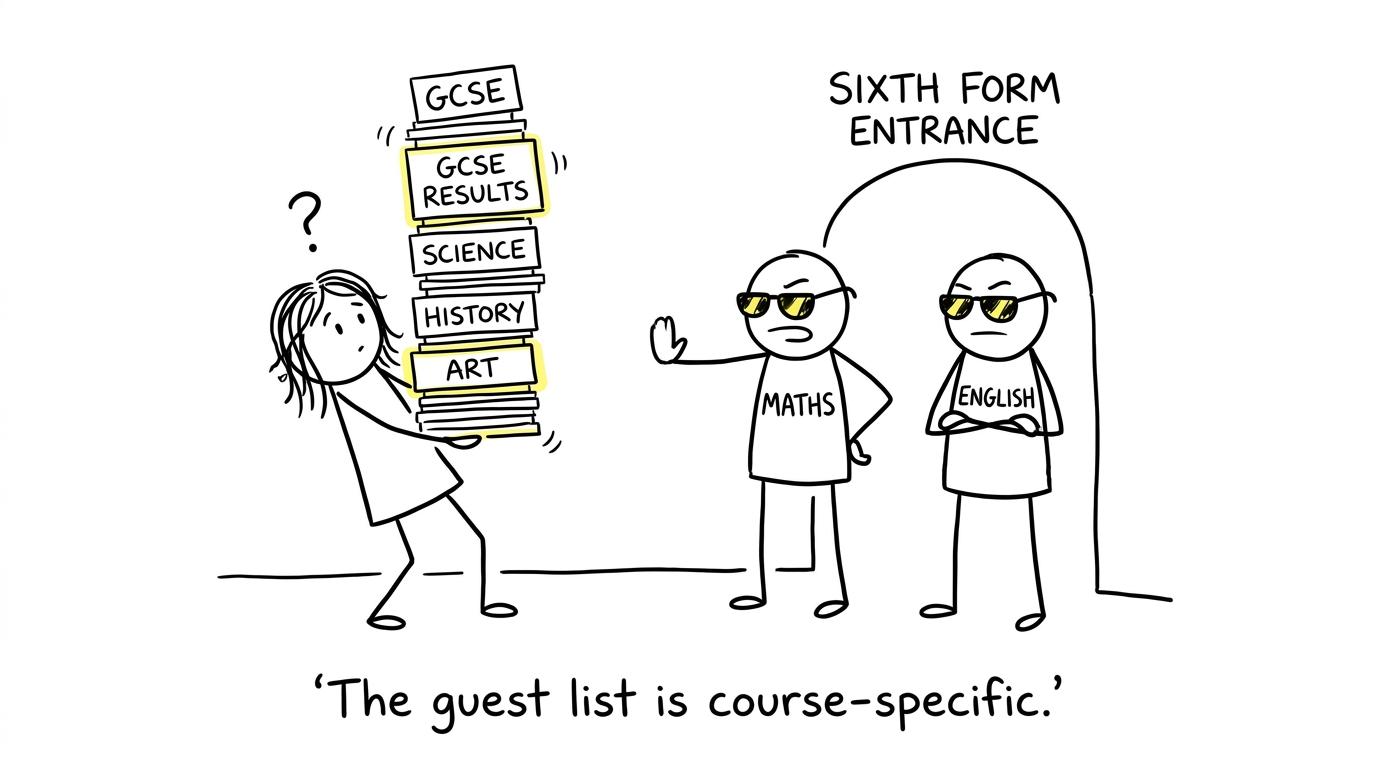 Maths and English acting as course-specific sixth-form gatekeepers
How to check whether your Bengali grade will count
The safest approach is simple and specific.
Read the general admissions policy
Look for wording such as “five GCSEs at grade 444 or above” or “six GCSEs at grades 999 to 555”. Check whether English and maths must be included and whether the provider limits the number or type of equivalent qualifications.
Open every course entry page
General admission and course admission are separate tests. You could qualify for the sixth form but not for a particular combination of A Levels.
Write down the requirement for each subject you want. If A Level Maths requires grade 777 in GCSE Maths, that condition remains in place regardless of your Bengali result.
Ask whether Bengali is included in the count
Send admissions a direct question: “Does my AQA GCSE Bengali at grade 444 count as one of the GCSEs required for this programme?” Include the course names and intended year of entry.
A clear written answer is more useful than speculation from social media or an older prospectus.
Prepare an alternative course combination
A backup is not an admission of defeat. It is sensible planning. Identify one alternative subject or pathway whose entry requirements fit your likely grades. Colleges may offer A Levels, T Levels, applied qualifications and Level 222 routes with different thresholds.
Turn the answer into a maths revision target
Once you know the exact grades required, revision becomes less emotional. A vague fear such as “I might not get into sixth form” can become a concrete task: improve algebra accuracy, recover marks on ratio, or build confidence with foundation or higher papers.
Use this revision cycle:
- Complete a short diagnostic paper for your board and tier.
- Mark it carefully and identify the topics losing repeated marks.
- Use a revision lesson to rebuild each method.
- Complete practice questions without looking at the solution.
- Revisit the same topic after a few days.
- Move to timed papers once the underlying skills are more secure.
The GCSE one-month maths revision plan provides a structured schedule if your exams are approaching. If time is tighter, follow the one-week GCSE maths revision plan rather than trying to revise the entire specification without priorities.
Past papers are most useful when they change what you do next. The guide to when to start GCSE past papers explains how to move from short diagnostic work to complete timed papers. Near the examination, GCSE predicted papers can provide fresh practice, but they should complement official past papers rather than replace them.
Common mistakes when judging sixth-form eligibility
Treating grade 4 as automatic admission
Grade 444 may meet one condition, but admission depends on the complete policy and your chosen subjects.
Assuming any GCSE can replace maths or English
A Bengali grade cannot normally substitute for a separately stated GCSE Maths or English requirement. These subjects often have their own minimum grades.
Reading only the general entry rules
Meeting the sixth form's overall threshold does not guarantee entry to A Level Maths, sciences or another subject with additional criteria.
Using last year's prospectus
Course requirements and available pathways can change. Check the policy for your intended September entry and confirm unclear wording with admissions.
Giving up on maths because one mock was low
A mock result is evidence about current gaps, not a final certificate. Diagnose the topics behind the mark and revise them deliberately. If a resit later becomes necessary, MathsGenie's GCSE Maths resit revision plan explains how to organise the process.
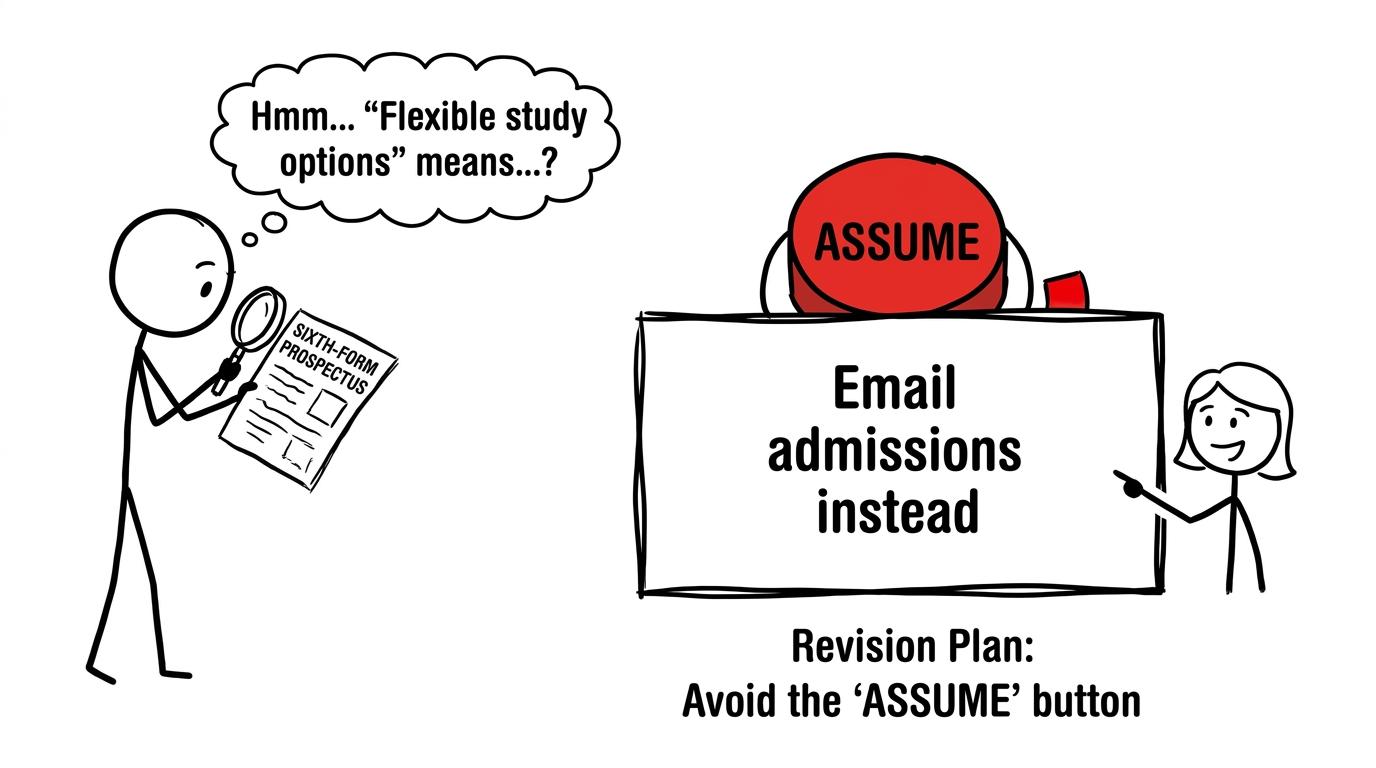 A student choosing to contact admissions instead of assuming
A grade is one condition, not the whole future
A grade 444 in GCSE Bengali can be good enough to count towards sixth-form or college entry when the provider accepts it within the required GCSE total. It will not override higher overall thresholds, missing English or maths conditions, or subject-specific requirements.
Check the current policy, list every condition and ask admissions for confirmation. Then put your energy into the grades you can still influence.
For maths, begin with MathsGenie's free revision resources. Use revision lessons to understand difficult methods, practice questions and mini tests to build fluency, mark schemes and video solutions to correct mistakes, and past papers or predicted papers to develop exam confidence. If you take Edexcel, the guide to revising Edexcel GCSE Maths efficiently can help you turn the entry grade you need into a practical plan.
Your Bengali result is one line on the page. The next step comes from understanding how all the lines fit together and acting early enough to improve the ones that still can change.