GCSE to A-Level Further Maths Jump: How Big?
GCSE to A-level further maths jump explained: compare topics, depth and workload, then build the algebra, calculus and proof habits needed to prepare.
The name creates a tempting illusion. GCSE Further Maths sounds as though it should lead smoothly into A-level Further Maths, with the next course simply continuing where the first one stopped.
The reality is more demanding. The GCSE to A-level further maths jump is substantial because A-level Further Maths does not merely extend the Level 2 course. It builds on A-level Maths as well as GCSE Maths, introducing broader content, deeper reasoning and questions that combine several ideas at once.
That does not make the jump unmanageable. GCSE Further Maths gives you a useful head start in algebra, functions, calculus and matrices. But it is a runway, not half of the flight.
The jump at a glance
Here is the short answer:
- GCSE Further Maths is usually an additional Level 2 qualification for strong GCSE Maths students.
- A-level Further Maths is a full Level 3 qualification, normally taken alongside A-level Maths.
- Some topics overlap, particularly matrices, algebra and introductory calculus.
- A-level questions demand much greater fluency, proof, problem solving and independence.
- Your most important preparation is mastering higher-tier GCSE algebra before trying to race ahead.
- You do not normally need GCSE Further Maths to begin the A-level course, although it can make the opening topics more familiar.
The phrase “GCSE Further Maths” can describe different qualifications. A common route is the AQA Level 2 Certificate in Further Mathematics, while other schools may offer a different additional maths qualification. Always check what your school teaches. MathsGenie's AQA GCSE Further Maths revision hub provides specification-focused lessons, questions and papers for the AQA route.
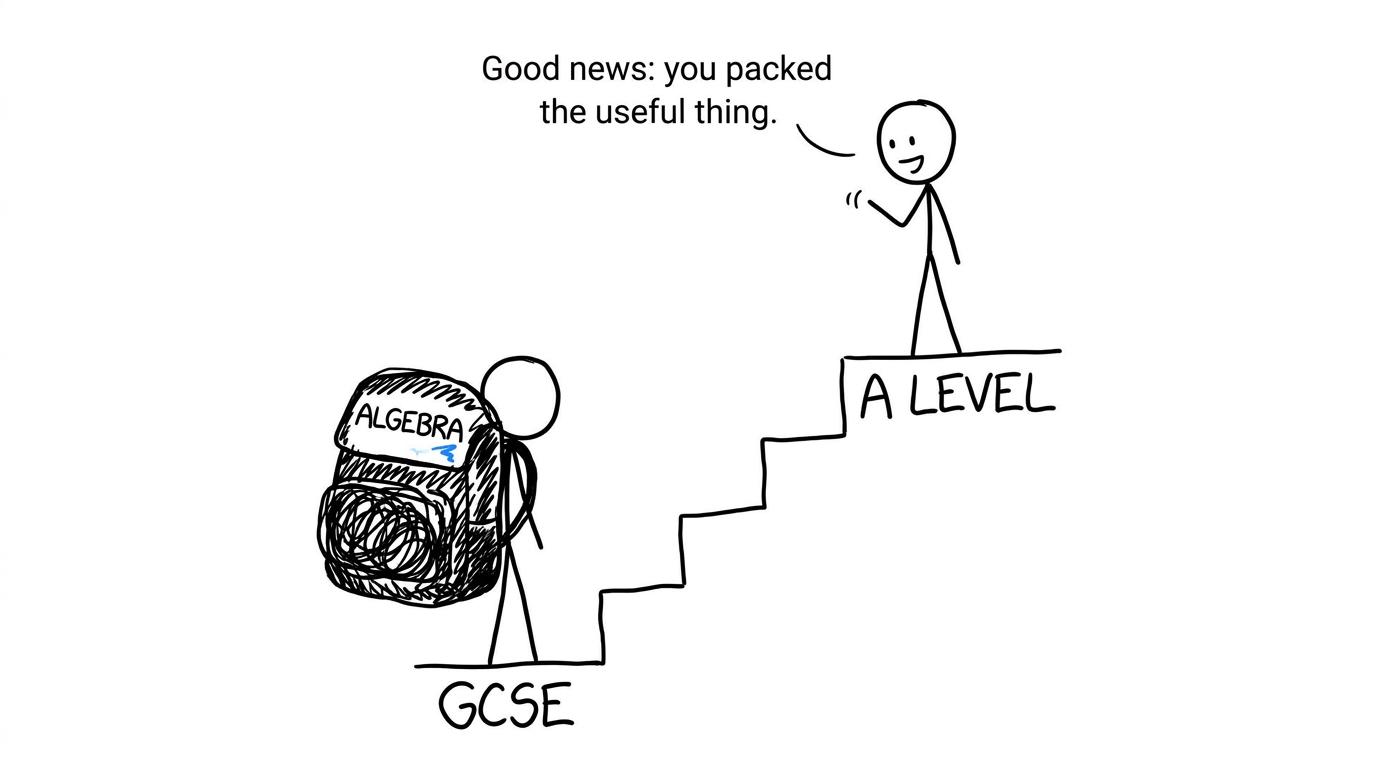 A student discovers that algebra is the useful luggage for the journey to A Level
Why the comparison is not quite direct
A-level Further Maths is not the direct replacement for GCSE Further Maths. The missing part of the comparison is A-level Maths.
Current A-level Further Mathematics specifications build on GCSE Maths and substantial content from AS or A-level Maths. Students usually take the two A levels together, although schools organise the teaching in different ways. This means you are learning the ordinary A-level course while also extending beyond it.
For example, Level 2 Further Maths may introduce differentiation of powers such as
y=xn.y=x^n.y=xn.A-level Maths then develops differentiation using functions, trigonometry, exponentials and more advanced rules. A-level Further Maths goes further again, applying calculus to areas such as differential equations, hyperbolic functions or polar coordinates, depending on the specification.
So the real journey is not:
GCSE Further Maths⟶more of the same.\text{GCSE Further Maths} \longrightarrow \text{more of the same}.GCSE Further Maths⟶more of the same.It is closer to:
GCSE foundation⟶A-level Maths fluency⟶further extension.\text{GCSE foundation} \longrightarrow \text{A-level Maths fluency} \longrightarrow \text{further extension}.GCSE foundation⟶A-level Maths fluency⟶further extension.Before deciding whether the subject suits you, explore the broader A-level Maths revision resources. They show the mathematical foundation that Further Maths students must develop alongside their additional course.
How much harder is A-level Further Maths?
There is no honest numerical measure of how much harder one qualification is. Difficulty depends on your algebra, teaching programme, chosen options and willingness to practise unfamiliar problems. However, the increase appears in four clear ways.
The content is much broader
AQA Level 2 Further Mathematics covers number, algebra, coordinate geometry, calculus, matrices and geometry. It is untiered and assessed through two papers, one non-calculator and one calculator paper.
A-level Further Maths retains some familiar threads but moves into topics such as:
- complex numbers, including numbers of the form z=x+iyz=x+iyz=x+iy;
- mathematical induction;
- advanced matrices and transformations;
- further vectors and algebra;
- polar coordinates;
- hyperbolic functions;
- differential equations;
- optional statistics, mechanics, discrete mathematics or further pure content.
The Department for Education prescribes a common core representing approximately 50%50\%50% of an A-level Further Mathematics course. Exam boards determine the remaining option structure, so Edexcel, AQA and OCR courses are not identical.
You can compare current resources through the Edexcel A-level Further Maths revision page and OCR A-level Further Maths revision page. If your school uses AQA, Eduqas or another specification, check its precise papers and options with your teacher.
Familiar topics become deeper
Matrices are a good example. At Level 2, you may use matrices to describe transformations. At A level, matrices connect with inverses, systems of equations, determinants, repeated transformations and proof.
Calculus changes in the same way. An introductory question may involve differentiating a polynomial such as
f(x)=ax3+bx2+cx+d.f(x)=ax^3+bx^2+cx+d.f(x)=ax3+bx2+cx+d.Later work expects you to select and combine techniques, interpret the result and justify each stage. A-level Maths integration alone includes substitution, integration by parts, partial fractions, areas and differential equations. The A-level integration revision resources illustrate how quickly introductory calculus develops.
The symbols are not the main difficulty. The challenge is recognising which ideas belong together.
Questions contain fewer obvious signposts
At GCSE, a question may strongly suggest a method. At A level, you are more often expected to decide what structure is hidden inside the problem.
A single question might require you to manipulate an expression, recall a theorem, introduce a useful representation and complete a proof. Each individual step may be reasonable. The difficulty comes from finding the chain without being shown it.
This is why algebraic fluency matters so much. If rearranging fractions, factorising polynomials or using indices still consumes most of your attention, there is less mental space available for the new idea.
The pace and workload increase
Further Maths is an additional full A level, not an occasional extension class. Assessment structures also vary by board.
| Exam board | Typical A-level Further Maths structure |
|---|---|
| Edexcel | Two compulsory Core Pure papers and two optional papers, each lasting 909090 minutes |
| AQA | Two pure papers and one paper assessing two chosen applications, each lasting 222 hours |
| OCR A | Two compulsory Pure Core papers and two optional papers, each lasting 909090 minutes |
The exact teaching order depends on your school. Some departments teach A-level Maths first and then Further Maths; others teach them in parallel. Either way, missed work accumulates quickly because later topics rely on earlier techniques.
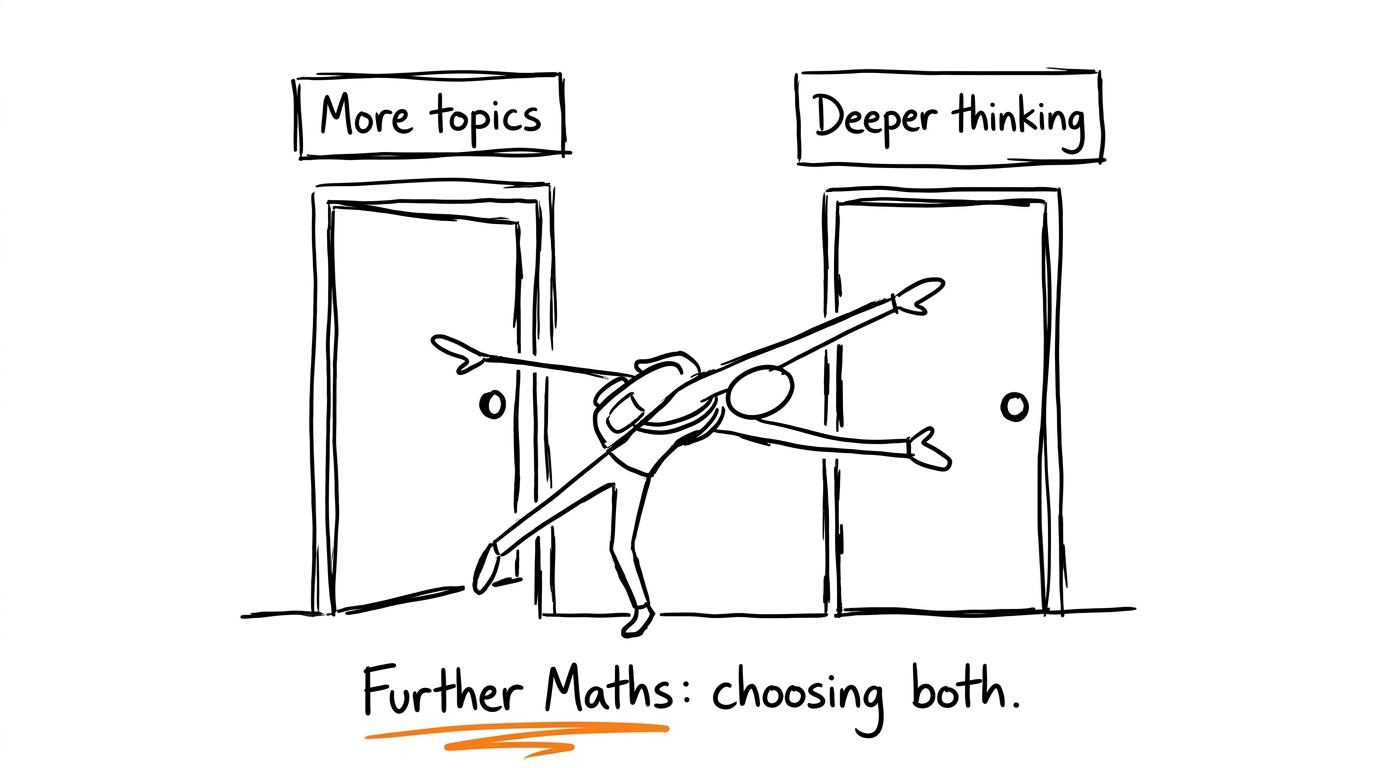 A student opens the doors to more topics and deeper thinking at the same time
What GCSE Further Maths genuinely prepares you for
The Level 2 qualification remains valuable. Its advantage is not that it removes the A-level jump, but that it changes which parts feel completely new.
You may arrive with experience of:
- manipulating more demanding algebraic expressions;
- functions and function notation;
- polynomial reasoning and the factor theorem;
- coordinate geometry involving circles;
- introductory differentiation and integration;
- matrix transformations;
- trigonometric identities and equations;
- multi-step problems requiring sustained working.
That familiarity can make the first encounter calmer. You already know that a matrix is more than a grid of numbers and that differentiation describes a gradient function. However, familiarity must not be confused with mastery. A-level questions revisit these ideas at greater depth and connect them to new ones.
The best preparation is therefore not to collect advanced topic names. It is to make your existing skills reliable.
How to prepare for the step up
Make higher-tier GCSE algebra automatic
Prioritise factorising, rearranging formulae, algebraic fractions, indices, surds, simultaneous equations, quadratics, functions and graph transformations. You should be comfortable moving between equivalent forms rather than treating each form as a separate method.
Aim to recognise relationships such as
am+n=amana^{m+n}=a^m a^nam+n=amanand
x2−y2=(x−y)(x+y)x^2-y^2=(x-y)(x+y)x2−y2=(x−y)(x+y)without needing a long pause. These facts become tools inside larger A-level arguments.
Strengthen proof and mathematical communication
A correct answer is not always a complete argument. Practise writing linked statements, defining variables and explaining why a conclusion follows.
Further Maths uses proof more explicitly, including proof by induction at A level. GCSE reasoning questions are useful preparation because they teach you to distinguish evidence from a general argument.
Use a learn, practise, review cycle
A sustainable session has three parts:
- learn or revisit one precise method;
- answer questions without copying the model;
- mark the work and record the cause of each error.
Classify mistakes as knowledge gaps, algebra slips, misread questions or incomplete reasoning. That gives you a next action instead of a vague sense that the topic was difficult.
The GCSE Maths revision timetable guide can help you turn this cycle into a realistic weekly routine.
Practise papers without sacrificing topic repair
Past papers reveal whether you can select methods under pressure. They are most useful after you review them properly. Use the GCSE past paper library, mark your attempt, return to the weakest topic and then retry the questions later.
Near your GCSE exams, Edexcel predicted papers can add realistic practice if that is your board. Predicted papers should supplement the full specification, not replace it.
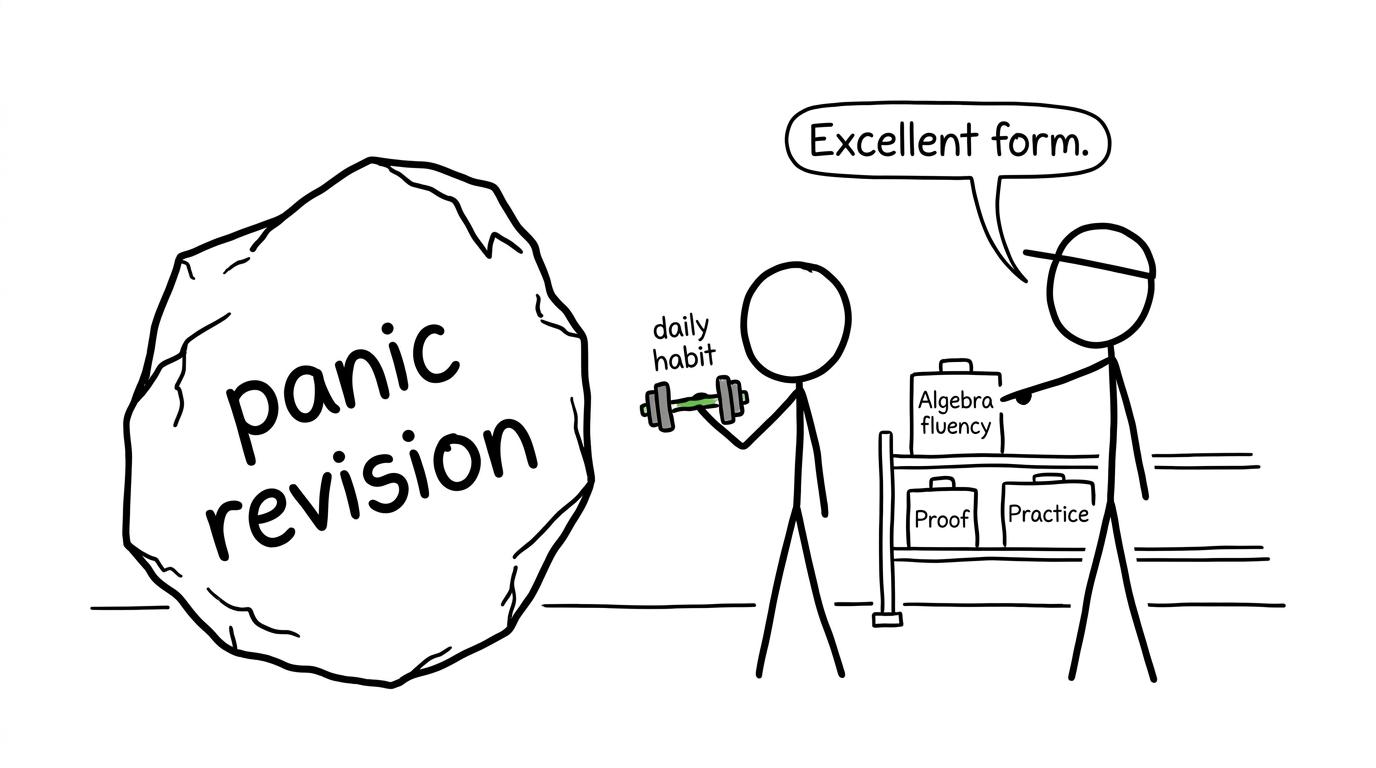 A student builds mathematical strength with a small daily habit instead of panic revision
Common mistakes when preparing for Further Maths
Racing into complex numbers too early
Advanced topics are interesting, but weak algebra will follow you into every one of them. Secure GCSE and early A-level foundations before trying to complete the entire Further Maths specification independently.
Assuming a high GCSE grade guarantees an easy transition
A strong grade shows valuable knowledge, but A level also tests consistency, independence and resilience with unfamiliar questions. Treat your grade as evidence of potential, not permission to stop practising.
Watching solutions without attempting questions
A clear video can make a method feel obvious. That feeling is not the same as being able to reproduce it. Attempt the question first, use the solution to diagnose the gap, then close the solution and repeat the method yourself.
Ignoring ordinary A-level Maths
Further Maths depends heavily on A-level algebra, trigonometry, calculus and vectors. Giving all your attention to the “further” course while neglecting A-level Maths weakens both subjects.
Measuring progress only through marks
Marks matter, but an early low score can contain useful information. Also track whether you can start unfamiliar questions, explain your method and correct errors without being shown every step.
The jump is large, but it has a clear route
A-level Further Maths is significantly harder than GCSE Further Maths because it assumes a stronger mathematical base, moves faster and asks you to connect ideas with fewer prompts. Yet the qualities that make the course manageable are ordinary ones: fluent algebra, regular practice, careful correction and the patience to stay with a problem.
Start with MathsGenie's free GCSE Further Maths revision lessons and practice questions. Build the A-level Maths foundation alongside them, then explore board-specific Further Maths content. As exams approach, use past papers, predicted papers, mini tests, mark schemes and video solutions to turn weaknesses into a focused revision plan.
The staircase is real. But every secure technique gives you another step.