GCSE Statistics Paper 1: What to Actually Expect
GCSE Statistics Paper 1 explained: timings, calculator rules, question styles, likely demands and a practical revision plan for AQA and Edexcel.
The unsettling thing about a statistics exam is not usually the calculation. It is the uncertainty. Will Paper 1 focus on probability? Will there be a long investigation question? Is the calculator allowed? And what, exactly, makes it different from Paper 2?
Here is the useful answer: GCSE Statistics Paper 1 can assess any part of the specification. For both AQA and Pearson Edexcel, it is a calculator paper worth 50%50\%50% of the qualification. You should expect a mixture of statistical techniques, interpretation, contextual reasoning and evaluation of the statistical enquiry cycle. There is no official Paper 1-only topic list.
That makes the paper broad, but not mysterious. Once you understand its structure and the kinds of thinking it rewards, your revision becomes much easier to organise.
GCSE Statistics Paper 1 at a glance
Before looking at individual questions, check these essentials:
- Confirm whether you take AQA or Pearson Edexcel.
- Confirm whether you are entered for foundation or higher tier.
- Expect any part of your specification to appear.
- Bring an approved scientific calculator and know how to use it.
- Prepare for short responses, calculations and longer contextual questions.
- Revise the whole statistical enquiry cycle, not just graphs and averages.
- Answer every question and show working where a method is required.
If you are unsure of your exam board, ask your teacher or look at the logo and paper code on a mock. You can then choose the correct board through the GCSE Statistics revision hub.
Paper 1 timing, marks and calculator rules
The two main GCSE Statistics specifications in England have similar structures, but their timings are not identical.
| Exam board | Paper length | Marks | Qualification weighting | Calculator |
|---|---|---|---|---|
| AQA GCSE Statistics | 111 hour 454545 minutes | 808080 | 50%50\%50% | Allowed |
| Pearson Edexcel GCSE Statistics | 111 hour 303030 minutes | 808080 | 50%50\%50% | Allowed |
Both boards offer foundation and higher tiers. Paper 1 and Paper 2 carry equal weight, so a difficult first paper does not decide the whole qualification.
AQA identifies Paper 1 as a written examination containing multiple-choice questions, short answers and a statistical enquiry cycle question. Edexcel uses short, medium and extended responses involving familiar and unfamiliar contexts. Both assess knowledge, interpretation and the appropriateness of statistical methods.
Use the AQA GCSE Statistics revision page or the Edexcel GCSE Statistics revision page to find resources matched to your board and tier.
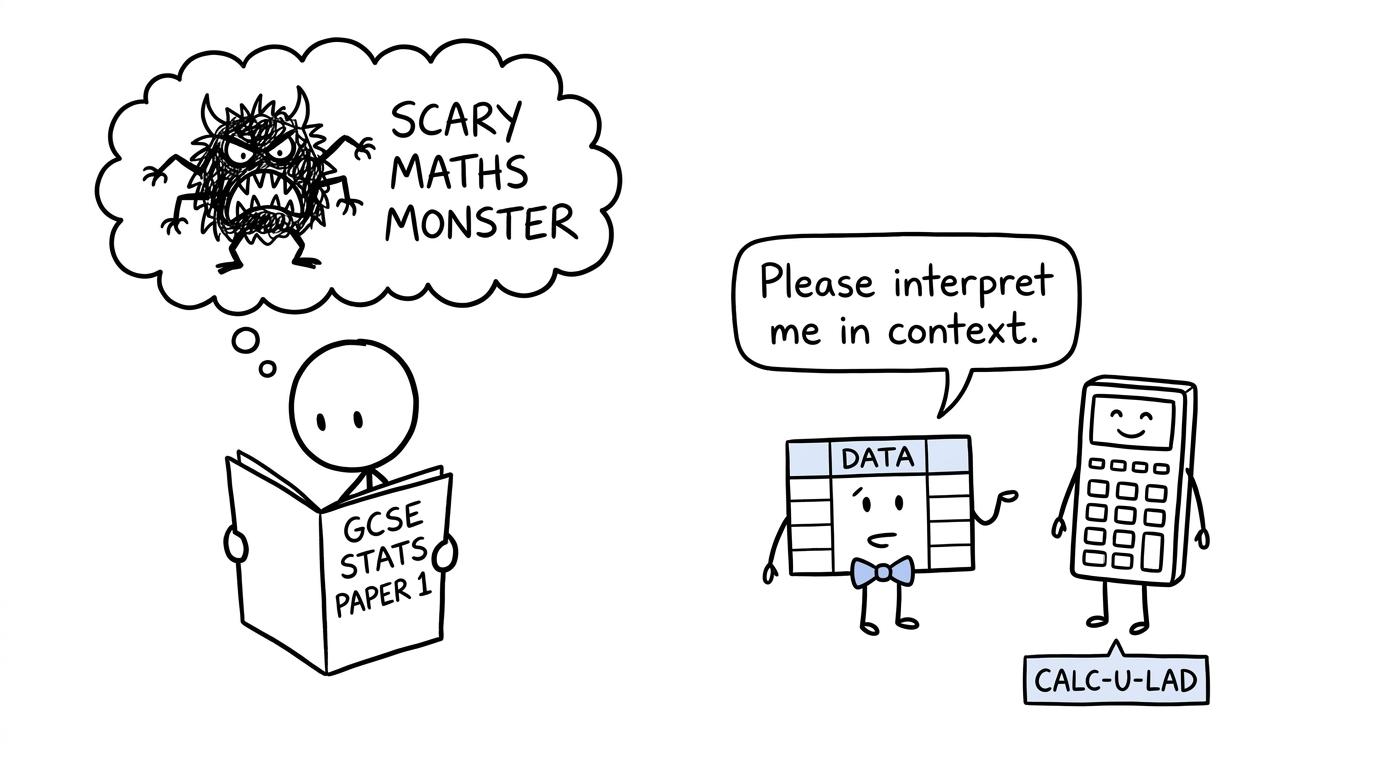 A polite data table surprises a student expecting an exam monster
What is actually different about Paper 1?
The most important difference is also the easiest to miss: Paper 1 is not a separate content unit.
For AQA and Edexcel, content from across the specification can be assessed on either paper. Paper 1 is not officially the sampling paper, the probability paper or the easier paper. Paper 2 is not reserved for whatever was absent from Paper 1.
The papers are separate opportunities to assess the same broad subject content and assessment objectives. Their precise questions differ, but there is no dependable topic split to memorise.
This matters because students sometimes revise from an imagined pattern: “That topic usually appears on Paper 2, so I can leave it.” A pattern noticed in a small collection of past papers is not a rule. The next paper is allowed to break it.
After Paper 1 has been sat, topics appearing on it may influence how you prioritise the remaining days before Paper 2. Even then, do not assume those topics cannot return in a different form.
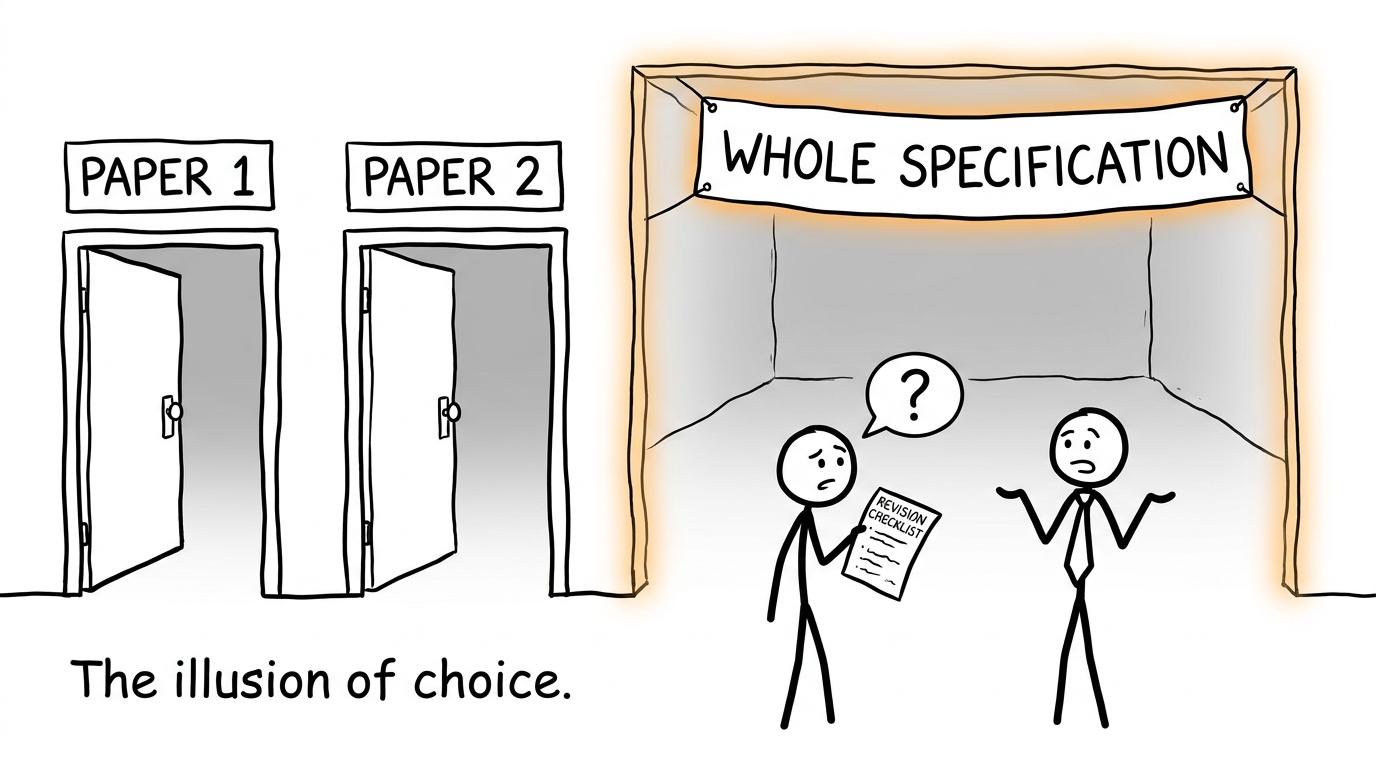 Paper 1 and Paper 2 lead into the same whole-specification room
What kinds of questions does Paper 1 favour?
It is more accurate to talk about question styles than favourite topics. GCSE Statistics is designed to test whether you can use statistical ideas sensibly, not merely operate a calculator.
Applying standard statistical techniques
A substantial part of the assessment concerns statistical knowledge and routine methods. Depending on your board and tier, this may involve:
- identifying types of data and variables;
- choosing or analysing sampling methods;
- calculating and comparing measures of central tendency and spread;
- constructing or interpreting statistical diagrams;
- analysing time series and correlation;
- calculating probabilities;
- using statistical formulae and calculator functions.
Graphs deserve careful revision because they combine technique with interpretation. The histograms revision guide reinforces why bar area, rather than height alone, represents frequency. The cumulative frequency revision guide covers the relationship between cumulative totals, quartiles and box plots.
These GCSE Maths guides overlap with useful statistical techniques, but your GCSE Statistics specification remains the final checklist for what you must know.
Interpreting results in context
A correct number is often only the beginning. Questions may ask you to compare distributions, explain what a value means or decide whether evidence supports a claim.
A strong statistical comparison normally considers both a typical value and spread. More importantly, it refers to the groups and variable named in the question. Saying that one group is “more consistent” is incomplete unless you connect that judgement to an appropriate measure of spread and the given context.
Command words matter here:
- State usually requires a brief answer.
- Describe requires a relevant feature or pattern.
- Compare requires linked statements about both data sets.
- Explain requires a reason, not just an observation.
- Evaluate requires a judgement supported by statistical evidence.
Evaluating the statistical enquiry cycle
The statistical enquiry cycle runs through the qualification. You may need to consider:
- the question or hypothesis being investigated;
- the population and sampling frame;
- how a sample was selected;
- possible bias and non-response;
- the suitability of a questionnaire or data source;
- the choice of diagram or summary statistic;
- whether a conclusion is justified;
- how an investigation could be improved.
These questions reward precision. “The sample is biased” is weaker than identifying why it is biased and explaining how that limitation could affect the conclusion.
Foundation and higher tier expectations
Foundation and higher papers share the same broad statistical story: collect data, represent it, analyse it and judge what it supports. The difference lies in the depth, complexity and range of techniques required.
Foundation questions tend to provide more structure and use more accessible procedures. Higher questions can require less familiar contexts, more demanding techniques and longer chains of statistical reasoning. On either tier, however, later questions should not be treated as automatically impossible. Read them before deciding.
Revise from material labelled for your own tier. Sitting the wrong tier of past paper can distort your view of both difficulty and timing. The Edexcel Higher Paper 1 specimen, for example, is useful only if you recognise that it represents higher-tier demand and the Edexcel format.
How to manage the time
Timing is not about rushing from the first minute. It is about preventing one difficult question from consuming time that could earn marks elsewhere.
Use the marks printed beside each question as a guide. A longer response carrying several marks should receive more attention than a one-mark definition, but your pace need not be mechanically identical throughout the paper.
A sensible approach is:
- scan the paper briefly so you know its length;
- answer accessible questions without unnecessary delay;
- underline command words and key contextual information;
- leave space and move on when progress stops;
- return to unfinished questions later;
- preserve time to check graphs, labels, units and conclusions.
For graphical work, carry a ruler, pencil, eraser, protractor and compasses alongside your calculator. Check the instructions on your own paper and follow your centre's equipment guidance.
Do not wait until the real examination to discover how your calculator handles statistical functions. Practise entering lists, checking settings and interpreting displayed values during revision.
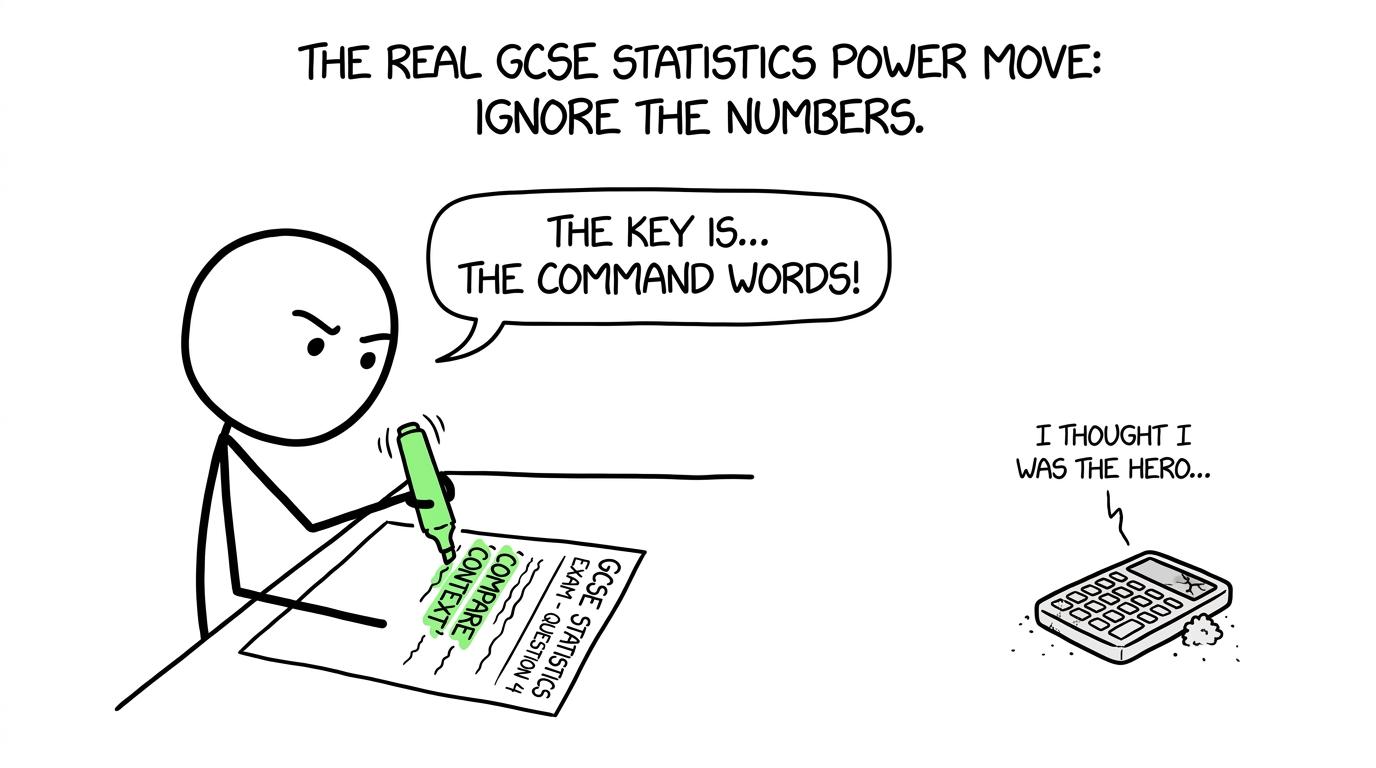 A calculator discovers that context words are the real exam heroes
How to revise for GCSE Statistics Paper 1
Begin with coverage, then move towards exam performance.
Build a specification checklist
Divide your course into three broad areas:
- collecting data;
- processing, representing and analysing data;
- probability.
Within each area, mark topics as secure, uncertain or not yet secure. Base the judgement on questions you have attempted, not on whether your notes look familiar.
Use topic practice to repair gaps
For an uncertain topic, review the revision lesson, complete practice questions and mark them immediately. Record the exact cause of each lost mark: missing knowledge, incorrect method, calculator use, weak interpretation or imprecise language.
A practical schedule can be built using the ideas in the GCSE maths revision timetable guide. Adapt the structure to Statistics by mixing topic sessions with timed Paper 1 sections.
Complete full papers under the correct conditions
Once most topics are reasonably secure, sit complete papers using your board's official time allowance. A timed paper measures more than knowledge. It reveals whether you can switch between sampling, diagrams, calculations, probability and evaluation without losing focus.
Mark each attempt with the relevant mark scheme. Do not merely total the score. Rewrite weak explanations, correct methods and return to the underlying topic before attempting another paper.
Predicted papers and mini tests can add variety near the exam, but they should not replace broad specification coverage. MathsGenie's GCSE predicted papers and resources are most useful as part of a larger cycle of learning, practising, marking and correcting.
Common mistakes on Paper 1
Treating Paper 1 as a non-calculator paper
That assumption often comes from GCSE Maths. GCSE Statistics is different: calculators are allowed on both AQA and Edexcel papers. Bring one, but still show enough working to communicate your method.
Revising predicted topics instead of the specification
Any specification content can appear. Predictions can guide extra practice, but they cannot safely remove topics from your revision.
Giving calculations without interpretation
When the question asks for a conclusion, comparison or comment, a numerical answer alone may not address it. Refer to the actual variable and groups.
Comparing only averages
Two distributions can have similar centres but very different spreads. Check whether the question expects comparison using both an appropriate average and an appropriate measure of dispersion.
Using vague criticism
Statements such as “the sample is bad” or “the graph is misleading” need explanation. Identify the precise weakness and its likely effect.
Rounding too early
Keep sufficient calculator accuracy during intermediate stages and round only when the question requires it or at the final answer. Make the degree of accuracy clear.
Trusting a calculator entry without checking it
A calculator can process the numbers you enter, but it cannot notice that you used the wrong column, omitted a frequency or selected an inappropriate statistic. Estimate what kind of answer is reasonable.
Go into Paper 1 knowing what it is
GCSE Statistics Paper 1 is not a secret list of favourite topics. It is the first of two equally weighted opportunities to show that you can perform statistical techniques, interpret evidence and judge the quality of an investigation.
That is good news. You do not need to outguess the examiner. You need a dependable process.
Start at the MathsGenie GCSE Statistics hub, choose your board and tier, and work from revision lessons into practice questions. Then use past papers, mark schemes, video solutions, mini tests and predicted papers to turn individual skills into complete-paper performance. The aim is not to make every question feel familiar. It is to become calm and capable when the context is not.