GCSE Statistics Foundation Tier Grade Cap Explained
GCSE Statistics foundation tier grade cap explained: the highest grade is 5. Learn what the limit means and when to discuss taking Higher tier.
It is possible to answer almost every question correctly and still be unable to reach the highest grades. That sounds strange until you understand how tiering works.
The GCSE Statistics foundation tier grade cap is grade 555. Foundation tier offers grades 111 to 555, so you cannot receive grade 666, 777, 888 or 999 from a Foundation Statistics paper, regardless of how high your raw mark is. To access those grades, you must be entered for Higher tier.
That is the short answer. The more useful question is what the ceiling means for your revision, your target grade and the conversation you may need to have with your teacher.
Foundation tier grade cap: the quick checklist
Here are the facts to remember:
- The highest available grade on Foundation tier GCSE Statistics is grade 555.
- Foundation tier covers grades 111 to 555.
- Higher tier primarily covers grades 444 to 999.
- You cannot convert an exceptionally high Foundation mark into grade 666 or above.
- Both papers must be taken at the same tier in the same examination series.
- Grade boundaries are set after the examinations and can change between series.
- If your target is grade 666 or higher, discuss Higher tier entry with your teacher well before final entries are made.
You can begin by checking your board and available papers through the GCSE Statistics revision hub. GCSE Statistics is a separate qualification from GCSE Maths, even though several topics overlap.
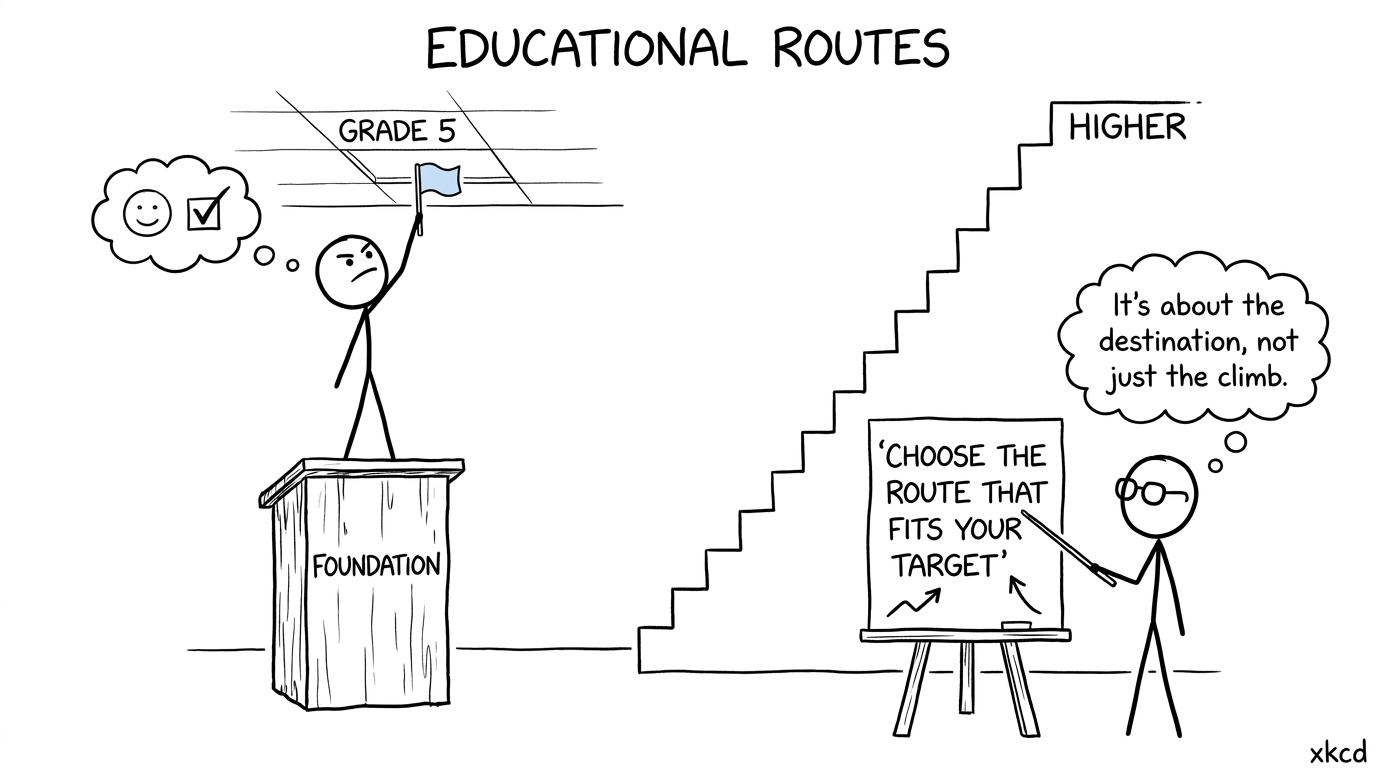 A student reaches the Foundation grade ceiling while a Higher staircase continues
Why is Foundation GCSE Statistics capped at grade 5?
Tiering is designed to give students papers with an appropriate level of demand. Foundation papers target the knowledge, interpretation and evaluation needed for grades 111 to 555. Higher papers include access to the upper grades, but they also contain more demanding questions and a less forgiving lower end.
Current Ofqual conditions for GCSE Statistics require Foundation assessments to target grades 111 to 555 and Higher assessments to target grades 444 to 999. The current AQA and Pearson Edexcel specifications follow that model.
This is not a penalty applied after you sit the paper. It is part of the qualification design. If you are entered for Foundation, grade 555 is the maximum certification grade available from the beginning.
A useful way to think about it is that a tier is a route, not a judgement. Foundation offers a clearer route towards grades up to 555. Higher opens the road to grades 666 to 999, but introduces questions designed for that higher level of demand.
What happens if you get full marks on Foundation tier?
Even a perfect raw mark on Foundation tier cannot produce grade 666. You would receive grade 555, because that is the highest grade available on the tier.
Your result is based on your combined subject mark rather than a separate grade for each paper. In both current AQA and Pearson Edexcel GCSE Statistics, there are two papers worth 808080 marks each, giving a total of:
80+80=160 80 + 80 = 160 80+80=160The grade boundary tells you the minimum combined raw mark needed for each available grade. It is not a permanent percentage. Boundaries can move because awarding bodies review the difficulty of the papers and the performance evidence from that examination series.
This matters when using past papers. A previous boundary can help you judge progress, but it cannot promise a future grade. Track your raw marks, look for consistency across several papers and avoid revising towards one supposedly guaranteed percentage.
The Edexcel GCSE Statistics revision page brings together tiered practice, worksheets and past papers so that you can compare performance over time rather than relying on one attempt.
Foundation versus Higher tier GCSE Statistics
The choice is not simply between an easy paper and a hard paper. It is a decision about risk, opportunity and your current evidence.
Foundation tier may be appropriate when
- your target is grade 555 or below;
- Foundation questions currently give you the best chance of demonstrating secure knowledge;
- you need to strengthen core statistical ideas and interpretation;
- your recent timed assessments support a Foundation entry.
The top end of Foundation is not effortless. Grade 555 questions can require careful reasoning, connected methods and conclusions written in context. You still need a complete revision plan.
Higher tier may be appropriate when
- your target is grade 666 or above;
- you are consistently secure on grade 444 and 555 material;
- your teacher has evidence that you can cope with Higher-tier demand;
- you understand the greater risk at the lower end of the Higher paper.
Higher tier offers grades 444 to 999. Under the tiering rules, a grade 333 may also be awarded as a narrow safety net when a candidate falls a small number of marks below the grade 444 boundary. Below that range, the result is unclassified. Higher therefore creates more upside, but it is not automatically the safer choice.
Tier decisions should be based on several pieces of timed evidence, not one unusually good worksheet or one difficult mock. Your teacher can consider your consistency, target, classroom work and ability to handle the full Higher specification.
What the grade cap means if you want a top grade
If your goal is grade 777, 888 or 999, the practical conclusion is immediate: you need a Higher-tier entry. No revision technique can override the Foundation cap.
However, moving tier is only useful if your preparation changes with it. Higher Statistics is not Foundation with a few harder questions attached. You must be ready for the additional content and for deeper statistical reasoning, interpretation and evaluation.
Start by asking three questions:
- What tier am I currently entered for?
- What grade do I need or genuinely want?
- What evidence would my teacher need before considering a change?
Have that conversation early. Schools and colleges control examination entries and may have internal deadlines before the awarding body's final deadline. Do not assume that a strong mock automatically changes your entry.
If a move is being considered, use a Higher paper under timed conditions, mark it carefully and identify whether lost marks come from missing content, weak interpretation or avoidable errors. The aim is not to prove something in one afternoon. It is to see whether Higher-tier performance is becoming dependable.
How to aim for grade 5 on Foundation tier
A ceiling can feel limiting, but it can also make the goal precise. To secure grade 555, revision should focus on collecting available marks consistently.
Know the whole Foundation specification
GCSE Statistics includes more than calculating averages. Depending on your board, Foundation content can include the statistical enquiry cycle, sampling, data collection, diagrams, measures of central tendency and spread, correlation, time series, index numbers and probability.
Use your own exam board's specification as the final authority. AQA and Edexcel papers differ in format and timing, so practise the correct papers rather than treating every Statistics qualification as interchangeable.
Practise explanation as well as calculation
Statistics often asks what a result means, whether a method is suitable or why a conclusion may be unreliable. A numerical answer without context may not complete the task.
Train yourself to ask:
- What does this value describe?
- Which group or population does the conclusion concern?
- Is the sample representative?
- Does the evidence show association, or is someone claiming causation?
- Is interpolation reasonable, and would extrapolation be risky?
These habits matter because statistical understanding lives in the interpretation, not only in calculator work.
Use a paper-mark-repair cycle
Complete a timed section or paper, check it with the mark scheme and classify every lost mark. Then repair the exact weakness before attempting another full paper.
The GCSE Statistics resit revision plan explains how to turn paper performance into a focused list of missing knowledge, incorrect methods, weak interpretation and examination errors. The process is useful whether or not you are resitting.
For structure, add weak topics and paper sessions to the free MathsGenie revision planner. A realistic plan makes improvement easier to repeat.
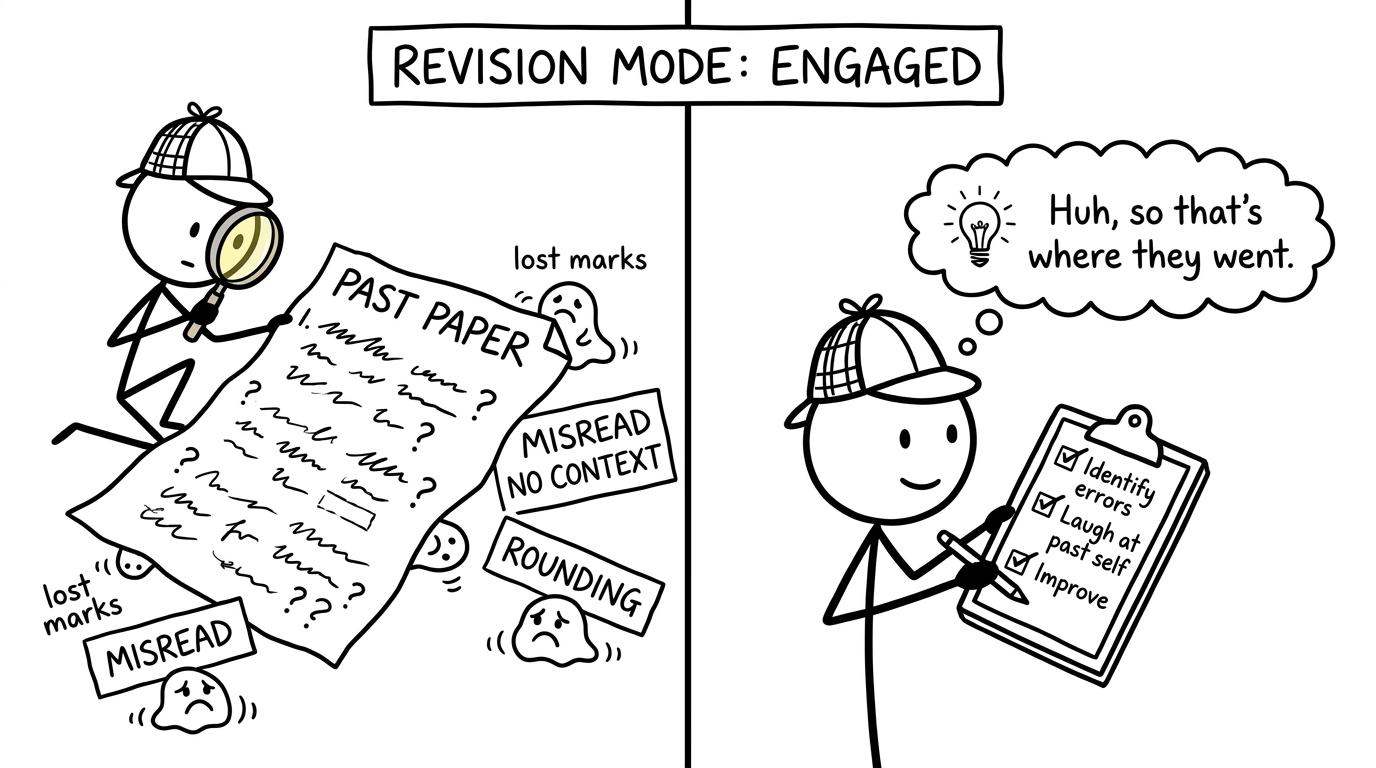 A student detective searches a past paper for hidden lost marks
Common mistakes about the Foundation grade ceiling
Assuming a high percentage can become grade 6
It cannot. Raw marks determine where you sit within the grades available on your tier. Foundation remains capped at grade 555 even if your mark is far above that year's grade 555 boundary.
Confusing GCSE Statistics with the statistics part of GCSE Maths
GCSE Statistics is a standalone qualification. GCSE Maths also contains statistics and probability, but it has different papers, specifications and assessment structures. Always check the title and specification code on your materials.
Using one past boundary as a guaranteed target
Grade boundaries vary. A past boundary is historical information, not a fixed prediction. The better measure is whether you can repeatedly earn secure raw marks on unseen papers.
Moving to Higher only because Foundation feels comfortable
Comfort on routine Foundation questions is encouraging, but Higher entry requires evidence across the additional content and harder reasoning. Try full Higher assessments and listen to your teacher's judgement.
Marking only the final answers
Mark schemes reveal whether marks are awarded for method, interpretation, comparison and conclusions in context. Treat every paper as feedback. The guide on when to start GCSE past papers can help you introduce timed work without using all your papers too early.
Your next step with MathsGenie
The GCSE Statistics foundation tier grade cap is clear: grade 555 is the highest possible result. If grade 555 matches your goal, build accuracy across the full Foundation specification. If you are aiming for grade 666 to 999, speak to your teacher about Higher tier and gather reliable evidence from timed Higher work.
Then turn the decision into action. Choose your board in the MathsGenie GCSE Statistics revision area, use revision lessons and practice questions to close topic gaps, and test your progress with past papers, mark schemes and video solutions. Where available, add mini tests and predicted papers closer to the examination.
A grade cap tells you where one route ends. Good revision helps you decide whether to master that route or prepare, carefully and honestly, for another.