GCSE Statistics Careers: Jobs That Value Your Grade
GCSE statistics careers explained: discover the jobs, apprenticeships and next-step courses where data skills and a strong grade can help you stand out.
A qualification can feel strangely abstract when you are revising sampling methods at the kitchen table. You may understand how to compare distributions, yet still wonder who will ever care.
The short answer is that GCSE statistics careers extend across data analysis, healthcare, finance, market research, government, sport, technology and manufacturing. A strong grade will not qualify you for these careers by itself, but it can support applications for data-focused courses and apprenticeships. More importantly, it begins to show that you can collect evidence, question its reliability and explain what it means.
That combination is useful almost everywhere decisions are made.
GCSE statistics careers at a glance
GCSE Statistics can be particularly relevant if you are considering:
- data technician or data analyst apprenticeships;
- market and social research;
- healthcare, medical research and epidemiology;
- finance, insurance and actuarial work;
- business intelligence and operations;
- government statistics and policy analysis;
- quality control, engineering and manufacturing;
- sports, environmental and geographical analysis;
- psychology and other social sciences.
There is an important distinction, however. Employers and apprenticeship providers commonly specify GCSE Maths and English in their entry requirements. They are less likely to demand GCSE Statistics specifically. Your Statistics result is therefore usually an additional relevant qualification, not a replacement for GCSE Maths.
Entry criteria also vary by employer, provider and nation, so always read the current vacancy rather than assuming every programme follows the same rules.
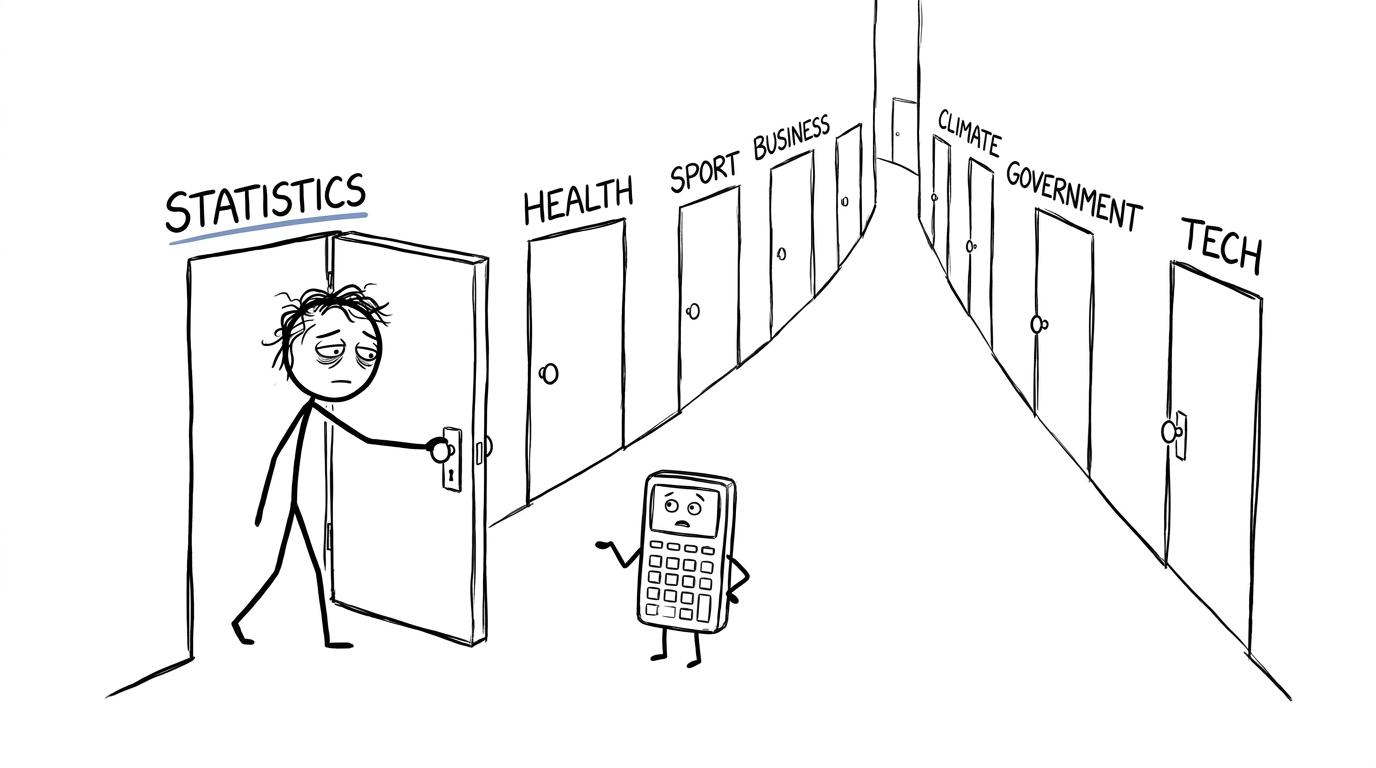 A GCSE Statistics doorway opening onto careers in health, sport, business, government and technology
What does GCSE Statistics actually teach employers?
Official GCSE Statistics specifications place substantial emphasis on the statistical enquiry cycle. You learn to define a question, collect appropriate data, process and present it, interpret the results, and evaluate the investigation.
That matters because workplace data rarely arrives as a perfectly labelled exam question. Someone must decide whether the information is trustworthy before using it.
Collecting reliable information
Sampling is not merely a classroom technique. Businesses survey customers, researchers recruit participants, manufacturers inspect products and public bodies collect information about communities.
Knowing the difference between a population, sampling frame and sample helps you ask whether the selected data represent the wider group. Understanding random, systematic, stratified and quota sampling helps you identify where bias might enter an investigation.
Analysing and presenting data
Averages, measures of spread, time series, index numbers and data visualisations turn raw observations into something interpretable. The underlying habit is more valuable than any single graph: choose a method that matches the question.
If this is one of your weaker areas, MathsGenie's GCSE Statistics revision hub brings together free resources by exam board. Students taking Pearson can also use the dedicated Edexcel GCSE Statistics revision resources.
Questioning conclusions
Statistics is not just calculation. It involves noticing misleading scales, small samples, non-response, confounding factors and conclusions that stretch beyond the evidence.
Correlation, for example, does not establish causation. That sentence is short, but the judgement behind it is central to research, journalism, policy and business.
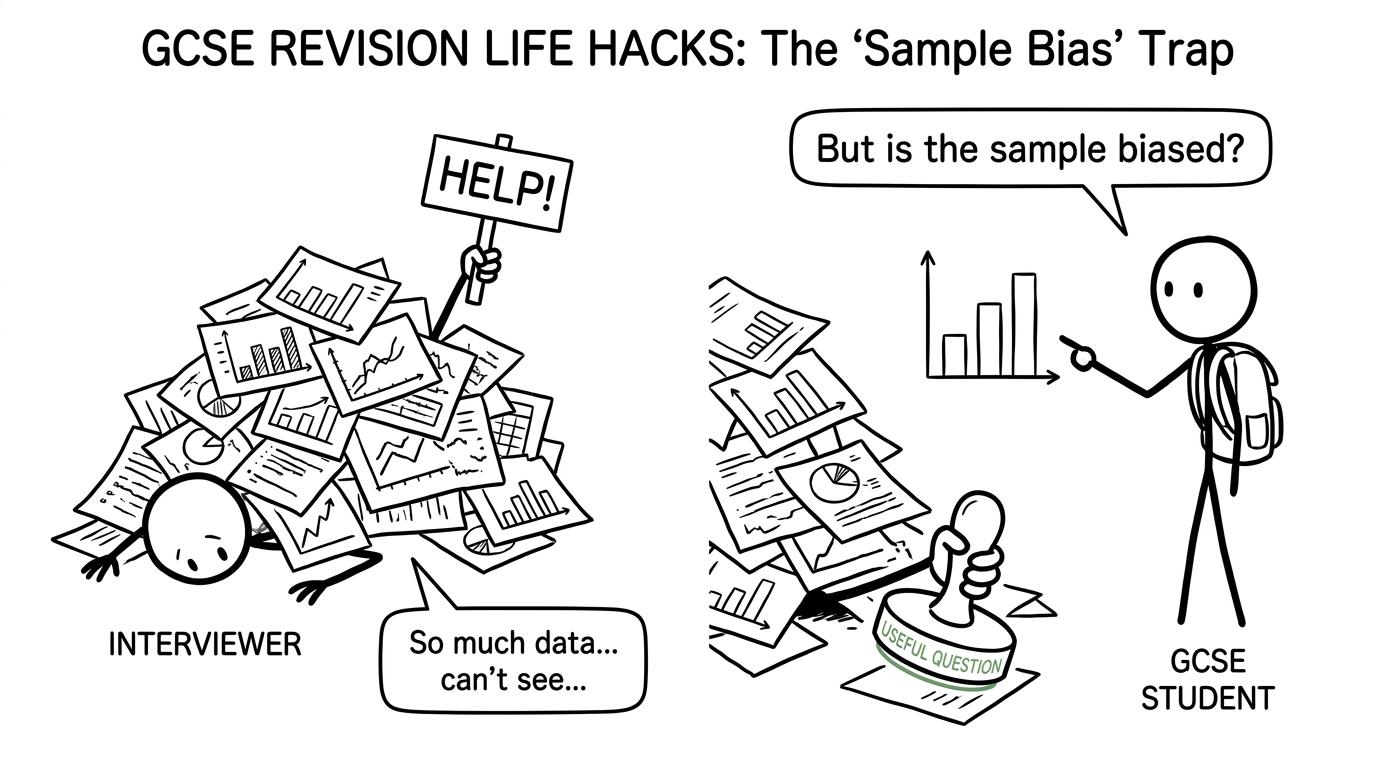 An interviewer appreciating a student who questions whether a sample is biased
Career paths where statistical skills matter
Data analysis and technology
Data analysts collect, organise and examine information so that organisations can understand performance, identify patterns and make decisions. Depending on the role, they may create reports and dashboards, check data quality or communicate findings to colleagues.
GCSE Statistics introduces the reasoning behind this work. Later courses add spreadsheets, databases, programming and more advanced statistical methods.
This field includes several apprenticeship routes. Current occupational pathways include Level 333 data technician programmes, Level 444 data analyst apprenticeships and Level 666 data scientist degree apprenticeships. Availability and exact entry requirements change, but providers commonly value mathematical confidence, communication and an interest in data.
Market research and business intelligence
Market researchers use surveys and other data to explore customer behaviour, opinions and demand. Business intelligence teams analyse information about sales, costs, services and performance.
Questionnaire design is especially relevant here. A leading question can distort responses; an unrepresentative sample can produce a confident-looking but weak conclusion. GCSE Statistics gives you a vocabulary for explaining those problems.
Healthcare and medical research
Healthcare organisations use data to monitor services, evaluate treatments and investigate patterns in illness. Medical statisticians and epidemiologists require qualifications well beyond GCSE, usually involving advanced study, but the foundations begin with probability, risk, sampling and interpretation.
This is an area where context matters. Relative risk and absolute risk can create very different impressions, so accurate communication is as important as calculation.
Finance, insurance and actuarial work
Actuaries estimate financial risk and uncertainty, particularly in insurance, pensions and investment. Financial and risk analysts also use models, probabilities and historical data to support decisions.
These careers normally require strong post-161616 mathematics and, for many professional routes, a relevant degree or degree apprenticeship. GCSE Statistics is not a professional qualification, but a good result can strengthen the story told by your wider subject choices: you are comfortable reasoning with uncertainty rather than merely manipulating numbers.
Government, economics and social research
Government analysts study population, economic and service data. Their work may inform decisions about transport, health, education or local services. Social researchers design surveys and investigate how people experience policies and institutions.
This is why statistics connects naturally with geography, economics, sociology and psychology. MathsGenie's GCSE Psychology handling data guide shows how averages, frequencies and graphs operate in another subject rather than staying inside a maths classroom.
Engineering, manufacturing and quality control
Manufacturers collect data to check whether products and processes meet expected standards. Engineers examine variation, reliability and performance. A suspicious result may indicate a genuine fault, a measurement problem or ordinary variation, and those possibilities should not be treated as identical.
GCSE Statistics develops the early habit of comparing centre and spread rather than judging a process from one isolated value.
Sport, geography and environmental work
Sports analysts examine performance patterns, while environmental and geographical roles use data about weather, populations, land and resources. These careers combine subject knowledge with the ability to interpret evidence.
The connection is visible in MathsGenie's GCSE Geography statistical skills guide, where measures of spread, cumulative frequency and percentage change support geographical conclusions.
Where a good GCSE Statistics grade gets noticed
A grade is most useful when it is relevant to the next opportunity. It may stand out in three places.
Apprenticeship applications
A data technician or analyst apprenticeship may list GCSE Maths and English as formal requirements while asking applicants to demonstrate analytical ability, accuracy, digital confidence or interest in data. GCSE Statistics gives you direct evidence for that second group of qualities.
On an application, do not simply write that you “like statistics”. Mention relevant learning honestly: interpreting data, evaluating sampling, comparing distributions or communicating conclusions. Never claim experience with software or projects you have not completed.
College and sixth-form choices
A strong Statistics result can support progression into A Level Maths, Psychology, Geography, Biology, Economics, Business or vocational courses involving digital data. It does not guarantee admission, and each school or college sets its own entry requirements, but it provides evidence that you can manage data-rich work.
If A Level Maths is your goal, remember that GCSE Maths performance will usually carry greater formal weight. Statistics should be seen as valuable reinforcement.
CVs and interviews
An additional GCSE can help distinguish your academic profile, particularly when the role involves reports, surveys, spreadsheets or evidence-based decisions. Its value grows when you can explain what you learnt from it.
A grade opens the conversation. Your explanation shows whether the knowledge stayed with you.
Apprenticeship or A Levels: which route is better?
Neither route is automatically better. They serve different preferences.
An apprenticeship may suit you if you want paid work alongside structured training and enjoy applying skills to real organisational data. A Levels may suit you if you want broader academic preparation before university, a degree apprenticeship or later specialist training.
Data careers now include routes at several apprenticeship levels, but vacancies are employer-led and can be competitive. Check the exact role, training level, location and entry requirements when you apply. Do not choose a programme solely because its title contains the word “data”. Read what the job involves each day.
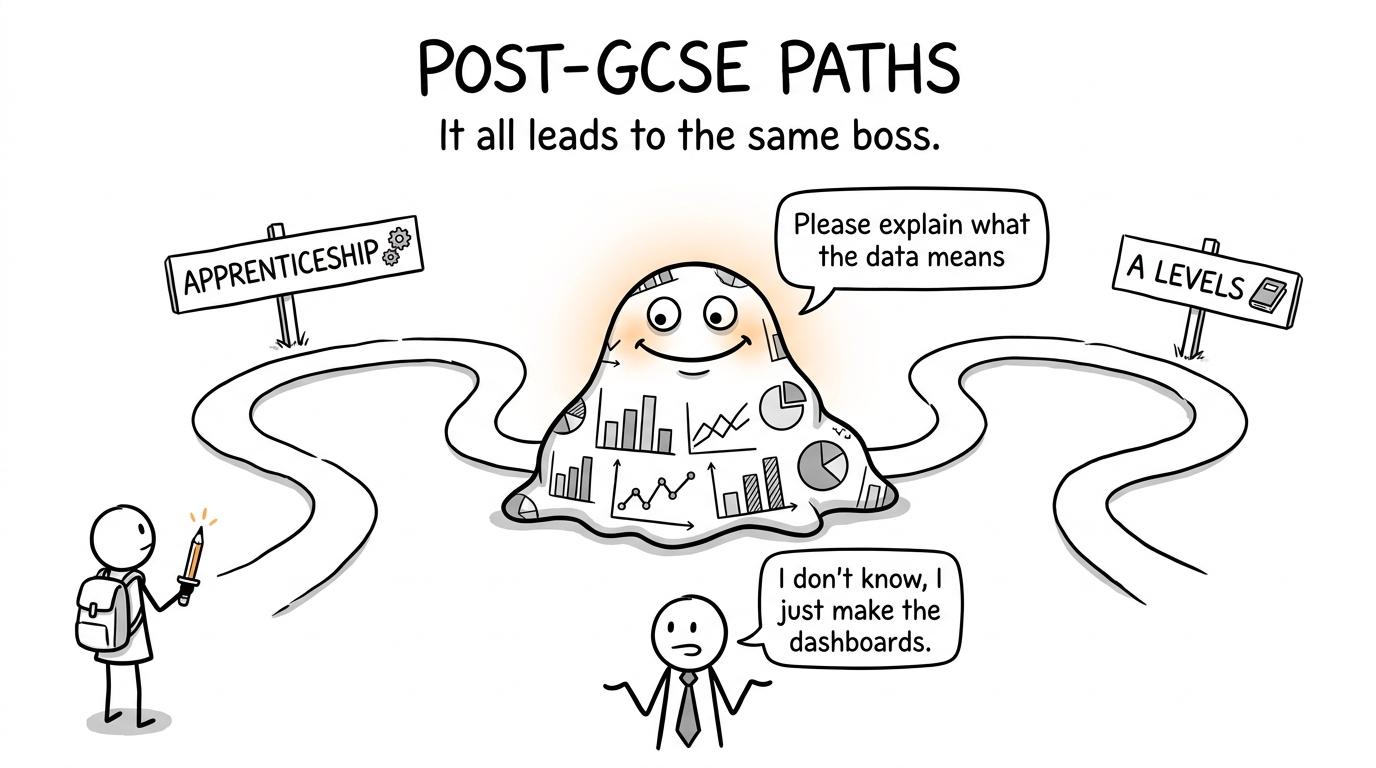 Apprenticeship and A Level paths meeting at the challenge of explaining what data means
How to turn revision into career evidence
You do not need to turn every revision session into a career plan. You can, however, build the same habits that employers and later courses value.
- Interpret in context: finish calculations with a sentence about what the result means.
- Check reliability: ask how the data were collected and what might create bias.
- Compare properly: discuss both a suitable average and a measure of spread.
- Communicate clearly: make graphs readable and use precise statistical language.
- Correct mistakes: use mark schemes to identify whether you lost knowledge, method or interpretation marks.
For visual topics, revise with the cumulative frequency lesson and practice resources. If you later progress to A Level Maths, the AS Level representations of data guide shows how ideas such as histograms, box plots and outliers develop further.
Common mistakes when thinking about statistics careers
Assuming the GCSE guarantees a data job
It does not. Specialist careers usually require further education, technical training or an apprenticeship. GCSE Statistics is a foundation and a useful signal of interest.
Treating it as a substitute for GCSE Maths
Where an application explicitly requires GCSE Maths, a Statistics qualification will not normally replace it unless the provider clearly says otherwise. Check the stated requirements.
Believing only statisticians use statistics
Healthcare workers, researchers, managers, engineers, journalists and sports analysts can all encounter data. The qualification is useful because the skill travels between sectors.
Focusing only on calculations
Employers do not simply need people who can produce a number. They need people who can decide whether that number is relevant, reliable and clearly communicated.
Ignoring interpretation marks in revision
Students sometimes practise methods while neglecting conclusions, assumptions and limitations. Use the mark scheme as a description of what a complete statistical argument requires. If you are rebuilding your preparation, the GCSE Statistics resit revision plan provides a structured approach to diagnosing and correcting gaps.
Make your Statistics grade mean something
The lasting value of GCSE Statistics is not that every employer will ask to see the certificate. It is that you begin learning how to make decisions without pretending the evidence is perfect.
That skill can lead towards an apprenticeship, A Levels, university or a career that you have not discovered yet. Start by making the next revision session count. Choose your board on MathsGenie's free Statistics hub, review a revision lesson, complete practice questions and check every answer against the mark scheme. Then build towards mini tests, past papers and predicted papers where available.
If you want a wider plan across GCSE Maths as well, follow MathsGenie's recommended order for learning GCSE Maths topics. The goal is not to collect resources. It is to use revision lessons, video solutions and honest marking until the evidence of improvement is visible in your work.