GCSE Spanish Revision: Silence or Background Noise?
GCSE Spanish revision silence or noise? Explore what research says about music, lyrics and concentration, then choose the best setting for each task.
Revision can look productive while very little is being remembered. Your book is open, the playlist is running and an hour passes pleasantly. The harder question is what remains tomorrow.
If you are weighing up GCSE Spanish revision silence or noise, the evidence supports a clear starting point: use silence for vocabulary, reading, writing and exam practice. If silence feels uncomfortable, quiet instrumental sound may be a workable compromise, but music with lyrics is the riskiest choice for language-based tasks.
That is not because every sound destroys concentration. Research is more nuanced than that. The effect depends on the noise, the task and the learner, and much of the available evidence comes from general cognitive tasks or adult participants rather than GCSE Spanish students specifically. Still, the pattern around lyrics and verbal work is consistent enough to guide a sensible revision routine.
The quick answer: choose the sound to match the task
Use this checklist before beginning a session:
- Vocabulary recall: silence is the safest default.
- Reading comprehension: choose silence, especially for unfamiliar passages.
- Writing practice: avoid songs with lyrics in any language.
- Listening practice: play only the Spanish recording you need to hear.
- Speaking practice: work somewhere quiet enough to hear and evaluate yourself.
- Routine organisation: quiet instrumental music may be fine if the task requires little verbal thinking.
- Mock papers: reproduce exam conditions as closely as possible.
The important distinction is not simply music versus no music. It is whether the background contains information that competes with the information you are trying to process.
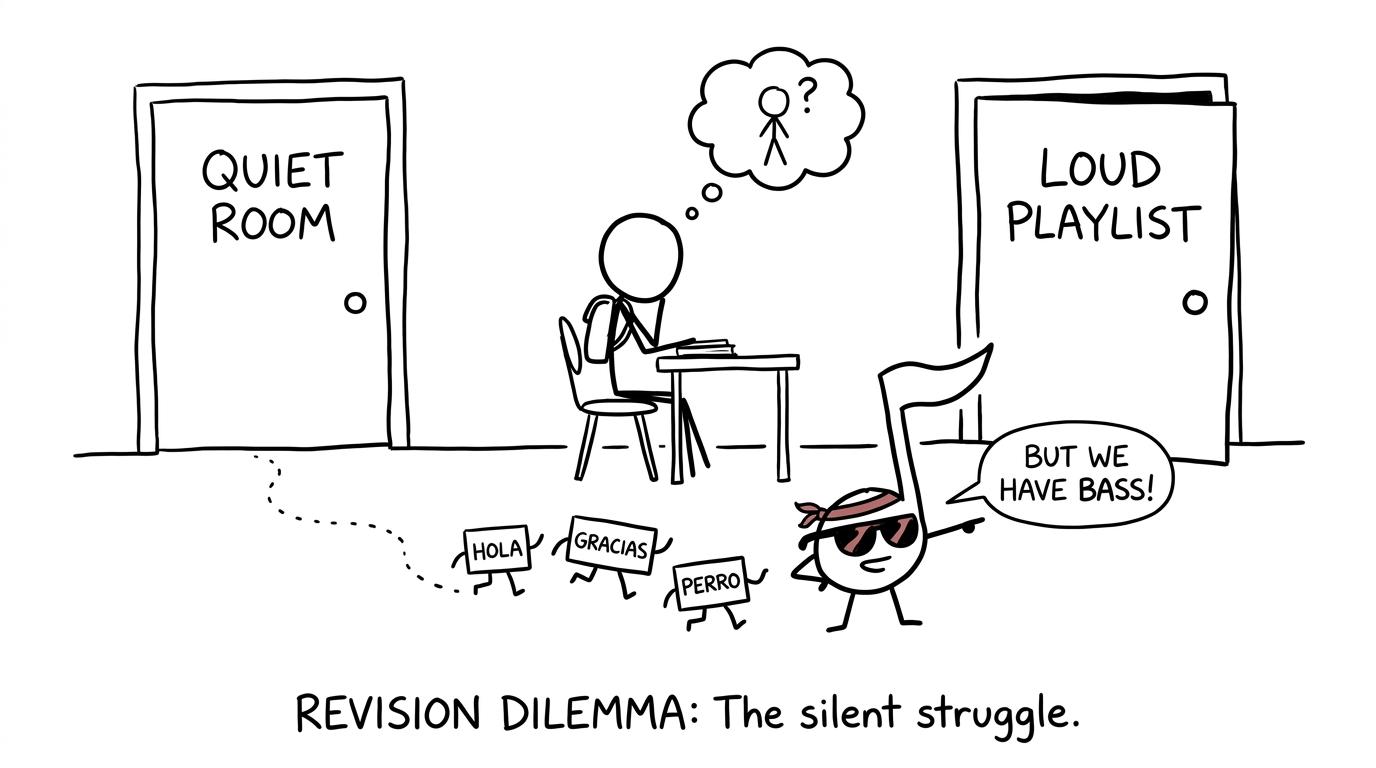 A student chooses between a quiet revision room and a loud playlist
What the evidence says about silence and background music
A systematic review published in 2022 examined background music across memory, language and other cognitive tasks. Its overall findings were mixed: music did not harm every task in every study, but music with lyrics was associated with poorer performance in important areas of memory. Background music also tended to slow reading, while lyrical music was particularly troublesome for reading comprehension.
A controlled study published in 2023 found a similar pattern. Performance was generally strongest in silence, between the two extremes with instrumental music, and weakest with lyrical music. Instrumental lo-fi music did not reliably improve or damage performance, whereas lyrics interfered with verbal and visual memory as well as reading comprehension.
Research published in 2024 found that pop music with lyrics reduced reading comprehension compared with no music. Lyrics in the same language as the text could be especially distracting. Other recent work on self-selected music has produced more mixed results, suggesting that habits, proficiency and individual differences can influence the size of the effect.
This does not prove that every student must revise in absolute silence. It does suggest three practical conclusions:
- silence is the strongest general-purpose option for demanding verbal work;
- instrumental music is not a proven learning aid, even when it feels helpful;
- lyrics add avoidable competition when you are reading, writing or memorising words.
There is an important limitation. These studies do not provide a perfect experiment involving every GCSE student, exam board and Spanish task. Most investigate broader reading, memory or learning activities, often with adults. The advice should therefore be treated as an evidence-informed default, not a universal law.
Why lyrics are especially awkward for Spanish revision
Language revision already asks your attention to manage meaning, spelling, grammar and sound. A song introduces another stream of words at the same time.
Imagine learning a set of Spanish verbs while an English chorus repeats in the background. The lyrics may be familiar, but familiarity does not make them silent. Your brain can still detect words, phrases and changes in the music. That competing verbal material can interfere with holding the Spanish in mind long enough to retrieve or use it.
Spanish-language songs are not automatically better during focused revision. They can be useful learning material when the song itself is the task: perhaps you are identifying vocabulary or following a transcript. They are less helpful when unrelated lyrics are playing behind a reading passage or writing exercise.
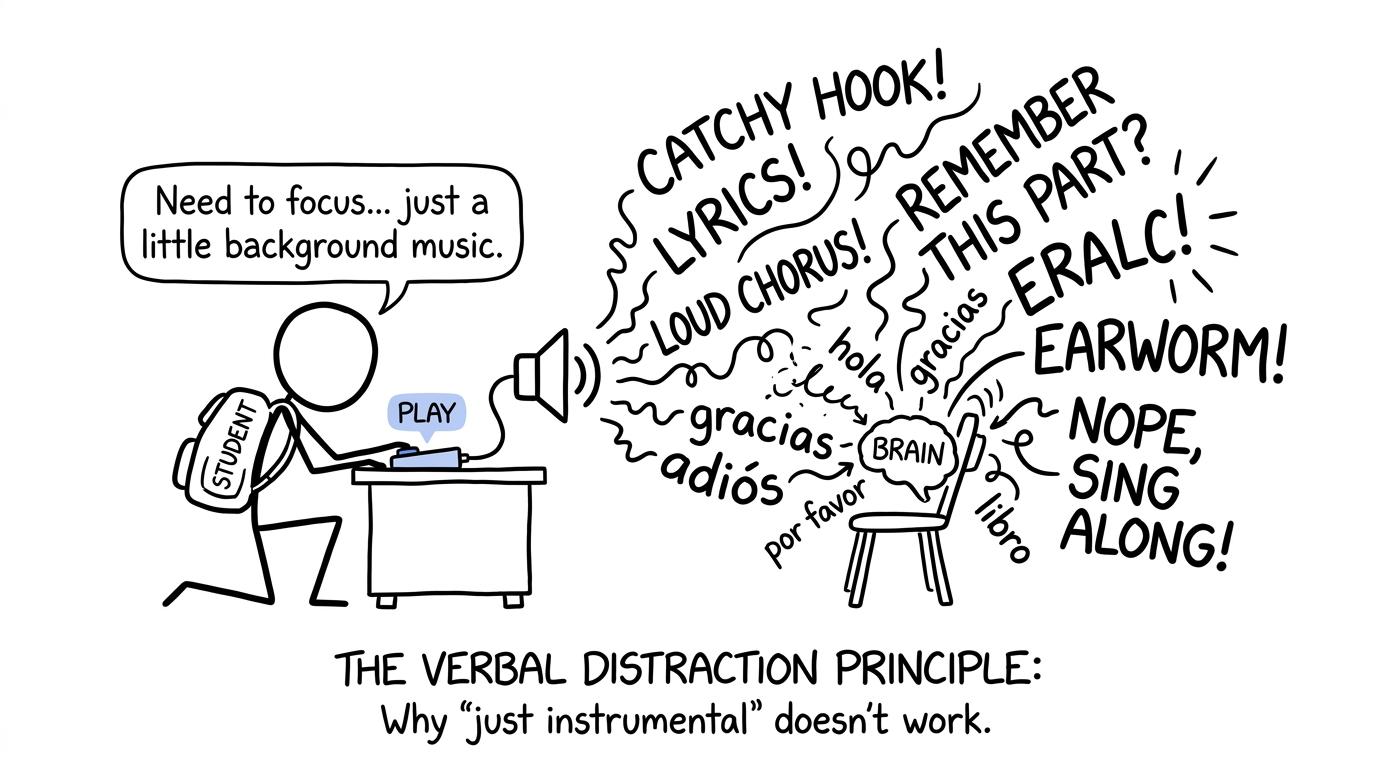 Song lyrics and Spanish vocabulary compete for the brain's only chair
Vocabulary and grammar
Vocabulary practice depends on retrieval. You need to see an English meaning and produce the Spanish word, or move in the opposite direction, without letting recognition masquerade as knowledge.
Silence makes it easier to notice whether the answer genuinely came from memory. The same applies when recalling verb endings, adjective agreement or sentence structures. Instrumental sound may be tolerable, but there is little reason to add it if you can already work comfortably without it.
Reading and writing
Reading comprehension requires you to connect words across a sentence and distinguish detail from plausible distraction. Research most consistently identifies lyrical music as a problem in this kind of verbal task.
Writing is similarly demanding. You must generate an idea, choose vocabulary, control grammar and check accuracy. A background vocalist is effectively supplying an unrelated stream of language while you do it. Silence gives your own sentence a clearer stage.
Listening and speaking
For listening practice, the target recording should be the only deliberate audio. Music, television or conversation makes the task artificially cluttered and can hide details such as negatives, numbers and changes of tense.
Speaking practice is different because you need to create sound. A quiet room still helps: record an answer, listen back and check whether your pronunciation is clear and your response develops naturally. Silence here does not mean never speaking. It means removing irrelevant sound so that you can hear the sound that matters.
Does background noise ever help?
Some students use sound to mask unpredictable distractions: doors closing, conversations nearby or traffic outside. In that situation, a steady non-verbal sound may be less disruptive than constantly changing speech.
Quiet instrumental music can also make it easier to begin a low-demand task, such as arranging notes or planning the week. Enjoyment matters because a theoretically perfect environment is useless if you never sit down in it. But feeling calmer is not the same as remembering more.
Keep the volume low, avoid frequent track changes and choose music without lyrics. If you start following the melody, changing songs or adjusting the playlist, the background has become a foreground activity.
The same principle transfers to maths. Straightforward arithmetic may sometimes be less affected by music than verbal memory, but GCSE maths includes instructions, multi-step reasoning and worded problems. Use silence when completing timed papers from the GCSE Maths revision hub, then use your score and errors to judge the quality of the session rather than how focused it felt.
Run a fair revision experiment
Personal preference matters, but it should be tested rather than assumed. Run two or three comparable sessions:
- choose similar vocabulary sets or reading passages;
- revise for the same amount of time;
- use silence in one session and quiet instrumental sound in another;
- keep your phone, time of day and revision method as consistent as possible;
- test yourself immediately;
- test the same material again after a delay;
- compare accuracy, time taken and the number of avoidable errors.
Do not compare a difficult silent session with an easy musical one. That only measures task difficulty. Also avoid testing your favourite lyrical playlist first and deciding from enjoyment alone.
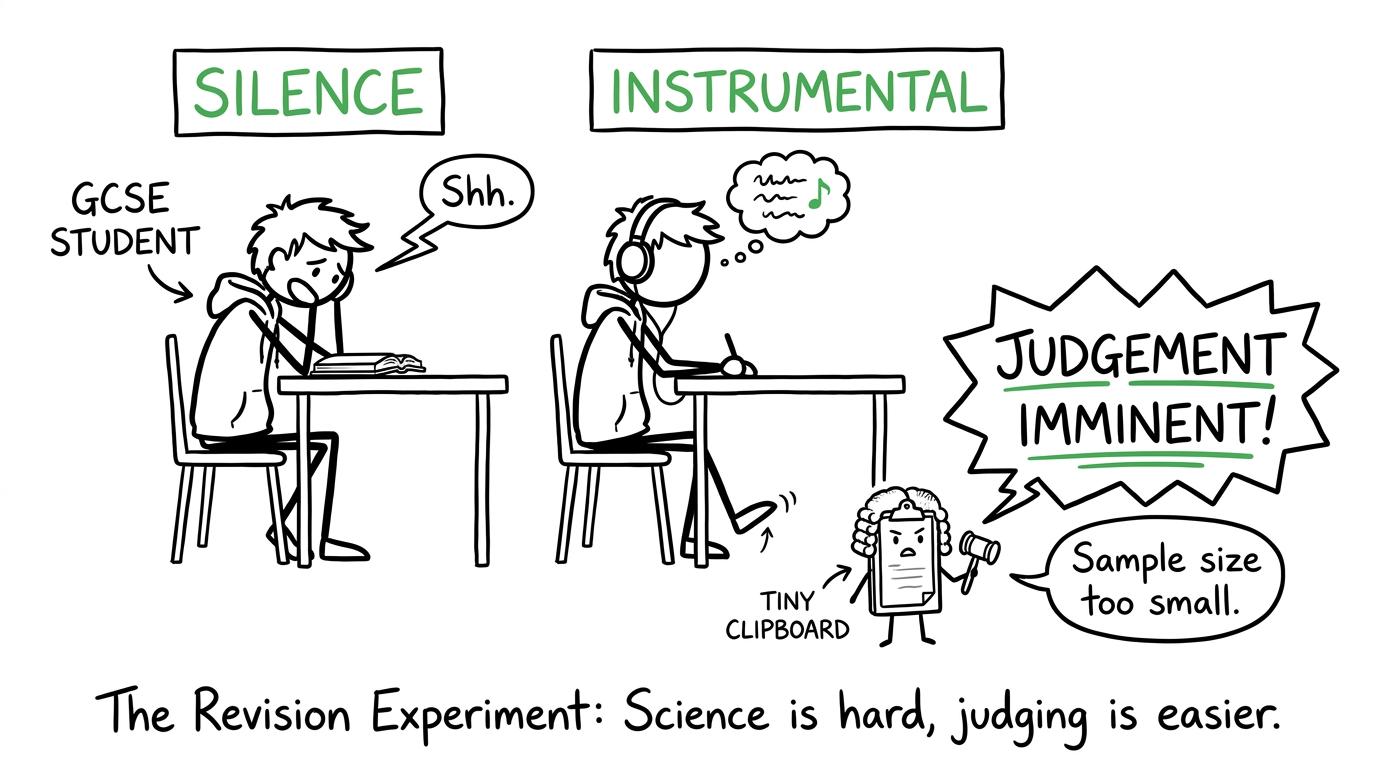 A GCSE student runs a dramatic silence versus instrumental revision experiment
This approach works for maths revision too. Try a MathsGenie mini-test and revision routine under each condition, mark it carefully and compare concentration slips. When you are ready for longer practice, the guide to starting GCSE past papers explains how shorter diagnostics can develop into full timed papers.
Build silence into exam preparation
Revision is partly about knowledge and partly about becoming familiar with performance conditions. If every difficult task is completed with music, silence in the real exam may feel strangely empty. Practising without a soundtrack removes that mismatch.
For Spanish, complete reading and writing practice without background audio. During listening practice, use only the official or teacher-provided recording. Follow the conditions set by your school for speaking preparation and assessment.
For maths, use a paper matching your board and tier. MathsGenie provides free resources for Edexcel, AQA, OCR and Eduqas through the GCSE Maths revision page. Edexcel students can use GCSE Maths predicted papers for fresh exam-style practice, alongside official past papers.
Sit the paper quietly, mark it and turn each lost mark into a specific next action. The guide to using Edexcel past papers properly shows how to move from a score to targeted topic repair. Predicted papers should supplement past papers, not replace them.
Common mistakes when choosing a revision soundtrack
Assuming preference proves performance
A playlist can make revision feel quicker without improving recall. Measure what you remember later, not just how comfortable the session felt.
Treating instrumental music as a guaranteed boost
Evidence often finds little reliable difference between instrumental music and silence. Instrumental sound may be neutral or manageable for some learners, but it is not a shortcut to better grades.
Using Spanish songs as unrelated background audio
Spanish music can become a useful learning resource when you actively analyse it. When you are answering unrelated questions, its lyrics are still competing verbal information.
Revising with television or conversation nearby
Changing voices and meaningful speech are difficult to ignore. If your home is noisy, move rooms where possible, agree on a quiet period or use a steady non-verbal sound to mask unpredictable noise.
Never practising under exam conditions
Music may help you begin ordinary revision, but your final practice should resemble the assessment. The same applies when following a GCSE maths night-before plan: choose a short, focused task and complete it without avoidable distractions.
The best default is simple
For GCSE Spanish revision, silence is the sensible first choice for vocabulary, grammar, reading, writing and realistic exam practice. Quiet instrumental sound is a possible compromise for students who struggle with unpredictable environmental noise, but it has not been shown to be a dependable learning advantage. Music with lyrics carries the clearest risk, particularly when the task itself involves words.
You do not need a perfect room or an elaborate playlist. You need an environment in which effort becomes retrievable knowledge.
Use the same principle across your subjects. Open the MathsGenie GCSE revision hub, choose a revision lesson or set of practice questions, and work in focused silence. Then move to mini tests, past papers and predicted papers, using mark schemes and video solutions to repair mistakes. A calm room cannot do the revision for you, but it can stop competing with the work that will improve your marks.