GCSE Spanish Grade Boundaries Year to Year
GCSE Spanish grade boundaries year to year can move. Compare recent AQA and Edexcel shifts, learn why they change, and revise with a safer mark target.
There is a particular kind of uncertainty that appears after an exam. You remember an awkward listening question, estimate your marks and search for last summer’s boundary as though it can reveal the future.
The direct answer is that GCSE Spanish grade boundaries year to year usually move by several marks, but occasionally shift more noticeably. Between summer 2024 and summer 2025, changes ranged from no movement at some Foundation boundaries to a rise of 101010 marks at one AQA Higher boundary. The direction differed by board and tier.
That does not mean grades became unfairly easier or harder. Boundaries move so that the standard of work represented by a grade remains comparable when the difficulty of an examination changes.
The short checklist
Before comparing Spanish boundaries, check:
- the exact exam board and specification;
- whether the entry was Foundation or Higher tier;
- the correct examination series;
- the maximum available mark;
- the overall qualification boundary, not a notional paper boundary;
- whether a specification change makes older figures less comparable.
You can inspect the historical figures directly on MathsGenie’s AQA GCSE Spanish grade boundaries and Edexcel GCSE Spanish grade boundaries pages.
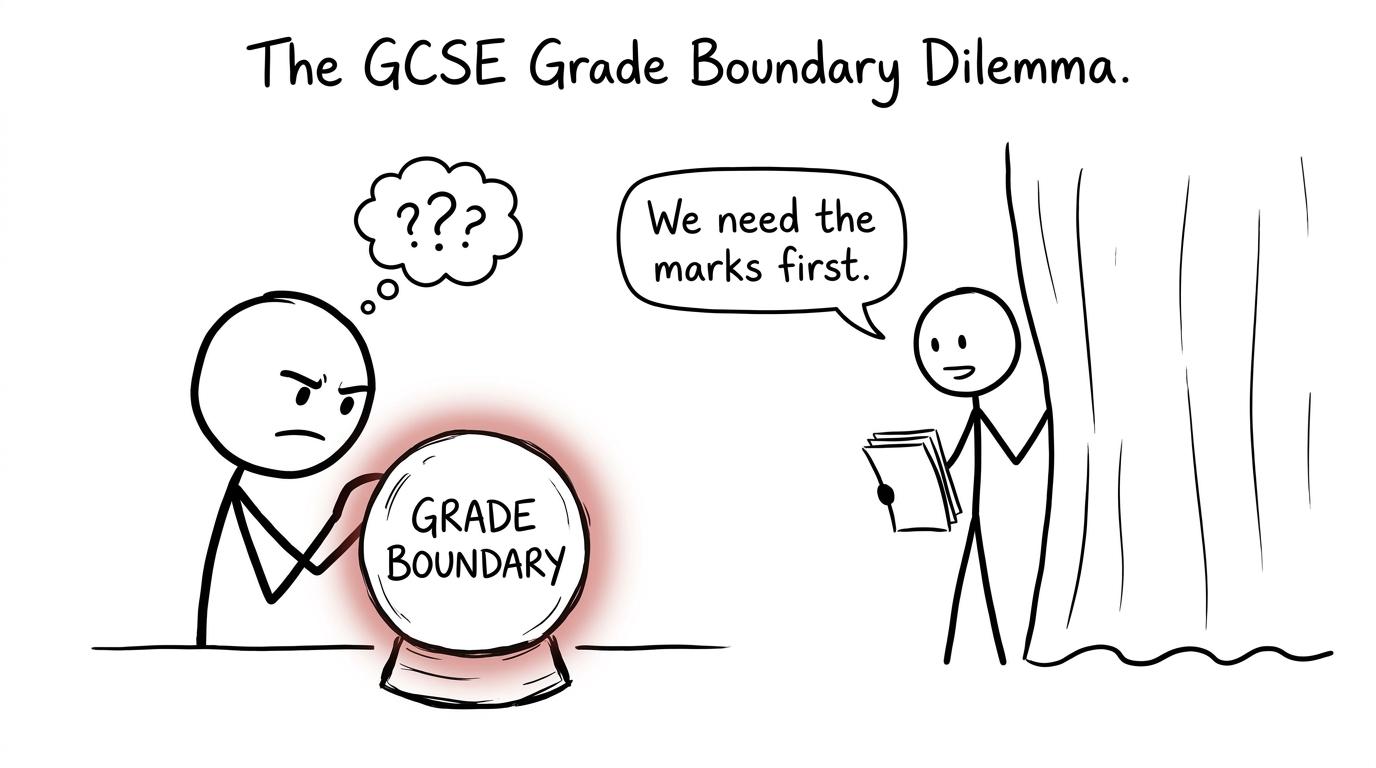 A student asks a crystal ball for a grade boundary before the papers have been marked
How much did GCSE Spanish boundaries move recently?
A comparison of the summer 2024 and summer 2025 qualification boundaries gives a useful, concrete picture. These figures refer to the outgoing AQA 869886988698 and Pearson Edexcel 1SP01SP01SP0 specifications.
| Board and tier | Movement from 2024 to 2025 | Largest movement | Maximum mark |
|---|---|---|---|
| AQA Higher | Up by 666 to 101010 marks | 101010 marks | 240240240 |
| AQA Foundation | Up by 000 to 555 marks | 555 marks | 240240240 |
| Edexcel Higher | Up by 111 to 777 marks | 777 marks | 280280280 |
| Edexcel Foundation | Down by 000 to 888 marks | 888 marks | 280280280 |
The contrast matters. AQA’s boundaries rose on both tiers, while Edexcel’s Higher boundaries rose and its Foundation boundaries stayed level or fell. There was no single national adjustment applied to every Spanish student.
As a proportion of the available marks, the largest changes were approximately:
- AQA Higher: 4.24.24.2 percentage points;
- AQA Foundation: 2.12.12.1 percentage points;
- Edexcel Higher: 2.52.52.5 percentage points;
- Edexcel Foundation: 2.92.92.9 percentage points downwards.
The relevant comparison is:
boundary percentage=boundary markmaximum mark×100%.\text{boundary percentage}=\frac{\text{boundary mark}}{\text{maximum mark}}\times 100\%.boundary percentage=maximum markboundary mark×100%.Percentages are useful when maximum marks differ, but they still do not make two specifications identical. The questions, assessment structure and candidate groups remain different.
Do the boundaries normally change a lot?
Usually, the movement is modest rather than dramatic. Recent changes suggest that several marks either way should not be surprising. A movement approaching 101010 marks is possible, particularly across a qualification with several components, but it is not something you can safely predict.
Some older comparisons show larger movements. They need context. Grading arrangements during and immediately after the pandemic were not a normal long-term baseline, so jumps between those years should not automatically be treated as evidence that the next boundary will behave similarly.
The deeper lesson is simple: a historical boundary is a reference point, not a promise.
MathsGenie’s guide to how GCSE grade boundaries work explains the same principle across subjects. The boundary is the minimum total mark needed for a grade in one specific board, tier, specification and examination series.
Why GCSE Spanish grade boundaries change year to year
Every examination is new
Exam boards design papers to a specification and aim for consistent demand. Yet two sets of questions can never be perfectly equal in practice.
A listening extract may prove harder to follow than expected. A reading question might be more accessible. A writing task may allow candidates to demonstrate their vocabulary particularly well. Small differences accumulate across the qualification.
If a paper proves easier overall, boundaries may rise. If it proves harder, they may fall. The moving boundary is the mechanism that protects the meaning of the grade.
Boundaries are set after marking
Final boundaries are not secretly fixed before students enter the examination room. Exam boards set them when marking is nearly complete, using statistical evidence and expert judgement.
Senior examiners examine work around proposed boundaries and compare its quality with work representing the same grade in previous years. The aim is to keep the required standard comparable, not to preserve an identical raw mark.
This is also why predicted boundaries circulating before results day are only estimates. Until the board has evidence from the completed assessments, the final figure is unknown.
Student performance can vary
The students entering a qualification are not exactly the same every year. Their preparation, prior attainment and performance can vary. Exam boards consider statistical evidence, but there is no fixed quota requiring a particular number of students to pass or fail.
If more candidates produce work deserving a high grade, more can receive it. Boundaries exist to maintain standards, not to ration grades.
Each board and tier is awarded separately
AQA and Edexcel use different papers, mark totals and specifications. Foundation and Higher tier candidates also take different assessments. A boundary rising on AQA Higher therefore tells you nothing certain about Edexcel Foundation.
Comparisons must remain within the same board, tier and specification. This principle is just as important in maths, where MathsGenie maintains separate pages for AQA GCSE boundaries, Edexcel GCSE Maths boundaries and OCR GCSE boundaries.
Why the new Spanish specifications matter
GCSE Spanish specifications taught from September 2024 have their first awards in summer 2026. This includes the current AQA and Pearson Edexcel qualifications.
The assessment has changed. For example, the current AQA specification has four components, listening, speaking, reading and writing, each contributing 25%25\%25% of the qualification, with a total scaled mark of 200200200. New task types include dictation and reading aloud.
Consequently, boundaries from the outgoing specifications cannot predict the first boundaries for the new qualifications. Even converting old marks into percentages does not remove differences in content, task design and assessment objectives.
At the time of writing, summer 2026 boundaries are not yet available because grade boundaries are published on results day. Use the specimen materials and guidance supplied for your current specification rather than treating a 2025 raw mark as a 2026 target.
How to use boundaries without letting them control revision
A boundary can help you interpret a completed mock. It is much less useful as a target to hit exactly.
Suppose your latest assessed mark sits just above an old grade boundary. That tells you the grade is vulnerable to ordinary variation: a harder task, a missed instruction or a modest movement in the new boundary. The sensible response is to create a margin rather than trying to predict the precise cut-off.
Your revision priorities should be:
- build dependable marks across listening, speaking, reading and writing;
- practise the task types in your current specification;
- mark work using the correct assessment criteria;
- record why marks were lost;
- revisit weak vocabulary, grammar and examination technique;
- aim comfortably above historical boundaries where comparison is valid.
The same calm approach works when Spanish is competing with maths for revision time. Use the GCSE Maths revision hub to identify your board and tier, then alternate focused topic work with timed assessment. MathsGenie’s guide to using past papers properly gives a repeatable cycle: attempt, mark, diagnose, fix and retest.
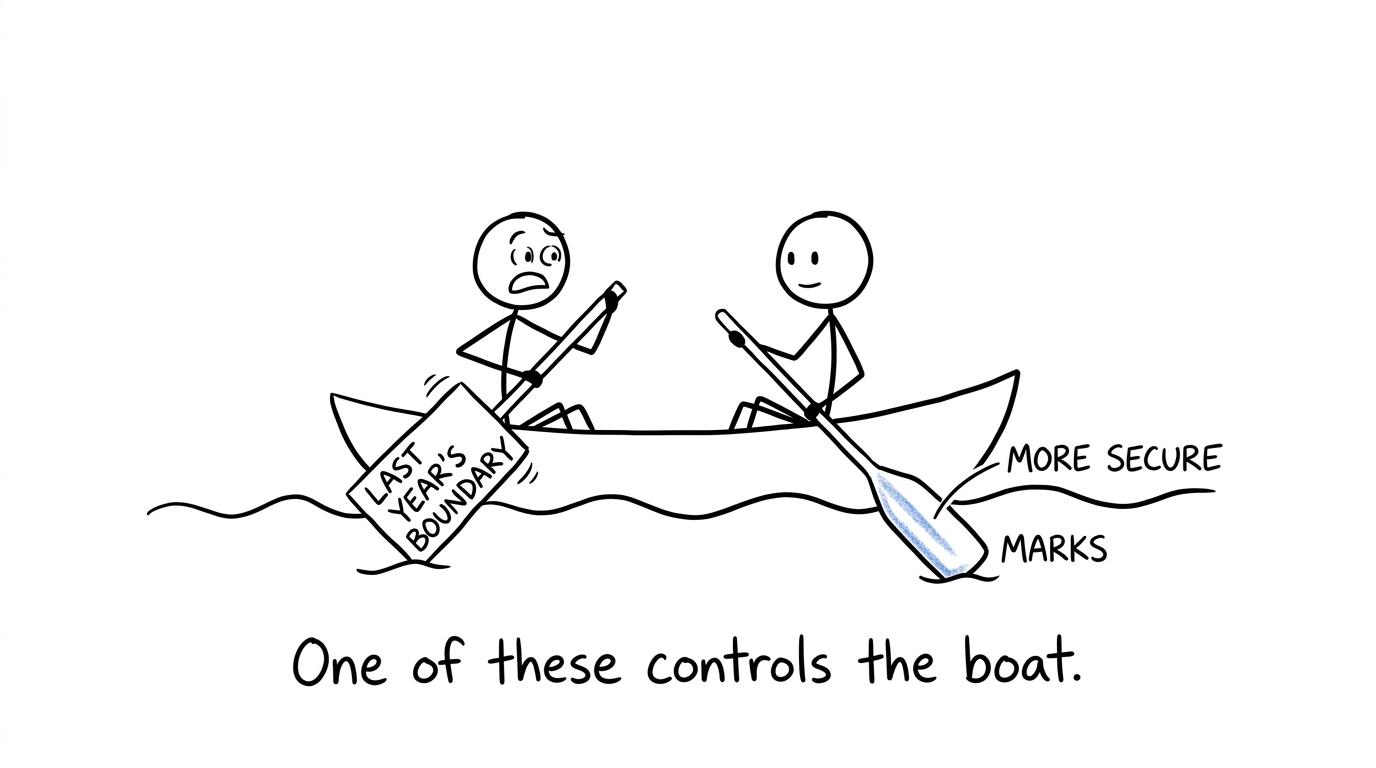 Two students discover that earning more marks is a better steering method than following last year's boundary
Common mistakes when reading Spanish grade boundaries
Treating last year’s mark as a guaranteed target
A previous boundary describes a completed examination series. It cannot tell you the exact boundary for an unseen set of assessments.
Comparing raw marks from different boards
A mark out of 240240240 cannot be compared directly with one out of 280280280. Even percentage comparisons need qualification because the assessments differ.
Adding notional component boundaries
Linear GCSEs award the grade at qualification level. Boards may publish notional boundaries for individual components to support analysis, but these are illustrative and do not represent separate certificated grades.
Ignoring the specification change
The first boundaries for a reformed qualification are not continuations of the old raw-mark series. Check the specification code before using any historical table.
Revising towards the lowest possible mark
A boundary is a threshold, not a revision plan. Trying to land exactly on it leaves no protection against normal exam variation. Your controllable task is to gain more secure marks.
Focus on the mark you can change
Grade boundaries do change, but usually because the paper has changed in difficulty, not because examiners have decided to make a grade arbitrarily harder to earn. Recent AQA and Edexcel figures show that movement of several marks is normal, while larger changes can occur and deserve context.
So use historical boundaries to understand the past. Do not ask them to predict the future.
For the maths part of your GCSE timetable, start with MathsGenie’s free GCSE past-paper collection. Combine revision lessons and practice questions with mini tests, past papers, predicted papers, mark schemes and video solutions. Each extra secure mark gives you something no boundary forecast can provide: a margin you have earned yourself.