GCSE Sociology Paper 1: What to Actually Expect
GCSE Sociology Paper 1 explained: compare AQA and Eduqas content, timing, question styles, assessment objectives and practical revision priorities.
The first page of an exam paper can make familiar knowledge feel strangely distant. You know you revised families, education and research methods, but suddenly the clock is moving and every command word looks more serious than it did at home.
Here is the useful answer upfront: GCSE Sociology Paper 1 is a written exam lasting 111 hour 454545 minutes and worth 50%50\%50% of the qualification on both AQA and Eduqas. However, the content and question structure are not identical. AQA Paper 1 focuses on families and education, with relevant theory and methodology. Eduqas Component 1 also includes cultural transmission and a distinct research-methods section.
That exam-board difference matters. Before planning anything, confirm your specification through the GCSE Sociology revision hub.
GCSE Sociology Paper 1 at a glance
Use this checklist before beginning detailed revision:
- Confirm whether you study AQA or Eduqas.
- Expect a 111 hour 454545 minute written examination.
- Remember that the paper contributes 50%50\%50% of your final GCSE.
- Revise knowledge, application, analysis and evaluation, not definitions alone.
- Practise short answers as well as extended responses.
- Include sociological theories, evidence, concepts and methods where relevant.
- Complete at least one paper under timed conditions.
- Review your answers using the correct mark scheme.
There is no foundation or higher tier in GCSE Sociology. Everyone taking the same specification sits the same assessment, so your revision should be based on your exam board rather than a tier.
| Exam board | Name of first component | Main content | Time | Marks |
|---|---|---|---|---|
| AQA | Paper 1: The Sociology of Families and Education | Families, education, relevant theory and methodology | 111 hour 454545 minutes | 100100100 |
| Eduqas | Component 1: Understanding Social Processes | Cultural transmission, families, education and sociological research methods | 111 hour 454545 minutes | 100100100 |
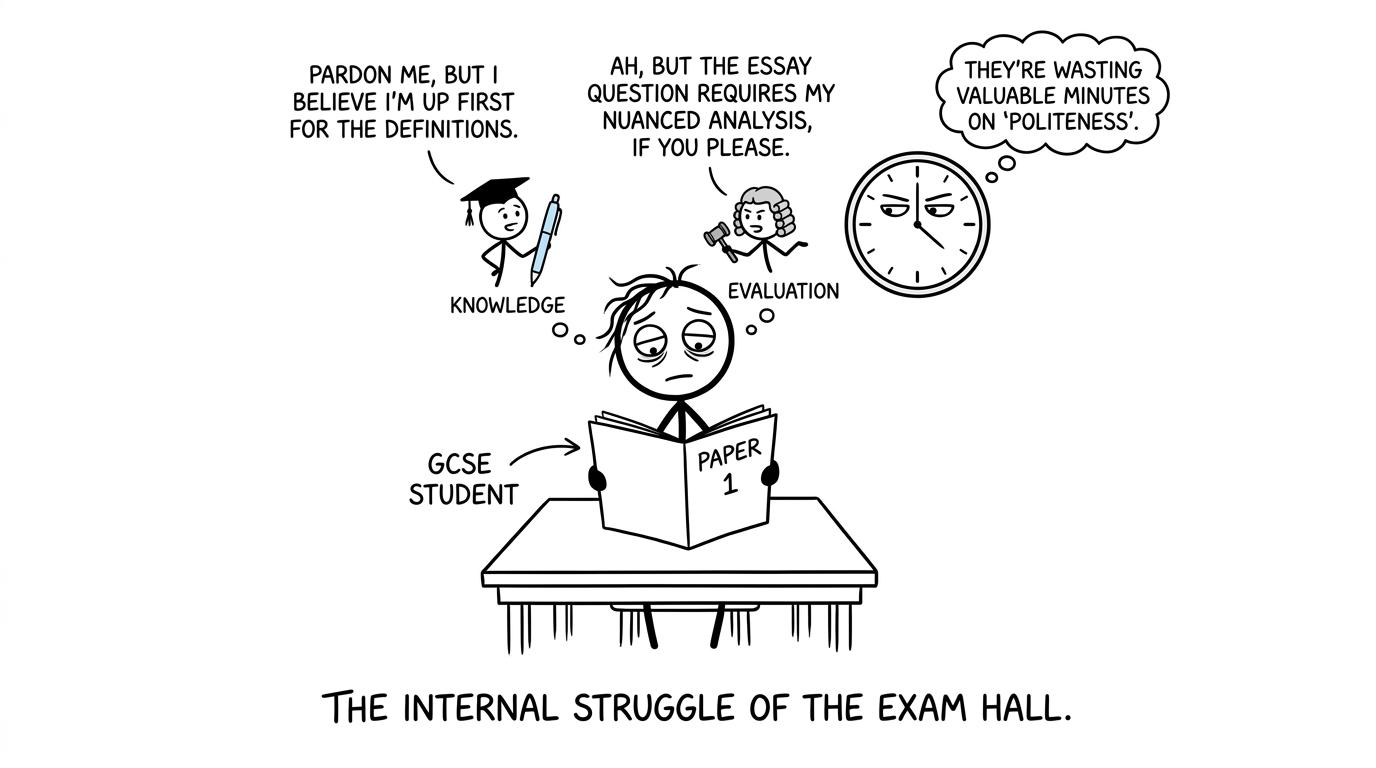 A student discovers that knowledge and evaluation both want control of the exam pen
What is on AQA GCSE Sociology Paper 1?
AQA Paper 1 is divided into two main sections:
- The sociology of families
- The sociology of education
Relevant areas of sociological theory and methodology are assessed within these topics. Research methods are therefore not simply a separate list to memorise. You may need to understand how evidence was gathered, recognise limitations in a method or connect methodological ideas to a substantive topic.
Each section begins with multiple-choice questions and continues through short and extended responses. All questions are compulsory. The paper rewards breadth because many ideas may be tested, but it also rewards depth through questions requiring developed explanation, discussion and evaluation.
For direct preparation, use the AQA GCSE Sociology revision area, where lessons, questions and paper resources are organised around the specification. Then move to AQA GCSE Sociology past papers when you are ready to practise the complete format.
What AQA questions favour
AQA questions move from recognition and accurate recall towards explanation and argument. That means you should be ready to:
- define or identify a sociological idea accurately;
- describe a feature, trend or process;
- apply knowledge to the wording or context provided;
- explain links between causes and consequences;
- discuss competing sociological views;
- evaluate theories, evidence or explanations;
- reach a reasoned judgement in an extended response.
The important shift is from knowing a fact to using that fact. A memorised paragraph may contain accurate sociology but still miss marks if it does not address the particular claim in the question.
What is on Eduqas Component 1?
Eduqas calls its first assessment Component 1: Understanding Social Processes. It covers:
- key concepts and processes of cultural transmission;
- families;
- education;
- sociological research methods.
The paper uses compulsory recall, structured and extended-response questions. Part-questions range from 111 to 151515 marks, so students must change pace repeatedly: a brief factual answer may be followed later by a sustained argument requiring analysis, evaluation and a conclusion.
Unlike AQA, Eduqas gives research methods a clearly identifiable place within Component 1. Cultural transmission also has a more visible role. Concepts such as socialisation, identity, norms, values and culture should therefore be treated as examinable content rather than introductory vocabulary you can leave behind.
The Eduqas GCSE Sociology revision page brings together its assessment structure and available papers. Check that page rather than borrowing an AQA checklist from a friend; the subjects overlap, but the paper architecture does not.
What is actually different about Paper 1?
Paper 1 is not necessarily easier than Paper 2. It is different because it draws on a different set of substantive topics and may package research methods differently.
For AQA, Paper 1 concentrates on families and education, while Paper 2 assesses crime and deviance and social stratification. Both papers have the same duration, marks and qualification weighting. The main difference is content, not status.
For Eduqas, Component 1 examines social processes, including cultural transmission, families, education and research methods. Component 2 turns towards social differentiation and stratification, crime and deviance, and applied methods of sociological enquiry.
Paper 1 often feels familiar because family and school are part of everyday life. That familiarity can be deceptive. Sociology does not reward an unsupported personal opinion about parenting, marriage or teachers. It rewards explanations grounded in sociological concepts, theories and evidence.
Understand what the assessment objectives demand
Across GCSE Sociology specifications, the assessment objectives are weighted as follows:
| Assessment objective | What it requires | Qualification weighting |
|---|---|---|
| AO1 | Knowledge and understanding of theories, concepts, evidence and methods | 40%40\%40% |
| AO2 | Application of that knowledge and understanding | 40%40\%40% |
| AO3 | Analysis and evaluation used to construct arguments, make judgements and draw conclusions | 20%20\%20% |
This explains why revision based entirely on flashcards is incomplete. Flashcards can strengthen AO1, but the exam also expects you to select relevant material for a specific question and make analytical connections.
A balanced revision session should therefore contain three stages:
- Recall: retrieve concepts, theories, studies and key terminology without notes.
- Apply: choose which material fits a particular issue or question.
- Evaluate: consider strengths, limitations, alternatives and the judgement supported by the evidence.
The MathsGenie revision planner can help you distribute these tasks across your available time instead of leaving every essay practice session until the final week.
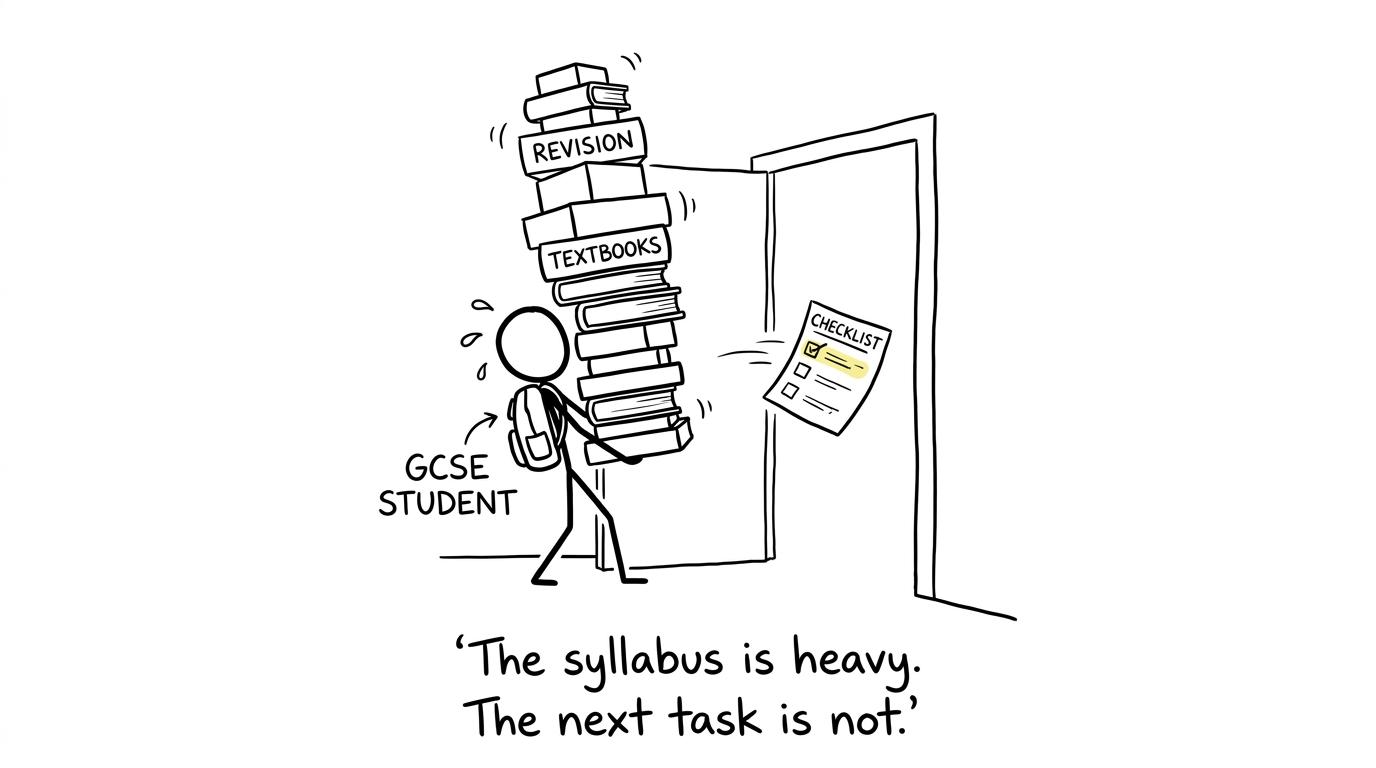 A checklist takes the sensible route while a student carries every revision book at once
How to manage the timing
The paper gives you 105105105 minutes for 100100100 marks. That works out at approximately:
105100=1.05\frac{105}{100}=1.05100105=1.05minutes per mark. This is a planning guide, not an official requirement. Reading, choosing evidence and checking answers also need time, so blindly spending exactly 1.051.051.05 minutes on every mark would be impractical.
A better approach is to establish checkpoints during timed practice. Reserve a small amount of time for reading and checking, then divide the remaining time in rough proportion to the marks available. Higher-tariff responses should receive more planning and writing time than short recall questions.
If one short question refuses to cooperate, leave space and return later. A difficult low-tariff item should not consume the time needed for an extended answer worth substantially more marks.
Practise this with an authentic paper rather than guessing how timing feels. Complete it without pausing, then note where you rushed, stalled or wrote beyond what the tariff justified. This is the same disciplined paper-review habit explained in MathsGenie's guide to starting GCSE past papers effectively.
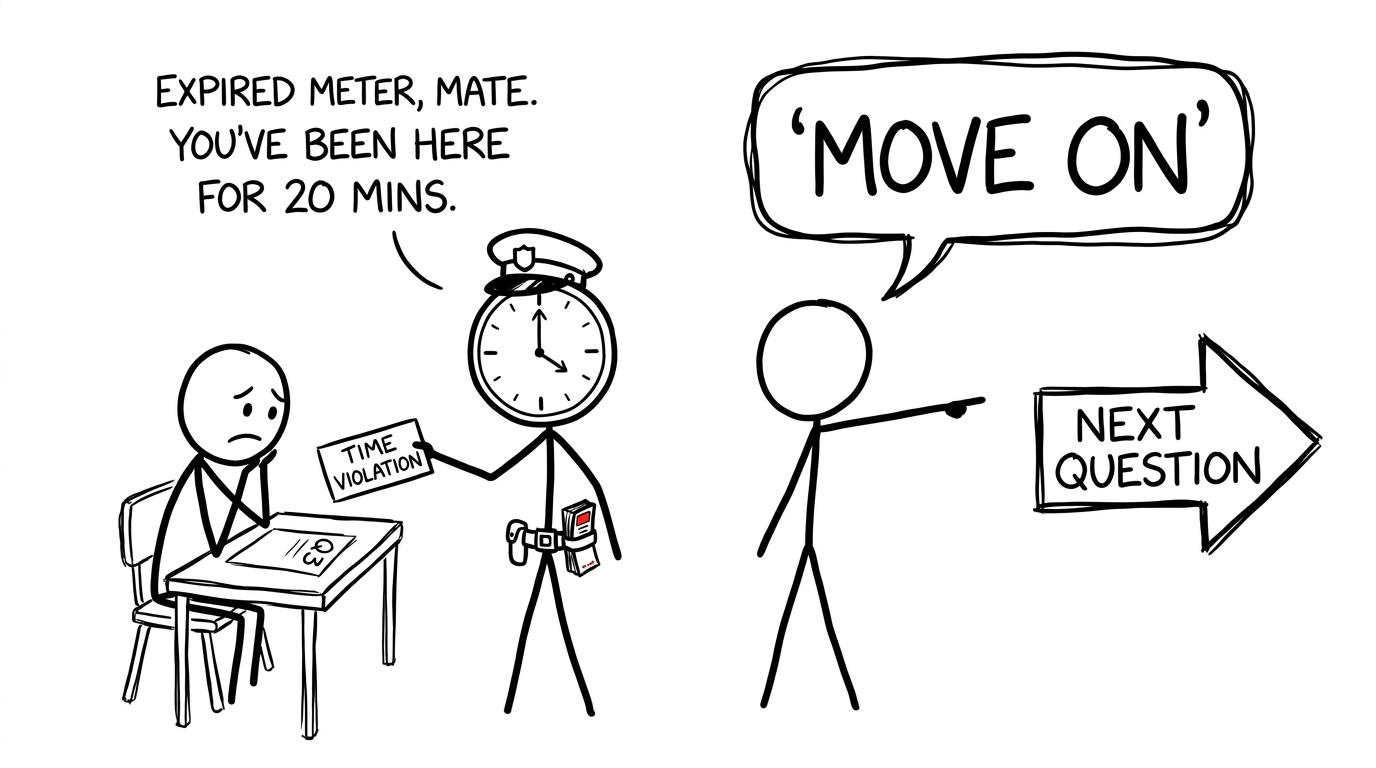 An exam clock issues a ticket for staying on one question too long
A revision method that matches the paper
Begin with the specification, not predictions. Divide Paper 1 into manageable topic areas and build a checklist covering concepts, theories, evidence, debates and methods. Traffic-light each area honestly.
Next, use retrieval rather than repeated reading. Close the notes and reconstruct a theory, comparison or evaluation point from memory. MathsGenie's guide to turning GCSE notes into active recall is written around maths revision, but its central cycle transfers well: retrieve, check, correct and revisit.
Then practise by question type. Short responses train precision; extended responses train selection, structure and judgement. Mark each attempt promptly and record why marks were lost:
- missing knowledge;
- weak application;
- undeveloped explanation;
- unsupported evaluation;
- no judgement;
- poor timing;
- misreading the command word.
Finally, complete whole papers. Use the mark scheme to understand what creditworthy sociology looks like rather than merely counting your score. Reattempt weak questions later without copying the original answer.
Students balancing Sociology with GCSE Maths can keep both subjects organised through the GCSE Maths revision hub, using short maths mini tests between longer Sociology writing sessions rather than allowing one subject to disappear for a week.
Common mistakes on GCSE Sociology Paper 1
Revising the wrong exam board
AQA Paper 1 and Eduqas Component 1 overlap, but they are not interchangeable. Confirm the board from your teacher, specification or past-paper front cover.
Writing everything you know
More content is not automatically better. Select material that answers the exact question, then explain its relevance.
Treating application as name-dropping
Mentioning a theory or study does not guarantee AO2 marks. Application means using knowledge to illuminate the issue or context presented.
Giving one-sided extended answers
Extended discussion usually needs competing arguments, limitations or alternative interpretations. Evaluation should influence your final judgement, not appear as an isolated sentence saying that a theory is “outdated”.
Ignoring research methods
Methods are an explicit part of Eduqas Component 1 and are integrated into AQA topic assessment. Revise practical, ethical and theoretical considerations alongside the strengths and limitations of different methods.
Spending too long on low-mark questions
Answer in proportion to the tariff. A short question needs accuracy and directness; it does not need an essay.
Using common sense instead of sociology
Everyday experience can help you understand a topic, but examination answers need sociological terminology, theory and evidence. Personal opinion becomes useful only when transformed into a supported sociological argument.
Go into Paper 1 knowing the shape of the task
Confidence rarely comes from predicting the exact question. It comes from recognising the paper's rhythm: retrieve, apply, explain, evaluate and move on.
Confirm your board first. Use MathsGenie's free GCSE Sociology resources to revisit the content, then complete practice questions and past papers under timed conditions. Check every attempt against the mark scheme, use video solutions or revision lessons where available, and turn each lost mark into a specific task on your revision planner.
Predicted papers and mini tests can provide fresh rehearsal, but they work best after the specification and past papers have exposed your genuine gaps. The goal is not to guess what will appear. It is to be ready for the form in which it appears.