GCSE Sociology Grade Boundaries Year to Year
GCSE sociology grade boundaries year to year can shift by several marks. Compare AQA and Eduqas data, understand why they move, and set safer targets.
A mock result can feel reassuring until someone asks the awkward question: what if this year's boundary moves?
The short answer is that GCSE sociology grade boundaries year to year usually move by several marks, not by a fixed amount. In the recent summer data from 202320232023 to 202520252025, individual AQA boundaries shifted by between 111 and 666 marks in a year. For Eduqas, the largest annual movement over the same period was 555 marks. Those changes matter near a boundary, but they are not a reason to abandon your target or attempt to predict an exact pass mark.
Grade boundaries exist to account for differences in the difficulty of each examination series. Your safest strategy is therefore simple: use previous boundaries as context, aim above them and concentrate on collecting marks.
GCSE Sociology grade boundaries at a glance
Keep these points in mind before comparing any figures:
- A grade boundary is the minimum total mark required for a grade.
- Boundaries are set after students have taken the papers and marking is nearly complete.
- A harder paper will generally lead to lower boundaries; an easier paper will generally lead to higher ones.
- AQA and Eduqas boundaries cannot be treated as interchangeable.
- GCSE Sociology is not divided into foundation and higher tiers.
- Both the current AQA and Eduqas qualifications considered here total 200200200 marks across two equally weighted papers or components.
- Historical boundaries are useful guides, not predictions of the next series.
You can check the complete historical figures through the MathsGenie GCSE grade boundaries hub or read the wider guide to how GCSE grade boundaries work.
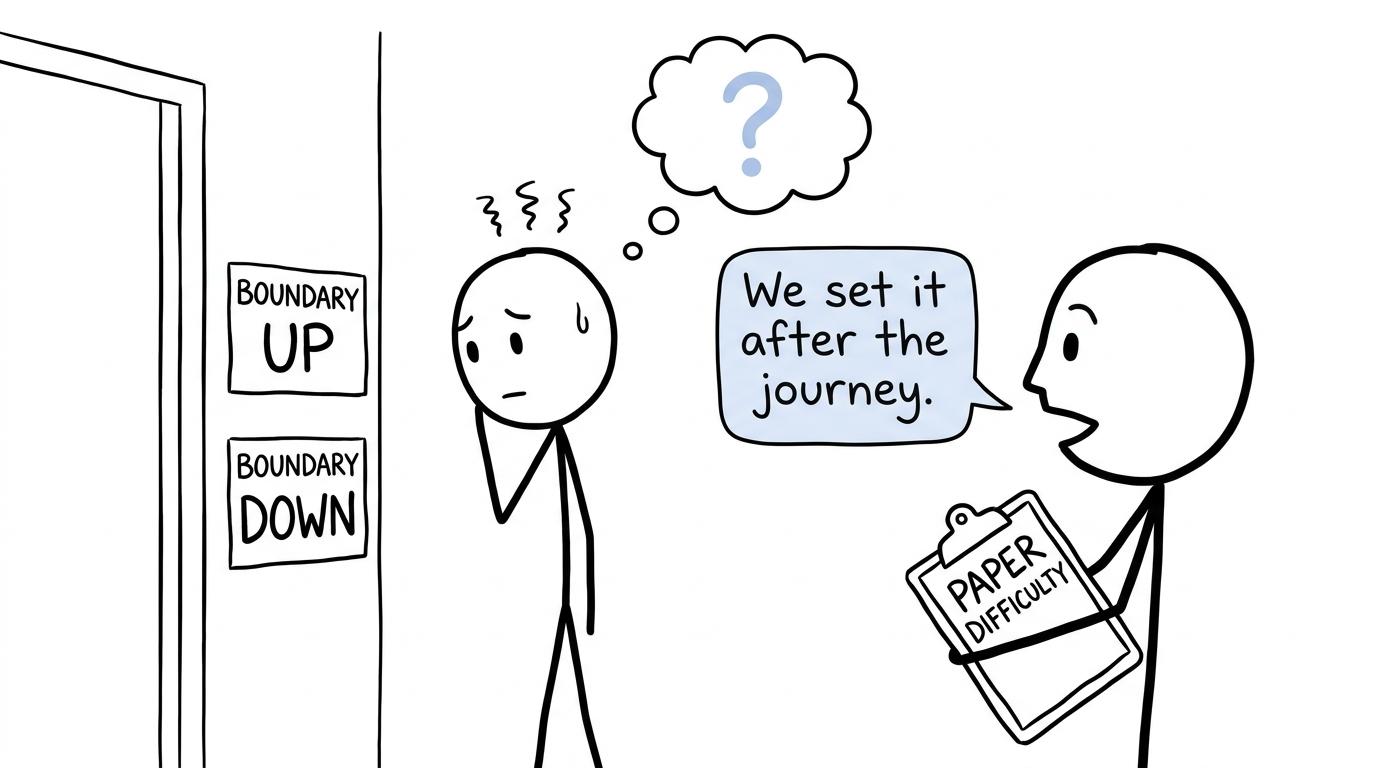 A student faces buttons for rising and falling grade boundaries while an examiner considers paper difficulty
How much have AQA boundaries actually changed?
AQA GCSE Sociology has two papers worth 100100100 marks each, producing an overall mark out of 200200200. The subject grade is based on that combined total, not on passing each paper separately.
The table shows selected confirmed boundaries from the three latest published summer series at the time of writing. Full figures for every grade are available on the AQA GCSE Sociology grade boundaries page.
| Grade | 202320232023 boundary | 202420242024 boundary | 202520252025 boundary | Largest one-year shift |
|---|---|---|---|---|
| 999 | 157157157 | 158158158 | 163163163 | 555 marks |
| 777 | 132132132 | 136136136 | 140140140 | 444 marks |
| 555 | 100100100 | 105105105 | 108108108 | 555 marks |
| 444 | 848484 | 909090 | 939393 | 666 marks |
Across all grades, the annual movements in this period ranged from 111 to 666 marks. The grade 444 boundary had the largest movement shown, rising by 666 marks between 202320232023 and 202420242024. It then rose by another 333 marks in 202520252025.
That creates an important distinction between an annual shift and a multi-year trend. The grade 444 boundary rose from 848484 to 939393 over two annual changes, a cumulative difference of 999 marks. A student who treated the 202320232023 figure as a guaranteed future threshold would therefore have planned with too little margin.
Because the qualification is out of 200200200, each raw mark represents 0.50.50.5 percentage points of the available total. A movement of 666 marks is equivalent to 333 percentage points. That is noticeable, especially for a borderline result, but it is still small enough to overcome through a handful of stronger short answers or a better-developed extended response.
How much have Eduqas boundaries changed?
Eduqas GCSE Sociology also has two 100100100-mark components, giving 200200200 marks overall. Its recent pattern has not been identical to AQA's. This is precisely why students must check their own exam board.
| Grade | 202320232023 boundary | 202420242024 boundary | 202520252025 boundary | Largest one-year shift |
|---|---|---|---|---|
| 999 | 167167167 | 170170170 | 165165165 | 555 marks |
| 777 | 146146146 | 148148148 | 143143143 | 555 marks |
| 555 | 118118118 | 116116116 | 112112112 | 444 marks |
| 444 | 105105105 | 101101101 | 979797 | 444 marks |
The Eduqas GCSE Sociology grade boundaries show movement in both directions. The grade 999 threshold rose by 333 marks from 202320232023 to 202420242024, then fell by 555 marks in 202520252025. The grade 444 threshold fell in both annual comparisons, moving from 105105105 to 979797 across the full period.
This tells us something useful: boundaries do not automatically rise every year. A short sequence of increases or decreases is not a rule that the next series must follow. Each new set of papers produces new evidence.
It also explains why comparing the raw AQA and Eduqas thresholds does not reveal which board is easier. Their specifications and papers are different. The boundary is part of the mechanism that compensates for differences in assessment demand.
Why grade boundaries change each year
Exam boards aim to keep the standard represented by each grade stable, even though the exact difficulty of a paper cannot be perfectly predicted before students sit it.
Ofqual explains that awarding organisations use statistical evidence alongside expert judgement. Performance data helps identify a possible range for each boundary. Senior examiners then review students' work around that range and compare its quality with work representing the grade standard in previous years.
Several factors can therefore influence the final position.
The difficulty of the papers
Two papers can follow the same specification yet differ slightly in how demanding students find their wording, source material or combination of topics. If a paper proves harder, students will typically achieve fewer raw marks, so boundaries may be lower. If it proves easier, boundaries may be higher.
This does not mean the lower-boundary year offered easier grades. The adjustment is intended to preserve the meaning of the grade.
How students performed on the assessment
Boundaries are not chosen from a historical table before the examination. Examiners need evidence from the current papers and current cohort. That is why any precise boundary circulating before official publication is only an estimate.
There is also no fixed quota saying that a certain number of students must pass or fail. Boundaries are set to maintain grade standards, not simply to force every year's results into an identical pattern.
Differences between exam boards
AQA and Eduqas assess the required GCSE Sociology objectives, including knowledge, application, analysis and evaluation, but they use their own papers and specifications. Their raw boundaries can consequently differ.
A higher numerical threshold does not prove that an exam board is harder. If one set of papers is more accessible, a higher raw boundary may be needed to represent the same grade standard.
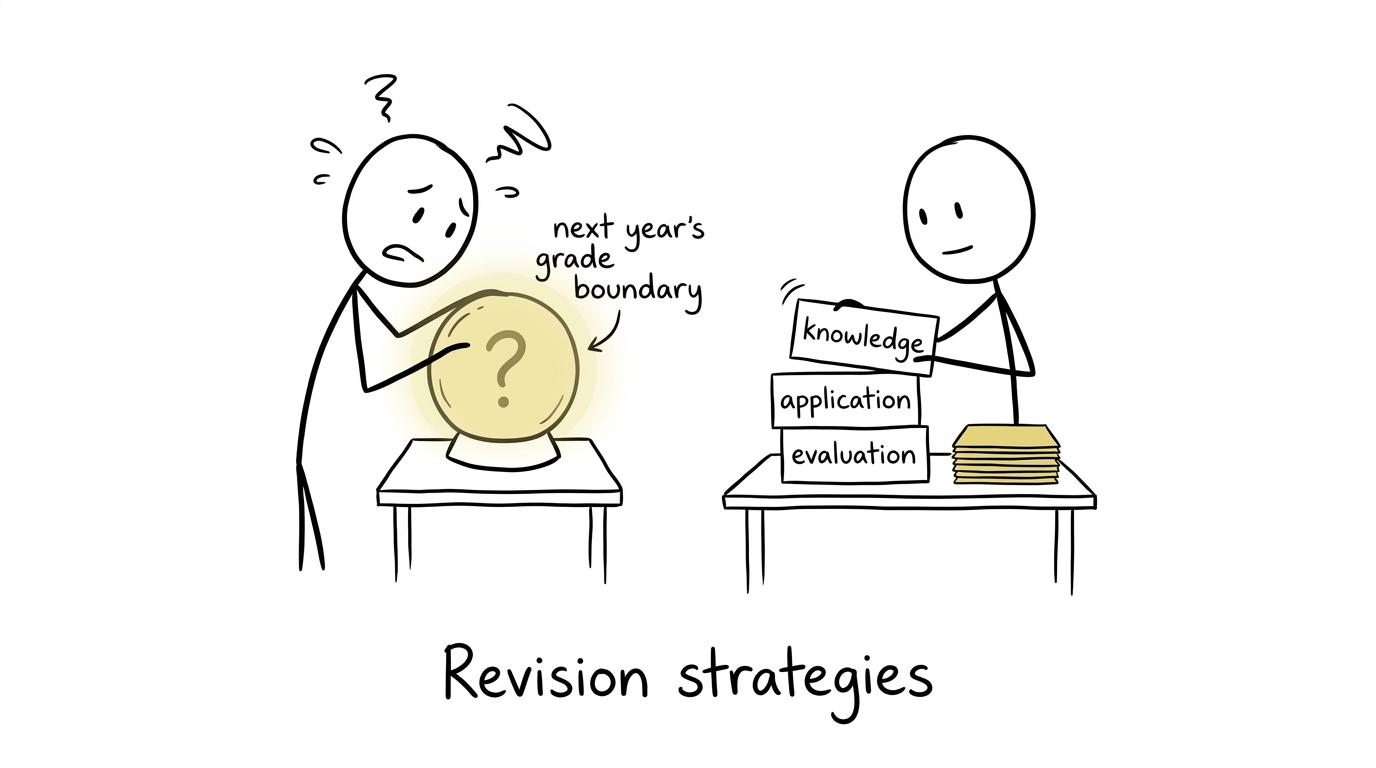 One student consults an unhelpful grade-boundary crystal ball while another builds revision knowledge
What should your target mark be?
Do not aim to land exactly on last year's boundary. That turns a useful historical figure into a fragile promise.
A calmer approach is to review several recent years and set a target with a reasonable cushion above the highest relevant boundary. The cushion is not a prediction of how far the boundary will move. It protects you from ordinary variation, marking errors in self-assessed work and the pressure of the real examination.
Your revision decisions should come from the marks you lose repeatedly:
- weak recall of sociological terms, theories or evidence;
- failure to apply knowledge to an item or context;
- unsupported assertions in extended answers;
- limited analysis or evaluation;
- poor timing that leaves questions unfinished.
The same evidence-led principle is valuable for students balancing Sociology with GCSE maths. Use the MathsGenie GCSE Maths revision hub to choose your board and tier, then turn every dropped mark into a specific topic to repair. The MathsGenie resources collection brings together predicted papers, mini tests and other focused materials.
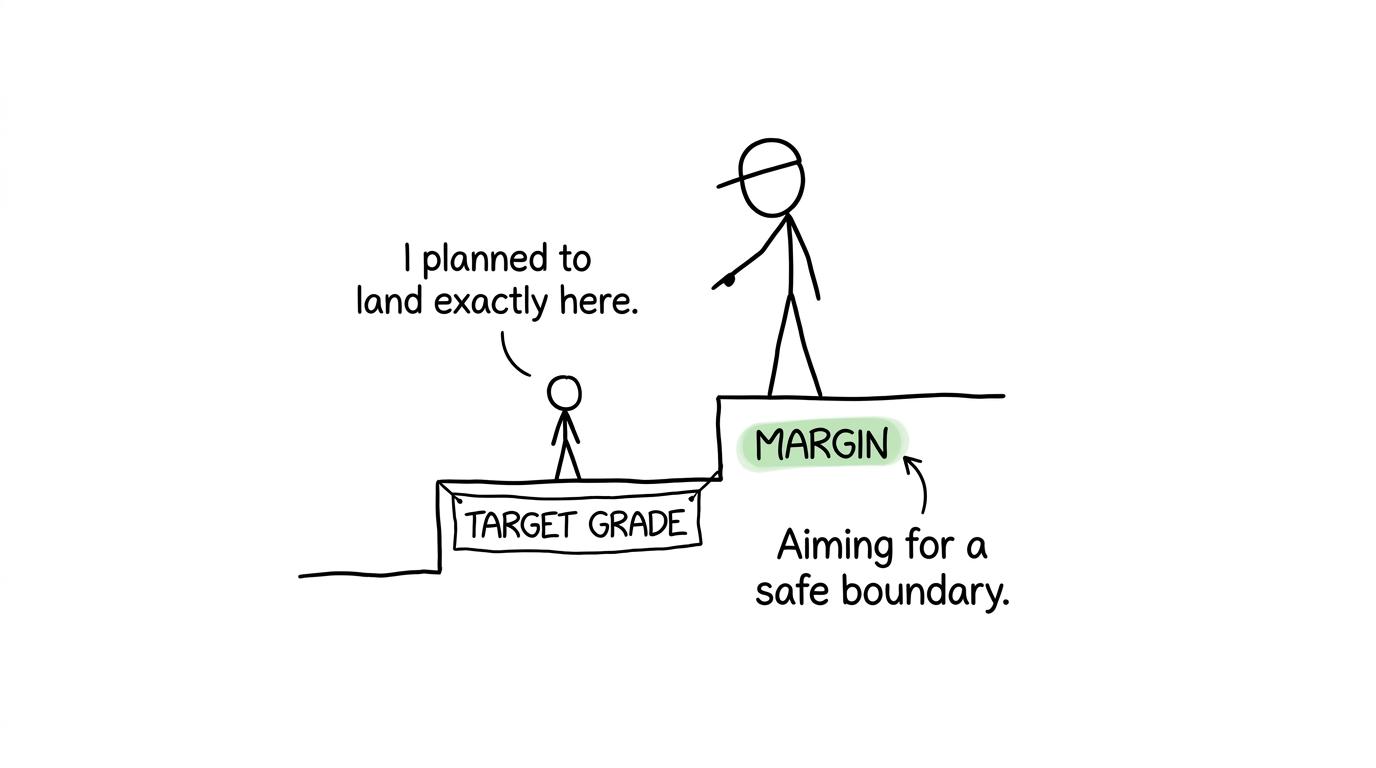 A student learns why aiming exactly at a historical boundary leaves no safety margin
Common mistakes when interpreting Sociology boundaries
Treating last year's boundary as this year's pass mark
The next boundary is unknown until the awarding process has taken place. Previous figures describe previous examination series only.
Looking at one paper instead of the subject total
AQA and Eduqas award the final GCSE from the combined 200200200-mark total. Published component boundaries may be described as notional and are not separate official grades. Strong performance on one paper can compensate for a weaker performance on the other.
Comparing boards using raw marks alone
AQA and Eduqas use different assessments. Their thresholds should be interpreted within the relevant specification, not placed in a league table of difficulty.
Assuming every boundary moves equally
Different grade thresholds can shift by different amounts. In AQA's 202420242024 data, for example, the selected grade 444 boundary moved more than the grade 999 boundary. There is no single adjustment automatically added to every grade.
Revising towards the boundary rather than the mark scheme
You cannot control the boundary. You can control whether you define terms precisely, use relevant evidence, apply material to the question and construct a supported judgement. In maths, the equivalent is showing method and checking accuracy. Try the AQA GCSE Maths past papers to practise that mark-by-mark discipline.
Boundaries are context, not a revision plan
Recent evidence gives a measured answer: GCSE Sociology boundaries can move enough to affect students close to a grade, but the annual changes are generally several marks rather than enormous jumps. Between 202320232023 and 202520252025, the largest one-year movement was 666 marks for AQA and 555 marks for Eduqas.
The boundary is the part everyone discusses because it is uncertain. Your preparation is quieter and more powerful because it is within your control.
Check your correct Sociology board, use several years of boundaries for perspective and build a margin above your target. Then bring the same discipline to maths. Follow a realistic GCSE one-week maths revision plan, use MathsGenie's free revision lessons and practice questions to repair weak topics, and finish with mini tests, past papers, predicted papers, mark schemes and video solutions.
Do not try to guess the line. Build a score strong enough to clear it.