GCSE Sociology 4 to 6: How to Raise Your Grade
GCSE sociology 4 to 6 guidance: improve knowledge, application, evaluation and essay technique with a focused revision plan that targets more marks.
A grade 4 answer often shows that you know the topic. A grade 6 answer shows that you can do something purposeful with that knowledge. If you are searching for a GCSE sociology 4 to 6 plan, the central change is this: build broader, more accurate knowledge, apply it directly to the question and develop evidence-based judgements rather than stopping at description.
That sounds like a large leap. In practice, it is usually a collection of smaller changes: using precise terminology, selecting relevant studies, explaining links and completing enough timed practice to make those habits reliable.
This guide explains what separates the two grade bands and how to train the skills that tend to move students upwards. Grade boundaries change between exam series, so no particular raw mark can guarantee a grade 6. The dependable target is the standard of performance described by the assessment objectives.
Your grade 4 to grade 6 checklist
Focus your revision on these changes:
- broaden your knowledge across the whole specification
- replace general language with accurate sociological terminology
- connect theories, concepts and evidence instead of listing them
- apply every paragraph to the exact issue in the question
- evaluate arguments with relevant counterpoints and evidence
- reach clear conclusions that answer the question
- practise research methods in context
- use timed questions, mark schemes and an error log
The final point matters. Reading can make content feel familiar, but exams reward what you can retrieve, select and communicate without support.
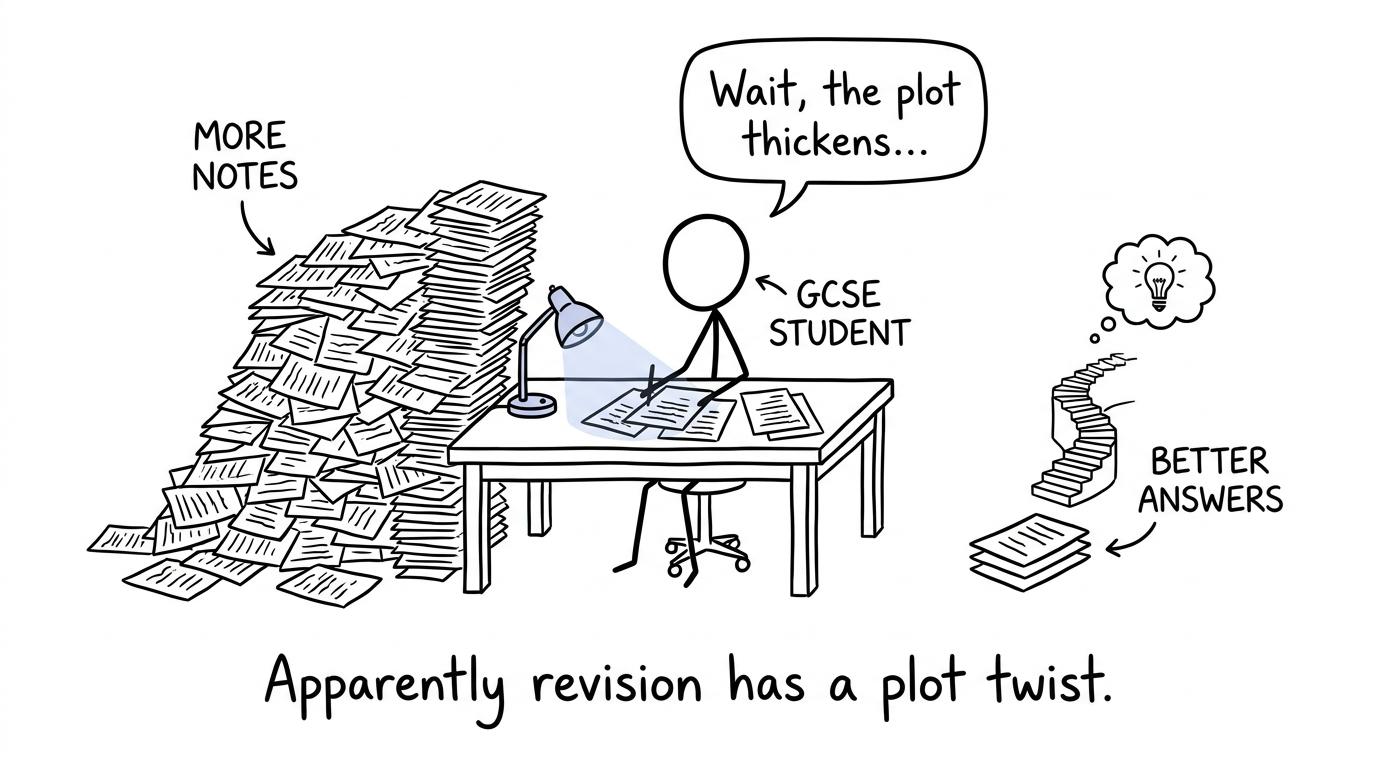 A student discovers that better answers matter more than a mountain of notes
What separates a grade 4 from a grade 6 in GCSE Sociology?
Official GCSE Sociology grade descriptors distinguish the bands through three broad qualities: the range and accuracy of knowledge, the quality of application, and the strength of analysis and evaluation.
At grade 4, a student typically demonstrates some accurate knowledge from a limited range. They can apply some theories and concepts to UK contexts, although subject terminology may be limited. Evaluation is present, but conclusions and judgements may be partial.
At grade 6, the expected performance is broader and more secure. Knowledge is accurate across a range of theories, concepts, perspectives, evidence and research methods. Application is appropriate to UK and some global contexts, terminology is used purposefully, and evaluation leads to clear judgements supported by relevant evidence.
The difference is not simply “write more”. Longer answers can still remain descriptive. A stronger answer is more selective, connected and decisive.
Knowledge moves from isolated facts to connected understanding
A grade 4 student may remember the definition of socialisation or identify a functionalist view. A grade 6 student is more likely to connect the concept to an institution, a named perspective, supporting evidence and a criticism.
Build revision sheets around relationships rather than disconnected definitions. For each topic, organise what you know under:
- key concepts and precise definitions
- sociological perspectives
- named thinkers or studies required by your specification
- supporting evidence
- criticisms and alternative explanations
- links to research methods
Check your own board's specification rather than relying on a generic online topic list. AQA and Eduqas organise GCSE Sociology content and question styles differently, even though the same national assessment objectives underpin the qualification.
Application becomes explicit
Application means using knowledge to answer the particular question, not displaying everything you remember about a topic.
After making a point, ask:
- How does this address the exact claim in the question?
- Which group, institution or social process is relevant?
- Have I used any item or source provided?
- Why does the evidence support this argument?
A useful paragraph should keep returning to the issue being assessed. If a paragraph could be copied unchanged into several unrelated essays, its application is probably too weak.
Evaluation produces a judgement
Evaluation is not created by adding “however” to the end of a paragraph. A genuine evaluative point tests an argument. It might question the evidence, compare perspectives, identify an overlooked social group, consider whether findings remain applicable or explain why an alternative interpretation is stronger.
The next step is judgement. State what the criticism does to the original claim. Does it weaken it completely, limit it to a particular context or show that several explanations are needed?
Understand where the marks come from
Across GCSE Sociology specifications, the assessment objectives are weighted as follows:
- AO1, knowledge and understanding: 40%40\%40%
- AO2, application: 40%40\%40%
- AO3, analysis and evaluation: 20%20\%20%
This balance exposes a common revision problem. Memorising notes primarily prepares you for AO1, but AO2 carries the same overall weighting. You need to practise choosing and adapting knowledge, not merely recalling it.
Research methods also deserve regular attention. Ofqual's subject requirements state that they must be assessed across AO1, AO2 and AO3 and account for at least 15%15\%15% of the qualification's marks. Treat sampling, validity, reliability, ethics and practical issues as examinable tools that must be applied to sociological contexts.
Always check the command word and mark allocation before writing. A short knowledge question and an extended evaluative response are asking for different things. Use your board's past papers and mark schemes to learn those distinctions accurately.
Make four specific changes to your answers
Use terminology to increase precision
Words such as class, culture and family can be used casually. Sociology requires more precision. Terms including primary socialisation, material deprivation, labelling, patriarchy and social stratification communicate specific ideas.
Do not insert terminology merely to sound academic. Define or use each term in a way that advances the argument. A smaller number of accurate concepts is stronger than a crowded paragraph containing misused vocabulary.
Explain the link after presenting evidence
Students often name a study and move on. The missing sentence is the reasoning: what does the evidence demonstrate, and why is that relevant to the question?
Use this mental sequence:
- make a relevant claim
- identify suitable theory or evidence
- explain how it supports the claim
- connect the explanation to the question
- test it with a relevant limitation or alternative
- state the resulting judgement
This is not a script to reproduce mechanically. It is a check that your paragraph contains an argument rather than a list.
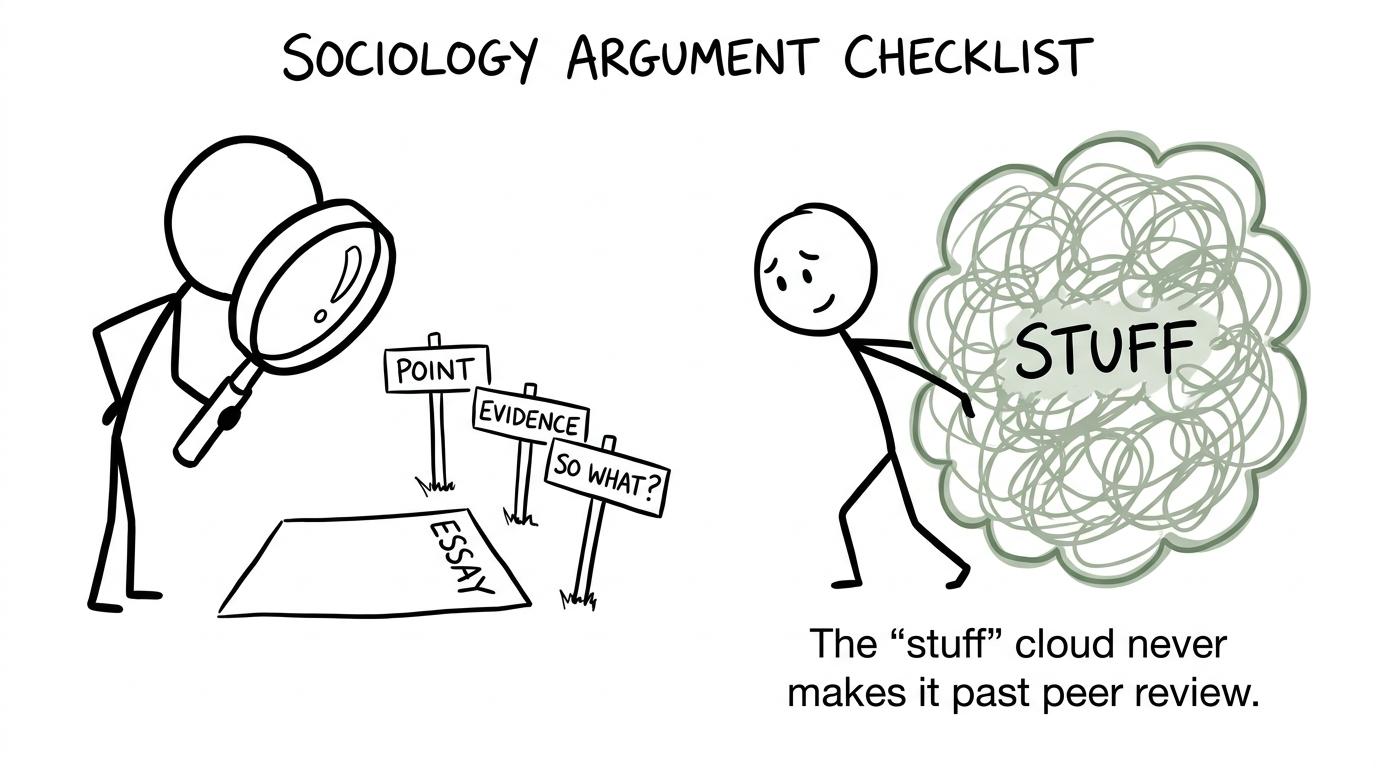 An examiner searches for point, evidence and the important so-what link
Compare perspectives directly
Comparison becomes more analytical when you identify the actual source of disagreement. For example, perspectives may differ over whether institutions create consensus or reproduce inequality, or whether behaviour is shaped mainly by social structures or everyday interactions.
Explain the basis of the disagreement. Then decide which view better addresses the question and why. Side-by-side summaries without a comparison leave the intellectual work to the examiner.
Finish with a supported conclusion
A conclusion should not introduce a new theory or repeat the introduction. It should answer the question after weighing the evidence.
A grade 6 conclusion is usually clear rather than dramatic. Identify the most convincing explanation, recognise an important limitation and state why your judgement follows from the evidence considered.
Use a revision cycle that changes performance
A productive cycle is retrieve, answer, mark, repair and retest.
Begin with a short closed-book retrieval task. Then complete one exam question and mark it using the official mark scheme or teacher guidance. Record why each mark was lost under AO1, AO2, AO3, command words, timing or incomplete coverage. Rewrite the weakest section before returning to a similar task later.
MathsGenie's guide to finding weak GCSE topics explains how to turn lost marks into a focused repair list. The subject may differ, but the diagnostic principle transfers directly to sociology.
For busy days, adapt the 20-minute GCSE revision routine: retrieve key concepts, write a short planned or timed response, mark it and record one correction. Longer preparation can be organised through the free MathsGenie revision planner or the structure in this one-month GCSE revision plan.
Build a realistic weekly pattern
A focused sociology week might contain:
- two short knowledge-retrieval sessions
- one research-methods session
- two planned or timed responses
- one marking and rewriting session
- one mixed-topic review
Rotate topics rather than completing a large block and abandoning it. Revisit difficult material after a few days, then again the following week. Your error log should decide what returns most often.
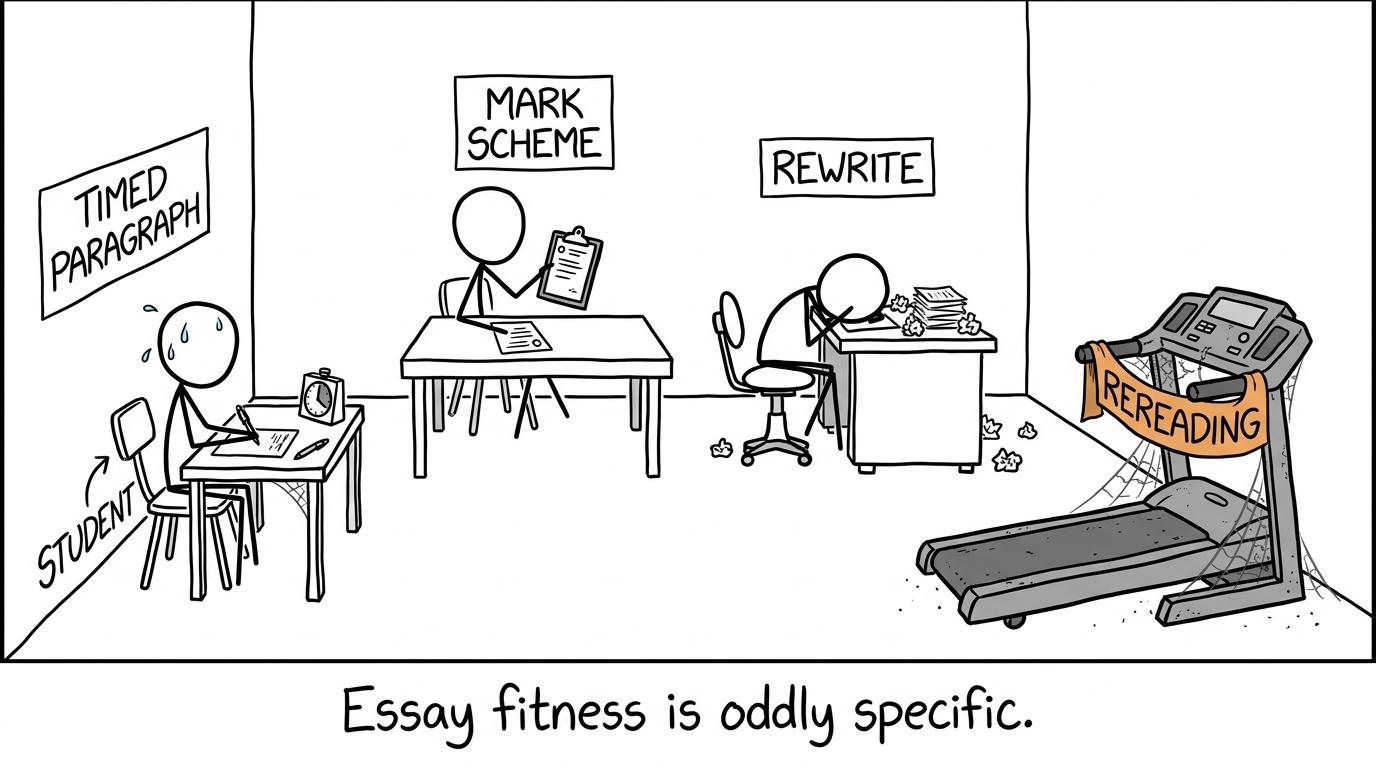 A student trains with timed paragraphs, mark schemes and rewrites
Common mistakes that keep answers at grade 4
Rereading instead of retrieving
Highlighting notes feels smooth because the information is visible. Close the book and reproduce a theory, study or evaluation point from memory. Difficulty during practice reveals what needs attention before the exam does.
Writing everything you know
Relevance earns marks; volume does not. Plan briefly, choose material that addresses the wording and leave unrelated knowledge out.
Treating every question like an essay
Short questions need concise, mark-focused responses. Extended questions require developed arguments and, where assessed, evaluation and judgement. Learn the requirements of each question type from your own board's materials.
Using vague evaluation
Claims such as “the study is old” or “not everyone agrees” are incomplete. Explain why the limitation matters and how it changes the strength of the conclusion.
Ignoring research methods
Methods cannot be secured by memorising definitions alone. Practise applying strengths, limitations, sampling choices and ethical concerns to the investigation described.
Marking generously
Use the mark scheme as evidence. MathsGenie's advice on using GCSE mark schemes and redoing past papers effectively can help you build a stricter feedback routine across subjects.
Turn better habits into a higher grade
Moving from grade 4 to grade 6 is not about becoming a different student. It is about changing the evidence your answers give the examiner: broader knowledge, direct application, developed reasoning and supported judgement.
Start with one timed sociology response. Mark it by assessment objective, identify the weakest paragraph and rewrite it. Then schedule the next attempt rather than waiting until you feel ready.
MathsGenie remains your free home for the rest of your maths preparation. Use the GCSE Maths revision hub for revision lessons, practice questions, mini tests, past papers, mark schemes and video solutions. Nearer your maths exams, add GCSE predicted papers to test unfamiliar questions under pressure. Apply the same calm cycle in both subjects, attempt, mark, repair and retest, and improvement becomes something you can see rather than merely hope for.