

GCSE Results Day Myths: Grading and Appeals
GCSE results day myths, debunked: understand grade boundaries, reviews of marking and appeals so students and parents can make informed choices.
Results day can make a rumour feel like a fact. A boundary shared in a group chat becomes “official”; being one mark short supposedly guarantees a higher grade; an appeal is imagined as a second opinion that cannot hurt. These GCSE results day myths and GCSE results misconceptions create anxiety precisely when students and parents need clear information.
Here is the short answer: grades are based on the quality of assessed work, boundaries are set after the exams, and a review only changes a mark when an error is found. Your first step after an unexpected result should be to speak to your school or college rather than acting on social-media speculation.
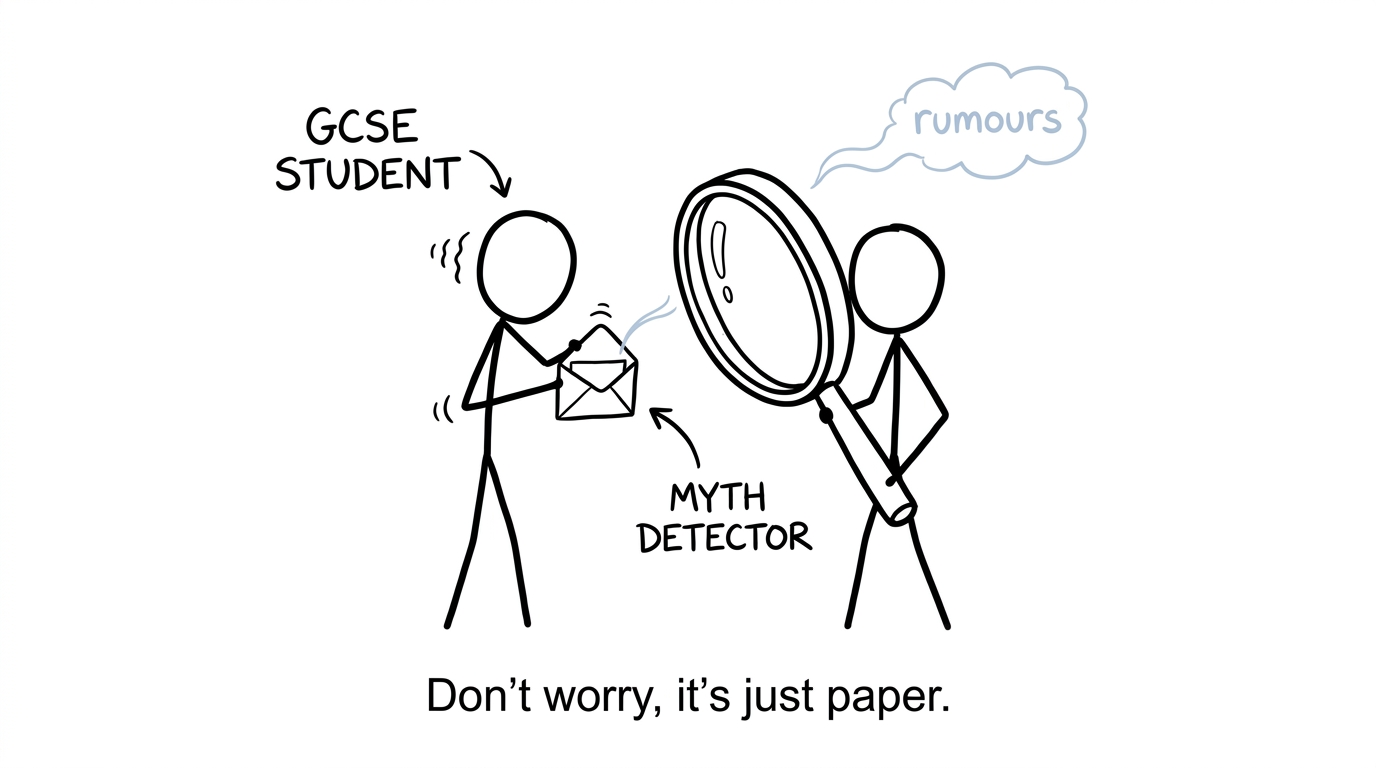 A student and parent use a myth detector on GCSE results day
Results day checklist for students and parents
Before examining the myths, keep this simple checklist nearby:
- Check every subject and confirm which exam board you took.
- Keep your results slip safe.
- Compare the result with any sixth-form, college or apprenticeship requirements.
- If a grade looks unexpected, ask your teacher or exams officer about the mark, grade boundary and access to your script.
- Do not request a review until you understand that marks can rise, remain unchanged or fall.
- Check your centre's deadlines immediately.
For the June 2026 series, GCSE results are released to candidates on Thursday 20 August 2026. Your school, college or exam centre decides its collection time and method.
Myth: Grade boundaries are fixed before the exams
Fact: Exam boards set grade boundaries after papers have been sat and marked.
Boundaries may change between years because papers are not identical in difficulty. If a paper proves more demanding, the boundary may be lower; if it proves less demanding, it may be higher. The aim is to maintain a comparable standard of work, not to preserve the same raw-mark boundary forever.
This is why speculative boundaries published before results day cannot be treated as official. Historical data can provide context, but it cannot reveal the new boundary in advance. After release, students taking Edexcel maths can use the Edexcel GCSE Maths grade calculator to understand how their total marks relate to published boundaries.
Myth: Only a certain number of students can pass
Fact: There is no predetermined quota limiting how many students may receive each GCSE grade.
Your grade is not reduced because too many other students performed well. Awarding organisations use evidence to maintain standards between years and exam boards. National outcomes may vary, but there is no fixed cap on the number of grade 444s, 777s or 999s.
Tier rules still matter in GCSE maths. Foundation tier awards grades 111 to 555, while Higher tier normally awards grades 444 to 999, with a narrow grade 333 safety net for students who just miss grade 444. You can review board-specific papers and resources through the GCSE Maths revision hub.
Myth: A predicted grade determines the final result
Fact: A predicted grade is an estimate, not part of the exam board's calculation.
Your final GCSE result comes from your assessed work. A school prediction, mock result or online calculator cannot add or remove marks. Equally, receiving a result below your prediction is not, by itself, evidence of a marking error.
Predictions are most useful before the exam, when they identify the distance between current performance and a goal. The Edexcel GCSE Maths revision hub combines lessons, questions and papers so that an estimate can become a practical revision plan rather than a label.
Myth: Being one mark short guarantees an upgrade
Fact: Closeness to a boundary does not create an extra mark.
A grade boundary is the minimum mark required for that grade. If the boundary is 145145145 and a student receives 144144144, the difference matters emotionally, but it does not change the rule. An exam board cannot award an additional mark simply because the result was close or a higher grade is needed for progression.
Closeness may, however, make it sensible for a teacher to inspect the marked script. The question is not merely “How close is the mark?” but “Is there evidence that the mark scheme was applied incorrectly?”
Myth: A review of marking means the whole paper is marked again
Fact: A review checks whether the original marking was completed correctly and whether the mark scheme was properly applied.
It is not an instruction to find more marks. The reviewer corrects genuine marking or administrative errors, such as a missed response or an incorrect total. If no error is found, the mark remains unchanged. If an error is found, the mark can go up or down, and the grade may rise, fall or stay the same.
Most students request a review through their school or college, which will normally need their permission. A fee may apply when the grade does not change. Access to the script can help a teacher assess the risk before making that request.
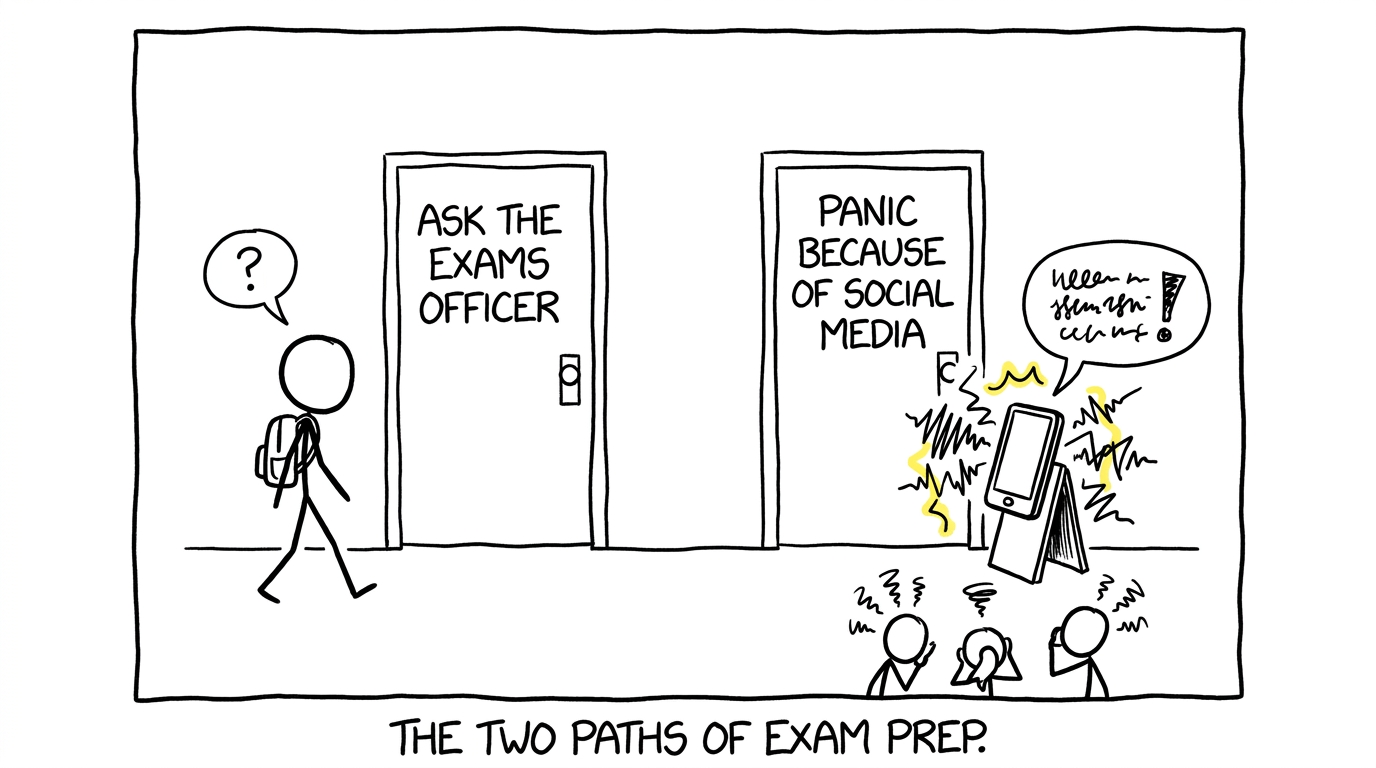 A student chooses the exams officer instead of social-media panic
Myth: An appeal is the first step after a disappointing grade
Fact: An appeal normally follows a review of marking or moderation.
The usual route is to discuss the result with the centre, obtain or inspect the script where appropriate, request a review, and then consider an appeal if a marking error remains or the awarding organisation may not have followed its procedures properly.
An appeal cannot be used simply to challenge the decision to place a grade boundary at a particular mark. For the June 2026 series, JCQ lists 24 September 2026 as the awarding-body deadline for GCSE review-of-results requests. Schools often set earlier internal deadlines, so students should contact their exams officer promptly.
Common mistakes after receiving GCSE results
The most costly mistakes usually come from moving too quickly:
- comparing marks with boundaries from the wrong year, board, subject or tier;
- assuming every unexpected result indicates incorrect marking;
- requesting a review without accepting that the mark can fall;
- confusing a review of marking with a formal appeal;
- waiting until the published deadline rather than checking the school's earlier deadline;
- allowing one result to end the conversation about college places, resits or alternative routes.
Parents can help by slowing the process down. Gather the correct documents, ask precise questions and let evidence replace guesswork.
Replace results-day rumours with a better revision system
The best time to challenge GCSE results misconceptions is before results day, when marks can still be influenced through preparation. Use GCSE Maths past papers under timed conditions, then check the mark scheme and revisit weak topics. MathsGenie's guide to using GCSE past papers properly explains how to turn each lost mark into a specific revision action.
You can also use predicted papers, mini tests and revision resources alongside revision lessons, practice questions, mark schemes and video solutions. Start with the grade boundaries calculator and explainer, understand what the numbers mean, and then return to the work that can still change them. Calm information helps on results day; consistent practice helps create the result.











