

GCSE Results Day for Parents: How to Help
GCSE results day for parents: prepare for collection, support emotions, understand reviews and help your child choose calm, practical next steps.
Results day compresses months of effort into a few lines on a screen or sheet of paper. It is no surprise that families sometimes approach it as though every future door will open or close that morning. In reality, GCSE results day for parents is less about having every answer and more about providing calm, practical support.
For the summer 2026 series, GCSE results are released to candidates on Thursday 20 August 2026. Your child’s school or exam centre decides its collection time and whether results are provided in person, by email or through a secure portal. Check those details before the day.
The short version is simple: prepare the logistics, let your child lead, listen before solving, and speak to the school promptly if a result affects their next step.
GCSE results day checklist for parents
Before the morning arrives:
- Confirm the collection time, location and method with the school.
- Check whether your child needs identification or portal login details.
- Save sixth-form, college or apprenticeship offer information.
- Write down relevant admissions telephone numbers and deadlines.
- Ask whether your child wants you nearby, in the building or at home.
- Make a simple plan for travel, breakfast and what happens afterwards.
- Keep the day flexible in case a conversation with the school is needed.
Do not assume that parents can collect results on a student’s behalf. Schools set their own arrangements and may require advance permission if the student is unavailable.
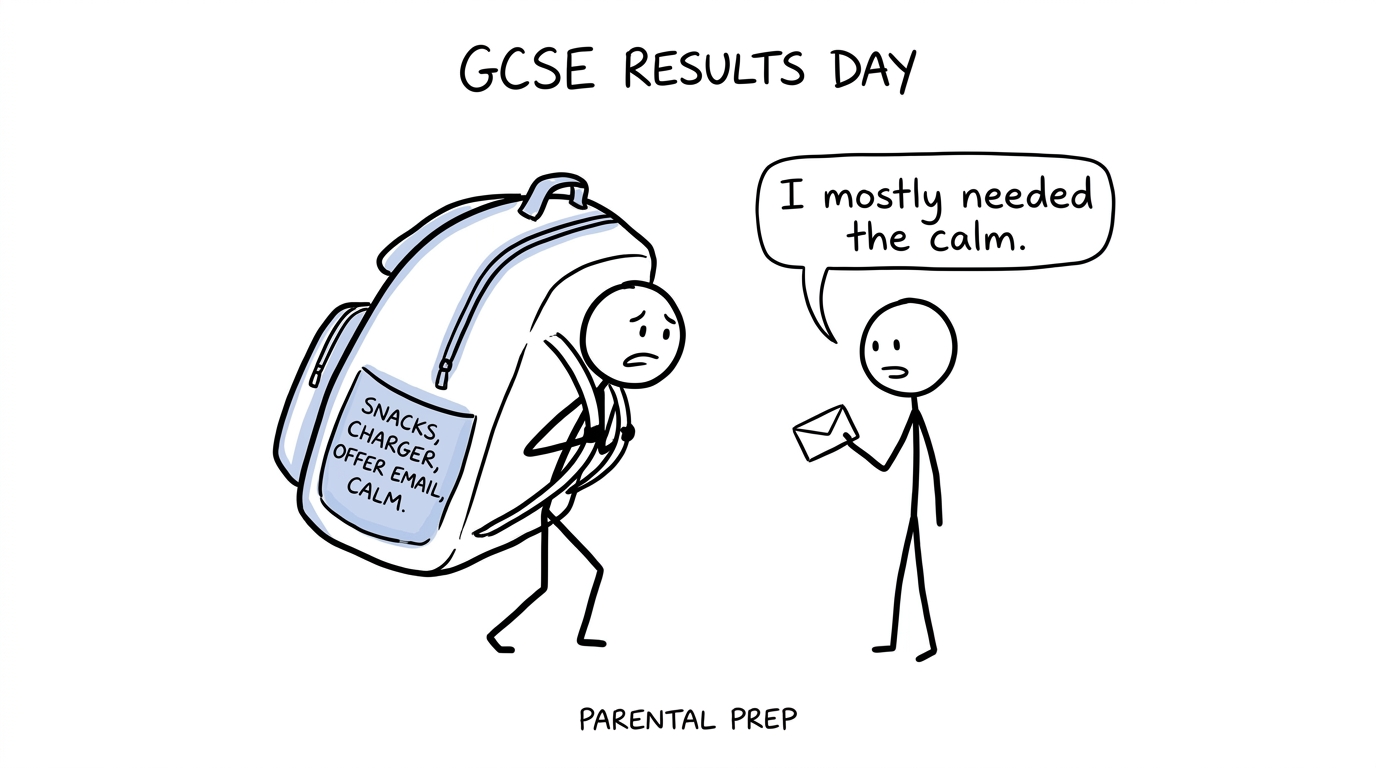 A parent brings an enormous results-day emergency bag while the student only needs calm support
What happens on GCSE results day?
Your child will receive a breakdown of results by subject. Depending on the qualification and location, this may show grades, marks or other information. GCSEs in England use grades 9-1, while grading arrangements differ elsewhere in the UK.
Students should check every subject rather than looking only at maths and English. They should then compare their grades with the exact conditions of any post-16 offer. If the conditions have been met, the provider may require online confirmation, enrolment paperwork or an in-person visit.
If an entry is missing, a grade appears unusual or an offer condition has narrowly been missed, encourage your child to speak to a teacher, careers adviser or exams officer before leaving. A disappointing line on the results slip may require action, but it rarely benefits from instant panic.
Supporting your child’s GCSE results emotionally
A parent’s first reaction can become the moment a child remembers most clearly. That does not mean pretending every outcome is ideal. It means separating the person from the result.
Try opening with:
- “How are you feeling about it?”
- “Would you like me to listen or help with the next step?”
- “Which result do you want to talk about first?”
Avoid immediately comparing the grades with predicted grades, siblings or friends. Predictions are planning tools, not promises. Equally, avoid turning good results into an instant discussion about the next academic target. Give success room to feel like success.
Some students will want to talk immediately. Others may need food, quiet or time with friends before they can think clearly. Supporting child GCSE results means responding to the child in front of you, not following a perfect script.
Results-day dos and don’ts
Do
- Let your child open the results. The information belongs to them.
- Pause before planning. Read the whole results slip and check offer conditions.
- Write things down. Record names, email addresses, advice and deadlines.
- Ask precise questions. For example: “Does this affect the course offer?”
- Contact the provider directly. A narrowly missed condition does not automatically tell you what the provider will decide.
- Keep options open. Sixth form, college, apprenticeships and alternative courses can all offer worthwhile routes.
Don’t
- Do not broadcast results without permission. Let your child decide what is shared.
- Do not demand an immediate post-mortem. Results day is not the moment to revisit every revision decision.
- Do not promise that a review will raise a grade. Marks and grades can rise, fall or remain unchanged.
- Do not contact an exam board before the school. Most candidates access post-results services through their school or exam centre.
- Do not treat one grade as a verdict on ability. It records an assessed outcome, not the limits of future progress.
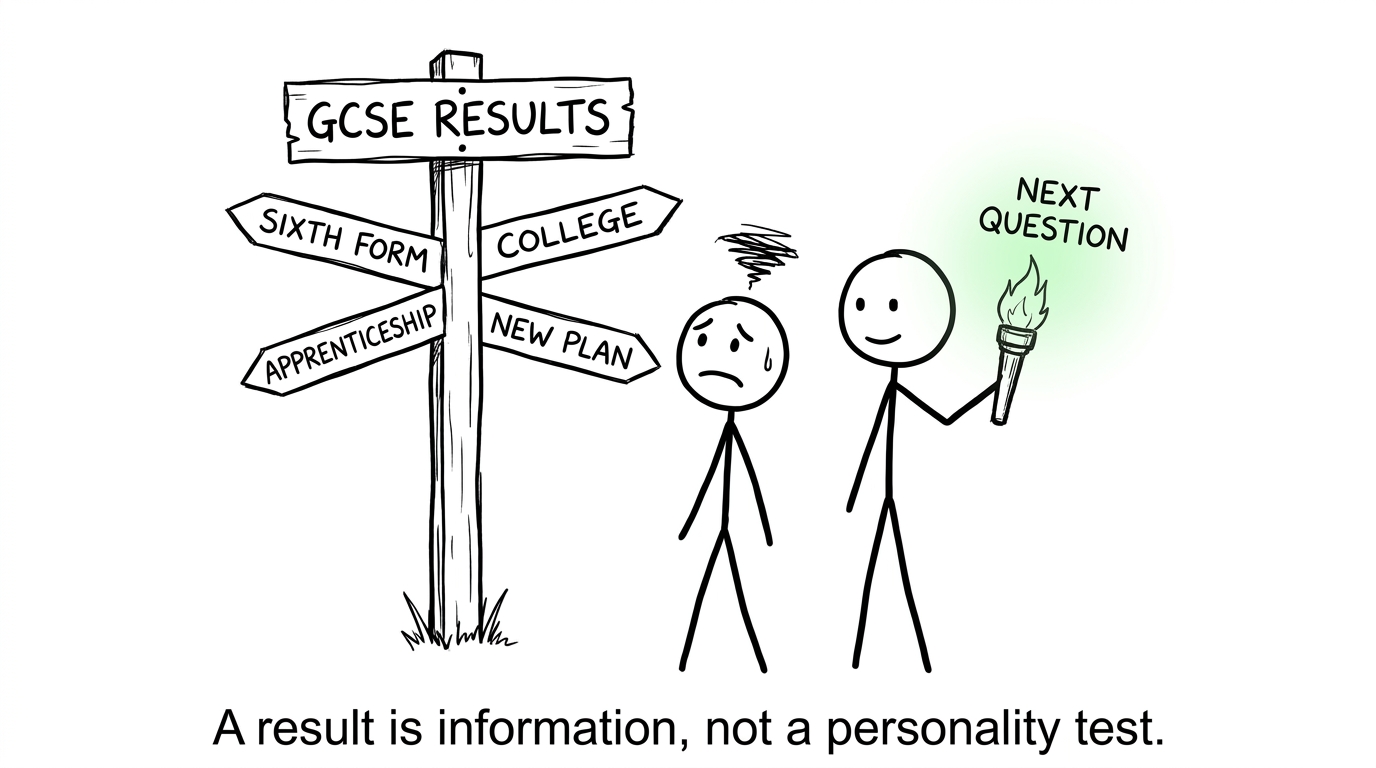 A results slip becomes a signpost towards several possible futures
What if a GCSE result is lower than expected?
First, establish whether the grade changes anything practical. If it affects a sixth-form, college or apprenticeship offer, contact the provider promptly and explain the situation. Ask whether the place can still be considered and what evidence or action is required.
If the school believes there may have been a marking error, it can discuss access to the script or a review of marking. The student’s consent is normally required because the result can move down as well as up. Fees may also apply.
For the June 2026 series, the JCQ deadline for awarding bodies to receive most review-of-results requests is 24 September 2026, but families should never wait until that date. School procedures can have earlier internal deadlines.
In England, students who have not achieved grade 4 in GCSE maths are generally required under post-16 funding conditions to continue studying the subject. GCSE maths and English language examinations are available in November for eligible students aged 16 or over by the relevant cut-off date. The school or new provider can explain whether a resit, another qualification or a different programme is appropriate.
Turning a maths setback into a clear plan
A resit should not become “do everything again”. It should begin with diagnosis.
Use the GCSE maths revision hub to select the correct exam board and tier. Students can then rebuild weak topics through revision lessons and practice questions before returning to papers. Dedicated pages are available for Edexcel GCSE maths, AQA GCSE maths and OCR GCSE maths, alongside other boards.
Short GCSE maths mini tests can reveal specific gaps without making every session feel like another full exam. Later, GCSE predicted papers and past papers can build timing and exam confidence. The useful rhythm is attempt, mark, repair and retest.
Parents do not need to become maths teachers. They can help by protecting a regular revision slot, printing a paper and asking one calm question: “What mistake are you fixing next?” Our guide to supporting GCSE maths revision without nagging develops that approach.
Common mistakes parents make on results day
The most common mistake is trying to remove uncertainty too quickly. Calling several providers before reading the offer, demanding a marking review before consulting a teacher, or discussing resits while a child is still processing the result can add noise rather than help.
Another mistake is focusing only on the grade boundary. Being close to the next grade does not itself prove a marking error. A teacher should consider the marked work and relevant mark scheme before advising on a review.
Finally, avoid making a long-term revision plan during an emotional morning. Deal with urgent admissions and post-results questions first. Planning works better once everyone has slept and the real options are clear.
A calm next step with Maths Genie
Results day matters, but it is a junction rather than a judgement. Your most valuable role is to make the next decision feel manageable: one conversation, one deadline and one action at a time.
If maths remains part of the journey, start with the free Maths Genie revision planner. Build a realistic routine around revision lessons, practice questions, mini tests, past papers, predicted papers, mark schemes and video solutions. A result describes where your child is today. A good plan helps them decide where to go next.











