GCSE Religious Studies Predicted Grade Process
GCSE religious studies predicted grade process explained: learn how teachers use mocks, classwork, assessment evidence and professional judgement.
A predicted grade can feel strangely final. One number appears on a report, sixth-form application or progress sheet, yet the decisions behind it are often invisible. The GCSE religious studies predicted grade process is not a single national calculation. Your school usually decides its own approach, with teachers using assessment evidence, the demands of your exam-board specification and professional judgement to estimate the grade you are currently most likely to achieve.
That estimate is useful, but it is not your final result. Your eventual GCSE grade is awarded from your completed assessments after the exam board has marked them and set the grade boundaries for that exam series.
The predicted grade checklist
Teachers commonly consider:
- mock examinations completed in realistic conditions;
- timed essays and extended responses;
- end-of-topic or end-of-unit assessments;
- performance across the different assessment objectives;
- recent classwork when it provides reliable evidence;
- consistency across Christianity, Islam, Judaism, Buddhism or other studied content;
- ethical and philosophical themes required by the specification;
- the direction of your recent progress;
- department moderation and the school’s prediction policy.
The balance between these sources varies. One school might place considerable weight on a recent mock, while another might use several assessments across the course. Asking your teacher how your school calculates predictions is therefore more useful than assuming every school follows the same formula.
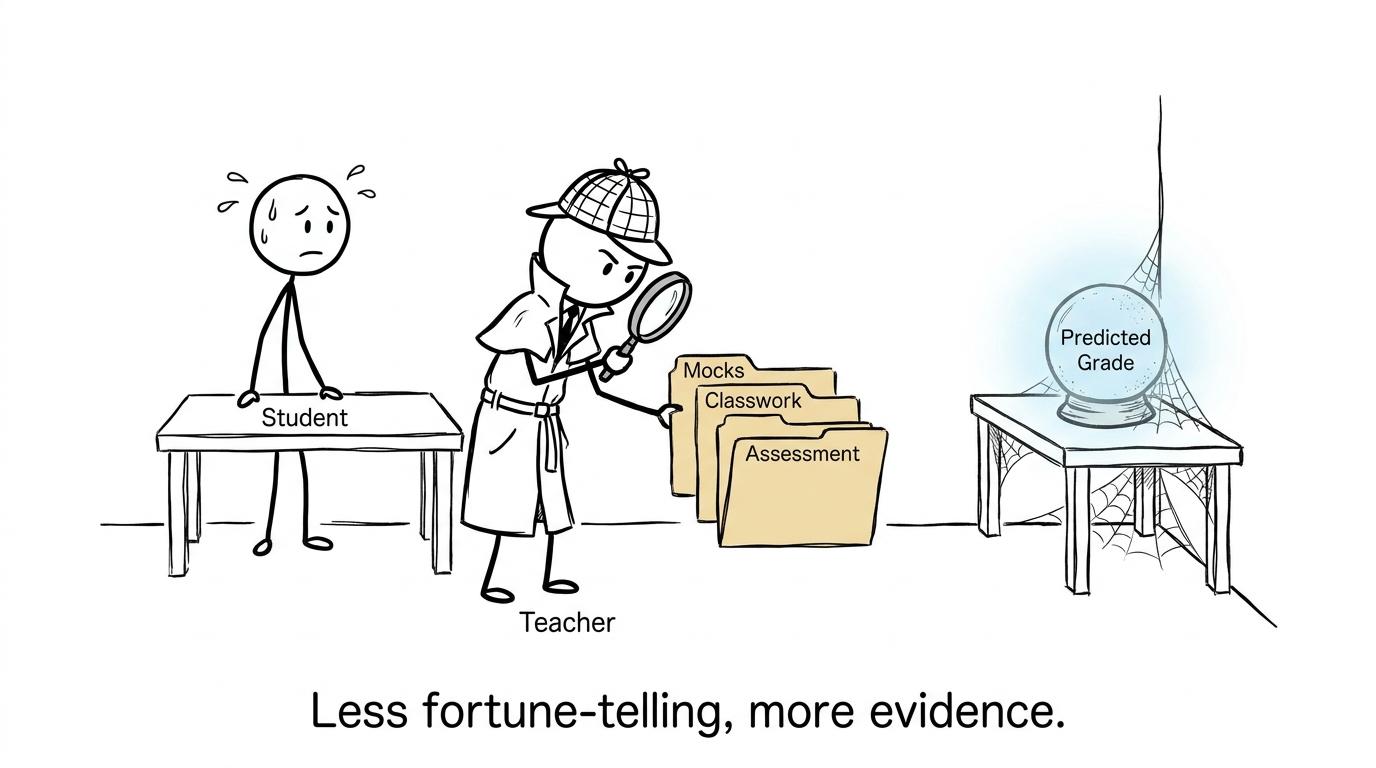 A teacher detective considers assessment evidence while ignoring a crystal ball
What a GCSE Religious Studies predicted grade means
A predicted grade is an informed estimate of likely future performance. Depending on your school and when the prediction is produced, it may describe the grade you are expected to achieve if your present pattern continues.
It should not automatically be confused with:
- a target grade, which may be generated from prior attainment and intended to provide an ambitious destination;
- a working-at grade, which usually describes the standard currently demonstrated;
- a mock grade, which records the outcome of one particular assessment;
- the final GCSE grade, which comes from the formal assessment and awarding process.
Schools do not always use these labels identically. If a report says “predicted grade”, ask what the term means locally and which evidence period was used.
This distinction matters because a student could be working at one grade now but predicted a higher grade after showing sustained improvement. Equally, one unusually strong homework response may not be enough to move a prediction if timed assessment evidence remains inconsistent.
How teachers actually arrive at the prediction
They begin with evidence that resembles the real assessment
Mocks are influential because they can reproduce several pressures of the real examination: unfamiliar questions, limited time, no access to notes and the need to sustain accurate writing across a full paper.
A mock is not automatically decisive. Illness, incomplete course coverage or an assessment that sampled a student’s weakest content can make one result less representative. Teachers can place it alongside other timed work rather than treating it as a verdict.
The closer an assessment is to the real conditions and specification, the more informative it tends to be. A carefully completed open-book homework may demonstrate understanding, but it does not reveal recall and time management as clearly as a controlled response.
They examine the quality behind the total mark
Two students can receive similar totals for different reasons. One may possess secure religious knowledge but struggle to evaluate competing arguments. Another may write thoughtful evaluations while losing marks through vague references to teachings, beliefs or sources of authority.
Teachers therefore look beyond the headline score. GCSE Religious Studies specifications commonly assess both accurate knowledge and understanding and the ability to analyse or evaluate religious and non-religious viewpoints. The precise question structures, content and assessment-objective weightings depend on the qualification and specification used by your school, including those offered by AQA, Edexcel, OCR and Eduqas.
A reliable prediction asks whether performance is balanced across the skills the final papers will test. Memorising quotations alone is not enough if they are not selected, explained and applied effectively.
They consider consistency across the course
Religious Studies covers multiple beliefs, practices and themes. A grade based only on one comfortable topic could be misleading.
Teachers may compare evidence from areas such as beliefs about God, worship, life after death, relationships, peace and conflict, crime and punishment, or matters of life and death. The actual selection depends on your specification.
Consistency does not mean every mark must be identical. It means there is enough evidence to judge your normal standard. Repeated performances at a similar level usually produce a more secure prediction than one exceptional response surrounded by weaker work.
They account for recent progress
Predictions should not be trapped permanently in Year 10. If your use of evidence, subject vocabulary, paragraph structure and evaluation has improved, recent controlled assessments may represent your current position more accurately than old work.
Teachers will still want evidence that improvement is sustained. A pattern matters more than a promise. This is why completing further timed responses and responding to feedback can be more persuasive than simply asking for a higher number.
Departments may moderate their judgements
Professional judgement does not mean an unsupported guess. Religious Studies departments may use common assessments, shared mark schemes, sample scripts and moderation meetings to make judgements more consistent between classes.
A teacher might review responses close to a grade threshold with colleagues. Schools may also compare current assessment patterns with previous cohorts, although past grade boundaries must be used cautiously.
Ofqual confirms that official GCSE grade boundaries are set after the examinations have been taken and marking is nearly complete. Boundaries can move when the difficulty of papers changes. Consequently, nobody can know the exact boundary for an upcoming Religious Studies paper in advance.
Which evidence usually carries the most weight?
There is no universal hierarchy, but evidence is generally stronger when it is recent, repeated and closely matched to the final assessment.
| Evidence | What it can show | Important limitation |
|---|---|---|
| Full mock papers | Recall, timing, stamina and performance across several questions | One difficult day may distort the result |
| Timed classroom responses | Current exam technique on a focused area | May cover only part of the specification |
| End-of-unit tests | Knowledge and application across a completed unit | Conditions and question styles can vary |
| Classwork | Understanding, participation and response to feedback | Help, notes or extra time may make it less comparable |
| Homework | Preparation and depth of thought | It may not represent independent timed performance |
| Teacher observation | Habits, progress and recurring strengths or gaps | It should support, rather than replace, assessable work |
Attendance or behaviour can affect how much evidence is available, but a predicted academic grade should represent likely attainment rather than operate as a reward or punishment. If substantial evidence is missing, the teacher may simply have less confidence in the prediction.
Why predicted grades can change
A prediction is a snapshot with a horizon attached. It can change when the evidence changes.
A later mock might cover more of the specification. Several improved responses might show that evaluation has become consistently stronger. Alternatively, repeated difficulty under timed conditions may lead a teacher to revise an earlier estimate.
That is not the system changing its mind at random. It is the estimate responding to a larger body of information.
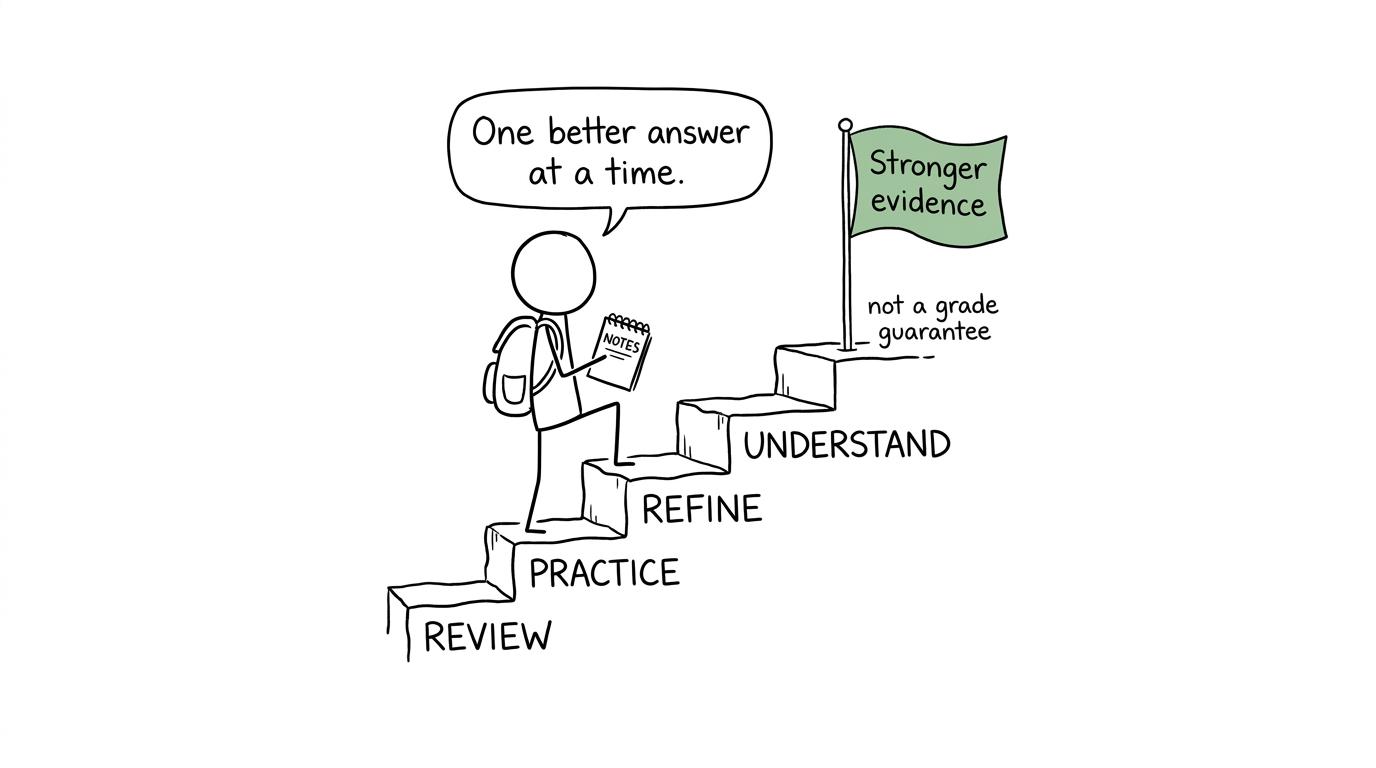 A student climbs towards stronger assessment evidence one answer at a time
What to do if you think the prediction is too low
Begin with curiosity rather than argument. Ask your teacher:
- Which assessments contributed most to the prediction?
- Which assessment objective is limiting my current grade?
- Is the issue knowledge, evaluation, timing or question interpretation?
- What evidence would demonstrate the next grade securely?
- When will predictions next be reviewed?
Then turn the answer into a short evidence-building plan. Complete timed responses, use the relevant mark scheme, identify exactly why marks were lost and repeat the weak skill after feedback.
This is also the approach that works in maths. The free GCSE Maths revision hub lets you select an exam board and use revision resources, exam questions and papers. You can find your weakest GCSE topics by marking diagnostic work rather than guessing what needs attention.
For a longer structure, MathsGenie’s one-month GCSE maths revision plan builds revision around retrieval, targeted practice and timed papers. The principle is identical: produce better evidence by improving the underlying skill.
Common mistakes when interpreting predicted grades
Treating the grade as a guarantee
A prediction neither guarantees nor caps the final outcome. Your final examination performance still matters.
Comparing raw mock marks between schools
Schools may use different papers, timings, content coverage and internal conversion methods. A raw mark from one mock cannot always be compared fairly with another school’s result.
Assuming last year’s boundaries will be repeated
Past boundaries provide context, not certainty. Official boundaries are set after the current papers have been taken and marked.
Focusing only on quotations
Relevant sources of wisdom and authority can strengthen an answer, but accuracy, explanation, application and evaluation remain essential. A memorised quotation earns little if it does not answer the question.
Asking for a change without producing new evidence
A calm conversation is worthwhile, especially if information has been missed. But the strongest case for a revised prediction is a sustained set of improved, independently completed assessments.
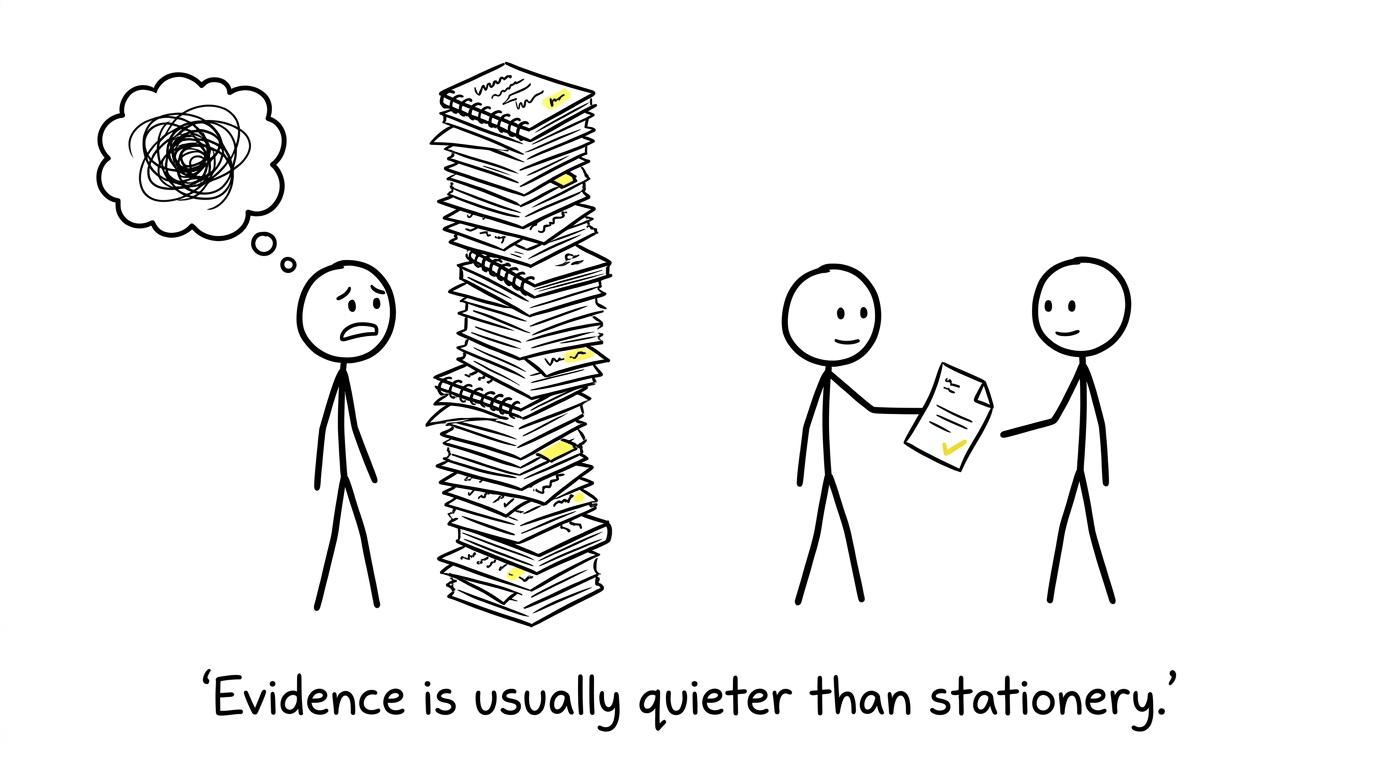 One student builds a tower of notes while another submits useful marked evidence
Use the prediction as information, not identity
The useful question is not, “What does this grade say about me?” It is, “What evidence would make the next prediction stronger?”
That shift turns a label into a plan. In Religious Studies, it may mean more precise knowledge, better-developed evaluation or greater control under time pressure. In maths, it may mean identifying recurring lost marks and repairing the exact topic.
MathsGenie can support that part of your GCSE preparation. Learn how to use past papers at the right stage, create a manageable GCSE maths revision timetable, and avoid unfocused practice with the guide to revising GCSE maths without wasting time.
Start at the MathsGenie GCSE hub, choose your exam board and use the free revision lessons, practice questions, mini tests, past papers, predicted papers, mark schemes and video solutions. A prediction is only an estimate. The work you produce next is new evidence.