

GCSE Religious Studies Lower Grade Than Expected
GCSE Religious Studies lower grade than expected? Check marks, consider a review, plan a resit and protect your next-step choices with calm advice.

Results day can shrink two years of work into one small box on a screen. If you received a GCSE Religious Studies lower grade than expected, do not make an immediate decision based on shock. First, confirm your marks and grade boundaries with your school. Then discuss whether there is evidence for a review, check whether the result affects your next step, and consider a resit only if it has a clear purpose.
A disappointing result matters, but it is information rather than a verdict. Here is the practical order to follow.
Your results-day checklist
- Record your overall grade and component marks.
- Ask how far you were from the next grade boundary.
- Check whether the grade affects sixth form, college or another course.
- Speak to your Religious Studies teacher or exams officer promptly.
- Consider access to your scripts before requesting a review.
- Check the cost, deadline and risk of any post-results service.
- Investigate resit availability for your exam board and specification.
- Keep preparing for any maths exams or resits alongside this decision.
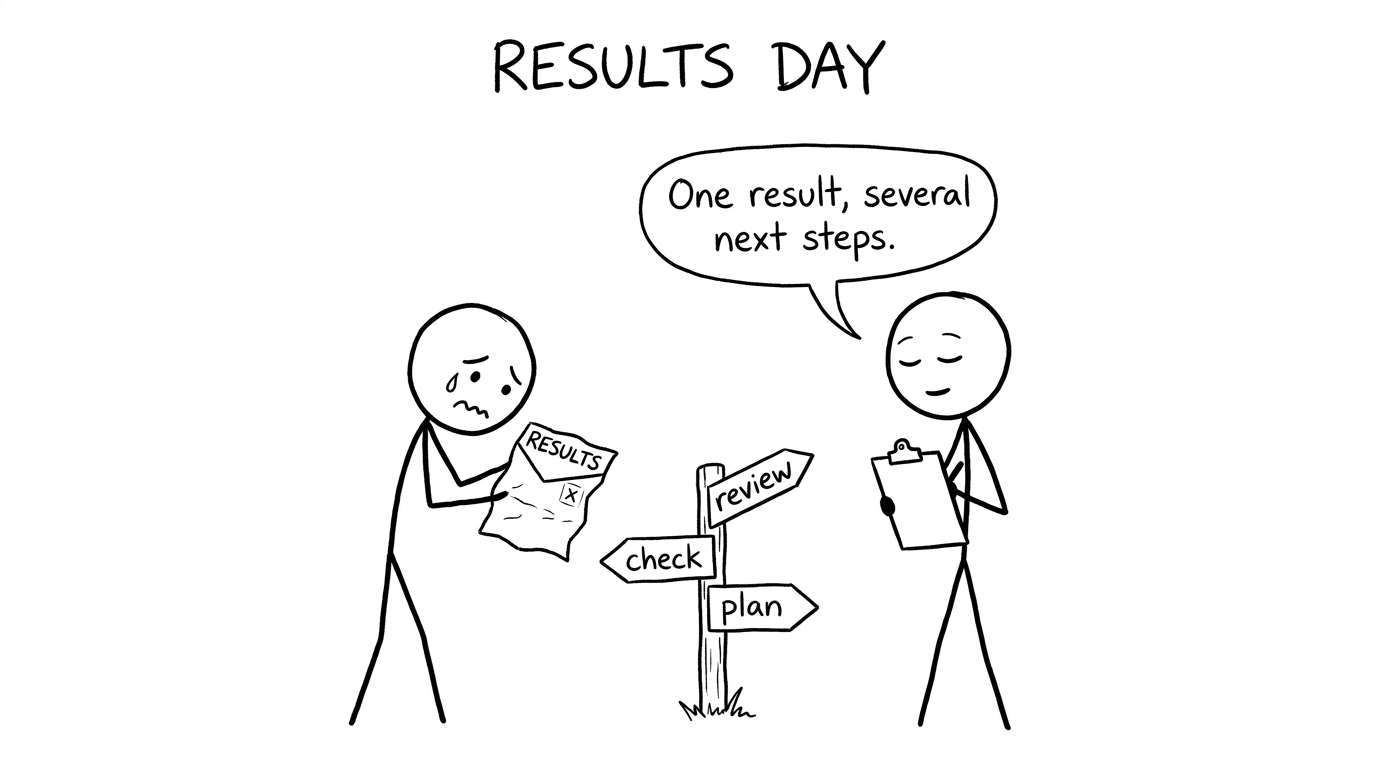 A student discovering that one result can lead to several sensible next steps
Start with the marks, not the emotion
A grade tells you the category into which your total mark fell. It does not tell you why. You might have missed the next boundary narrowly, performed unevenly across papers or lost marks through evaluation and exam technique.
Ask your school for:
- your mark for each paper or component;
- the relevant grade boundaries;
- your distance from the next boundary;
- your teacher's view of whether the mark looks unexpected;
- information about accessing your marked scripts.
Being close to a boundary does not automatically mean the marking was wrong. Equally, being several marks away does not prove that a review would be pointless. The useful question is whether a teacher can identify places where the published mark scheme may not have been applied correctly.
Decide whether to request a review of marking
A review of marking is not a fresh attempt by a more generous examiner. An independent reviewer checks whether the original mark scheme was applied correctly. A clerical re-check instead examines matters such as whether every question was marked and whether marks were totalled and recorded accurately.
Under current post-results arrangements, a school or college normally submits the request to the exam board and obtains the student's written consent. Fees and internal school deadlines vary. Your exams officer can explain the process for AQA, Edexcel, OCR or Eduqas.
There are three facts to understand before agreeing:
- Your mark can increase, remain unchanged or decrease.
- A changed mark does not necessarily change the overall grade.
- Deadlines are strict and are normally set shortly after results day.
Official review data consistently shows that many challenged GCSE grades remain unchanged. That is why seeing the script and asking a subject teacher for an evidence-based opinion is usually better than requesting a review simply because the result feels unfair.
If a review has been completed and you believe the exam board did not follow its procedures correctly, your school can explain the formal appeals route. An appeal is not simply another opportunity to seek extra marks.
Check what the result changes
The most important question is often not, "Was this the grade I wanted?" It is, "What does this grade prevent me from doing?"
Contact your intended sixth form, college or training provider if the result affects an offer. Entry requirements are set by individual providers, and a conversation may reveal that the Religious Studies grade is not decisive when your wider results are considered.
Do this before committing time and money to a resit. Unlike GCSE English language and maths in England, Religious Studies is not normally subject to the same post-16 resit condition. A resit should therefore serve a specific goal, such as meeting a course requirement or strengthening an application where the subject is particularly relevant.
If maths is the result affecting progression, read MathsGenie's guide to GCSE maths resit next steps before choosing your approach.
Consider the GCSE Religious Studies next steps
If a review is unsuitable or does not change the outcome, you can keep the grade or investigate a resit.
Check whether and when you can resit
Religious Studies resit arrangements depend on the exam board, specification and centre. Many GCSE Religious Studies qualifications have one examination series each year in May or June rather than a November opportunity. You may also need to retake all required components in the same series.
Ask your school, college or an approved private-candidate centre:
- whether it accepts Religious Studies resit candidates;
- which specification and religious options it offers;
- whether your previous specification remains available;
- which components must be retaken;
- what the entry and administration fees are;
- when entries close.
Do not purchase resources until you have confirmed the exact specification. Christianity, Islam, Judaism, Buddhism and thematic options are not interchangeable across boards or routes.
Diagnose what actually cost marks
A GCSE Religious Studies disappointing result is rarely fixed by rereading every page of a textbook. Separate the problem into four areas:
- Knowledge: beliefs, teachings, practices and ethical themes.
- Evidence: accurate religious sources, teachings and examples.
- Analysis: explaining how evidence supports a reason.
- Evaluation: reaching a justified judgement while considering contrasting views.
Use your script, teacher feedback, mark schemes and examiners' reports to identify which category caused the largest loss. Build revision around that evidence.
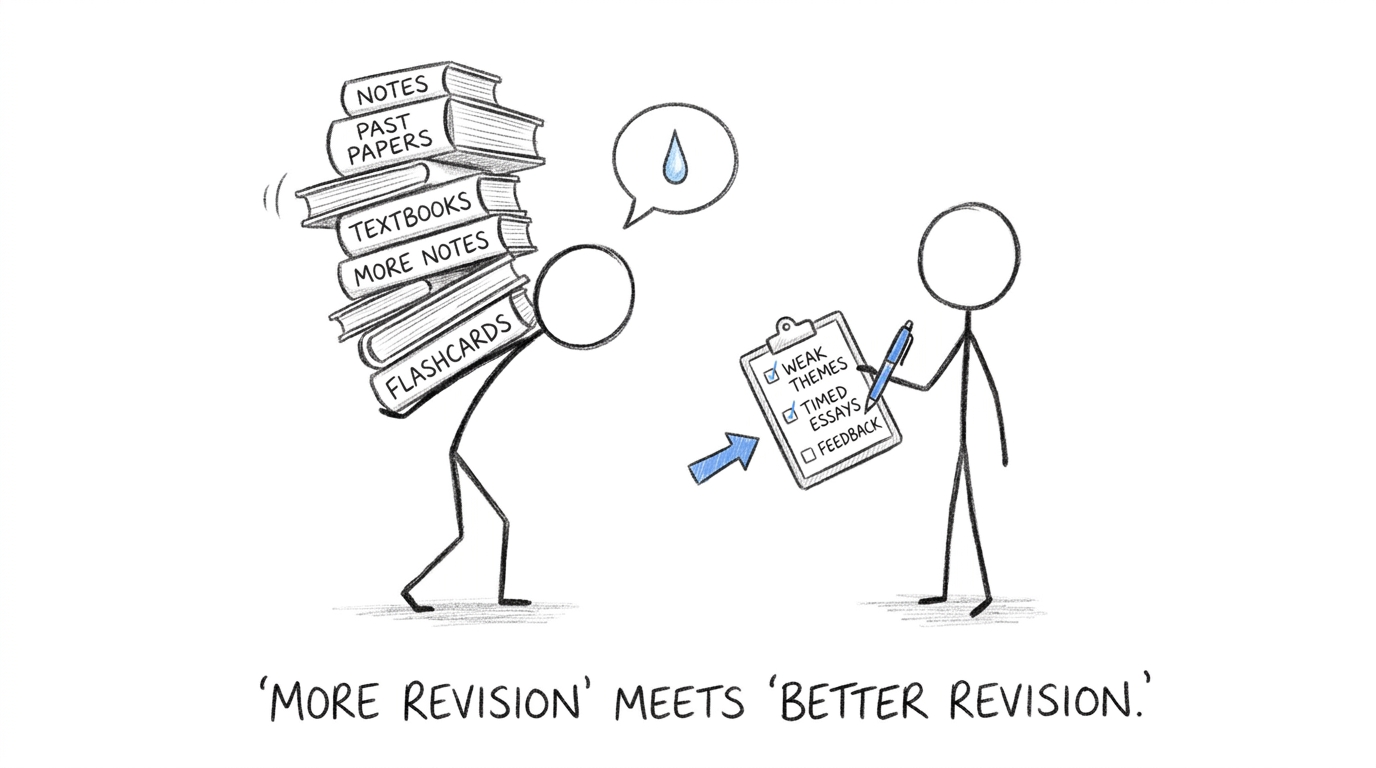 A large pile of revision books meets a smaller and more useful checklist
Build a focused resit routine
A useful weekly pattern is:
- one session retrieving beliefs, teachings and sources from memory;
- one session planning answers to board-specific command words;
- one timed extended response;
- one feedback session using the mark scheme and teacher guidance;
- regular mixed-topic practice so earlier content is not forgotten.
Measure progress through completed and corrected answers, not hours spent highlighting. The smaller checklist usually beats the larger pile of notes.
Keep your maths revision moving
One disappointing subject result can consume every available thought. Try not to let an RS decision disrupt your maths preparation, particularly if maths is essential for your next course.
Use the free GCSE Maths revision hub to choose your exam board, then organise sessions with the MathsGenie revision planner. You can access dedicated pathways for Edexcel GCSE Maths, AQA GCSE Maths and OCR GCSE Maths.
When exams approach, move from lessons and practice questions to timed papers. MathsGenie provides Edexcel past papers with mark schemes, OCR GCSE Maths past papers and GCSE predicted papers. This lets your RS next steps remain a contained decision rather than allowing them to derail every subject.
Common mistakes after a disappointing result
- Requesting a review without teacher input: closeness to a boundary is not evidence of a marking error.
- Missing the school's deadline: centres often set internal deadlines earlier than the exam board.
- Ignoring the risk: an individual paper mark can move down as well as up.
- Assuming a November resit exists: availability differs by subject, board and specification.
- Revising the wrong route: confirm the precise specification and religious options first.
- Repeating the same revision method: if passive reading produced weak recall, replace it with retrieval, timed answers and feedback.
- Neglecting maths: protect the subjects that directly affect progression while resolving the RS result.
Turn the result into a decision
A lower grade can feel personal because the work behind it was personal. The response should be calmer: gather the marks, inspect the evidence, protect your next destination and resit only when it has a clear benefit.
For Religious Studies resit materials, ask your centre for resources matched to your exact exam board, specification and route. For the maths preparation running alongside it, start with MathsGenie's free revision lessons, practice questions, mark schemes, video solutions, mini tests, past papers and predicted papers. Choose one resource, complete one focused session and let the next action be smaller than the result feels.











