GCSE Religious Studies at a Different Exam Centre
GCSE Religious Studies different exam centre guidance: find an approved centre, make a private entry, and check fees, deadlines and access arrangements.
A subject can matter to you even when it does not appear on your school timetable. Perhaps Religious Studies supports your sixth-form plans, reflects a genuine interest, or is simply a GCSE you want the opportunity to take.
The short answer to gcse religious studies different exam centre questions is yes: you can usually sit the qualification at another approved school, college or examination centre as a private candidate. However, that centre must accept private candidates and be willing to enter you for the exact exam board, specification and option you have prepared.
Your own school does not have to teach the subject, but it is still the best place to begin. An exams officer may be able to make an additional entry even if the school does not run Religious Studies lessons.
Your quick action checklist
- Ask your school whether it can enter you for GCSE Religious Studies.
- Identify the exact exam board, specification code and subject options you intend to take.
- Check that the qualification is available to private candidates.
- Search for approved centres that accept private entries.
- Contact several centres well before their deadlines.
- Confirm fees, examination dates, identification requirements and access arrangements in writing.
- Check your statement of entry as soon as it arrives.
- Plan Religious Studies revision without allowing your maths preparation to disappear.
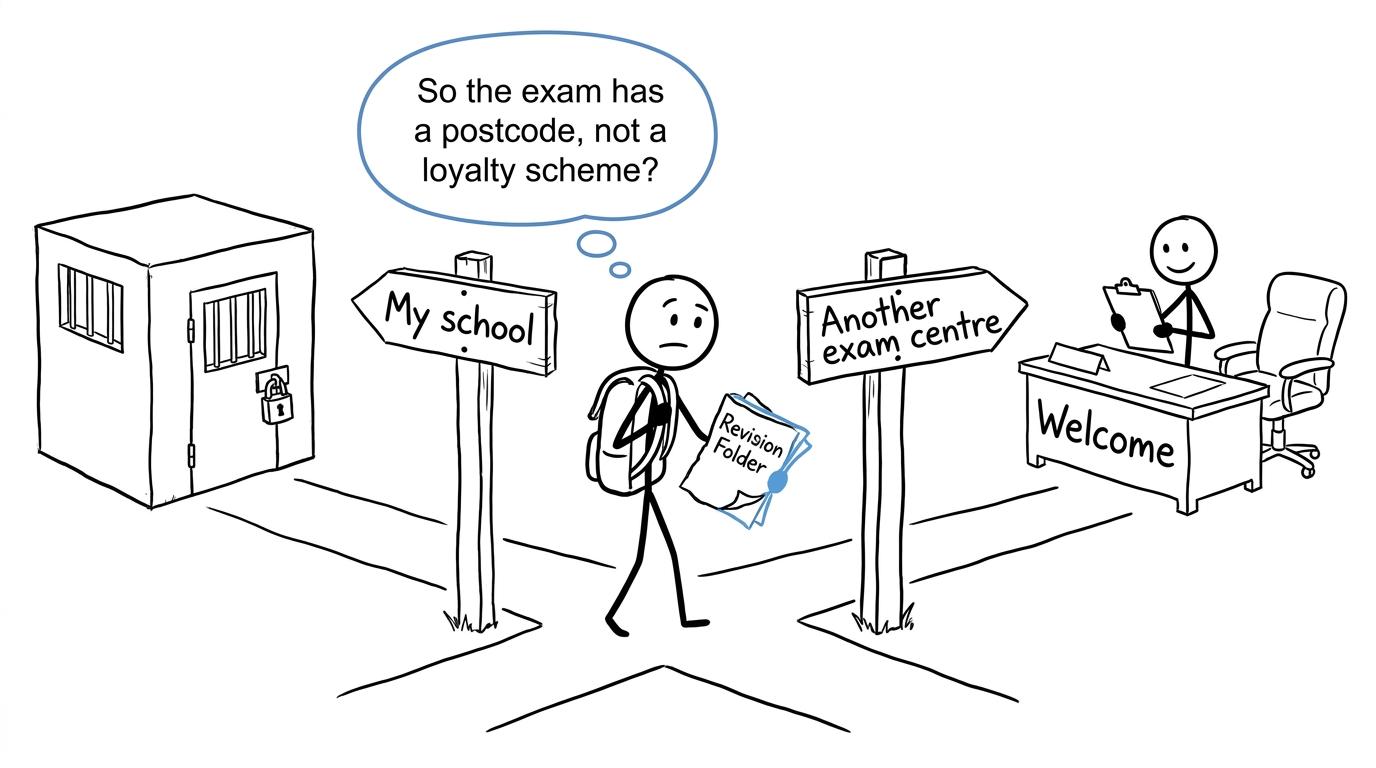 A student discovers that an examination can have a different postcode
Ask your school before looking elsewhere
A school not offering Religious Studies as a taught GCSE does not automatically mean that it cannot enter you for the examination. Speak to the exams officer, head of year or curriculum lead rather than relying on an informal answer from someone who does not manage entries.
Ask a precise question: can the school make an examination-only entry for the Religious Studies qualification you plan to prepare independently?
Give the school enough information to investigate:
- your intended awarding body, such as AQA, Pearson Edexcel, OCR or Eduqas;
- the full specification and entry code;
- the religions, themes or paper options required by that specification;
- the examination series you want to enter;
- any existing access arrangements.
Your school may agree, charge an entry or administration fee, or decide that it cannot support the entry. Centres are not generally required to accept a subject they do not deliver. A refusal is disappointing, but it does not necessarily end the plan.
How sitting GCSE Religious Studies elsewhere works
If another centre accepts you, you normally become a private candidate for that qualification. You can still remain enrolled at your usual school and sit your other GCSEs there.
The external centre makes the official entry with the awarding body. You cannot enter yourself directly with AQA, Edexcel, OCR or Eduqas. The centre will also confirm your identity, provide the examination room and invigilation, apply examination regulations, and explain how you will receive results and certificates.
JCQ maintains a private-candidate search service covering schools, colleges and other approved establishments that have indicated they may accept private candidates. Its list is a starting point rather than a guarantee. Each centre decides which qualifications, boards and candidates it can accommodate, and centres not shown in the search may sometimes accept enquiries.
Contact several places. Availability can depend on staffing, room capacity, the awarding body used by the centre and whether it can process your chosen entry option.
Match the exact board, specification and options
“GCSE Religious Studies” is not one interchangeable examination. Different specifications can assess different combinations of religions, philosophical and ethical themes, textual studies or religious practices.
Before paying, ask the centre to confirm all of the following in writing:
| Detail | What to confirm |
|---|---|
| Qualification | GCSE rather than International GCSE or a short course |
| Awarding body | The exact board whose specification you have revised |
| Specification code | The current code printed on the official specification |
| Entry option | The correct religions, themes and papers |
| Examination series | The series in which every required paper is available |
| Assessment | Whether there are any conditions beyond written papers |
AQA currently lists its GCSE Religious Studies qualifications as available to private candidates without special restrictions, but that does not oblige every AQA centre to accept the entry. Availability and entry arrangements must always be checked against the current awarding-body information for your chosen qualification.
Do not assume that changing board at the last moment will be easy. Much of the knowledge may overlap, but the content, paper structure and mark scheme can differ. Choose the specification before building your revision programme.
What to ask a prospective exam centre
A short, organised email makes it easier for an exams officer to answer accurately. Include your age, intended series, qualification, board, specification code and entry option. Then ask:
- Do you accept private candidates for this exact qualification?
- What is your internal booking deadline?
- What is the total fee, including entry and administration charges?
- What identification and previous candidate information do you require?
- When and where must I arrive for each paper?
- Can you process my access arrangements, if applicable?
- How will results and certificates be issued?
- What is the cancellation or refund policy?
Centres set their own private-candidate charges, so prices and payment conditions vary. Late entries may cost more or may not be accepted at all. Starting early gives the exams officer time to check your options and gives you time to approach another centre if necessary.
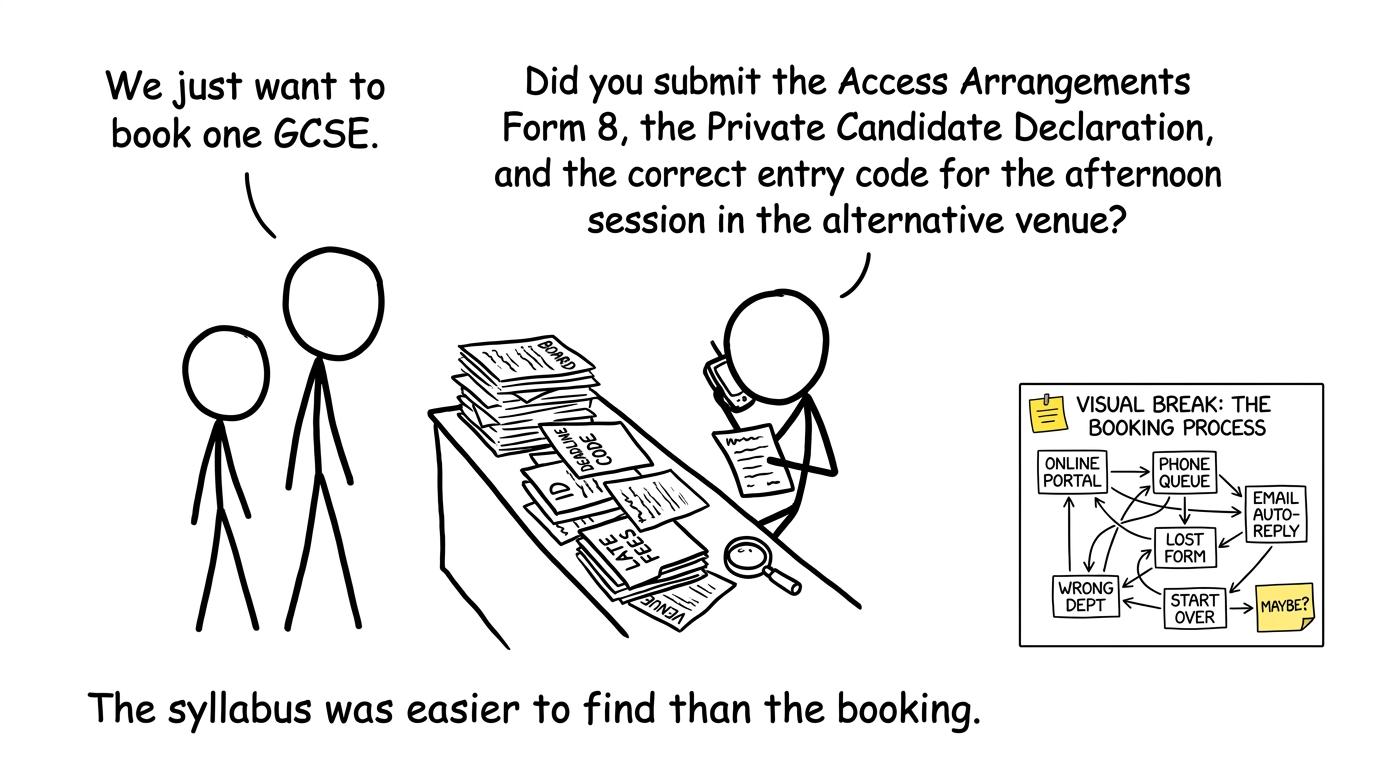 An exams officer, a determined student and a formidable pile of booking forms
Check access arrangements early
If you normally receive extra time, supervised rest breaks, a reader, a scribe, assistive technology or another adjustment, tell the prospective centre during your first enquiry.
An arrangement used at your school does not simply travel with you because you mention it on examination day. The centre responsible for your entry must follow the current JCQ rules, hold appropriate evidence and make any required application. It may need information from your school and time to establish your normal way of working.
Ask both centres to communicate early. Never wait until your entry has been completed before raising this issue, because the external centre may be unable to provide a particular arrangement or gather the necessary evidence in time.
After the centre accepts your entry
Acceptance is not the final check. When you receive a statement of entry, compare it with the specification you have been following. Check your name, date of birth, candidate details, awarding body, subject code, option code and listed papers.
Tell the centre immediately if anything appears wrong. Revising Christianity and Buddhism, for example, does not help if the submitted option requires a different combination.
Also compare the Religious Studies timetable with the examinations being sat at your usual school. If there is a clash or a difficult journey between centres, alert both exams officers. Do not attempt to create your own informal solution. Examination timetables and supervision have formal requirements.
Finally, save every email, payment receipt and entry document in one folder. Administration feels unimportant until a detail is disputed. Then it becomes the whole story.
Preparing independently without losing maths marks
Adding another GCSE creates two jobs: learning Religious Studies and protecting the subjects already filling your timetable. Ambition becomes expensive when it quietly consumes every available evening.
Use a weekly plan with defined sessions rather than promising to “do some revision”. Religious Studies might receive separate blocks for content recall, quotation knowledge, timed evaluation and mark-scheme review. Maths still needs regular problem-solving rather than occasional reading.
The free GCSE Maths revision hub lets you choose your exam board and move between revision lessons, worksheets, exam questions and paper practice. A short topic session can keep maths active while you handle the extra Religious Studies workload.
For exam practice, use the collection matching your board. MathsGenie provides Edexcel GCSE Maths past papers, AQA GCSE Maths past papers and an OCR GCSE Maths revision hub with relevant questions and papers.
Do not merely complete papers and count marks. The useful part happens afterwards: identify the weak topic, revisit the method and test it again. The guide to using GCSE past papers properly explains this revision loop, while the guide to finding your weakest GCSE topics helps turn lost marks into a practical plan.
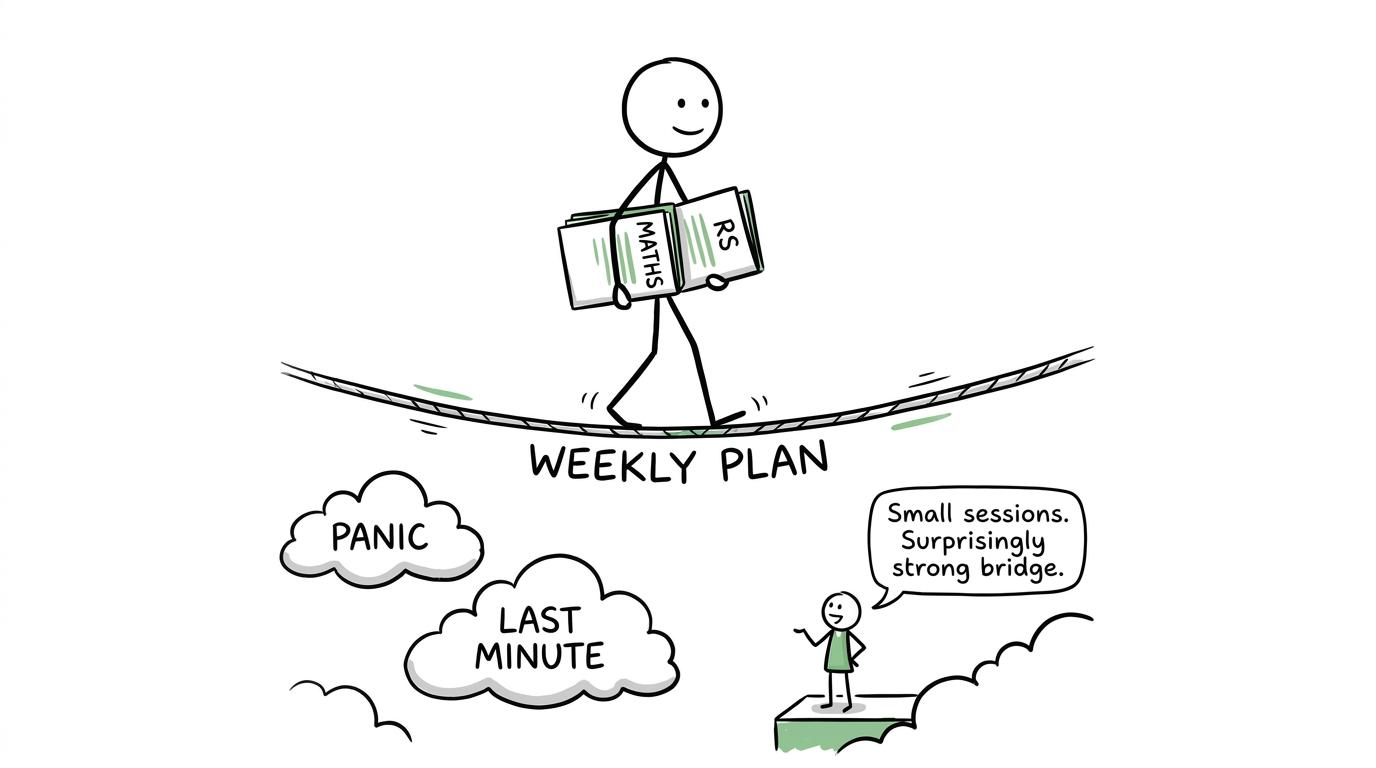 A student balances Maths and Religious Studies revision with a calm weekly plan
Common mistakes when arranging an external entry
Assuming any centre can enter any board
A centre may accept private candidates but not offer your awarding body or chosen Religious Studies option. Confirm the exact code before paying.
Searching too late
The awarding body's deadline is not necessarily the centre's deadline. Centres often need processing time and may set an earlier cut-off.
Booking before choosing a specification
Your revision resources must match the qualification entered. “Religious Studies GCSE” is not precise enough.
Forgetting access arrangements
Raise adjustments during the first conversation. Evidence, applications and suitable rooms cannot reliably be organised at the last minute.
Ignoring timetable and travel problems
You may be sitting most GCSEs at school and Religious Studies elsewhere. Check dates, start times, transport and possible clashes as soon as the timetable is available.
Letting the extra subject displace core revision
An additional GCSE should have a defined place in your week. Use Edexcel predicted papers for fresh maths practice, then use mark schemes and video solutions to repair specific gaps rather than revising without direction.
Turn the idea into a confirmed entry
Yes, sitting GCSE Religious Studies at a different exam centre is possible in many cases. The decisive word, though, is confirmed. You need an approved centre willing to accept you, the correct specification and option, a completed entry, settled fees, and written arrangements for every paper.
Begin with your school's exams officer. If the school cannot help, search for private-candidate centres and contact several with precise qualification details. Once your entry is secure, build a revision plan that gives Religious Studies enough attention without sacrificing maths.
MathsGenie can keep that part of the plan simple. Start with a free revision lesson, practise the matching questions, test yourself with past or predicted papers, and use mark schemes and video solutions to understand every lost mark. Good revision is rarely dramatic. It is a series of small arrangements made correctly, including where you sit the exam.