

GCSE Psychology 5 to 8: A Practical Grade Guide
GCSE psychology 5 to 8 advice for improving recall, application, evaluation, research methods and exam technique through focused, measurable revision.
Moving from a grade 555 to a grade 888 in GCSE Psychology is not mainly about writing more or memorising every page of a textbook. It is about making your knowledge more precise, applying it to unfamiliar scenarios and evaluating evidence with a clear purpose. That is the practical answer to the GCSE psychology 5 to 8 challenge.
A grade 555 response often shows sound knowledge but loses marks through vague terminology, undeveloped evaluation or weak links to the question. A grade 888 response is more selective. It identifies what the examiner wants, retrieves the right material and uses it to build a supported judgement.
The route upwards is therefore not simply learn more. It is recall, apply, evaluate and correct.
Your grade improvement checklist
Use this checklist to organise your revision:
- Check your exam board and current specification.
- Learn theories, studies and research methods through active recall.
- Separate knowledge, application and evaluation when marking answers.
- Use precise psychological terminology.
- Connect every applied point to the scenario.
- Develop evaluation by explaining why a strength or weakness matters.
- Practise data handling and mathematical skills regularly.
- Complete timed questions and analyse every lost mark.
- Revisit weak material after a gap rather than correcting it only once.
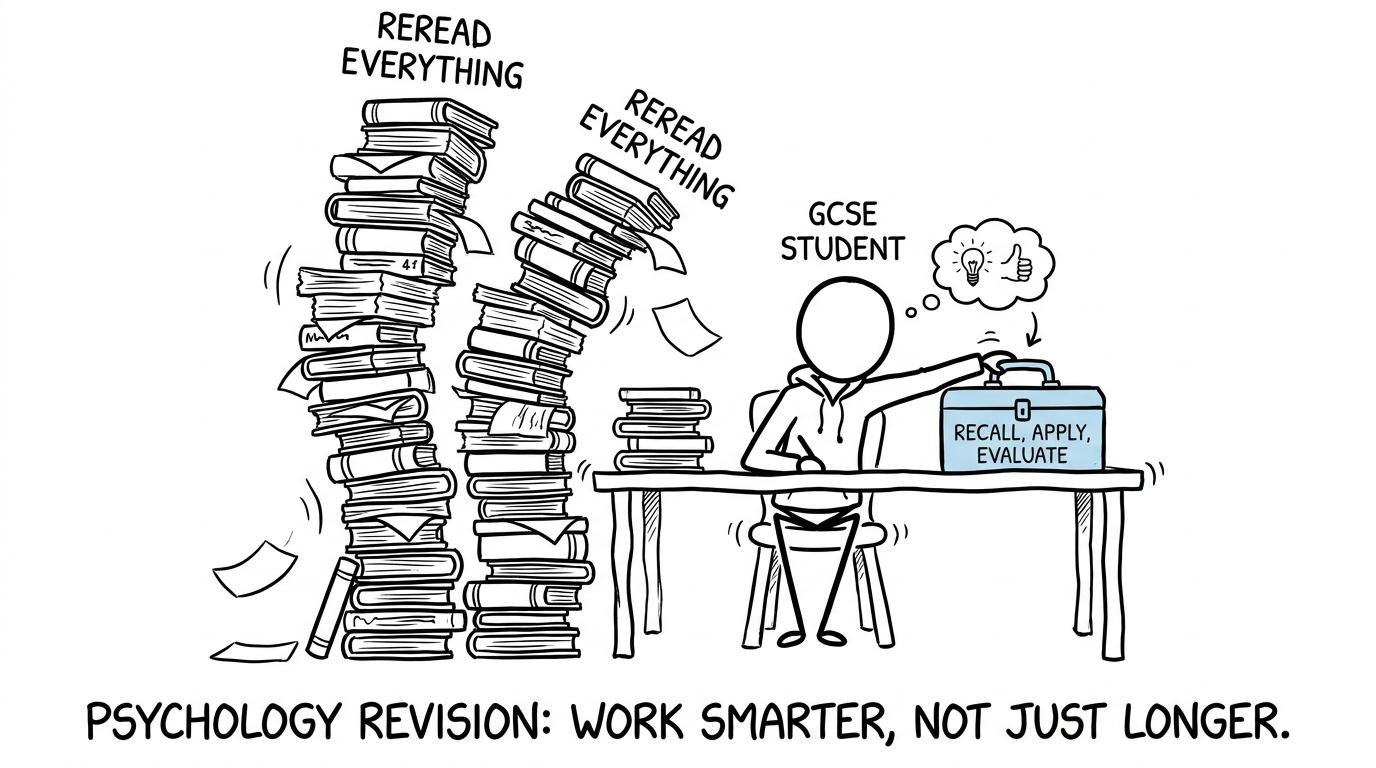 A student chooses a useful recall, apply and evaluate toolbox instead of rereading everything
What separates a grade 5 from a grade 8?
There is no universal raw-mark boundary that permanently defines either grade. Grade boundaries are set for each examination series, so your target should be stronger performance across the assessment objectives rather than a guessed number of marks.
Ofqual requires GCSE Psychology assessments to allocate approximately 35%35\%35% to AO1, 35%35\%35% to AO2 and 30%30\%30% to AO3. These objectives mean:
- AO1: demonstrate knowledge and understanding of psychological ideas, processes and procedures.
- AO2: apply that knowledge and understanding.
- AO3: analyse and evaluate information and use it to reach judgements or conclusions.
A student can remember a large quantity of content and still struggle to reach the highest grades if application and evaluation remain underdeveloped.
| Feature | Typical grade 5 performance | Strong grade 8 performance |
|---|---|---|
| Knowledge | Generally correct but sometimes broad or incomplete | Accurate, detailed and expressed with specialist terminology |
| Studies | Recalls the general aim or result | Selects accurate details relevant to the question |
| Application | Mentions the scenario | Uses specific details from the scenario throughout the explanation |
| Evaluation | Identifies a strength or weakness | Explains its consequence and connects it to a reasoned judgement |
| Research methods | Recognises common methods | Applies methodological ideas to unfamiliar investigations |
| Extended writing | Contains several relevant points | Follows a coherent argument shaped by the command word |
| Exam control | Answers from memory without enough planning | Allocates time and content according to the marks available |
The distinction is not perfection. It is control. Higher-grade students make more deliberate decisions about which knowledge belongs in each answer.
Know the course you are actually sitting
Before changing how you revise, confirm your exam board. Psychology specifications overlap, but their topic organisation, named studies, optional content and paper structures are not identical.
For example, AQA currently assesses two papers, each worth 50%50\%50% of the qualification and carrying 100100100 marks. Its topics include memory, perception, development, research methods, social influence, language, thought and communication, brain and neuropsychology, and psychological problems.
Pearson Edexcel organises its qualification differently. Paper 111 is worth 55%55\%55%, while Paper 222 is worth 45%45\%45% and includes compulsory research methods alongside two optional topics selected by the centre. Do not revise a named study simply because it appears in somebody else's online checklist.
Print or save your specification and turn it into a traffic-light audit:
- Green: you can answer an exam question without notes.
- Amber: you recognise the material but cannot retrieve enough detail.
- Red: you cannot yet explain or apply it accurately.
Recognition can feel like knowledge because the page looks familiar. The examination asks whether you can produce and use that knowledge without the page being there.
Upgrade recall from broad to precise
Grade 555 revision often consists of rereading, highlighting and copying notes. These activities can support initial learning, but they do not reliably test retrieval.
For every theory or explanation, build a compact recall structure covering:
- its central claim;
- its important processes or stages;
- the behaviour it explains;
- supporting or conflicting evidence;
- methodological or theoretical limitations;
- any required issue, debate or application.
For each named study, learn only specification-relevant details: aim, procedure, sample, findings, conclusion and useful evaluation. Accuracy matters more than decorative detail. An incorrect sample or result can weaken an otherwise sensible argument.
Close your notes and reconstruct the material. Then compare your response with the source and record omissions. This is more uncomfortable than rereading, which is precisely why it reveals what you do not yet know.
A spaced pattern might revisit content on day 111, day 333, day 777 and day 141414. The dates are not magical; the useful feature is having to retrieve information after some forgetting has occurred.
Turn knowledge into application
Application is one of the clearest differences between middle and higher-grade answers. A scenario is not background decoration. It is evidence that must be interpreted using psychology.
Read an applied question like a detective:
- underline the command word;
- identify the theory, process or method being tested;
- circle distinctive details in the scenario;
- match each selected detail to a psychological concept;
- explain the connection rather than merely repeating the scenario.
Weak application is detachable: it could be pasted onto almost any scenario. Strong application depends on the people, behaviour or investigation described in that particular question.
Useful phrases include “This suggests… because…” and “The detail that… is consistent with…”. These are not scripts to repeat mechanically. They remind you that an applied claim needs both contextual evidence and psychological reasoning.
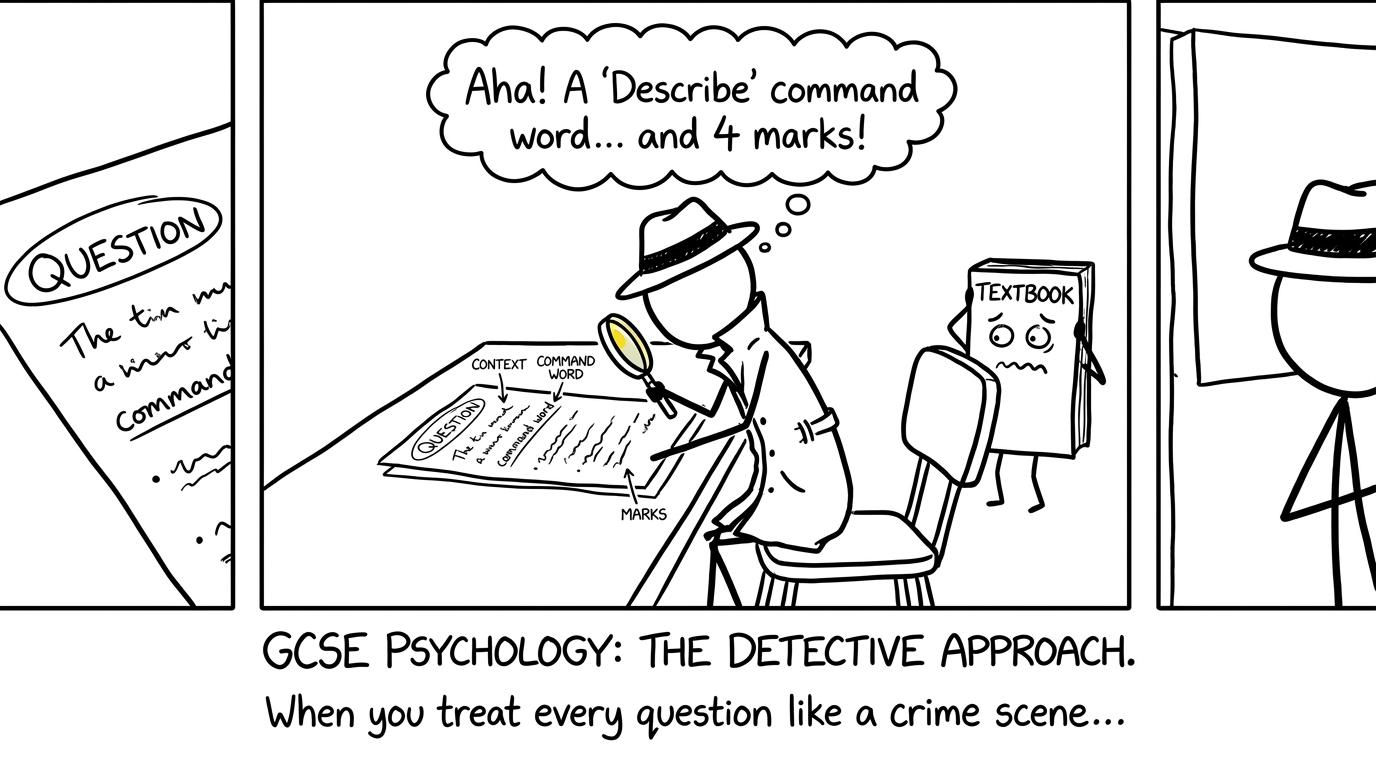 A student investigates command words, context and marks like an exam-question detective
Make evaluation earn its place
A labelled weakness is not yet developed evaluation. Writing that a study used a small sample, lacked ecological validity or was unethical may begin a point, but the examiner still needs to know why it matters.
Build evaluation using four moves:
- Claim: identify the strength or limitation.
- Evidence: give the relevant feature of the study, theory or method.
- Consequence: explain its effect on validity, reliability, generalisability or usefulness.
- Judgement: relate that consequence to the question.
The most valuable phrase in evaluation is often the silent question: So what? If demand characteristics may have influenced participants, explain how that could change their behaviour and reduce confidence that the findings represent the intended process.
Avoid treating every study with the same memorised paragraph. Evaluation must fit the evidence. A field study may offer more natural behaviour but less control; a laboratory study may produce greater control without fully representing everyday experience. Neither label automatically makes research good or bad.
Comparison also helps. When two explanations account for the same behaviour differently, decide which has stronger evidence, wider application or a more convincing account. A conclusion should follow from the argument rather than suddenly announcing a favourite theory.
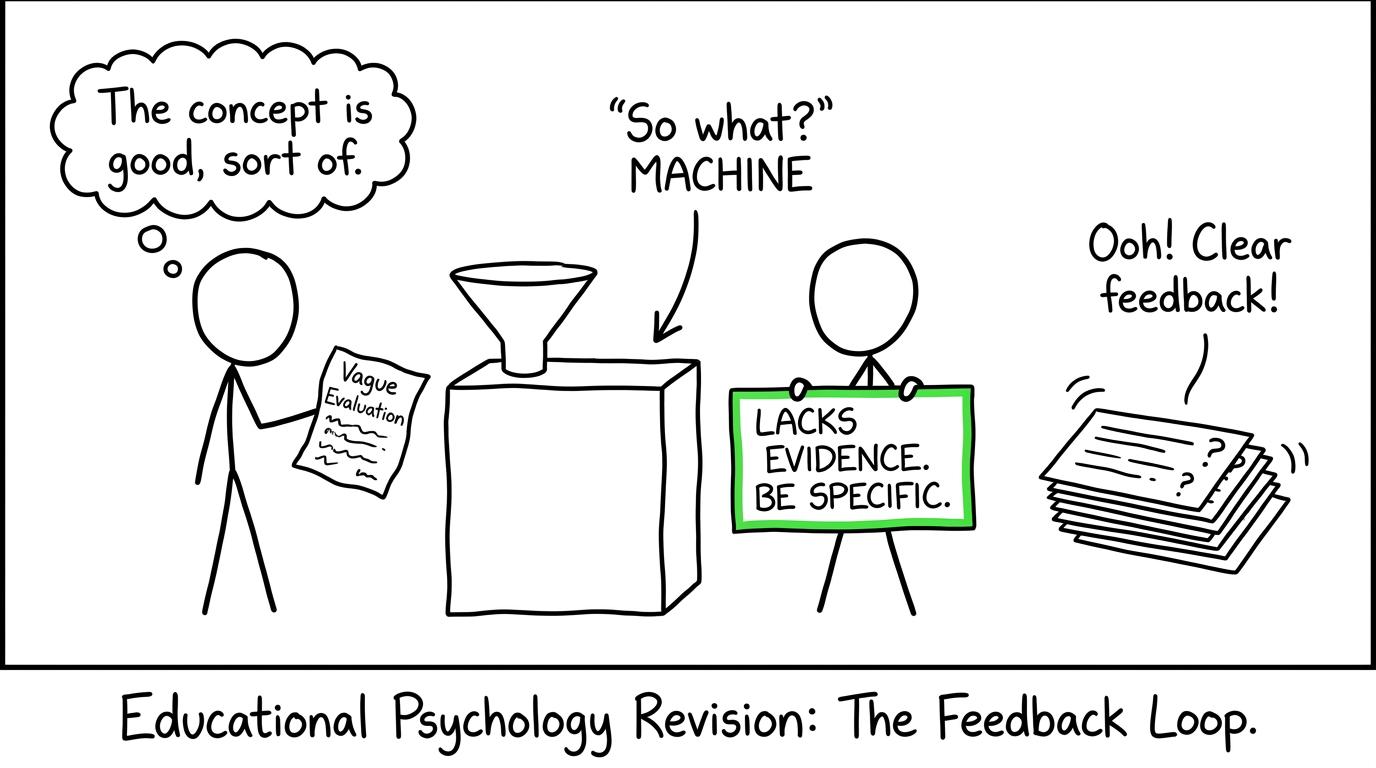 A machine labelled So what turns a vague evaluation point into a clear judgement
Treat research methods as a grade-building topic
Research methods should not be left until the final week. National GCSE Psychology requirements mean that at least 20%20\%20% of qualification marks assess research methods across the assessment objectives. At least 10%10\%10% of the total marks also reward mathematical skills at the required level of demand.
You should be comfortable with variables, hypotheses, experimental designs, sampling, ethics, reliability, validity, qualitative and quantitative data, averages, range, percentages, tables, graphs and correlations. Your exact required content still depends on the specification.
MathsGenie's AQA Psychology handling data guide covers tables, graphs, averages and interpretation. Students following another specification can strengthen the underlying skills through the OCR Psychology research methods guide, while checking terminology against their own course.
Keep the main descriptive calculations secure:
Mean=sum of scoresnumber of scores\text{Mean}=\frac{\text{sum of scores}}{\text{number of scores}}Mean=number of scoressum of scores Range=highest score−lowest score\text{Range}=\text{highest score}-\text{lowest score}Range=highest score−lowest scoreDo not stop after calculating. Psychology questions can ask you to interpret what a value shows, choose a suitable graph or explain why one measure is more appropriate than another. The GCSE Statistics revision hub and scatter graphs revision guide can reinforce these transferable data skills.
Remember that correlation does not establish causation. An association may involve another variable, and the direction of influence may be uncertain.
Use feedback to target the next grade band
Complete a timed question set, mark it strictly and classify every lost mark as:
- missing knowledge;
- inaccurate terminology;
- weak application;
- undeveloped evaluation;
- research-method error;
- data or calculation error;
- misread command word;
- poor timing.
You can calculate the proportion of your lost marks belonging to a category using:
Error proportion=marks lost in the categorytotal marks lost\text{Error proportion}=\frac{\text{marks lost in the category}}{\text{total marks lost}}Error proportion=total marks lostmarks lost in the categoryThe calculation is less important than the decision it supports. If application accounts for the largest share, another evening of copying study procedures is unlikely to solve the real problem.
MathsGenie's guide to finding your weakest GCSE topics explains how to turn marked work into a focused revision list. The same diagnostic principle works across subjects: gather evidence, label the error, practise the exact skill and re-test it.
A manageable weekly rhythm is:
- one session of active recall;
- one session of application and research-method questions;
- one timed extended response;
- one mixed or timed paper section;
- one correction session using the mark scheme.
Common mistakes that keep students near grade 5
Revising content without answering questions
Knowing a theory and constructing an answer are different skills. Include exam questions from the beginning, not only after you believe revision is complete.
Listing generic evaluation points
“Small sample” is not a complete evaluation. Explain who was sampled, why the group may be unrepresentative and how that limits the conclusion.
Ignoring the command word
“Describe”, “explain”, “evaluate” and “compare” require different intellectual jobs. Build your answer around the instruction rather than writing everything you remember.
Retelling the scenario
Repeating what happened is not application. Name the psychological concept and explain how the contextual detail demonstrates it.
Treating mark schemes as answer sheets
Use mark schemes to identify rewarded features, not to memorise one rigid paragraph. A different scenario may require different evidence and reasoning.
Avoiding maths and data
Data questions are often highly trainable. Use MathsGenie's GCSE Maths revision area for underlying number and statistics skills, then practise applying them in psychological contexts.
Completing papers without repairing mistakes
A score records the past; a correction changes the future. Short GCSE mini tests can help you practise the habit of attempting, marking and re-testing. For wider maths preparation alongside Psychology, the AQA GCSE Maths past papers and Edexcel GCSE Maths past papers include mark schemes and solutions where available.
Your next step with MathsGenie
The shift from grade 555 to grade 888 usually comes from many small corrections: a definition made exact, a scenario detail properly applied, an evaluation point developed and a weak method practised again.
Begin today with one timed Psychology question. Mark it by AO1, AO2 and AO3, identify the largest source of lost marks and plan one focused repair session. Then use MathsGenie's free revision lessons and practice questions to strengthen your data skills, mini tests to check recall, and past papers, predicted papers, mark schemes and video solutions to keep your wider GCSE maths revision moving.
Do not measure progress by how many pages you have read. Measure it by what you can retrieve, apply and evaluate when the notes are closed.










