GCSE Physics Edexcel Grade Boundaries Explained
GCSE Physics Edexcel grade boundaries explained clearly, with 2025 Foundation and Higher marks, 2026 results day guidance and practical next steps.
Opening a results envelope can make months of work feel as though they have been compressed into one line. Yet GCSE Physics Edexcel grade boundaries are less mysterious than they first appear: they are simply the minimum total raw marks needed for each grade in that examination series.
For summer 2026, GCSE results are released to candidates on Thursday 20 August 2026. The 2026 boundaries will not be confirmed until results day, so the most recent official comparison is from June 2025. Those figures are shown below, but they should be treated as historical guidance rather than predictions.
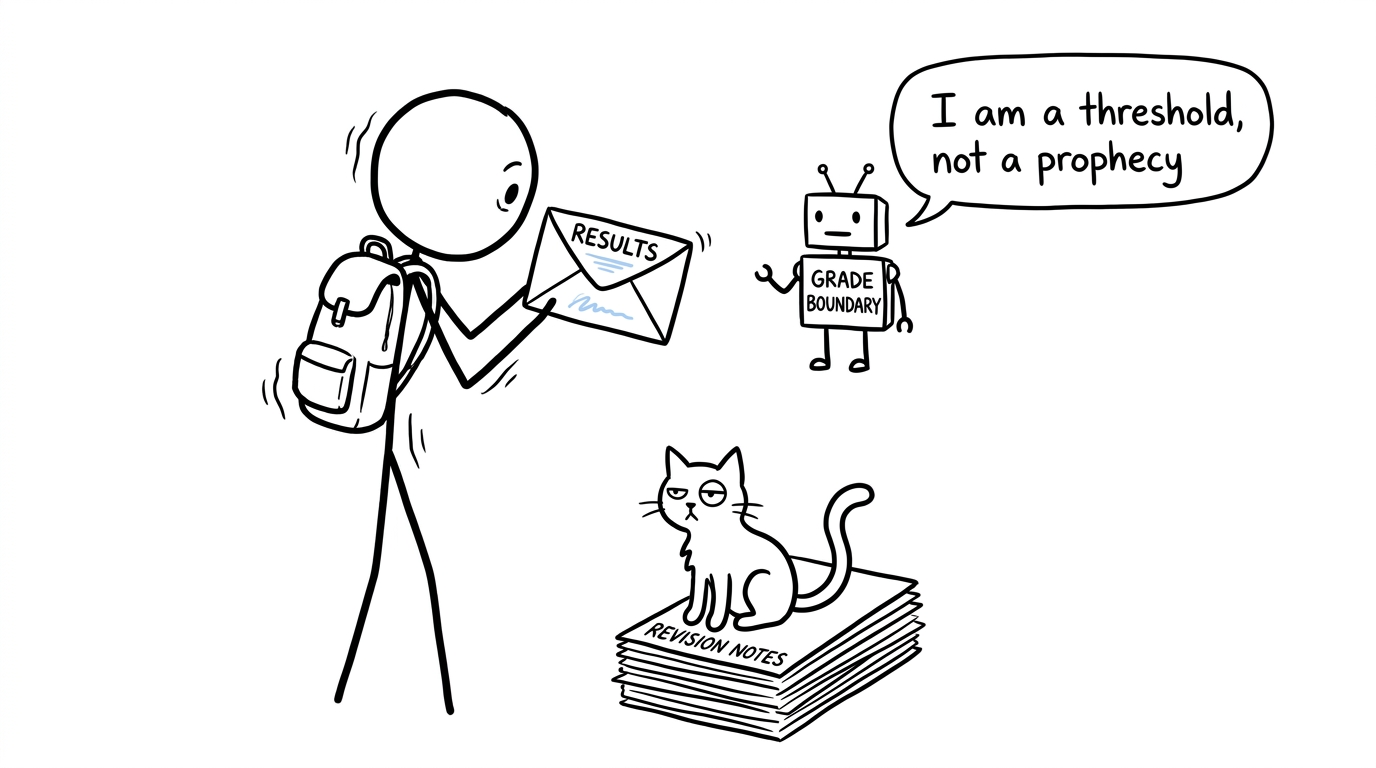 A student discovers that a grade boundary is a threshold rather than a prophecy
GCSE Physics results day checklist
Before looking at any boundary table, check four things:
- Your qualification is Pearson Edexcel GCSE Physics, specification code 1PH0.
- You took separate Physics rather than Combined Science.
- You know whether you sat Foundation or Higher tier.
- You are comparing your result with the boundaries from the correct exam series.
If your results slip does not show your raw mark, ask your teacher or exams officer. Your school will also explain its arrangements for collecting results.
Latest Edexcel Physics grade boundaries
Pearson’s official June 2025 boundaries for GCSE Physics 1PH0 were as follows. Each tier had a maximum total of 200200200 raw marks.
| Grade | Foundation minimum mark | Higher minimum mark |
|---|---|---|
| 999 | Not available | 161161161 |
| 888 | Not available | 145145145 |
| 777 | Not available | 130130130 |
| 666 | Not available | 110110110 |
| 555 | 131131131 | 909090 |
| 444 | 114114114 | 717171 |
| 333 | 868686 | 616161 |
| 222 | 585858 | Not available |
| 111 | 303030 | Not available |
These are overall qualification boundaries, not separate targets for each paper. A mark exactly on a boundary earns that grade. On the 2025 Higher tier, for instance, 130130130 was the minimum for grade 777, while a total below 130130130 but at least 110110110 received grade 666.
The Foundation tier normally offers grades 111 to 555. Higher targets grades 444 to 999, with an allowed grade 333 shown in the published boundary table. A result below the lowest available boundary is unclassified.
How the final Edexcel Physics grade is calculated
Edexcel GCSE Physics contains two externally examined papers:
- Paper 1: 100100100 marks and 50%50\%50% of the qualification
- Paper 2: 100100100 marks and 50%50\%50% of the qualification
Both papers last 111 hour 454545 minutes, and students must take both at the same tier. Your raw marks are added together:
overall raw mark=Paper 1 mark+Paper 2 mark\text{overall raw mark}=\text{Paper 1 mark}+\text{Paper 2 mark}overall raw mark=Paper 1 mark+Paper 2 markYou do not receive two independent paper grades. Pearson applies the overall grade boundary to the combined mark out of 200200200. Paper-level boundaries sometimes published for assessment purposes are described as notional because individual papers are not certificated separately.
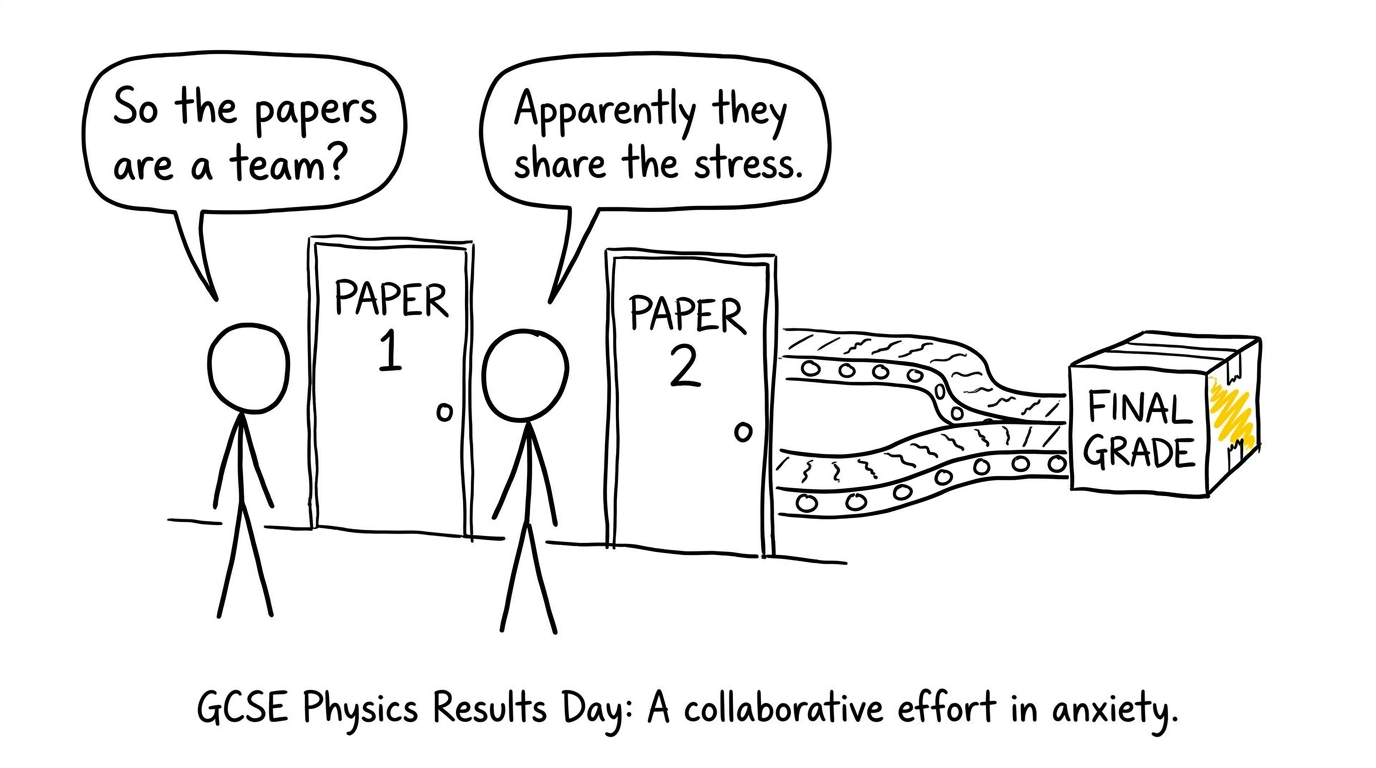 Two Physics papers discover that they must work together for the final grade
Why Edexcel Physics boundaries change
Grade boundaries can move from one examination series to another. This does not mean Pearson chooses an arbitrary percentage for each grade. Awarding combines statistical evidence with expert judgement so that differences in paper difficulty do not unfairly change the standard required.
A more demanding paper may therefore have lower boundaries, while a more accessible paper may have higher ones. This is why last year’s grade boundary is useful for reviewing a timed Edexcel GCSE Physics past paper, but it cannot tell you the exact boundary for 2026.
It also explains why comparing Edexcel boundaries directly with AQA, OCR or Eduqas can be misleading. Their specifications, assessments and maximum marks are not necessarily identical.
What to do with your result
First, read the grade as it stands. Then ask for your raw mark and compare it with the official 2026 boundary when Pearson publishes it.
If you are close to the next grade, speak to your school before requesting a review of marking. A review is not a free search for extra marks: the mark can stay the same, increase or decrease. Your school can discuss access to scripts, deadlines, consent and any fees that apply.
If you are preparing for a resit or beginning post-GCSE study, turn the result into specific revision decisions. Use the Edexcel GCSE Physics revision guides to rebuild weak knowledge, then test it against questions and mark schemes.
Useful starting points include:
- Energy stores, work done and calculations
- Newton’s laws and momentum revision
- Forces, vectors and free-body diagram questions
- Mains electricity and safety
Physics marks are often lost through rearranging formulae, graph interpretation, standard form and units. MathsGenie’s advice on revising GCSE Physics efficiently and turning Physics notes into active recall helps connect knowledge with exam performance.
Common grade-boundary mistakes
Using a boundary from the wrong year
Boundaries belong to one specific exam series. Never use the 2025 table as though it were the confirmed 2026 table.
Looking at the wrong qualification
GCSE Physics 1PH0, Combined Science and International GCSE Physics are different qualifications. Their marks and boundaries are not interchangeable.
Treating a paper boundary as a final grade
Your certificated grade comes from the combined total across both papers. Notional paper boundaries are mainly tools for interpreting mocks and past papers.
Assuming every boundary is a revision target
A previous boundary is not a safe target because future boundaries can move. Build a sensible margin through accurate marking, repeated topic practice and timed papers.
Turn the boundary into a next step
A boundary tells you where one grade ended and another began. It cannot describe every strong answer, difficult week or improvement made along the way.
Once results day has passed, focus on what you can use. MathsGenie brings together free Edexcel revision guides, practice questions, past papers, predicted papers, mini tests, mark schemes and video solutions. Start with the Edexcel GCSE Physics revision guides, identify one weak topic and make your next revision session specific.