

Revise GCSE Physics Without Wasting Time (Maths Wins)
GCSE Physics revision without wasting time: use past papers, maths-first methods, mark schemes and a simple plan so every minute turns into marks.
If you’ve ever sat down to “revise” GCSE Physics and, two hours later, realised you’ve mostly highlighted a page and panicked quietly, you’re not alone. The trap is that GCSE revision can feel productive without actually improving your marks. Physics is especially sneaky: it rewards clear thinking, tidy maths, and exam-style phrasing, yet many students spend their time rereading notes instead of practising.
This post is for UK GCSE and A Level maths students who want a smarter way to revise GCSE Physics: fewer hours, more marks, less stress. We’ll lean into what you already have as a mathematician: equations, proportional reasoning, rearranging formulae, and units in order and we’ll use YesGenie tools (past papers, predicted papers, revision lessons, flashcards, and mark schemes) to keep every session honest.
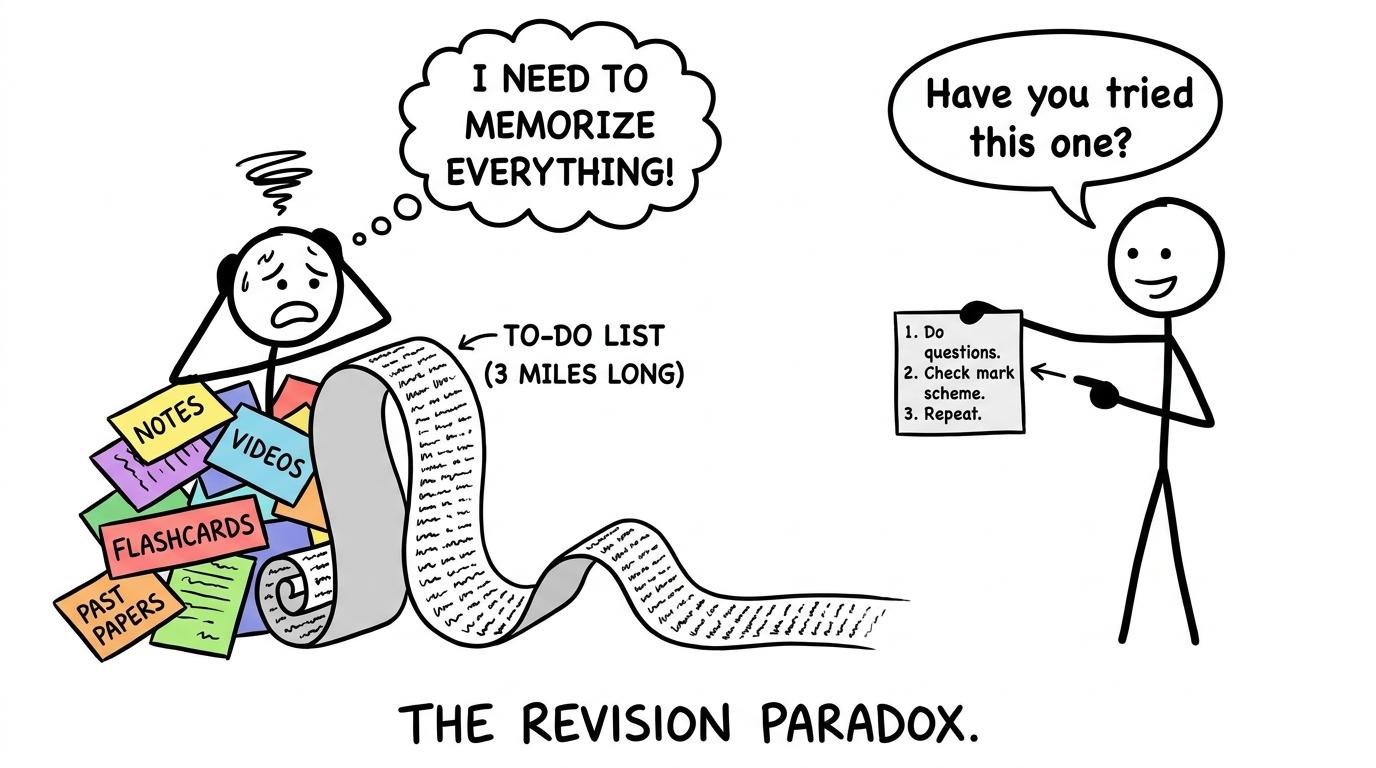 A tiny checklist beats a huge to-do list
The 20-minute checklist that stops GCSE Physics time-wasting
When GCSE Physics revision goes wrong, it’s usually because the task is vague: “do electricity”, “learn waves”, “go over forces”. Vague tasks expand. Specific tasks finish.
Use this checklist at the start of every session:
- Pick one topic and one question source (not five).
- Write the equation(s) you expect to use before you start.
- Do 4-8 exam-style questions under light time pressure.
- Mark using a mark scheme and write one improvement sentence.
- Repeat with a slightly harder set.
YesGenie is built for this kind of revision discipline: you can move from GCSE Subjects to your resources quickly, and keep everything in one place instead of hunting across tabs.
Why GCSE Physics revision works best when you think like a mathematician
A lot of GCSE Physics marks aren’t “knowledge” marks in the way students imagine. They’re “can you apply an equation, track units, and communicate steps?” marks. That’s good news if you’re already revising maths.
Here’s the hidden bargain GCSE Physics offers:
- If you can rearrange formulae, you can access whole topics (motion, electricity, energy).
- If you treat units like algebra, you catch errors early.
- If you practise with past papers, you learn the examiner’s favourite phrasings.
So, instead of building revision around reading, build it around doing.
As a quick companion, keep your maths sharp using GCSE Maths Revision and topic lists like Edexcel GCSE Maths Revision Guides. Even if you’re not Edexcel, the skills transfer directly.
The fastest structure for GCSE Physics revision (without burnout)
Think of revision like a training plan, not a rescue mission. The aim is to convert time into marks.
Phase 1: Build your equation confidence (but only by using equations)
In GCSE Physics, formulae are not decorations. They are tools. And tools get learned by being used.
A powerful habit: whenever you see an equation, ask:
- What are the units of each quantity?
- What happens if one variable doubles?
- Can I rearrange it cleanly?
If rearranging is a weak spot, practise it directly in maths first. Use a clear method and keep it tidy.
Worked rearrangement example (Physics-style):
Suppose you need to rearrange V=IRV = IRV=IR to make RRR the subject.
V=IR V = IR V=IRDivide both sides by III:
VI=R \frac{V}{I} = R IV=RSo R=VIR = \frac{V}{I}R=IV.
That looks basic, but that exact movement, isolating the unknown and guarding the algebra, is where GCSE Physics marks are quietly won.
If you want extra practise with “make xxx the subject” skills, link it to maths topics like rearranging formulae and algebraic manipulation via your revision guides (for example, the Edexcel GCSE Maths Revision Guides topic list is a useful checklist).
Phase 2: Convert knowledge into marks using mark schemes
Mark schemes are not just for checking answers; they teach you what the exam board values.
AQA, Edexcel, OCR and Eduqas often reward:
- a stated equation,
- substitution with units,
- a final answer rounded appropriately,
- and a sentence that matches the command word (describe/explain/evaluate).
That means your revision should include “mark scheme reading” as an active skill. After you mark a question, write one line:
- “Next time, I will show equation→substitution→units\text{equation} \rightarrow \text{substitution} \rightarrow \text{units}equation→substitution→units.”
Phase 3: Past papers and predicted papers (the only honest test)
GCSE Physics revision gets efficient when you practise in the same format you’ll be assessed.
Even if you’re revising Physics, the best way to train your exam brain is to do exam papers as papers. YesGenie makes this easy with:
- GCSE Past papers
- subject/board pages that surface exam resources quickly (for example, Edexcel GCSE Old Maths Revision shows how YesGenie structures papers, mark schemes and practice)
Use the same approach for your Physics provider (your school will tell you whether you’re AQA, Edexcel, OCR or Eduqas). The point isn’t the brand name; it’s that you practise the exact style.
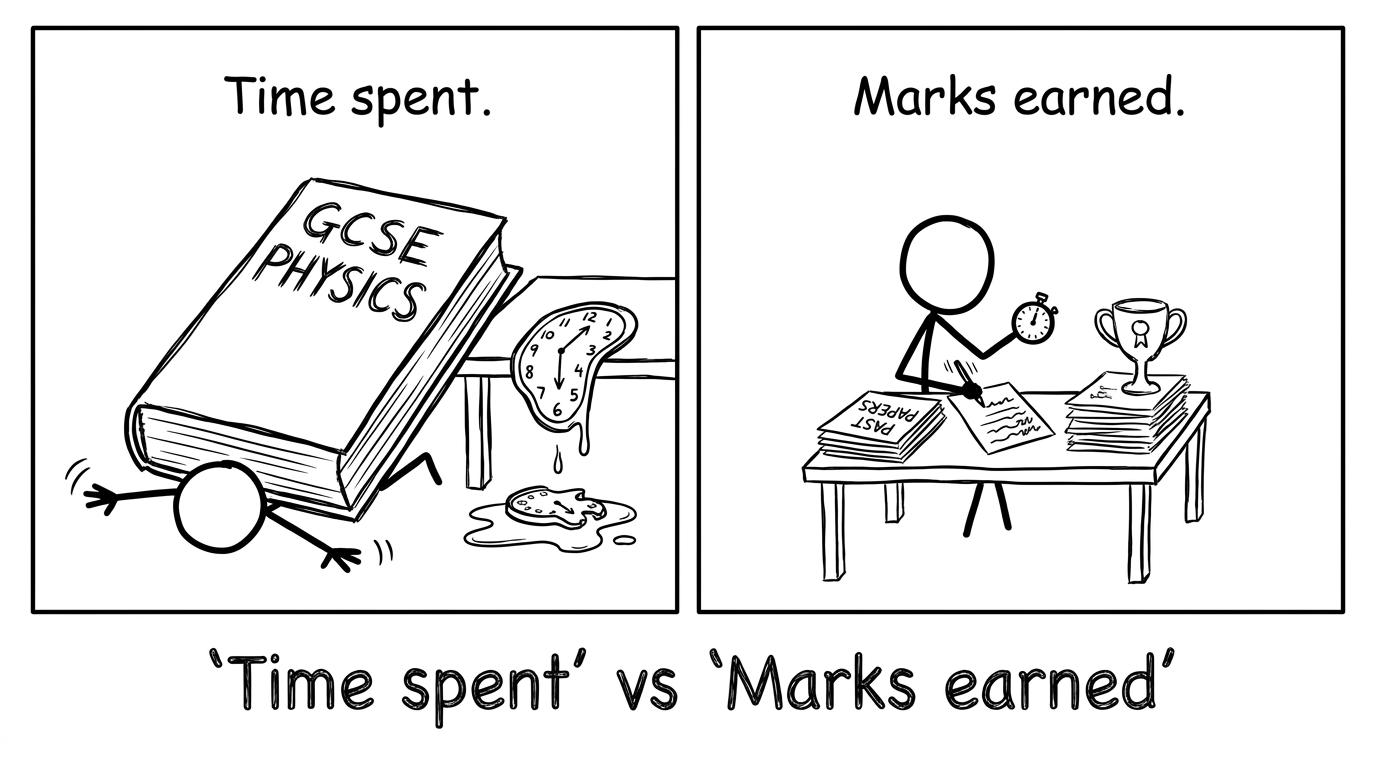 Reading vs doing past-paper questions
A GCSE Physics worked example that uses GCSE maths properly
Let’s take a classic GCSE Physics calculation: energy transfer.
Example: A device uses a power of 60 W60\text{ W}60 W for 5 minutes5\text{ minutes}5 minutes. Calculate the energy transferred.
Key equation:
E=Pt E = Pt E=PtStep 1: Convert time to seconds.
5 minutes=5×60=300 s 5\text{ minutes} = 5 \times 60 = 300\text{ s} 5 minutes=5×60=300 sStep 2: Substitute.
E=60×300=18000 E = 60 \times 300 = 18000 E=60×300=18000So E=18000 JE = 18000\text{ J}E=18000 J.
Now notice what you just did:
- Unit conversion (minutes to seconds): GCSE maths skill.
- Multiplication and place value: GCSE maths skill.
- Clear working that a mark scheme can reward.
If you’re prone to dropping conversions, practise that explicitly with maths topics like Metric Conversions (use the page as a topic checklist even if you’re not on Edexcel).
A second example: speed, distance and time without guesswork
Example: A runner travels 1500 m1500\text{ m}1500 m in 6 minutes6\text{ minutes}6 minutes. Find their average speed in m/s\text{m/s}m/s.
Equation:
v=dt v = \frac{d}{t} v=tdConvert time:
6 minutes=6×60=360 s 6\text{ minutes} = 6 \times 60 = 360\text{ s} 6 minutes=6×60=360 sSubstitute:
v=1500360=256≈4.166… v = \frac{1500}{360} = \frac{25}{6} \approx 4.166\ldots v=3601500=625≈4.166…So v≈4.17 m/sv \approx 4.17\text{ m/s}v≈4.17 m/s (or 4.2 m/s4.2\text{ m/s}4.2 m/s depending on rounding instructions).
That’s GCSE maths in a Physics coat. If you want to reinforce the maths method, make sure you’re confident with fractions, division, and rounding using Other Resources (formula lists and self-assessment sheets help you spot small gaps that cost marks).
How to plan GCSE Physics revision alongside GCSE maths
Many students waste time because they treat GCSE subjects as separate islands. In reality, your time is shared. Your energy is shared. Your focus is shared.
Try a simple split that protects both:
- 3 sessions per week: GCSE Physics question practice (short, intense)
- 3 sessions per week: GCSE maths (topic gaps + past papers)
- 1 session per week: mixed paper marking + error log
Use YesGenie’s Resources area to keep revision practical: mini tests, predicted papers, and printable resources stop you overthinking what to do next.
A useful anchor for maths paper practice is your board’s past paper hub (for example, Edexcel GCSE Maths Past Papers). Even if Physics is your focus today, keeping maths exam technique warm makes Physics calculations feel calmer.
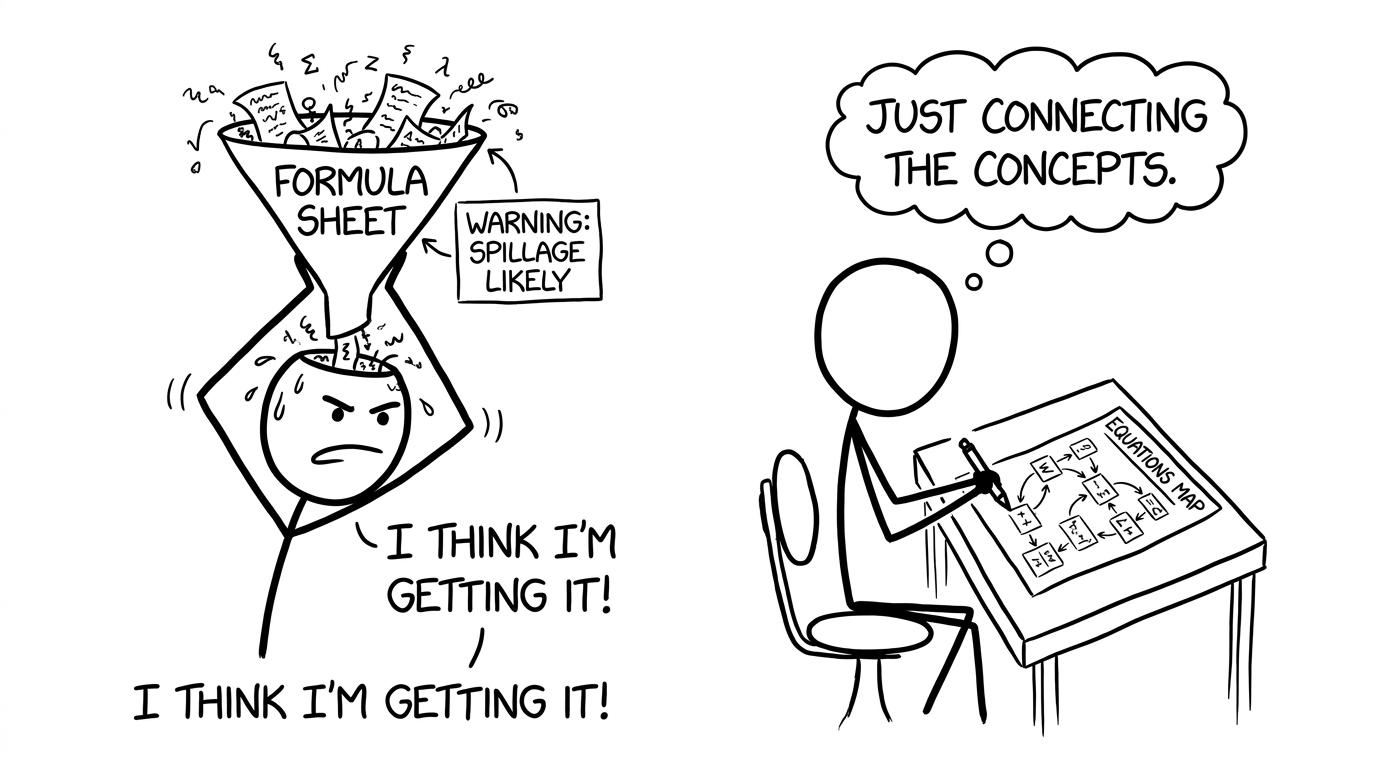 Formula funnel vs equation map
Common mistakes that waste time (and how to fix them)
These are the patterns that silently ruin GCSE Physics revision:
Doing revision that can’t be marked
If your session produces nothing that can be marked (no answers, no written explanations, no workings), you can’t improve reliably. Fix: always end with a marked set of questions and at least one action point.
Rereading notes instead of retrieving information
Rereading feels smooth. Exams aren’t smooth. Fix: use active recall. Close the notes and write the equation, the definition, or the method from memory. Then check.
Ignoring units until the final line
Units are part of the method. If you wait until the end, you’ll miss the signal that something’s wrong. Fix: write units alongside values during substitution.
Not showing steps (then losing method marks)
Even if your final answer is wrong, you can often earn marks for a correct equation and substitution. Fix: write one clean line for the equation and one for substitution.
Practising only easy questions
Easy questions build comfort, not grades. Fix: after one set you can do confidently, step up to exam-style questions from papers.
Bringing it together: revise GCSE Physics like your marks depend on it (because they do)
The best GCSE Physics revision is quiet and almost boring: questions, mark scheme, corrections, repeat. It doesn’t look dramatic. It looks consistent. And that’s why it works.
If you want GCSE results you can trust, make your revision measurable. Use exam-style questions, timed practice, and honest marking. Keep your maths foundations strong, because rearranging formulae, unit conversions, and tidy working are where Physics marks are often won or lost.
To make that routine easier, build your sessions around YesGenie resources: start from GCSE Subjects, keep your maths sharp via GCSE Maths Revision, and use GCSE Past papers to turn revision into exam-ready confidence. When you’re ready to push for higher grades, add predicted papers, mini tests, and targeted practice so every GCSE session has a clear purpose.










