8.1.1 Energy stores and transfer diagrams
Systems and energy stores
System
A system is the object or group of objects chosen for study, with everything outside it treated as the surroundings.
Energy store
An energy store is a way in which energy is held in a system, such as a kinetic, gravitational, elastic, chemical, magnetic, electrostatic, nuclear or thermal store.
- A system is the object or group of objects you decide to study, and everything outside it is called the surroundings.
- Drawing the boundary of a system decides which energy changes you count and which ones are treated as happening outside it.
- Energy is measured in joules, J\text{J}J, whichever store is holding it.
- Every store is named after the reason the energy is there, so naming a store also means naming the object it belongs to.
- Eight energy stores are used at this level.
- A kinetic energy store holds energy because an object is moving.
- A gravitational potential energy store holds energy because two objects are separated in a gravitational field.
- An elastic potential energy store holds energy because an object has been stretched, squashed or twisted.
- A thermal energy store holds energy because of the random motion of the particles inside an object, and it grows as the temperature rises.
- A chemical energy store holds energy in the bonds inside fuels, food and the chemicals in a battery.
- An electrostatic energy store holds energy because electric charges have been pulled apart.
- A magnetic energy store holds energy because magnets or magnetic materials are held apart or pushed together.
- A nuclear energy store holds energy inside the nuclei of atoms.
- The gravitational potential energy store belongs to the object and the Earth together, because a separation needs two objects.
- A store is where energy sits, so words such as light, sound and electricity name ways of moving energy rather than stores.
Changes in the way energy is stored
- When a system changes, one store decreases while one or more other stores increase.
- Describing a change means naming the store that falls, naming the store that rises, and naming the object each store belongs to.
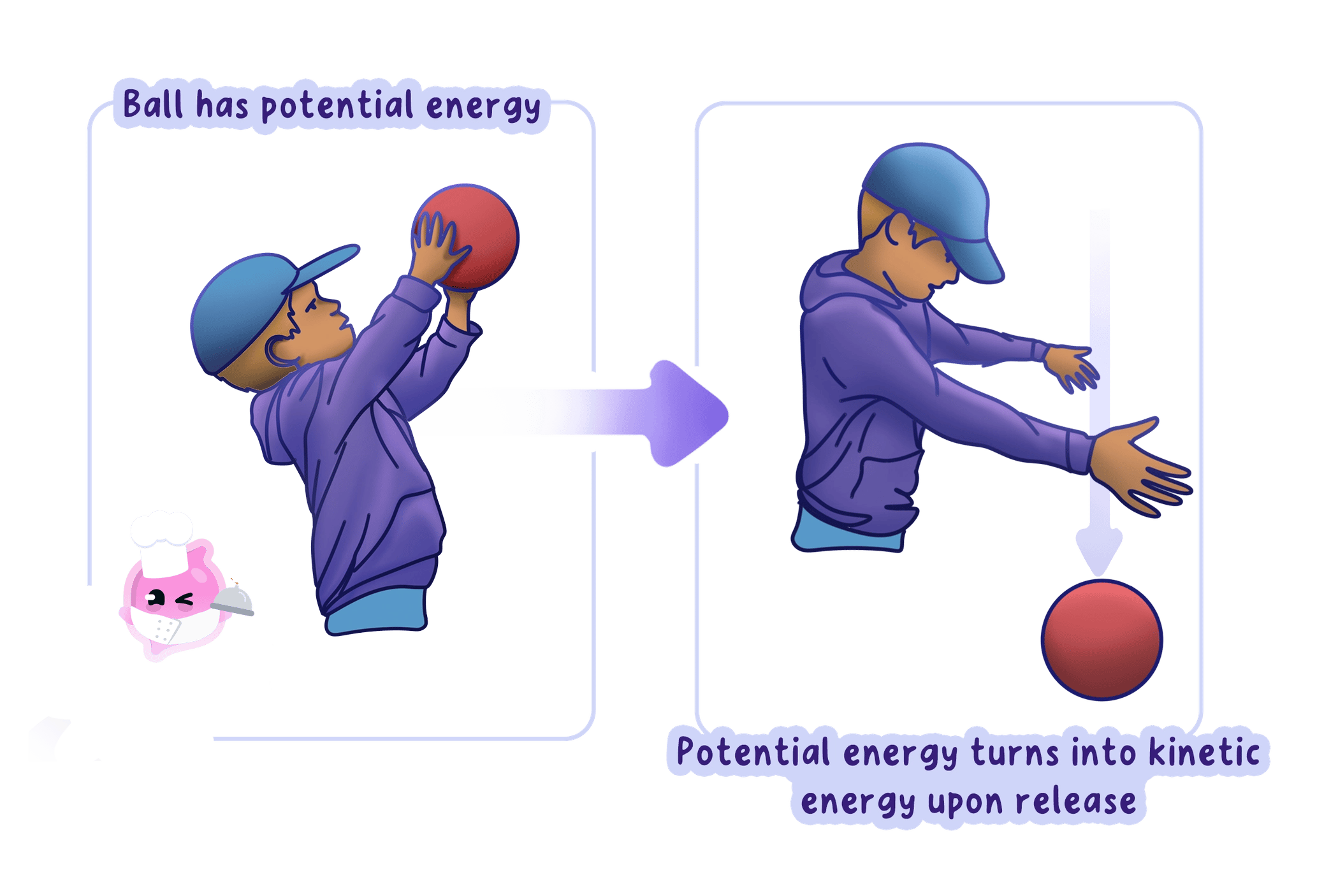
- As a ball falls, the gravitational potential energy store of the ball and Earth decreases while the ball's kinetic energy store increases, so the ball speeds up.
- When a stretched catapult is released, the elastic potential energy store of the rubber decreases and the kinetic energy store of the stone increases.
- When a battery drives a motor, the chemical energy store of the battery decreases and the kinetic energy store of the turning parts increases.
- When a mug of tea cools on a kitchen worktop, the thermal energy store of the tea decreases and the thermal energy store of the room increases.
- When a crane raises a steel beam, the gravitational potential energy store of the beam and Earth increases.
- When a firework burns, the chemical energy store of the powder decreases while the thermal and kinetic energy stores of the hot gases increase.
Drawing energy transfer diagrams
- An energy transfer diagram shows the store the energy starts in, the store or stores it ends in, and an arrow for each transfer.
- Write both the store and the object it belongs to inside each box, such as chemical store of the battery.
- Draw every arrow from the store that decreases towards the store that increases, and put an arrowhead on it.
- One arrow means all of the energy ends in a single store, while several arrows mean the energy is shared between several stores.
- Label an arrow with the way the energy travels when the question asks for it, for example an arrow marked electrically for a battery driving a motor.
- For that battery and motor the diagram reads: chemical store of the battery ⟶\longrightarrow⟶ kinetic store of the motor.
- To interpret a diagram, follow each arrow from its tail to its head, then state that the tail store decreases and the head store increases.
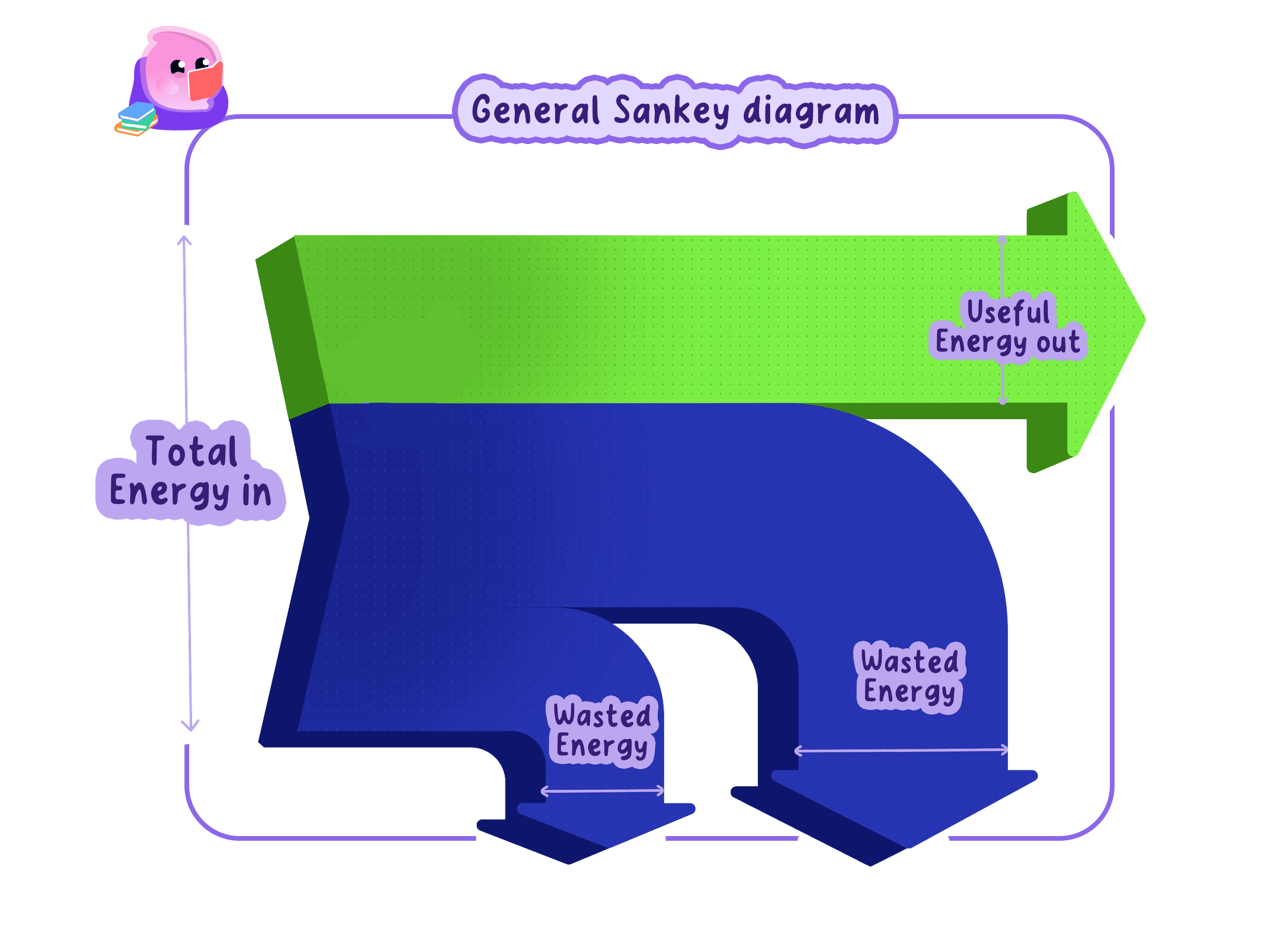
- A Sankey diagram is an energy transfer diagram drawn with arrow widths in proportion to the number of joules, so the widest branch carries the most energy.
- The single arrow entering a Sankey diagram on the left stands for the total energy supplied, and the branches leaving it show how those joules are shared out.
- The widths of all the branches leaving a point add up to the width of the arrow entering it, which is a quick check that the diagram is drawn correctly.
Energy in a closed system
Closed system
A closed system is a system across whose boundary no energy is transferred, so its total energy stays constant.
Conservation of energy
Conservation of energy means that energy cannot be created or destroyed, only transferred between stores.
- Conservation of energy means the total number of joules in a closed system is the same before and after any change, so Etotal before=Etotal afterE_{\text{total before}} = E_{\text{total after}}Etotal before=Etotal after.
- Energy is never created and never destroyed, so a change only moves joules from one store to another.
- A closed system therefore shows no net change in its total energy, and any decrease in one store is matched by an equal total increase in the others.
- If one store of a closed system falls by 250 J250\ \text{J}250 J, the remaining stores must gain 250 J250\ \text{J}250 J between them.
- Whether a system counts as closed depends on where the boundary is drawn, so a swinging pendulum on its own is not closed while the pendulum together with the air and its support is much closer to closed.
- Widening the boundary to include the surroundings makes the total easier to account for, because joules that leave the object are still inside the system.
Describing a falling ball
- A ball is held above a lawn and then released, and air resistance is small enough to ignore.
- The gravitational potential energy store of the ball and Earth decreases as the ball drops.
- The ball's kinetic energy store increases by the same number of joules, so the ball speeds up as it falls.
- Treating the ball and Earth as a closed system, the total energy does not change during the fall.
- Just before the ball lands, almost all of the energy that left the gravitational store is held in the ball's kinetic store.
Reading a Sankey diagram
- A Sankey diagram for a lamp has one arrow of width 60 J60\ \text{J}60 J entering on the left.
- Two branches leave it, one of width 6 J6\ \text{J}6 J carrying energy away by light and one of width 54 J54\ \text{J}54 J going to the thermal energy store of the surroundings.
- The branch widths add to 6+54=60 J6 + 54 = 60\ \text{J}6+54=60 J, which matches the arrow entering, so energy is conserved.
- The wide branch shows that most of the energy supplied ends in the thermal energy store of the surroundings.
Writing about energy stores
- Name the store and the object together, so write kinetic energy store of the trolley rather than movement energy.
- Use the words decreases and increases for the two stores in a change, because the direction of the transfer usually carries its own mark.
- Quote conservation of energy whenever a question mentions a closed system, then state that the total energy does not change.
- Label every box with a store and put an arrowhead on every arrow when a diagram is asked for, because an unlabelled box scores nothing.
- Check that the branch widths add up before quoting any value read from a Sankey diagram.
- Do not write that energy is used up, lost or destroyed, because energy is always conserved.
- Do not treat light, sound, electricity or heat as energy stores, because each of them describes a transfer.
- Do not write heat energy or movement energy, and use thermal energy store and kinetic energy store instead.
- Do not give the gravitational store to the raised object alone, because that store belongs to the object and the Earth together.
- Define a system and state what its boundary decides.
- Name the eight energy stores and give one object that holds energy in each.
- Describe the changes in energy stores as a catapult launches a stone.
- Explain what an arrow on an energy transfer diagram tells you.
- State what conservation of energy says about the total energy of a closed system.
8.1.2 Ways of changing a system's energy
Changing the energy of a system
Energy transfer pathway
An energy transfer pathway is the route by which energy moves from one store to another, such as mechanically, electrically, by heating or by radiation.
- The energy of a system changes only when joules cross its boundary into or out of one of its stores.
- An energy transfer pathway is the route those joules take, so a pathway is how energy moves while a store is where it ends up.
- Three pathways change the energy of a system in this topic: work done by forces, electrical equipment and heating.
- Naming the pathway and naming the store that changes are separate marks, so a full answer needs both.
- No pathway makes or destroys joules, so the number leaving one store equals the number arriving in the others.
Work done by forces
- A force does work on an object when the object moves in the direction of that force, and the energy is then transferred mechanically.
- Lifting a crate off the floor transfers energy mechanically into the gravitational potential energy store of the crate and Earth.
- Pushing a supermarket trolley from rest transfers energy mechanically into the trolley's kinetic energy store.
- Drawing a bow transfers energy mechanically into the elastic potential energy store of the bow.
- Friction between brake pads and a wheel transfers energy mechanically out of the bicycle's kinetic energy store and into thermal energy stores.
- Holding a heavy bag still at one height transfers no energy mechanically, because the bag does not move.
- Carrying that bag horizontally at a steady speed adds nothing to its gravitational store either, because the upward force and the movement are at right angles.
Electrical equipment
- Energy is transferred electrically when charge is pushed through a component by a power supply.
- The store of the supply falls as this happens, so a torch battery's chemical energy store decreases while the torch is switched on.
- An electric motor transfers energy electrically and increases the kinetic energy store of its turning parts.
- A kettle element transfers energy electrically and increases the thermal energy store of the water.
- A filament lamp transfers energy electrically, then passes it on by light and by heating the surroundings.
- A loudspeaker transfers energy electrically and then carries it away by sound waves through the surrounding air.
- Electrical equipment never creates joules, so every joule delivered to the components has come out of the store of the supply.
Heating
Heating
Heating is the transfer of energy from a region at a higher temperature to a region at a lower temperature because of the temperature difference between them.
- Heating transfers energy whenever two regions are at different temperatures, and it always runs from the hotter region to the cooler one.
- The thermal energy store of the hotter region decreases while the thermal energy store of the cooler region increases.
- The transfer keeps going until the two temperatures are equal, and it then stops.
- A gas hob heats a pan, so the pan's thermal energy store increases and its temperature rises.
- A mug of coffee left on a desk cools down because energy is transferred by heating to the cooler air of the room.
- Energy transferred by heating can travel by conduction, by convection or by radiation.
- Burning gas in a boiler empties the chemical energy store of the fuel and then transfers energy by heating into the water in the radiators.
Tracing the pathways in an electric kettle
- A kettle is plugged in and switched on to boil water for tea.
- Energy is first transferred electrically from the mains supply to the heating element.
- Energy is then transferred by heating from the hot element to the water, so the water's thermal energy store increases.
- Energy is also transferred by heating from the kettle body to the kitchen air, so the room's thermal energy store increases as well.
- Two pathways are named in this change, electrically and by heating, and each one is matched to the store that increases.
Comparing a straight lift with a ramp
- A worker raises a 20 kg20\ \text{kg}20 kg box onto a shelf by lifting it straight up.
- The upward force moves the box in the direction of that force, so work is done and energy is transferred mechanically into the gravitational store.
- A second worker slides an identical box up a ramp onto the same shelf.
- The push moves the box along the ramp, so work is done mechanically again, and friction means part of that work also raises the thermal energy stores of the ramp and box.
- Both routes change the system's energy through work done by forces, so the pathway is the same even though the forces and distances differ.
Naming the pathway and the store
- Read the question for the words that fix the pathway, such as a force, a circuit or a temperature difference.
- Write the pathway in the board's own wording: mechanically, electrically or by heating.
- Follow the pathway with the store that changes, for example energy is transferred electrically, so the thermal energy store of the water increases.
- Give one pathway for each transfer the question asks about, because a two-mark question usually wants two separate transfers.
- The mark for direction is lost unless you say which store increases and which decreases.
- Do not name a pathway when a store is asked for, because electrically and by heating are not stores.
- Do not write that a device makes or produces energy, because equipment only moves joules between stores.
- Do not say work is done when the object does not move, because a force on its own transfers no energy.
- Do not use heat as a store, because heating is the pathway and the thermal energy store is the destination.
- Name the three ways the energy of a system can be changed.
- Explain the difference between an energy store and an energy transfer pathway.
- State why holding a bag still at one height transfers no energy mechanically.
- Describe the pathway and the store that changes when a kettle heats water.
- Explain what decides the direction of an energy transfer by heating.
8.1.3 Work done by forces
Work done and energy transferred
Work done
Work done is the energy transferred when a force moves an object through a distance in the direction of the force.
Joule
The joule is the unit of energy and of work done, equal to the work done when a force of one newton moves an object one metre in the direction of the force.
- Work done is the energy a force transfers when it moves an object through a distance in the direction of that force.
- Work done and energy transferred are the same quantity, so the work done by a force equals the energy it transfers.
- Both are measured in joules, J\text{J}J, while force is measured in newtons, N\text{N}N, and distance in metres, m\text{m}m.
- One joule is the work done when a force of 1 N1\ \text{N}1 N moves an object 1 m1\ \text{m}1 m in the direction of the force, so 1 J=1 N m1\ \text{J} = 1\ \text{N}\ \text{m}1 J=1 N m.
- A force that acts without producing any movement does no work, so it transfers no energy.
- Only the part of the movement lying along the force counts, so a bag carried horizontally gains nothing from the upward force holding it.
The work done equation
- Work done is calculated from E=F×dE = F \times dE=F×d.
- In this equation EEE is the work done in joules, FFF is the force in newtons and ddd is the distance moved in the direction of the force in metres.
- Rearranging gives F=EdF = \dfrac{E}{d}F=dE when the force is wanted and d=EFd = \dfrac{E}{F}d=FE when the distance is wanted.
- Convert every distance into metres before substituting, so 60 cm=0.60 m60\ \text{cm} = 0.60\ \text{m}60 cm=0.60 m and 1.5 km=1500 m1.5\ \text{km} = 1500\ \text{m}1.5 km=1500 m.
- For a lift straight upwards at a steady speed the force needed equals the weight, so the work done is the weight in newtons multiplied by the vertical distance in metres.
- Doubling the force doubles the work done over the same distance, and doubling the distance doubles the work done for the same force.
- A force at right angles to the movement contributes no distance in its own direction, so it does no work.
Dragging a crate across a floor
- A stagehand drags a crate 4.0 m4.0\ \text{m}4.0 m along a flat floor using a horizontal force of 25 N25\ \text{N}25 N.
- The equation is E=F×dE = F \times dE=F×d.
- Substituting gives E=25×4.0E = 25 \times 4.0E=25×4.0.
- The work done is E=100 JE = 100\ \text{J}E=100 J, so the pulling force transfers 100 J100\ \text{J}100 J of energy.
Finding a force from the work done
- A winch transfers 4500 J4500\ \text{J}4500 J while pulling a sledge 30 m30\ \text{m}30 m along level ground.
- Rearranging E=F×dE = F \times dE=F×d gives F=EdF = \dfrac{E}{d}F=dE.
- Substituting gives F=450030F = \dfrac{4500}{30}F=304500.
- The force is F=150 NF = 150\ \text{N}F=150 N, acting along the direction of the movement.
Measuring the work done by a force
- Aim: to measure the work done by a known force as it drags a wooden block along a bench.
- Apparatus: wooden block, newton meter reading to 0.1 N0.1\ \text{N}0.1 N, metre rule, bench or runway, masking tape, slotted masses, balance and clamp.
- Variables: the distance moved in the direction of the force is the independent variable, the work done is the dependent variable, and the block, the mass on top of it, the bench surface and the pulling direction are controlled.
- Method, set-up:
- Weigh the block, then tape a start line and a finish line to the bench and measure the distance between them with the metre rule.
- Hook the newton meter to the block and hold it horizontally, in line with the direction of travel, so the reading is the pulling force.
- Zero the newton meter while it is held in the pulling direction with nothing attached.
- Method, measurements:
- Pull the block from the start line to the finish line at a slow, steady speed so the reading stays as constant as possible.
- Read the newton meter while the block is moving rather than before it starts, because a larger force is needed to break it free.
- Record the steady force in newtons and the distance in metres.
- Repeat each run three times and calculate the mean force.
- Repeat for at least five distances by moving the finish line further along the bench.
- Results: the work done rises in proportion to the distance moved while the pulling force is kept the same.
- Maths: calculate the work done for each distance from E=F×dE = F \times dE=F×d, then plot EEE on the vertical axis against ddd on the horizontal axis; the graph is a straight line through the origin and its gradient equals the pulling force FFF in newtons.
- Watch out: a newton meter held at an angle reads more than the horizontal pulling force, a block that accelerates is not being pulled by a steady force, and a dusty or worn patch of bench changes the friction part way along.
- Safety: clamp the runway or keep the block well away from the bench edge, keep fingers clear of falling masses, and use modest masses so the block stays under control.
Energy changes when work is done
- Work done by a force always changes a store, so every E=F×dE = F \times dE=F×d calculation can also be described as an energy transfer.
- Lifting an object at a steady speed puts the work done into the gravitational potential energy store of the object and Earth.
- A resultant force that speeds an object up puts the work done into the object's kinetic energy store.
- Stretching a spring puts the work done into the elastic potential energy store of the spring.
- Work done against friction or air resistance puts the energy into the thermal energy stores of the surfaces and the surroundings, so their temperature rises.
- A car braking from 30 m/s30\ \text{m/s}30 m/s has the work done by the braking force taken out of its kinetic energy store and put into the thermal energy stores of the brakes, tyres and road.
- To describe any of these changes, name the force, state that the object moves in the direction of that force, state that work is done, then name the store that increases and the store that decreases.
Work done against friction while braking
- A cyclist and bicycle of total mass 85 kg85\ \text{kg}85 kg are brought to rest by a braking force of 340 N340\ \text{N}340 N acting over 12 m12\ \text{m}12 m.
- The work done by the braking force is E=F×d=340×12E = F \times d = 340 \times 12E=F×d=340×12.
- This gives E=4080 JE = 4080\ \text{J}E=4080 J.
- The cyclist's kinetic energy store therefore falls by 4080 J4080\ \text{J}4080 J as the bicycle stops.
- Those joules are transferred into the thermal energy stores of the brake blocks, the wheel rims and the surrounding air, which is why the rims feel warm.
Setting out a work done answer
- Write E=F×dE = F \times dE=F×d before any numbers, because the equation itself often carries a mark.
- Check that the distance used is measured along the direction of the force and not the whole path length.
- Convert centimetres and kilometres into metres, and never substitute a mass where a force is needed.
- Give the answer in joules, and use kJ\text{kJ}kJ only when the question asks for it.
- For a describe question, join the ideas with so, such as the force moves the crate, so work is done and energy is transferred to the thermal store of the floor.
- Do not give a force in joules, because joules measure work done and energy while newtons measure force.
- Do not multiply by the whole path length when only part of the movement lies along the force.
- Do not claim work is done while a bag is simply held still, because there is no movement.
- Do not confuse mass in kilograms with weight in newtons when the work done in a lift is calculated.
- Define work done and state its unit.
- Write the equation linking work done, force and distance.
- Explain why 1 J1\ \text{J}1 J is the same as 1 N m1\ \text{N}\ \text{m}1 N m.
- Describe how to measure the work done by a force dragging a block along a bench.
- Name the store that increases when work is done against friction.
