GCSE Physical Education Time Pressure Mistakes
GCSE physical education time pressure mistakes cost easy marks. Learn to pace answers, follow command words, apply sporting context and check calculations well.
The clock becomes strangely loud near the end of an exam. You know the content, but your writing speeds up, command words blur and a straightforward calculation suddenly feels unfamiliar. The most damaging GCSE physical education time pressure mistakes are usually not obscure gaps in knowledge. They are avoidable losses: answering the wrong question, failing to apply a point to sport, rushing data work or leaving accessible marks untouched.
The solution is a repeatable routine. Read the command word, notice the number of marks, apply knowledge to the stated performer or activity, move on when progress stops and reserve time for checks. Although this guide focuses on GCSE PE, the same habits are valuable in GCSE maths exams.
A quick time-pressure checklist
Before writing, ask:
- What is the command word?
- How many marks are available?
- Is a sporting example, stimulus or named performer provided?
- Do I need knowledge, application, analysis or evaluation?
- Have I answered every part of the question?
- Does a calculation need working, units or data from a table?
- If I am stuck, should I mark the question and return later?
AQA, Edexcel, OCR and Eduqas do not use identical paper structures, so follow the timing and instructions for your specification. However, their written assessments all require more than remembered facts. Students must demonstrate knowledge and understanding, apply it, and analyse or evaluate relevant factors. Under pressure, losing sight of those different demands is where many easy marks disappear.
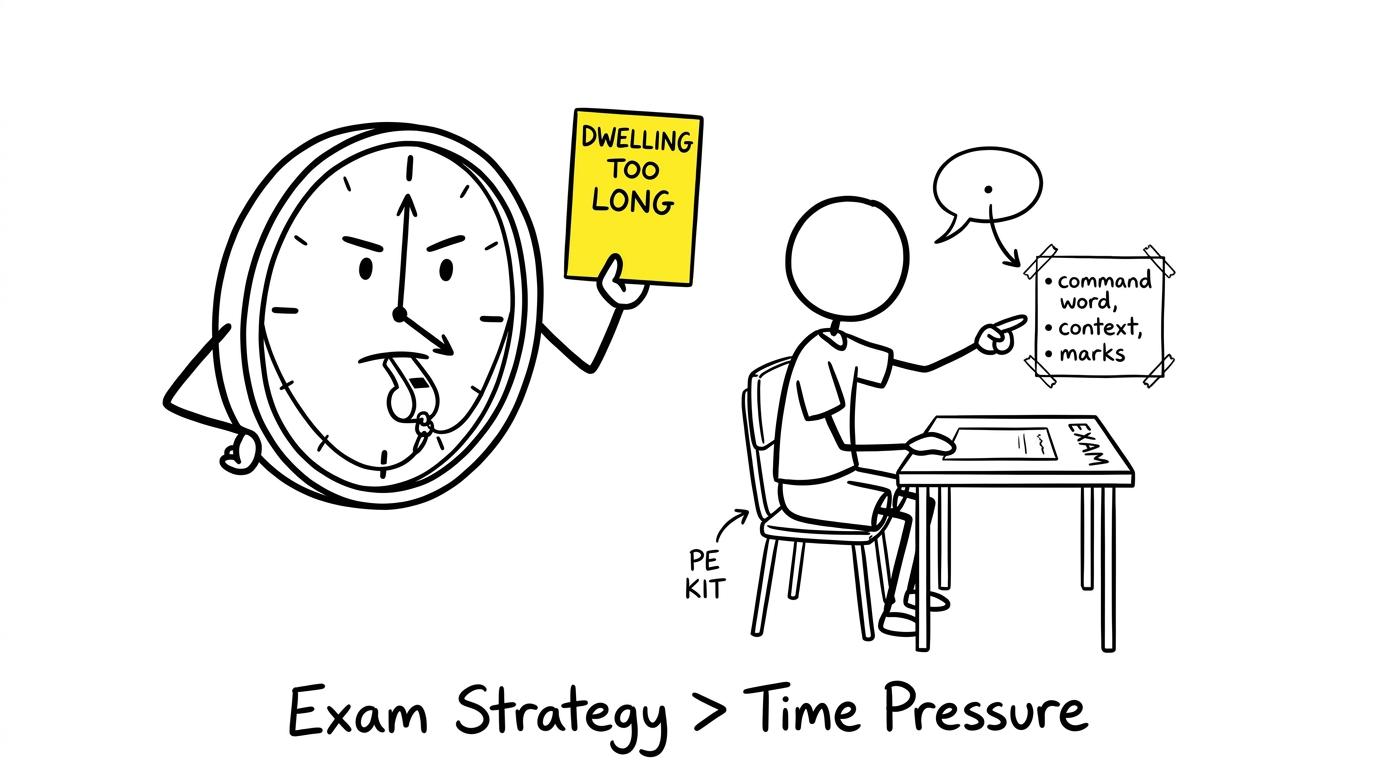 A referee clock gives a yellow card for spending too long on one exam answer
Mistaking knowledge for a complete answer
Remembering a correct fact feels reassuring. It is not always enough.
A response may accurately define cardiovascular endurance or identify a training method, yet fail to connect that knowledge to the performer described in the question. This matters because GCSE PE written papers assess different skills. AO1 concerns knowledge and understanding, AO2 concerns application, and AO3 concerns analysis and evaluation.
When the question provides a sport, movement, performer or set of results, use it. A useful chain is:
- make the relevant point;
- support it with accurate PE knowledge;
- connect it to the given activity or performer;
- explain the consequence for performance.
Application should be specific rather than decorative. Merely adding the name of a sport to a generic paragraph does not necessarily show how the idea operates in that context.
A calm prompt can help: What changes for this performer because of this factor? That question pushes an answer beyond recall and towards application or analysis.
Reading the topic but missing the command word
Students often notice the familiar subject content and begin writing before processing the task. The answer then becomes everything they know about training, motivation or movement analysis rather than what the examiner requested.
Official exam-board guidance makes the distinction clear:
| Command word | What the response generally needs |
|---|---|
| State or identify | A brief, precise fact or recognised term |
| Describe | Relevant characteristics or features |
| Explain | A reasoned account showing how or why |
| Analyse | Factors broken down and connected to their effects |
| Evaluate | Evidence or competing factors considered before a supported judgement |
| Calculate | A numerical result obtained from the available information |
The exact wording around the command word still matters. An explanation normally needs linked reasoning. An evaluation needs more than a list of advantages and disadvantages: it should weigh relevant evidence and reach a justified judgement.
Circle or underline the command word when reading. This takes little time and can prevent an entire answer being aimed at the wrong assessment objective.
Writing too much for small questions
One of the quietest time-pressure errors happens early. A student writes a paragraph for a short recall question because they want to be safe. The answer may earn the available marks, but the extra sentences consume time needed later for extended responses.
Use the mark allocation as a guide to scale, not as a mechanical sentence count. A low-mark question usually rewards concise, distinct information. Repeating the same idea in different words does not create another valid point.
For planning during the paper, you can compare the time remaining with the marks remaining:
working pace=minutes remainingmarks remaining\text{working pace} = \frac{\text{minutes remaining}}{\text{marks remaining}}working pace=marks remainingminutes remainingThis is not an exam-board rule. It is a practical warning system. If one small question is consuming far more than its share of the available time, leave space, move forward and return if possible.
The same discipline matters in maths. Timed GCSE maths past papers help you learn when to persist and when to protect the rest of the paper.
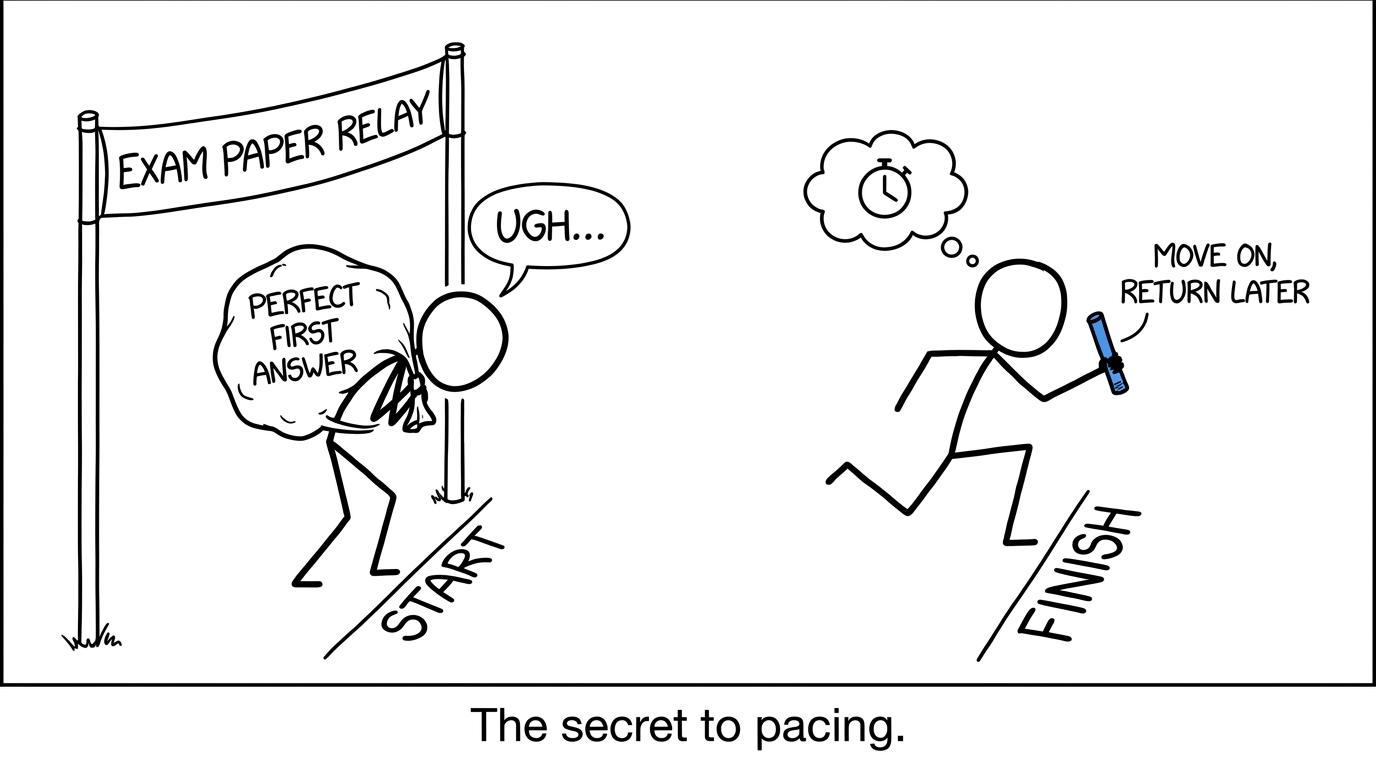 One relay runner carries a huge perfect-answer bag while another moves on with a small baton
Rushing the maths and data in GCSE PE
Physical education includes quantitative skills and the interpretation of data, graphs and tables. Under time pressure, students may understand the sporting principle but lose marks through an arithmetic, scale or unit error.
Commonly needed relationships include:
mean=total of the valuesnumber of values\text{mean} = \frac{\text{total of the values}}{\text{number of values}}mean=number of valuestotal of the values percentage=partwhole×100\text{percentage} = \frac{\text{part}}{\text{whole}} \times 100percentage=wholepart×100 speed=distancetime\text{speed} = \frac{\text{distance}}{\text{time}}speed=timedistanceProtect calculation marks with a short routine:
- identify what the question asks you to find;
- copy the relevant figures accurately;
- write the formula or operation;
- check that units are compatible;
- keep working visible;
- round only when instructed or when an appropriate degree of accuracy is required;
- decide whether the result is plausible in the sporting context.
For targeted support, revise averages and range, percentages, speed and density and real-life graphs. These MathsGenie lessons are designed for GCSE maths, but the numerical fluency transfers directly when PE questions use performance data.
Losing structure in extended responses
An extended response is not simply a longer short answer. AQA describes extended writing as an opportunity to construct and develop a coherent, relevant, substantiated and logically structured line of reasoning. Pearson also makes clear that its extended PE responses can reward knowledge, application and analysis or evaluation.
Under pressure, students tend to fall into one of two traps. They either write everything they remember without direction, or spend too long building an elaborate plan and leave too little time to write.
Use a compact plan containing only:
- the factors you will consider;
- the sporting context or stimulus evidence;
- the effect of each factor on performance;
- the judgement you expect to reach.
Then build connected paragraphs. Phrases such as because, therefore, however and this is more significant when can help reveal the reasoning, provided the underlying PE content is accurate.
Do not save the judgement for a vague final sentence. A useful conclusion answers the precise question, identifies the most important factor and explains why it matters in the stated context.
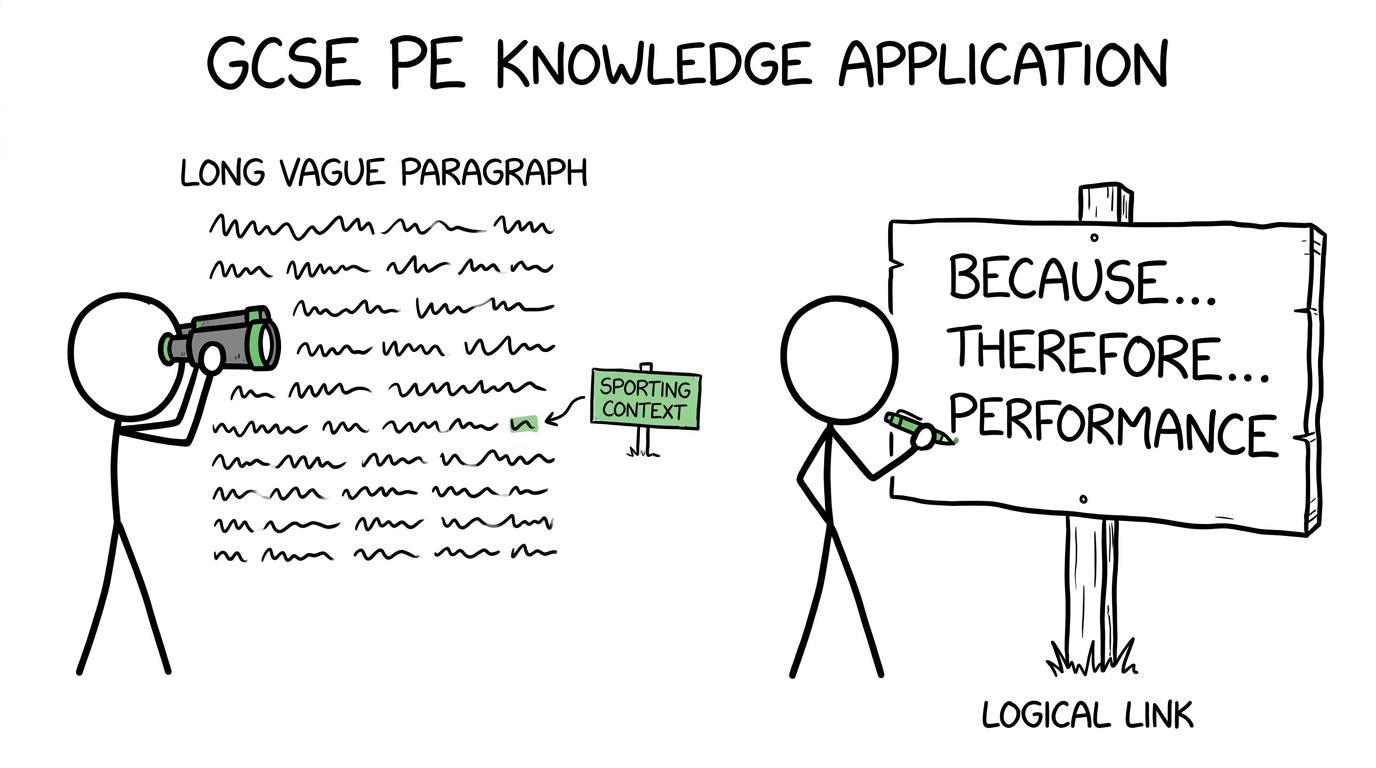 An examiner searches a vague paragraph for sporting context while a clear reasoning signpost stands nearby
Common mistakes when the clock is running out
Leaving blanks because the perfect term will not come
A blank cannot show partial knowledge. If you cannot recall the ideal phrase, write the most precise relevant information you can, then move on. Do not invent technical vocabulary.
Repeating one developed point
Two sentences may sound different while expressing the same effect. Look for distinct knowledge or a genuinely new link rather than paraphrasing the first point.
Ignoring the stimulus
Graphs, tables, scenarios and named performers are there to be used. Refer to relevant evidence and explain what it shows. Copying a figure without interpreting it adds little value.
Giving an unbalanced evaluation
Evaluation requires a supported judgement. Consider relevant strengths, weaknesses or alternative factors, then decide which carries more weight in the context.
Hiding calculations
A calculator display is not a clear method. Write the operation, substitution and result. Visible working also makes checking faster.
Forgetting units and labels
A correct numerical value can become incomplete or misleading without an appropriate unit. Check graph axes, time units and whether the question requires a percentage.
Spending the final minutes finishing one sentence
The last part of the exam should be a marks search. Check unanswered questions, missing units, overlooked command words and conclusions before polishing prose that is already sufficient.
How to practise before the exam
Time management cannot be learned only by reading advice. It needs rehearsal.
Complete PE questions using your board's specification, past papers and mark schemes. After each timed section, classify every lost mark as:
- knowledge;
- application;
- analysis or evaluation;
- calculation;
- question reading;
- time management.
That classification turns a disappointing mark into a useful instruction. If the problem is data handling rather than PE knowledge, use MathsGenie's GCSE maths revision hub to repair the skill. Short mini tests and predicted-paper resources can build the habit of working accurately while a timer is running.
You can also borrow the review process from MathsGenie's guide to using past papers properly: sit the material under realistic conditions, mark it honestly, record the exact error and revisit the weak skill. For a broader routine, the GCSE revision mistakes guide explains why feedback and reattempting matter more than simply completing more questions.
Turn pressure into a familiar routine
Time pressure does not usually create entirely new weaknesses. It exposes habits that have not yet become reliable. The student who regularly checks command words will still check them when nervous. The student who practises showing calculations will not need to invent that habit in the final minutes.
Keep the method simple: read precisely, match the command word, use the sporting context, show quantitative working, move on when progress stops and return for a final marks search.
For the mathematical skills behind data, percentages, averages, graphs and speed, make MathsGenie your free revision base. Use the revision lessons to rebuild understanding, practice questions and mini tests to improve accuracy, then past papers, predicted papers, mark schemes and video solutions to develop calm performance under exam conditions.