GCSE Old Maths vs the Alternative Option
GCSE old maths vs GCSE the alternative option explained: compare current GCSE Maths, legacy papers and Functional Skills before choosing the right route for you.
Choosing a maths route can feel strangely permanent. One page says “old maths”, another mentions an alternative qualification, and both seem to promise a way forward. Yet they are not two equivalent GCSE subjects. In the debate around gcse old maths vs gcse the alternative option, the first thing to understand is simple: “GCSE Old Maths” usually means archived material from a withdrawn specification, not a GCSE you can now choose to sit. The alternative normally means a qualification such as Functional Skills Maths.
For most current Year 101010 and Year 111111 students, the correct choice is the current GCSE Mathematics specification offered by their school through Edexcel, AQA, OCR or Eduqas. Functional Skills may suit some post-161616 learners, but its acceptance and eligibility must be checked against the exact college course, apprenticeship or career being considered.
The decision in one quick checklist
Before choosing revision materials or discussing an alternative qualification, confirm these points:
- Your actual qualification: Ask for the exam board and specification code.
- Your tier: Foundation offers grades 111 to 555; higher offers grades 444 to 999, with a narrow grade 333 safety net for candidates who just miss grade 444.
- Your destination: Check the published maths requirement for your intended course, apprenticeship or career.
- What “old maths” means: It is normally an archive of legacy papers, not a current entry option.
- What the alternative is called: Do not accept a vague label. Ask whether it is Functional Skills Maths Level 111, Functional Skills Maths Level 222, an Entry Level qualification or something else.
- Whether it is accepted: A qualification at the same level is not automatically interchangeable for every purpose.
The safest starting point is the current GCSE Maths revision hub, where resources are organised around present exam boards and GCSE requirements.
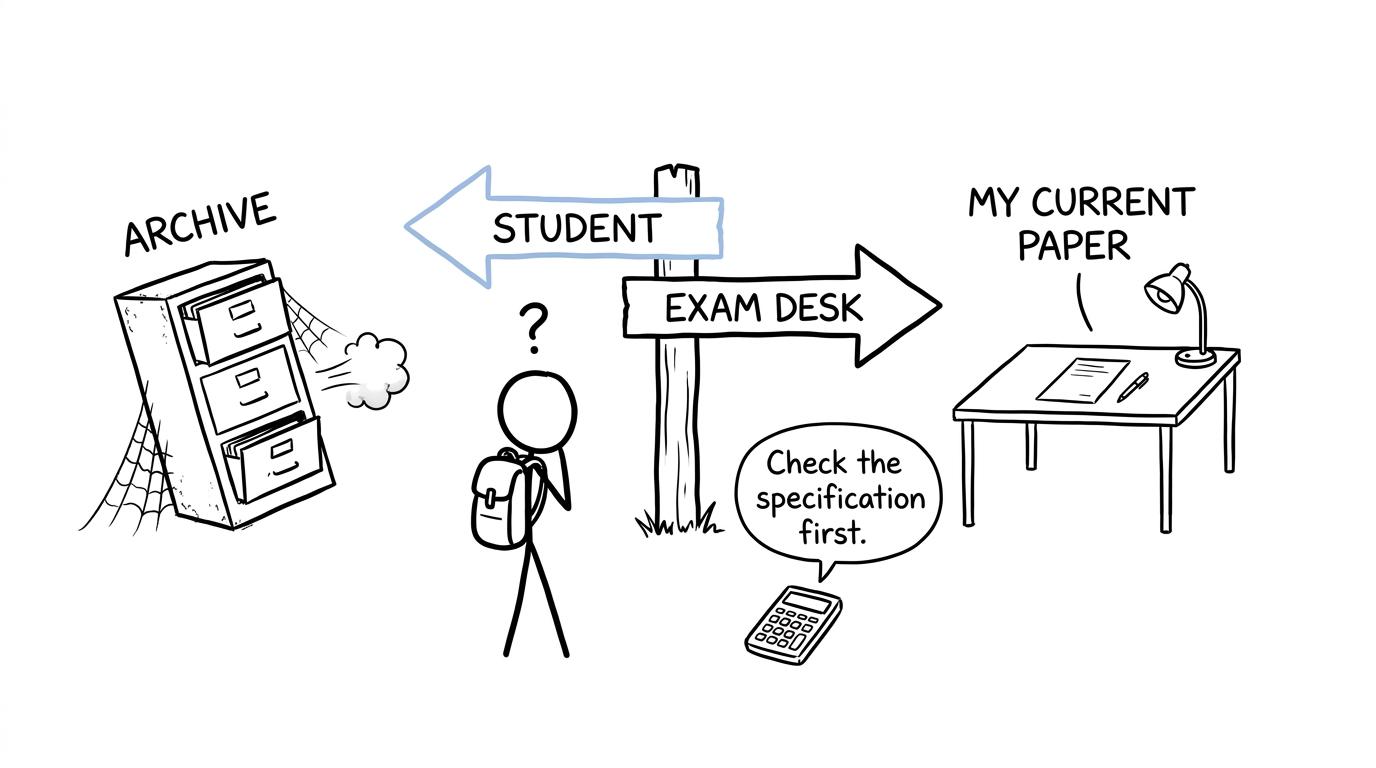 A student choosing between an archive and the current exam paper
What does GCSE Old Maths actually mean?
“GCSE Old Maths” is not the formal title of a current qualification. On revision websites, the phrase generally identifies resources written for legacy GCSE specifications that used the former letter-grade system.
England’s old GCSE Mathematics specifications were withdrawn during the transition to reformed qualifications. Their final standard examinations took place in 201620162016, followed by limited resit opportunities that ended in 201720172017. A student entering GCSE Maths now normally takes a current grades 999 to 111 specification instead.
MathsGenie keeps a GCSE Old Maths archive because old papers can still contain useful questions. Fractions have not changed. Neither have the angle facts in a triangle, the logic of solving an equation or the need to interpret a graph carefully.
But a useful old question is not the same thing as a reliable guide to your current exam.
Legacy papers may differ in:
- topic coverage and emphasis;
- question style and problem-solving demand;
- paper structure and calculator arrangements;
- grading and mark distribution;
- terminology or formula support;
- the balance between number, algebra, geometry, ratio, probability and statistics.
Use old papers as extra practice after you have covered your present specification. Do not use them as your main map.
What is “the alternative option”?
There is no nationally recognised qualification formally called “GCSE the alternative option”. If this phrase appears on a form, timetable or website, ask the school or provider to give you the full qualification title, awarding organisation and level.
Most often, the intended alternative is Functional Skills Maths. It focuses on applying number, measures, data and problem-solving skills in practical contexts. Functional Skills qualifications run at several levels, including Entry Level, Level 111 and Level 222.
Functional Skills Maths Level 222 is recognised at Level 222 of the qualifications framework and is commonly described as comparable to a GCSE grade 444 for many employment, college and apprenticeship purposes. However, it is not a GCSE, it does not award a grade from 999 to 111, and acceptance is not universal.
That last point matters. “Equivalent level” can sound like “accepted everywhere”, but those statements are different. A particular sixth form, university course, apprenticeship or regulated career may specifically require GCSE Mathematics at grade 444, grade 555 or higher. Always ask the organisation making the decision.
Entry Level or Functional Skills Level 111 may provide a helpful stepping stone, but they do not represent a GCSE grade 444 pass. Core Maths is different again: it is a Level 333 qualification generally intended for students who have already achieved at least grade 444 in GCSE Maths and are not taking A Level Maths. It is not a replacement for securing the GCSE pass that an application requires.
GCSE Old Maths vs GCSE the alternative option
The comparison is not between two current versions of the same examination. It is really a comparison between three separate things:
- Legacy GCSE material: archived revision questions from withdrawn specifications.
- Current GCSE Mathematics: the grades 999 to 111 qualification most school students take.
- An alternative qualification: usually Functional Skills Maths for eligible learners, often after age 161616.
Current GCSE Maths is generally the stronger route if you are still at school, want to keep progression options open, may study A Level Maths, or need a specific GCSE grade. It develops abstract and applied mathematics across number, algebra, ratio, geometry, probability and statistics.
Functional Skills may fit better if you are an eligible post-161616 learner who needs a practical Level 222 qualification and your intended destination explicitly accepts it. Availability can also depend on your previous GCSE grade, age, programme and college arrangements. Funding rules for post-161616 English and maths programmes can change, so your school or college should confirm which route you are permitted to follow.
Old GCSE papers are not a separate route at all. They are simply optional practice material.
Which route fits your strengths?
A qualification should not be chosen solely because it sounds easier. The better question is whether its content, assessment and recognition match both your strengths and your next destination.
Current GCSE Maths may suit you if
- you are preparing for your school’s normal Year 111111 examinations;
- you want a grade from 999 to 111;
- your future course specifies GCSE Mathematics;
- you may progress to A Level Maths or a mathematically demanding subject;
- you are comfortable developing algebraic, geometric and multi-step problem-solving skills;
- you want the qualification with the broadest familiar recognition.
If your immediate target is a secure grade 444 or 555, foundation tier can be a sound strategic choice. A grade 444 or 555 has the same value whichever tier produced it. Higher tier is necessary for grades 666 to 999, but it is not automatically the better paper for every student.
Functional Skills Maths may suit you if
- you are eligible to take it through a post-161616 provider;
- practical and workplace-style contexts help you understand questions;
- you need a Level 222 maths qualification for a destination that accepts it;
- a flexible assessment arrangement is important;
- your provider believes a stepping-stone qualification is the right stage for you.
Before committing, contact the admissions team for the exact course you want. Ask: “Does Functional Skills Maths Level 222 satisfy your maths entry requirement?” Keep the written response where possible.
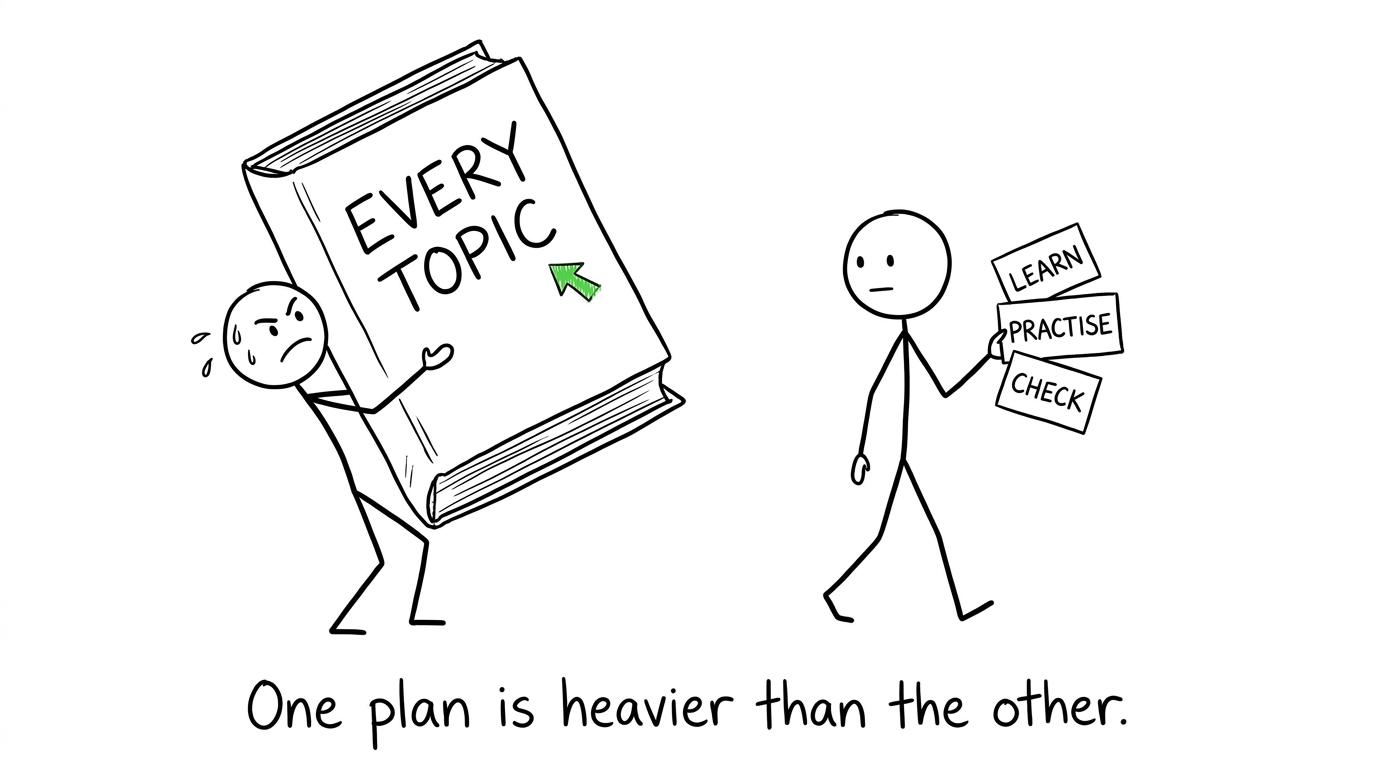 A huge revision book compared with a simple learn-practise-check plan
How to revise once your route is confirmed
If you are taking current GCSE Maths, match every resource to your board and tier. Begin with a diagnostic paper or mini test, identify the topics losing you marks, and then use a repeatable cycle:
- learn or refresh one method;
- complete practice questions without copying;
- mark them immediately;
- record the precise error;
- retry a similar question later;
- test the skill in a mixed paper.
MathsGenie’s guide to the best order for learning GCSE Maths topics can help if your knowledge feels fragmented. For a longer structure, build sessions around the GCSE Maths revision timetable.
Past papers become valuable when they change what you do next. The guide on when to start GCSE past papers explains how to move from short diagnostic work to complete timed papers. Near the exam, Edexcel GCSE Maths predicted papers provide fresh exam-style practice for Edexcel students, but they should complement rather than replace genuine past papers.
If you are resitting, use the GCSE Maths resit revision plan to turn your previous result into a focused list of actions. Students considering an autumn entry should also read the November GCSE resits guide and confirm all arrangements with their centre.
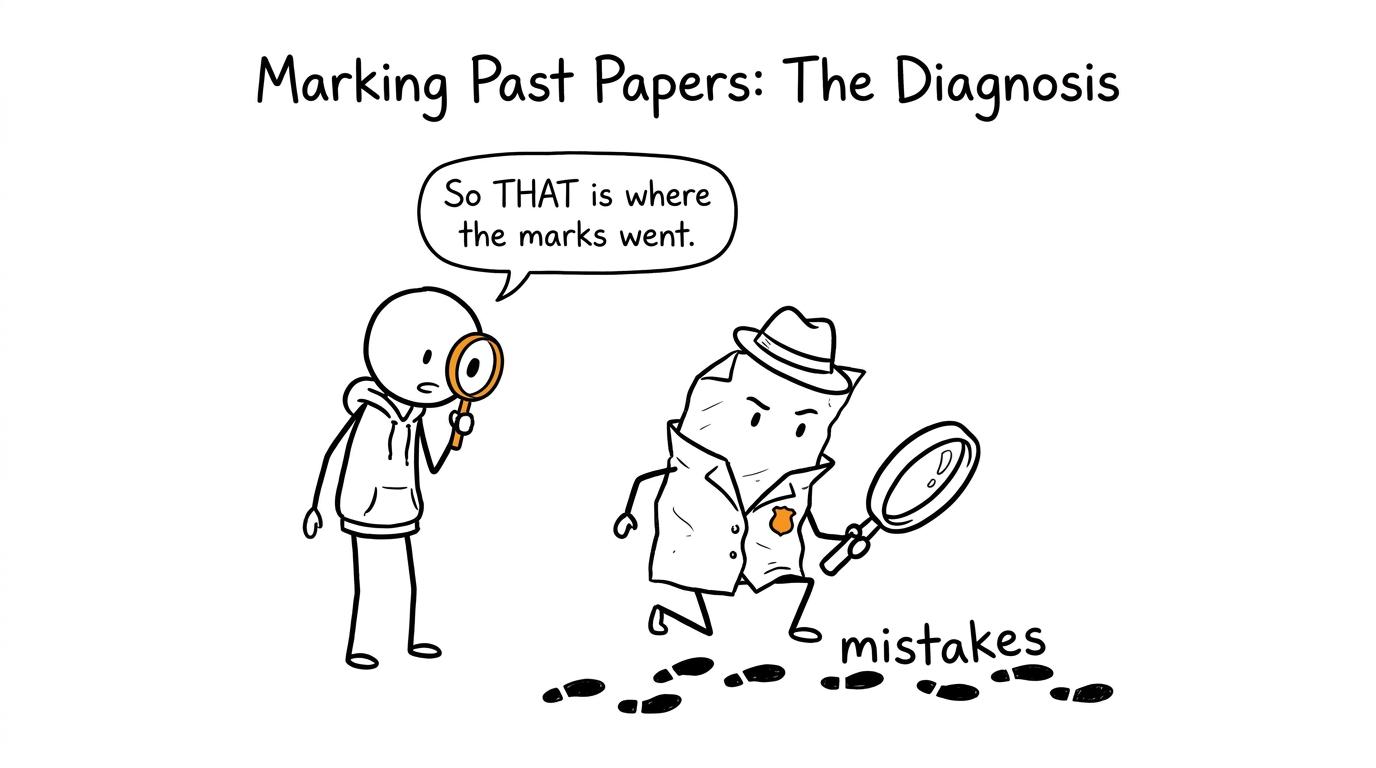 An exam-paper detective investigating where marks disappeared
Common mistakes when choosing a maths option
Treating old papers as the current specification
An old paper can train mathematical fluency, but it cannot reliably tell you everything that may appear in your present exam. Prioritise current specification resources and use the archive only for additional questions.
Assuming “equivalent” means universally accepted
Functional Skills Level 222 is accepted for many purposes, but individual courses and careers can set their own entry requirements. Check before enrolling, not after completing the qualification.
Choosing higher tier because it sounds more impressive
Higher tier opens grades 666 to 999, but foundation can offer a more secure route to grades 444 and 555. Your tier should reflect current evidence from assessments, teacher guidance and your target grade.
Revising for the wrong exam board
The underlying mathematics overlaps, but paper structures and presentation differ between Edexcel, AQA, OCR and Eduqas. Confirm your board before downloading papers.
Completing papers without reviewing them
A total mark describes what happened. It does not improve the next attempt. Use mark schemes and video solutions to identify whether each loss came from missing knowledge, an inaccurate calculation, weak reasoning or poor exam technique.
Choose clarity before convenience
The central answer to gcse old maths vs gcse the alternative option is that “old maths” is an archive, not a current qualification choice. Most school-age GCSE students should prepare for their present exam board’s GCSE Mathematics specification. Functional Skills may be a sensible alternative for some eligible post-161616 learners, provided it meets the requirement of the destination they actually want.
Once that decision is confirmed, progress becomes much less mysterious. Choose the correct board and tier, diagnose your gaps, and follow a steady learn then practise then mark then fix cycle.
Start with MathsGenie’s free GCSE revision lessons and practice questions, then build towards mini tests, past papers, mark schemes, video solutions and predicted papers. The right qualification matters. But after that, improvement comes from something quieter: using the right resource, noticing one mistake and returning better prepared the next time.