12 GCSE Maths Resit Mistakes That Cost a Grade 4
GCSE maths resit mistakes explained: fix 12 common errors, improve exam technique and protect the method marks that could help you reach grade 4.
Missing a grade 4 can feel as though the entire result came down to one impossible question. Often, it did not. The real damage may have been spread across several small GCSE maths resit mistakes: an unread instruction, a missing unit, an answer rounded too soon or useful working left off the page.
The encouraging part is that these errors can be changed. Recent examiner reports repeatedly identify difficulties with choosing operations, completing multi-stage calculations and communicating answers precisely. Better exam technique cannot replace mathematical knowledge, but it can help you turn more of what you know into marks.
A quick resit checklist
Before your next paper, aim to make these habits automatic:
- underline the instruction and important values;
- show a clear method, even when using a calculator;
- estimate before accepting a calculator display;
- keep full values until the final step;
- include units where required;
- answer the exact question asked;
- return to incomplete questions;
- check signs, scales and copied numbers.
Use the checklist while completing GCSE Maths past papers and revision questions. A good habit practised under realistic conditions is far more dependable than one remembered for the first time in the exam hall.
The 12 GCSE maths resit mistakes to fix
Misreading what the question wants
A student can perform flawless arithmetic and still answer the wrong question. Words such as estimate, write as a percentage, give a reason and show that are instructions, not decoration. Questions may also ask for the amount remaining rather than the amount used.
Quick fix: underline the command word and write a short target beside it. For example, note “remaining”, “percentage” or “two reasons”. Before moving on, compare your final line with that target.
Choosing an operation from one familiar word
“More” does not always mean add, and a percentage question does not always mean divide by 100100100. Context decides the operation. Examiner feedback commonly shows students carrying out a valid calculation that does not model the situation described.
Quick fix: say what your calculation represents. If 48÷6=848 \div 6 = 848÷6=8, write that 888 is the amount in each group. This small sentence tests whether the operation makes sense.
Showing too little working
A correct answer may earn full marks, but a wrong final value with no method can leave an examiner with nothing useful to reward. Multi-step questions are designed to assess reasoning as well as accuracy. Calculator use does not remove the need to communicate the method.
Quick fix: write one calculation per stage. Include substituted values, rearrangements and intermediate results. Your working should let another person follow the route without guessing what you pressed.
Stopping before the calculation is complete
This is one of the most avoidable common maths mistakes at GCSE. A student may add the data for a mean but forget to divide by the number of values. Another may find one area when the problem asks for a total area, or calculate a discount without subtracting it from the original price.
For a mean, the complete structure is:
mean=total of the valuesnumber of values.\text{mean}=\frac{\text{total of the values}}{\text{number of values}}.mean=number of valuestotal of the values.Quick fix: after every intermediate answer, ask: “What does this number represent, and is that what the question requested?”
Treating percentage change as an ordinary percentage
Percentage problems contain several different ideas. Finding 20%20\%20% of a price, increasing a price by 20%20\%20% and finding the percentage increase are not the same task. A frequent error is to calculate only the change when the new total is required.
An increase of 20%20\%20% can be represented by the multiplier:
1+20100=1.2.1+\frac{20}{100}=1.2.1+10020=1.2.Quick fix: label the original amount, the change and the new amount. Decide which one the question wants before calculating.
Losing control of fractions and negatives
Sign and fraction errors are often small on the page but expensive across a paper. Typical problems include subtracting a negative incorrectly, adding denominators or forgetting that a fraction line acts as a division sign.
Remember that:
−3−(−5)=−3+5=2.-3-(-5)=-3+5=2.−3−(−5)=−3+5=2.Quick fix: put negative values in brackets when substituting. For fractions, write an equivalent fraction step rather than trying to perform several changes mentally. The MathsGenie GCSE topic resources provide practice questions and video support for rebuilding these core skills.
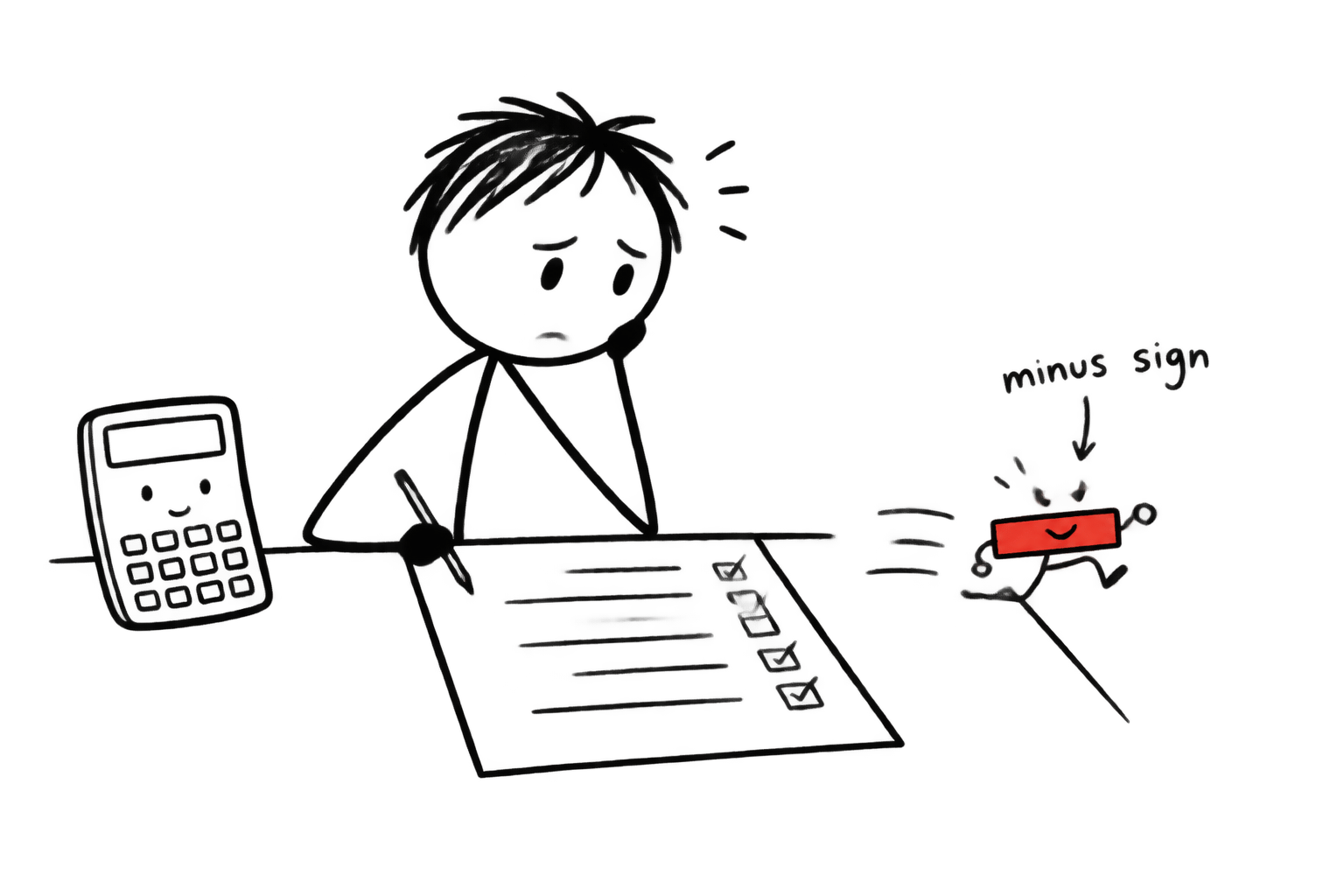 A mischievous minus sign tries to escape while a GCSE resit student checks an answer
Rounding too early
Rounding an intermediate value can alter the final answer enough to lose an accuracy mark. This matters particularly in questions involving area, volume, trigonometry, repeated percentage change and money.
Quick fix: keep the full calculator value in later calculations. Round only the final answer, unless the question explicitly tells you to round at an earlier stage. If asked for significant figures or decimal places, write the requested degree of accuracy clearly.
Trusting every calculator display
A calculator follows the input, not the intention. Missing brackets can completely change a result. So can entering 525^252 when you meant (5+2)2(5+2)^2(5+2)2, or copying a value incorrectly from the paper.
Quick fix: estimate the size and sign of the answer first. Enter complex calculations in sensible stages and use brackets deliberately. On calculator papers, a written method also makes it easier to find an input error during checking.
Forgetting units or failing to convert them
An answer of 242424 may be incomplete if the question requires 24 cm224\text{ cm}^224 cm2. Area uses square units, volume uses cubic units and compound measures require units such as km/h\text{km/h}km/h. Mixing centimetres and metres within one calculation is another common source of lost marks.
Quick fix: convert every measurement into compatible units before starting. Write the unit beside the final answer and check whether it should be linear, squared or cubed.
Reading graphs and scales carelessly
Not every small square represents 111. A graph axis might increase by 222, 555, 101010 or a decimal amount. Students also lose marks by plotting against the wrong variable, drawing freehand lines where a straight line is expected or reading from the wrong axis.
Quick fix: calculate the value of one small interval before plotting or reading anything. Mark coordinates lightly, use a ruler when appropriate and check that each coordinate is written in the order (x,y)(x,y)(x,y).
Giving an unsupported probability answer
Probability questions often require more than a decimal appearing from nowhere. Errors include counting outcomes that are not equally likely, forgetting replacement conditions and assuming probabilities always remain unchanged.
For a complete set of mutually exclusive outcomes:
P(A)+P(B)+P(C)=1.P(A)+P(B)+P(C)=1.P(A)+P(B)+P(C)=1.Quick fix: list or organise the possible outcomes before calculating. On tree diagrams, label branches carefully and check that the probabilities leaving a point total 111.
Managing time as if every question is equal
A difficult question can absorb ten minutes while accessible marks remain untouched later in the paper. The opposite mistake is rushing through early questions because they look easy. Careless arithmetic there can remove marks you were well prepared to earn.
Quick fix: if you have no productive step after a reasonable attempt, mark the question and move on. Return after securing the questions you can answer. Build this judgement with Edexcel GCSE Maths mini tests and full papers completed under timed conditions.
How to improve exam technique in maths
Reading advice is useful, but mistakes change only when the replacement habit is rehearsed. Complete one paper, mark it honestly and classify every lost mark. Useful categories include content gap, misread question, arithmetic slip, incomplete method, units, rounding and time pressure.
Then repair the cause rather than simply recording the score. If ratio is weak, use a revision lesson and focused practice questions. If the mathematics was understood but poorly presented, repeat the question with clearer working. The guide for students stuck around a pass grade explains how targeted practice and method marks can support progress.
Use MathsGenie's revision planner to schedule short correction sessions alongside topic revision. When you are ready for realistic practice, try the available Edexcel predicted papers, then compare your work carefully with the mark schemes and video solutions.
Past papers are most valuable when they create feedback. The advice in how many GCSE past papers to complete can help you balance full papers with focused repair work.
A grade 4 is built from collected marks
No single checklist can guarantee a grade because grade boundaries vary by exam series and paper difficulty. Yet the principle is steady: a pass is built one mark at a time. You do not need every question. You need to protect accessible marks, communicate methods and avoid repeating preventable errors.
Start with one timed paper on MathsGenie. Mark it, identify which of these twelve mistakes appeared, and choose two habits to practise this week. Free revision lessons, practice questions, mini tests, past papers, predicted papers, mark schemes and video solutions are there to help you turn each mistake into a more reliable method.