

GCSE Maths Reform: What Year 10 Parents Need to Know
GCSE maths reform: what it means for a child in Year 10 now, which specification they will sit in 2028, and the practical steps parents should take.
Updated: 3 November 2026. This article covers pupils in Year 10 during the 2026-27 academic year, who would normally sit GCSE exams in summer 2028.
Your Year 10 child is expected to sit the current GCSE Maths specification in summer 2028, not a newly reformed GCSE. That is the definitive answer to GCSE maths reform: what it means for a child in Year 10 now.
The nuance is that education reform rarely arrives as one clean event. The government plans to introduce a revised national curriculum from September 2028, while updated GCSE qualifications are intended for first teaching from 2029 or 2030. Those dates place a child currently in Year 10 before the changeover.
For a parent reading headlines about shorter exams, revised content and new qualifications, this matters. Your child does not need to prepare for a speculative future course. They need to learn the specification their school is already teaching.
The answer at a glance
For a typical Year 10 pupil in England in November 2026:
- their GCSE exams will normally take place in summer 2028;
- they are expected to take the existing GCSE Maths qualification;
- their exam board is likely to be Edexcel, AQA, OCR or Eduqas, as chosen by the school;
- they will be entered for foundation or higher tier;
- Ofqual has decided that a formulae sheet will remain available for the lifetime of the current specifications;
- parents should follow the school's exam board, tier and topic sequence rather than trying to anticipate future reforms.
The government's timetable can still develop, but it does not alter the sensible plan for this cohort: revise the course being taught now.
Which GCSE specification will a Year 10 child sit?
Imagine a parent opening a school email after seeing another headline about GCSE maths changes. The natural worry is not abstract policy. It is simpler: Has my child spent a year learning the wrong material?
No. A pupil who entered Year 10 in September 2026 will usually complete the course in summer 2028. The Department for Education's response to the Curriculum and Assessment Review says the revised national curriculum is due for first teaching from September 2028. Updated GCSEs are intended to begin later, from 2029 onwards, with government and Ofqual publications referring to first teaching in 2029 or 2030.
First teaching is not the same as the first examination. A qualification taught from September 2029 would ordinarily be examined after the course has been taught. It therefore cannot be the normal qualification for pupils already halfway through secondary school in 2026.
Your child's exact specification is the one selected by their school. Ask the maths department these three questions:
- Which exam board are you using?
- Is my child currently working towards foundation or higher tier?
- Which topics should be secure by the end of Year 10?
Once you know the board, use the GCSE Maths revision hub to select the corresponding resources. Parents of pupils following Pearson Edexcel can go directly to Edexcel GCSE Maths revision, while those following AQA can use the AQA GCSE Maths revision page.
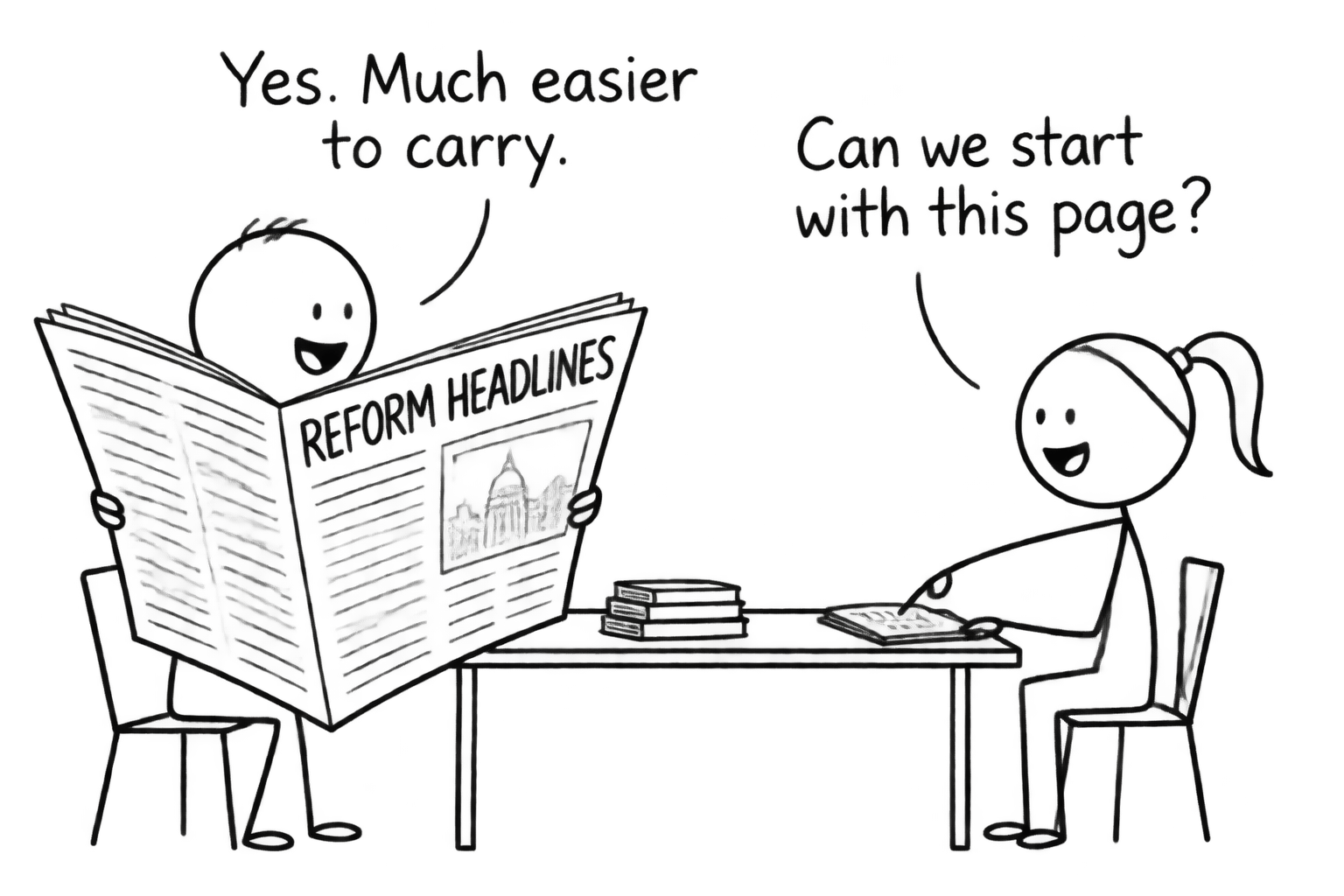 A parent puts down an enormous reform newspaper and focuses on one manageable revision page
What is actually changing?
The Curriculum and Assessment Review published its final report in November 2025. The government then accepted some recommendations, modified others and set out a staged implementation timetable.
For GCSE assessment generally, the government stated an intention to reduce total examination time. However, the design and timing of individual reformed qualifications still require detailed subject content, consultation and regulatory decisions. Parents should not treat a broad policy announcement as the final design of a future GCSE Maths paper.
There is one confirmed assessment point relevant to the present specification. In 2026, Ofqual decided that exam boards must continue providing GCSE Maths formulae sheets for the remaining lifetime of the current qualifications. A Year 10 pupil expected to sit the current specification in 2028 should therefore receive one, subject to the normal arrangements for that examination series.
That does not make learning formulae pointless. A pupil still needs to recognise which formula applies, substitute accurately and interpret the result. Knowing that the area of a trapezium can be found using
A=12(a+b)hA=\frac{1}{2}(a+b)hA=21(a+b)his only the beginning. The marks depend on turning the information in a question into a correct method.
A practical Year 10 plan for parents
The safest response to uncertainty is not to wait. It is to narrow the problem.
Confirm the course
Check the exam board with the school rather than guessing from a textbook or an older sibling's experience. Also confirm the current tier. Foundation tier targets grades 111-555, while higher tier targets grades 444-999, with an allowed grade 333 in limited circumstances under the qualification arrangements. Tier decisions can change before final entries, so discuss concerns with the teacher rather than treating a Year 10 set as permanent.
The foundation and higher tier guide explains how the choice affects content and available grades.
Establish the starting point
Ask your child to complete a short set of mixed questions without notes. The purpose is diagnosis, not judgement. Sort errors into three groups:
- knowledge gaps, where the method was unknown;
- execution errors, where the method was known but calculations went wrong;
- exam-reading errors, where the question was misunderstood or insufficient working was shown.
A topic list organised by board and tier helps turn vague concern into a usable checklist. The GCSE Maths topics by exam board and tier guide is a practical place to map what has and has not been covered.
Build foundations before chasing difficult questions
Weak fractions, percentages, ratio and algebra quietly make later topics harder. For example, probability, gradients, trigonometry and compound measures all rely on earlier numerical or algebraic fluency.
If foundations are insecure, choose one topic at a time. Watch the lesson, attempt questions without copying, mark the work, and return to mistakes several days later. The best order for learning GCSE Maths topics can help you choose a sensible sequence rather than jumping between unrelated worksheets.
If organising that sequence starts to feel like another family project, open the Maths Genie Lessons page for your child's current specification and begin with the first identified gap.
Move gradually towards exam conditions
Year 10 revision should not become a year-long mock examination. Topic practice is valuable while material is still being learned. Mixed questions and timed papers become increasingly useful as coverage grows.
A balanced weekly routine might include:
- one session relearning a weak topic;
- one session answering questions independently;
- one short review of earlier mistakes;
- periodic mixed or timed practice once enough content has been taught.
When your child is ready, use free GCSE Maths past papers and mark schemes from the correct board. Past papers show how knowledge is combined, but they work best after the underlying methods are understood.
What parents should not do
Switch resources because reform is coming
Materials for a possible 2029 or 2030 first-teaching specification are not the right target for a summer 2028 candidate. Stay aligned with the school's current course.
Assume every announced proposal is confirmed
The review, the government's response and Ofqual's regulatory decisions play different roles. A recommendation is not automatically policy, and a policy intention is not yet a finished exam-board specification.
Treat the formulae sheet as a substitute for understanding
The sheet reduces memorisation demands. It does not identify the method, organise the working or perform the calculation.
Buy materials before checking the exam board and tier
Much GCSE Maths content overlaps across boards, but paper structure, wording and specification details can differ. Accurate labelling matters, especially when full-paper practice begins.
Turn every mistake into a conversation about grades
A mistake in Year 10 is useful evidence. Record the topic and revisit it. Constantly converting each score into a predicted grade can obscure the more useful question: What should be learned next?
What the reform means in human terms
The parent in our imagined kitchen does not need to become an expert in regulatory timetables. They need one reliable decision.
For this Year 10 cohort, the decision is to keep moving through the current specification. Confirm the board. Understand the tier. Repair gaps while there is still time. Use papers later to test whether separate skills can be combined under pressure.
Reform matters, but timing matters more. The future GCSE belongs to a later cohort. Your child's task is the course already in front of them.
Start with the current specification
Knowing that the qualification is not changing removes one worry; following a steady topic-by-topic routine is the part that still requires action. Every week before the fixed summer 2028 exam season is an opportunity to strengthen one more gap. Start the Maths Genie Lessons for the current GCSE specification and help your child complete the next lesson for the exam board and tier confirmed by their school.















