

GCSE Italian Predicted Grades: Are They Accurate?
GCSE Italian predicted grades accuracy explained: discover how reliable forecasts are, why results differ and how to respond before your final exams.
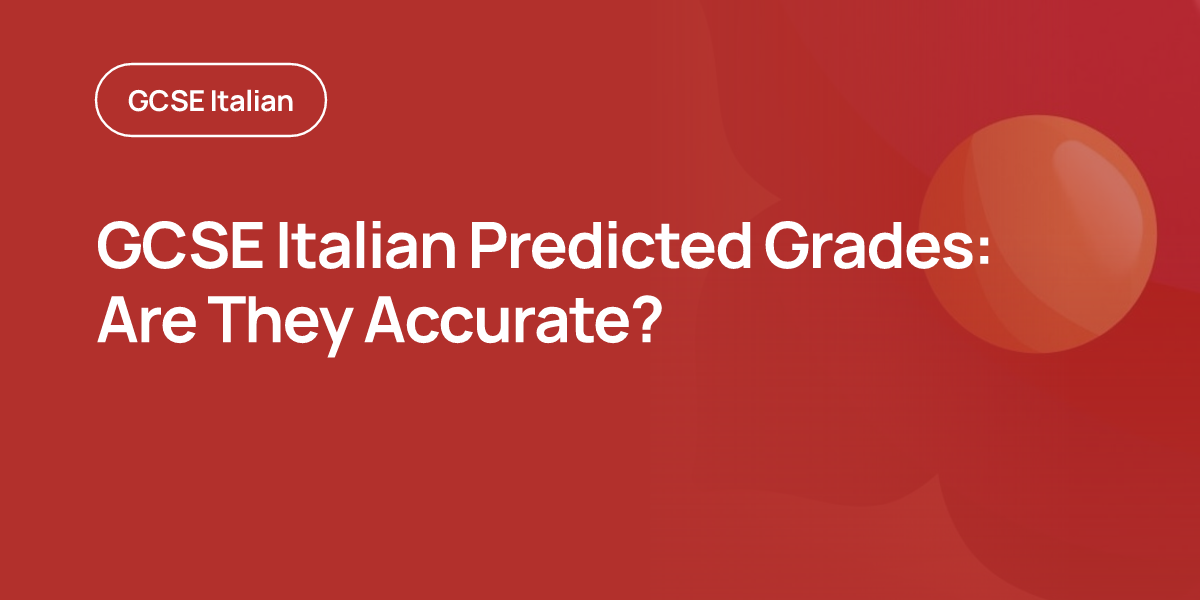
A predicted grade can feel strangely permanent. It appears on a report, sits beside your name and starts shaping what you think is possible. Yet GCSE Italian predicted grades accuracy is not precise enough for a prediction to be treated as a result waiting to happen.
The short answer is this: a carefully produced predicted grade is a useful estimate, but it is not a guarantee. Research reviewed by Ofqual suggests that teacher forecasts across GCSE subjects are often close, particularly when accuracy means being within one grade. Exact matches are less dependable, and forecasts have historically been more likely to be optimistic than pessimistic. There is no robust, current national accuracy figure specifically for GCSE Italian, so any claim that Italian predictions are accurate a particular percentage of the time should be treated cautiously.
Your prediction is evidence. Your final grade is still being written.
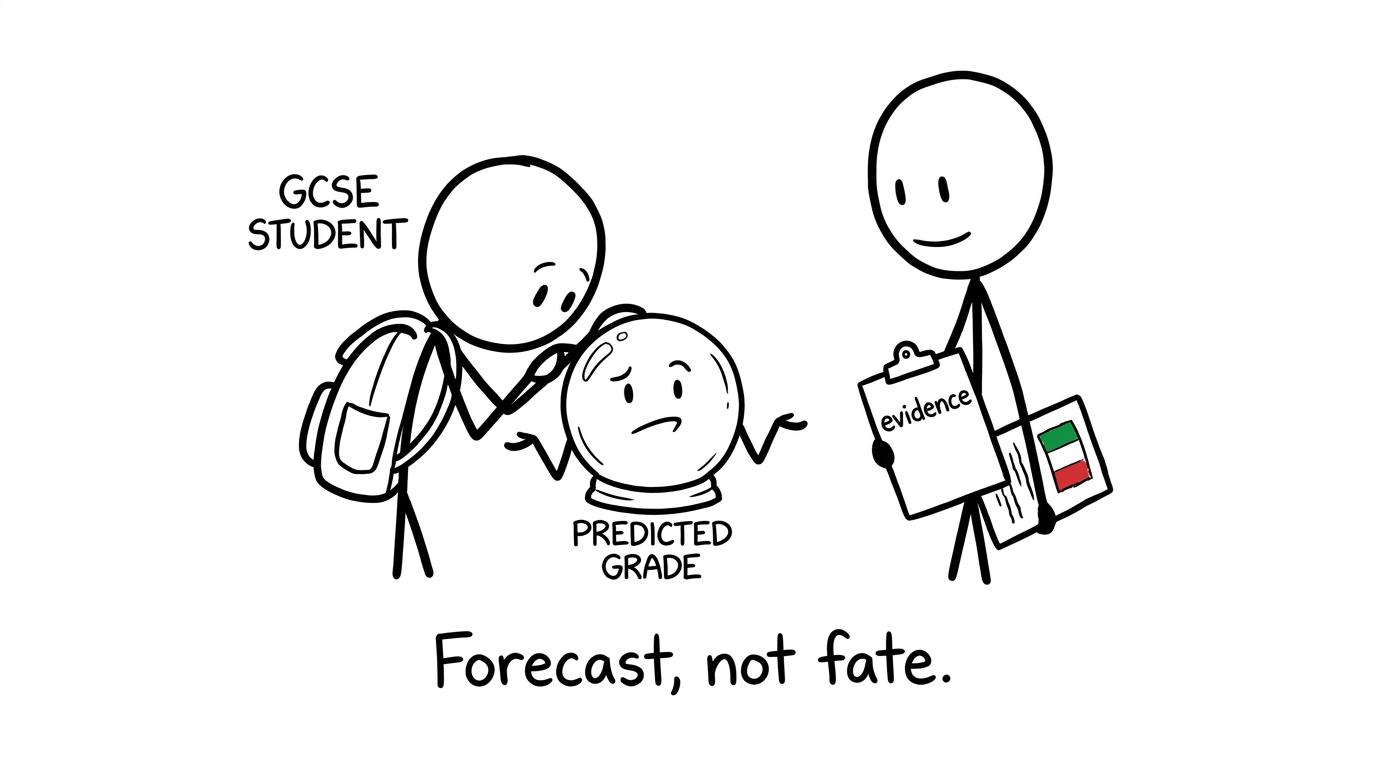 A predicted grade is a forecast, not fate
GCSE Italian predicted grades accuracy at a glance
Keep these points in mind when reading your forecast:
- A predicted grade is usually based on mocks, class assessments, speaking performance, homework and previous attainment.
- It may describe your most likely outcome, your current working level or what you could achieve in positive circumstances. Schools do not always use the term in exactly the same way.
- Research across GCSE subjects indicates that forecasts are much more reliable as a rough range than as an exact result.
- Italian predictions can move because the qualification draws on listening, speaking, reading and writing.
- Final grade boundaries are not confirmed before students sit the examinations.
- Tier entry matters because foundation and higher tier offer different grade ranges.
- A prediction that is too high or too low does not cause the final result. Your assessed performance does.
The most useful response is not to ask, “Is my prediction right?” It is to ask, “What evidence produced it, and what can I improve next?”
What does a predicted GCSE Italian grade actually mean?
A predicted grade is a professional judgement made before the final result is known. Teachers may consider several pieces of evidence, including timed assessments, vocabulary tests, extended writing, spontaneous speaking and performance across the course.
That makes it different from a mock grade. A mock grade reports what happened in one assessment. A prediction attempts to estimate what may happen later, often allowing for progress between the mock and the summer examinations.
It is also different from a target grade. A target may be generated from prior attainment or set as an aspiration. Your school could therefore show three different numbers:
- a mock grade, based on a particular paper;
- a working grade, representing current performance;
- a predicted or target grade, looking towards the final assessment.
Ask your teacher which definition your school uses. Without that context, two students with the same forecast may misunderstand it in completely different ways.
How reliable are GCSE Italian predictions?
The fairest conclusion is that they tend to be directionally useful but individually uncertain.
An Ofqual literature review reported that, across all subjects in one analysis of OCR GCSE forecasts, approximately 43%43\%43% were exactly correct and 87%87\%87% were within one grade. Those figures are historical, combine many subjects and should not be presented as an Italian-specific success rate. They do, however, illustrate an important distinction: predicting the exact grade is difficult, while identifying the approximate performance range is more realistic.
Teacher judgements can also lean towards optimism. Ofqual’s broader reviews of predicted and teacher-assessed grades found substantial evidence that forecasts are more commonly generous than severe when they differ from examination outcomes. That does not mean your particular prediction is inflated. It means a prediction should be interpreted as an informed estimate, not a promise.
For a personal forecast, it is sensible to think in terms of a range such as one grade either side. That is not an official rule. It is simply a calmer and more honest way to recognise uncertainty.
Why Italian predictions can be especially difficult
GCSE Italian assesses several forms of language performance rather than one repeatable procedure. Under current AQA and Pearson Edexcel specifications, listening, speaking, reading and writing each contribute approximately 25%25\%25% of the qualification. Students normally take all components at the same tier, although exact assessment details depend on the specification and examination series.
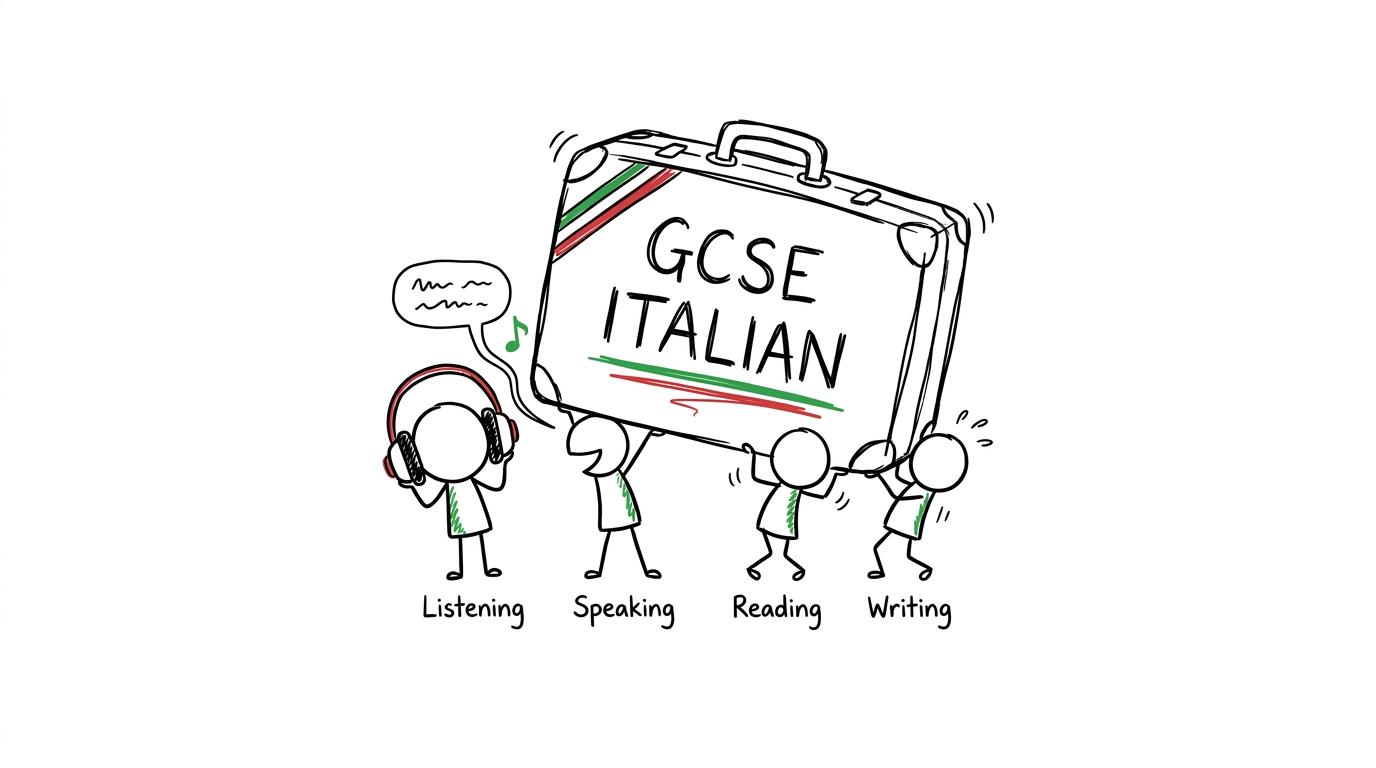 Listening, speaking, reading and writing carry GCSE Italian together
Performance can vary between skills
A student may write accurately when there is time to plan but find spontaneous speaking harder. Another may understand written Italian confidently but lose details in a fast listening passage.
A prediction built mainly from written homework may therefore miss weaknesses under timed or spoken conditions. The more balanced the evidence, the more useful the forecast is likely to be.
Speaking is affected by pressure and preparation
Speaking performance can change noticeably with the topic, level of spontaneity and confidence on the day. Thorough preparation helps, but memorising long answers without practising follow-up questions can create a misleading sense of security.
Mock assessments are imperfect samples
A mock cannot reproduce every vocabulary area, question style or source of pressure in the final assessment. If the mock happened to suit your strongest topics, the prediction may be high. If it focused on weaker material before you had completed the course, it may be low.
Grade boundaries are set after the examinations
Exam boards do not fix future grade-boundary marks in advance. Boundaries can change because papers vary in difficulty, and awarding decisions use evidence gathered after students have taken the assessments.
Past boundaries can help teachers interpret mock performance, but they cannot reveal exactly how many marks a future grade will require. This is one reason even a well-marked mock cannot produce a perfectly certain forecast.
Why your result might be lower than predicted
A lower result does not automatically mean the teacher made a careless judgement. Several things can change between prediction and results day:
- the prediction may have assumed continued progress that did not occur;
- classwork completed with support may have looked stronger than independent work;
- one weaker component may reduce the overall result;
- examination timing, nerves or unfamiliar vocabulary may affect performance;
- revision may focus too heavily on prepared writing and neglect listening or spontaneous speech;
- the final boundary may not match the provisional boundary used for a mock;
- higher-tier performance may fall below the standard needed for the expected grade.
The uncomfortable lesson is also a useful one: potential only becomes a result when it survives examination conditions.
Why your result might be higher than predicted
Predictions can underestimate students too. A forecast may have been based on early assessments, limited evidence or a mock taken before important content was taught.
You may finish above it if you:
- improve rapidly during the final months;
- develop better listening and translation habits;
- become more fluent and spontaneous in speaking;
- correct recurring grammar errors;
- manage time more effectively;
- complete enough timed practice to make examination pressure familiar.
Some students are simply more consistent in the real assessment than in classroom tests. The key is not to rely on a dramatic last-minute jump, but to create recent evidence that your performance has changed.
How to judge whether your own prediction is credible
Instead of comparing one number with your hopes, examine the evidence behind it.
Look for consistency
Collect your recent timed scores and grades from all four skills. A prediction supported by several assessments is usually more credible than one based mainly on a single mock.
You can record the gap between each forecast and result as:
forecast error=predicted grade−achieved grade\text{forecast error}=\text{predicted grade}-\text{achieved grade}forecast error=predicted grade−achieved gradeDo not overinterpret the average if you have only completed one or two assessments. Look for a pattern across time and across skills.
Ask what would change the forecast
A productive question for your teacher is: “Which evidence is keeping me at this grade, and what performance would demonstrate the next grade?” That invites specific feedback about accuracy, comprehension, vocabulary, pronunciation or examination technique.
Use fresh, timed evidence
Practising something until it feels familiar is not the same as being able to retrieve it under pressure. Complete unseen tasks with the correct time limit and without notes. Mark them honestly using the relevant criteria.
Maths students should apply exactly the same principle to their main revision. Use Edexcel GCSE Maths past papers or AQA GCSE Maths past papers to distinguish comfortable classroom understanding from independent examination performance.
Turn a prediction into a better revision plan
A prediction has little value unless it changes your next action. Use this calm feedback loop:
- Test: complete a timed task without help.
- Mark: identify the precise reason each mark was lost.
- Classify: separate knowledge gaps, execution errors and timing problems.
- Fix: practise the smallest skill responsible for the loss.
- Retest: use a different task to check whether the improvement lasts.
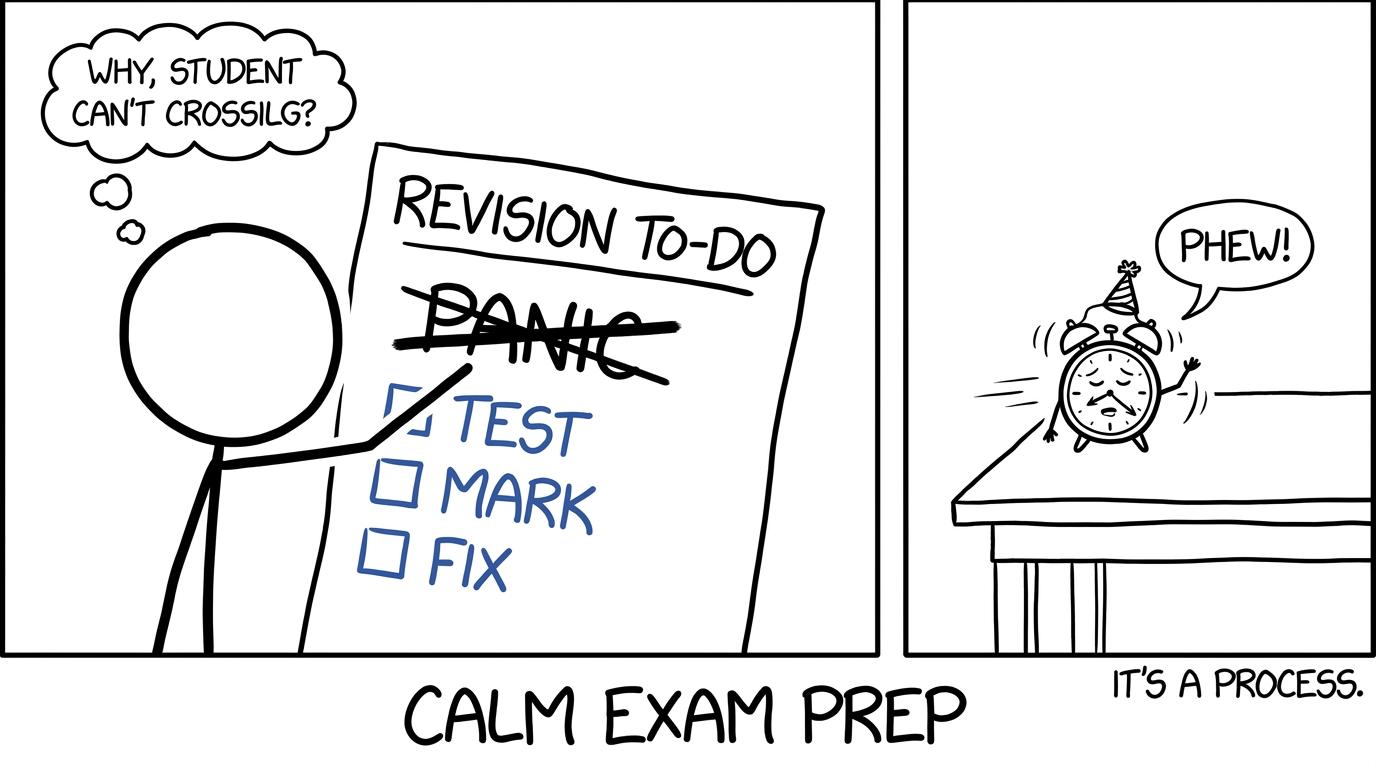 A calm revision plan replaces panic with test, mark and fix
This process transfers directly to maths. MathsGenie’s Edexcel GCSE Maths mini tests provide short diagnostic practice, while Edexcel predicted papers let you test unfamiliar combinations under timed conditions.
Students following other specifications can begin with the OCR GCSE Maths revision hub or Eduqas GCSE Maths revision hub. The board-specific wording may differ, but the underlying habit remains the same: attempt, mark, diagnose and repair.
Common mistakes when interpreting predicted grades
Treating the prediction as a ceiling
A lower forecast describes existing evidence. It does not set a maximum grade. Ask what evidence you need to produce next rather than arguing with the number alone.
Treating the prediction as a guarantee
A high predicted grade can create false comfort. Continue practising all four Italian skills, particularly the ones that feel less pleasant.
Comparing raw marks from different papers
Papers vary in demand, total marks and grade boundaries. Compare like with like and use the correct specification, tier and mark scheme.
Revising only the strongest skill
Repeatedly practising polished writing may feel productive while listening or speaking remains fragile. Your revision time should respond to evidence, not preference.
Completing papers without reviewing mistakes
Volume is not the same as progress. MathsGenie’s guide to finding your weakest GCSE topics explains how to convert lost marks into a focused revision list rather than simply collecting scores.
Your prediction is a compass, not a destination
The most accurate answer about GCSE Italian predicted grades is not a dramatic yes or no. Predictions often identify the right neighbourhood, but they cannot know the exact address. They combine professional judgement with incomplete evidence, changing performance and grade boundaries that have not yet been set.
Use the forecast without surrendering to it. Find out what it means in your school, inspect the evidence behind it and build a balanced plan for listening, speaking, reading and writing.
Then bring the same honesty to maths. Start at MathsGenie’s free GCSE and A Level maths revision hub, choose revision lessons for weak topics, practise exam questions, and use mark schemes and video solutions to understand every lost mark. As the examinations approach, add mini tests, past papers and predicted papers.
A prediction looks forward. Good revision changes what it sees.











