GCSE Italian Note Taking You'll Actually Use
GCSE Italian note taking made practical: organise vocabulary, grammar and corrections into compact notes designed for active recall and regular review.

A notebook can look busy without being useful. Pages fill with copied vocabulary, highlighted headings and grammar explanations, yet when revision begins, the information feels strangely unavailable. You recognise it, but cannot produce it.
Effective GCSE Italian note taking solves a different problem. It does not try to preserve every lesson. It creates prompts you can test, correct and revisit later. Your notes should help you retrieve Italian without support, because that is what listening, speaking, reading and writing assessments eventually demand.
The simplest approach is to capture less, organise it by function and convert every page into a revision activity.
The GCSE Italian note-taking checklist
Build your system around these principles:
- Keep vocabulary in phrases or sentences, not isolated lists.
- Record nouns with their article and adjectives with useful forms.
- Store verbs with tense patterns and sentence-ready examples.
- Turn grammar explanations into short decision rules.
- Keep a separate record of recurring mistakes.
- Add questions or prompts that let you cover the answers and self-test.
- Review notes through retrieval rather than repeated rereading.
- Revisit difficult material across several short sessions.
- Match your notes to your exam board, tier and current specification.
The final point matters. Current AQA and Edexcel GCSE Italian qualifications assess listening, speaking, reading and writing, with foundation and higher tiers available. Exact themes, task formats and vocabulary expectations can differ, so confirm your course with your teacher rather than relying on a generic online checklist.
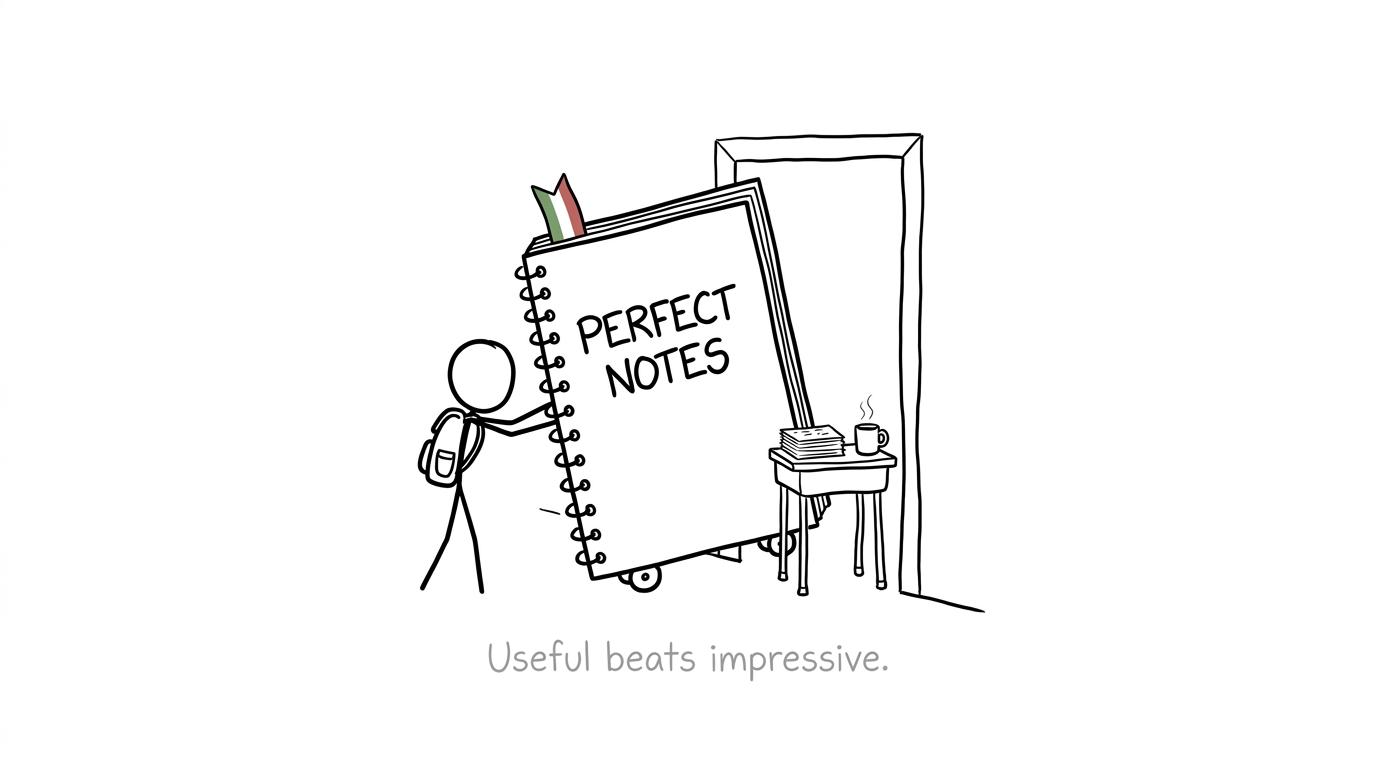 A student discovers that useful notes beat an enormous perfect notebook
Take notes for the student you will be later
The student writing notes in class has context. The teacher has just explained the rule, the vocabulary belongs to an obvious topic and the answer is still visible on the board.
The student revising six weeks later has none of that.
Write for that later version of yourself. A useful page should answer four questions quickly:
- What is this about?
- What am I expected to recall or do?
- How can I test myself?
- Where am I likely to make a mistake?
This changes what deserves space. A long copied explanation may feel thorough, but a concise rule, a retrieval prompt and a warning about a common error are more usable. Notes are not a transcript. They are equipment.
A good practical test is simple: if you cannot use a page without rereading the whole page, it is probably not yet a revision resource.
Build one repeatable page structure
Constantly inventing new layouts creates unnecessary decisions. Give each topic the same basic architecture, whether it concerns family, school, holidays, technology or the environment.
Start with a narrow topic label
Avoid broad headings such as “Theme One”. Use labels that tell you what language the page contains, such as:
- describing family relationships;
- giving opinions about school;
- recounting a past holiday;
- discussing environmental problems;
- explaining future plans.
Specific headings make notes easier to find and combine when preparing speaking or writing responses.
Divide the page by purpose
Use four compact areas:
- Core language: high-value vocabulary and reusable phrases.
- Grammar choices: tense patterns, agreements and word order.
- Retrieval prompts: English cues, questions or sentence openings.
- Corrections: errors from classwork, homework or practice tasks.
This is similar to a simplified Cornell layout, but the name of the method matters less than its behaviour. The cue side must allow self-testing. If both prompt and answer remain visible, recognition can masquerade as recall.
Leave space for later additions
Do not fill every line during the lesson. Useful notes grow through feedback. Leave room to add a stronger phrase, a corrected verb form or a warning from your teacher.
This also prevents the notebook becoming a museum of first attempts. It becomes a record of improving knowledge.
Capture Italian in usable units
Vocabulary lists often fail because they separate words from the information needed to use them accurately.
Record nouns with grammatical information
For a noun, include its article and any plural that is not immediately predictable. This helps you remember gender and makes adjective agreement easier to manage.
Do not treat the article as optional decoration. Learn the noun as one unit, such as la materia rather than simply materia. Where pronunciation or spelling is easily confused, add a brief personal warning rather than copying a dictionary entry.
Save verbs as patterns
An infinitive alone rarely prepares you to speak or write. Record the forms you repeatedly need and group them by communicative purpose:
- describing what you normally do;
- saying what you did;
- explaining what you are going to do;
- giving an opinion;
- expressing what you would like to do.
Keep each pattern short enough to retrieve. Your aim is not to reproduce an entire grammar textbook. It is to make the next sentence easier to build independently.
Store phrases that can travel between topics
Some language is useful across several themes: opinions, reasons, comparisons, time markers, connectives and expressions of frequency. Give these items a dedicated “transferable language” section.
Then tag where a phrase could work. A structure first recorded for school may also support answers about work, technology or local life. This reduces the amount you must memorise while increasing flexibility.
Turn grammar notes into decisions
Grammar notes become unwieldy when every exception receives equal attention. Begin with the decision you need to make.
For each point, write:
- When do I use it?
- What changes?
- What is the usual pattern?
- What mistake do I personally make?
This keeps grammar connected to production. If you repeatedly forget agreement, your note should direct you to check the relevant noun and ending. If tense selection is the problem, the note should highlight the time clue that triggers the choice.
Use colour sparingly and consistently. One colour might mark tense signals, another corrections. Ten colours create decoration rather than structure. The goal is to notice a decision quickly, not to make every line compete for attention.
Make every note testable
Research on learning consistently supports spacing practice over time and actively retrieving information instead of relying only on passive review. This gives note-taking a clear design rule: every page needs a way to hide the answer.
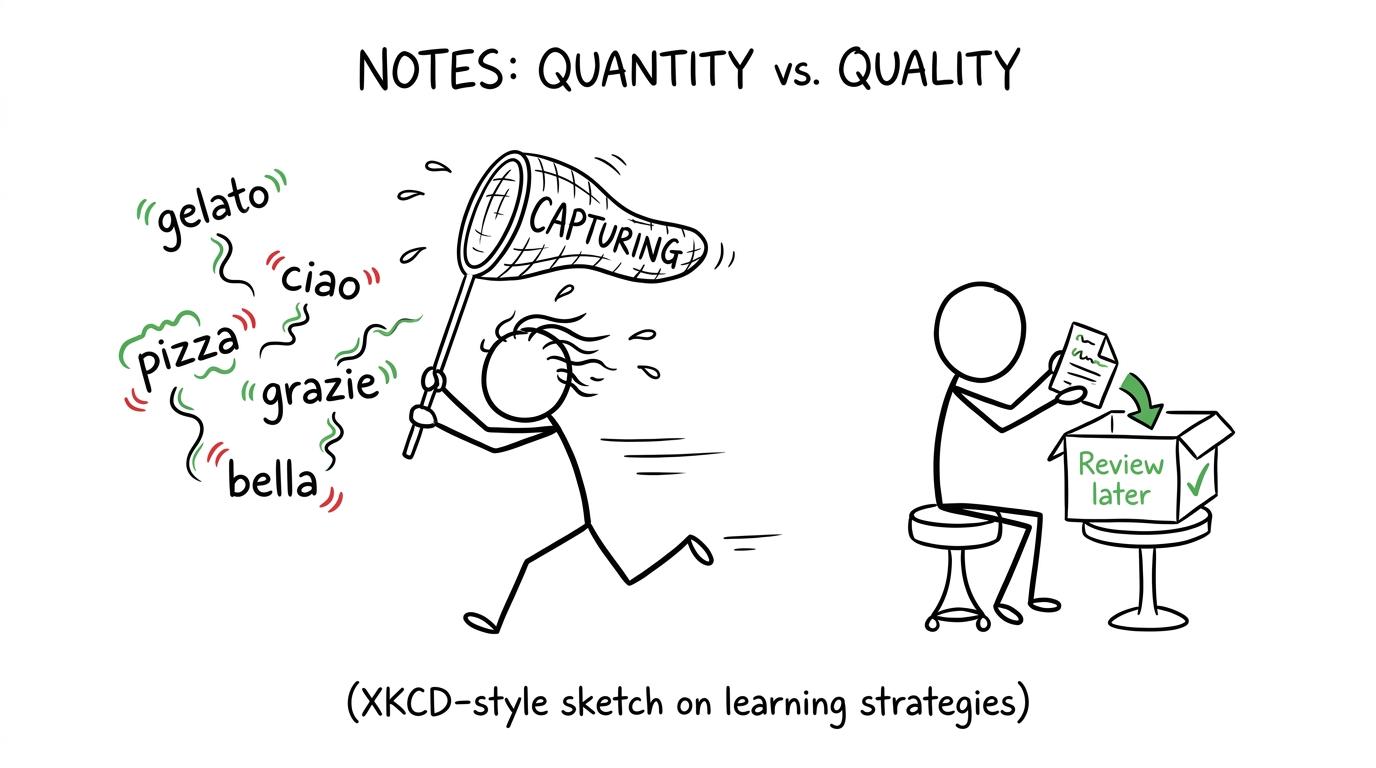 A student calmly stores Italian vocabulary for later review
Possible retrieval prompts include:
- an English meaning that requires the Italian phrase;
- a speaking question with the response covered;
- a tense label requiring the correct verb form;
- a sentence with a missing article, ending or connective;
- an error that you must correct from memory;
- a topic heading under which you recall five useful expressions.
Say answers aloud when practising speaking language. Write them when testing spelling, agreement or sentence construction. For listening, ask your teacher whether you may record approved vocabulary or use course audio, then practise recognising language without viewing the page.
Check immediately after attempting the answer. Retrieval without feedback can preserve errors, particularly when a nearly correct spelling or verb form begins to feel familiar.
Use a capture, convert and review routine
GCSE Italian note taking becomes manageable when each stage has a separate purpose.
Capture during the lesson
Write only what you may need later:
- new language;
- concise grammar rules;
- model structures provided by your teacher;
- pronunciation reminders;
- corrections and feedback;
- questions you still need answered.
Use a symbol beside anything uncertain. Do not silently turn a guess into a permanent note.
Convert after the lesson
Spend a short period turning rough notes into prompts. Remove duplication, clarify incomplete rules and move high-value language into the appropriate topic page.
This is not an invitation to rewrite everything neatly. Converting means making the material testable. If the page already works, leave it alone.
Review on a schedule
Revisit the material briefly after a gap, then again later. Exact timing can be flexible, but the reviews should be separated rather than compressed into one long session.
Use three labels:
- Secure: recalled accurately and promptly.
- Developing: recalled with hesitation or a small error.
- Relearn: could not be produced without support.
Spend most of your next session on “developing” and “relearn” material. The same evidence-led principle powers effective maths revision: practise what the work reveals, not merely what feels comfortable. Maths students can organise that process with the free MathsGenie revision planner.
Keep a correction bank, not a shame list
Mistakes are unusually valuable notes because they are personal. A textbook tells you what could go wrong; marked work tells you what actually does.
Keep one short correction bank with four fields:
- the original error;
- the corrected form;
- the reason;
- a future checking prompt.
Group repeated errors under useful labels such as agreement, verb ending, tense choice, spelling, word order or omitted detail. Before a writing task, choose two recurring patterns to monitor. Before speaking practice, select pronunciation or tense habits that need attention.
Do not copy an entire corrected paragraph. Extract the smallest lesson that prevents the error from returning.
This mirrors the error-log method used in effective GCSE maths revision. MathsGenie explains the wider learn, practise, mark and fix cycle in its guide to efficient GCSE maths revision.
Connect Italian notes to exam skills
Because Italian is assessed through four skills, one collection of static notes is not enough. Adapt the same material for different actions.
Listening and reading
Record synonyms, distractors, negatives, time expressions and words that change the direction of a sentence. Test recognition in context, not merely translation in a fixed order.
Speaking
Keep compact question prompts rather than fully memorised paragraphs. Prepare language for extending an answer: a reason, another tense, a comparison or an additional detail. Practise responding in varied orders so that your knowledge does not depend on one rehearsed sequence.
Writing
Build a checklist from your own correction bank. Include only checks that can change your work: tense coverage, agreements, verb endings, required content and accurate transferable structures.
Translation
Maintain a small list of structures that do not translate word for word. Your note should capture the Italian pattern and the decision behind it, rather than an unreliable literal substitution.
Common GCSE Italian note-taking mistakes
Copying everything
Transcription consumes attention and produces pages with no hierarchy. Capture essential language, decisions and feedback instead.
Making isolated word lists
A bare translation omits gender, agreement, verb behaviour and context. Save language in a form you can use.
Rewriting notes to make them attractive
Neatness helps only when it improves navigation. If you already understand the page, spend the time retrieving or applying it.
Highlighting before deciding what matters
Highlighting can become a substitute for selection. Read first, decide what must be recalled, then mark only that information.
Reviewing only by rereading
Rereading creates familiarity. Cover the answer, attempt it, check it and record whether retrieval succeeded.
Ignoring corrections
Teacher feedback should enter your correction bank. Otherwise, the same preventable error can survive from one task to the next.
Using resources for the wrong specification
Confirm your exam board, tier and current course details. Do not assume that every GCSE Italian vocabulary list or task format applies to you.
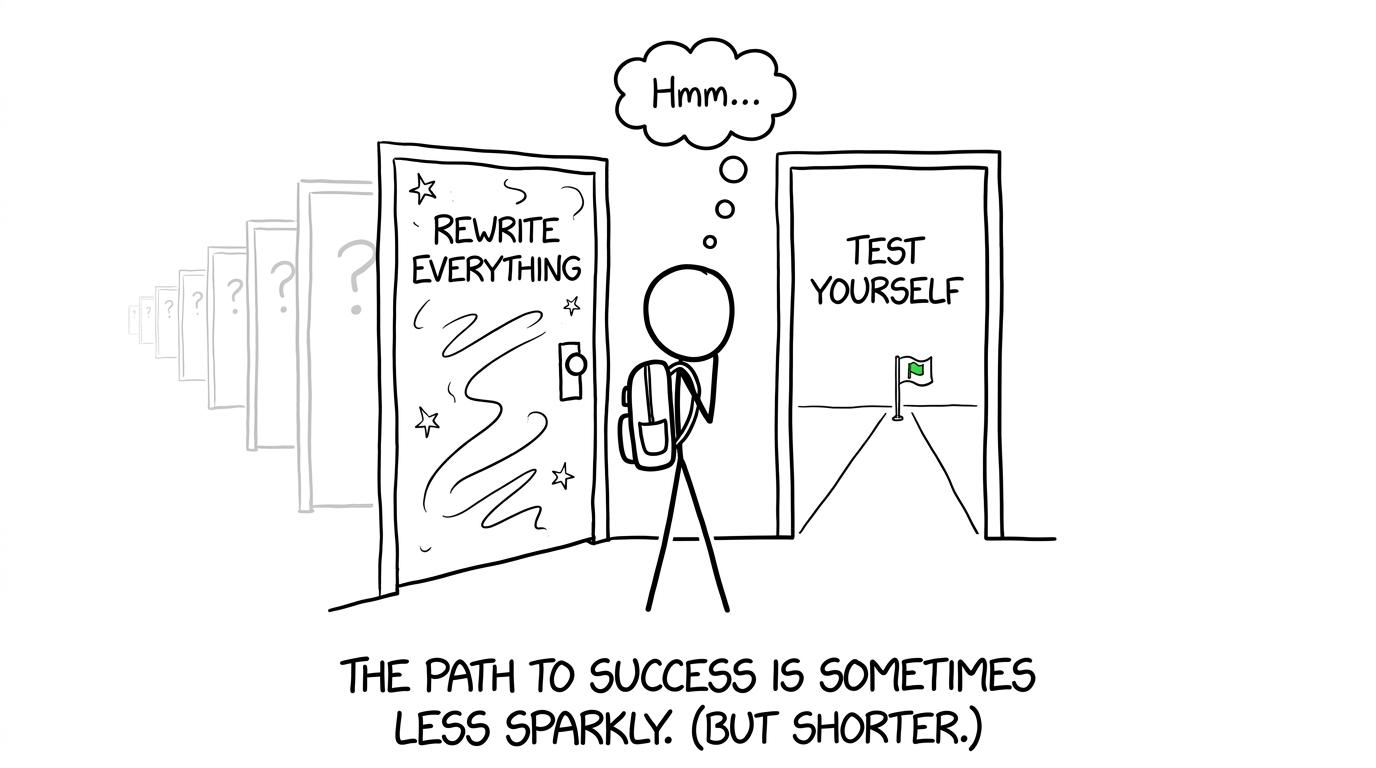 Testing yourself offers a shorter route than rewriting everything
Make the system work across your GCSE revision
The best revision systems are portable. The capture, test, correct and revisit loop works for Italian vocabulary, but it also works for formulae, mathematical methods and exam errors.
For maths, begin at the GCSE Maths revision hub, where free lessons, practice questions and revision resources are organised by board and topic. The MathsGenie resources collection adds mini tests, predicted papers and shorter practice papers.
When you are ready for full exam practice, choose material that matches your specification through the Edexcel GCSE Maths past papers, AQA GCSE Maths past papers or OCR GCSE Maths past papers. Use mark schemes and video solutions to turn each mistake into a brief correction note, just as you would in Italian.
Notes should lead to action
A useful notebook is rarely the thickest one. It is the one you can open, test and close with a clearer picture of what you know.
Start with one GCSE Italian topic. Reduce the page to core language, grammar decisions, retrieval prompts and corrections. Test it without looking. Then schedule the next review.
For your maths preparation, make MathsGenie your free revision base. Move from revision lessons to practice questions, check your work with mark schemes and video solutions, then build confidence through mini tests, past papers and predicted papers. Notes can organise learning, but retrieval and practice are what make that learning available when the exam begins.