

GCSE Italian Grade Boundaries Explained
GCSE Italian grade boundaries explained clearly: see why raw marks, scaling and paper difficulty mean your final grade is not a fixed percentage each year.
You finish a GCSE Italian mock, add up the marks and turn the total into a percentage. Then comes the unsettling question: What grade is that?
The honest answer is that the percentage alone cannot tell you. GCSE Italian grade boundaries explained simply means understanding that your grade comes from comparing your final subject mark with boundaries set for your exam board, tier and exam series. Those boundaries can move because papers are not equally difficult every year.
A raw mark tells you how many marks you earned. A percentage puts that mark on a scale of 100100100. Neither automatically carries a fixed GCSE grade.
The short answer: what determines your Italian grade?
Keep this checklist in mind:
- Your answers earn raw marks on listening, speaking, reading and writing assessments.
- Marks may be scaled so that each component has its intended weighting.
- Scaled component marks are combined into an overall subject mark.
- That total is compared with the official boundary for your board, tier and exam series.
- Boundaries are set when marking is nearly complete, using statistical evidence and expert judgement.
- Foundation and higher tier have different available grades and separate boundaries.
- A boundary from a previous year is useful for reviewing practice, but it cannot predict the next boundary exactly.
That final point matters most. The boundary adapts to the assessment; students are not expected to adapt to a secretly fixed percentage.
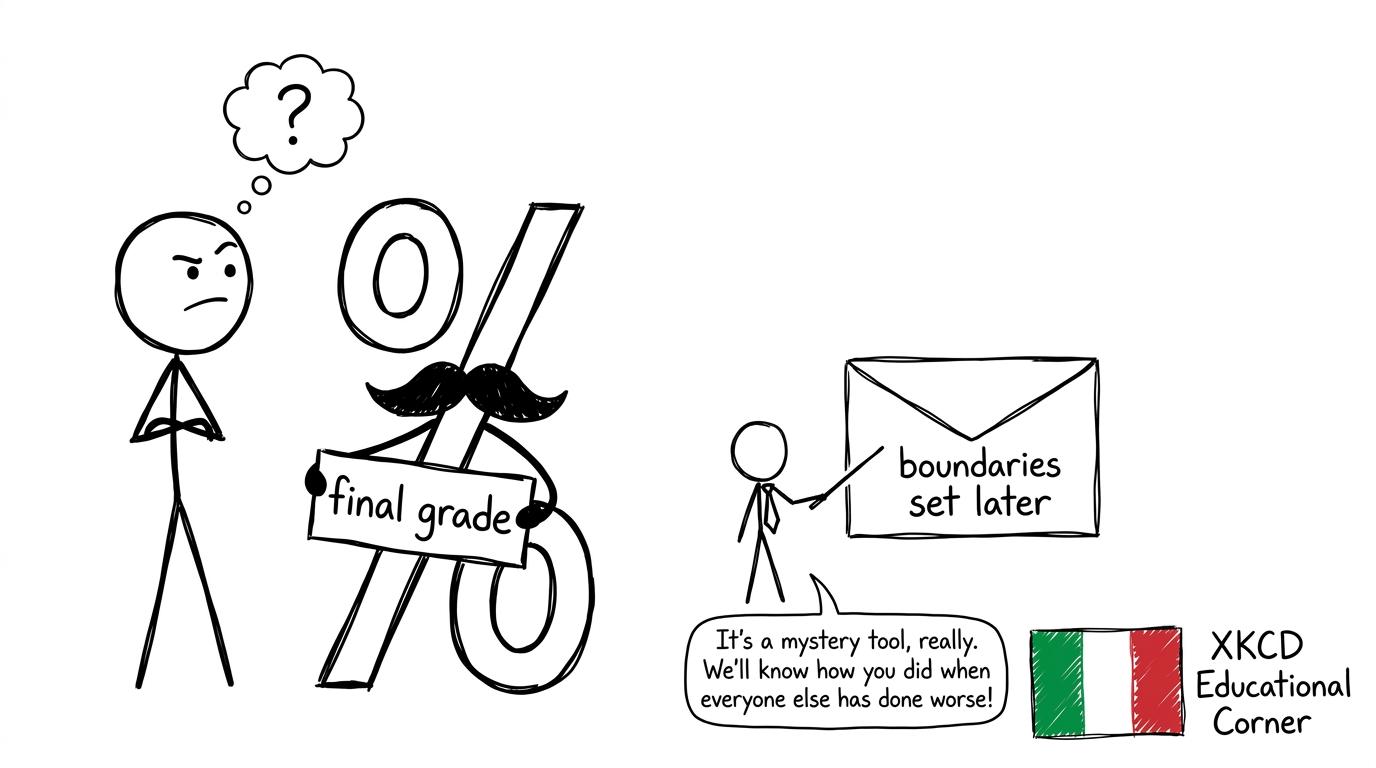 A suspicious percentage sign pretending to be a final GCSE grade
Why your raw mark is not automatically a percentage grade
A percentage is calculated using:
percentage mark=mark achievedmaximum mark×100\text{percentage mark}=\frac{\text{mark achieved}}{\text{maximum mark}}\times 100percentage mark=maximum markmark achieved×100That calculation is mathematically useful. It allows you to compare performances when papers have different totals. If you want to strengthen that skill, MathsGenie's free percentages revision lesson covers percentages as fractions out of 100100100.
The mistake is assuming that a familiar percentage must always equal a particular grade. There is no universal rule saying that a certain percentage is automatically a grade 444, 777 or 999 in GCSE Italian.
A percentage describes the proportion of available marks you collected. A grade boundary describes the minimum subject mark needed to receive a grade in one specific assessment series. These are related ideas, but they are not interchangeable.
How GCSE Italian marks become a final grade
GCSE Italian is a linear qualification. Students normally complete the required assessments in the same exam series, with their performance across the four language skills contributing to one qualification grade.
Raw marks come first
A raw mark is the mark awarded directly for your response. It may come from selecting the correct listening answer, understanding a reading passage, communicating successfully in the speaking assessment or meeting the criteria for a written response.
Raw marks show what happened on an individual assessment. They do not necessarily show how much that assessment contributes to the qualification.
Scaling protects the intended weighting
Listening, speaking, reading and writing each contribute 25%25\%25% to the current AQA and Pearson Edexcel GCSE Italian specifications, but their papers do not all necessarily have the same raw maximum mark. Exam boards can therefore scale marks so that each skill makes its intended contribution.
Pearson Edexcel's current specification provides a clear illustration. Its four Italian components have different raw maximum marks, but each is scaled to a maximum of 707070 subject marks. The resulting qualification total is:
70+70+70+70=28070+70+70+70=28070+70+70+70=280This does not mean an examiner has arbitrarily changed your performance. Scaling is a conversion used to preserve the agreed component weightings.
The subject total meets the boundary
Once the component marks have been converted where necessary, they are added together. The exam board then compares the total with the qualification-level boundaries.
The boundary is the minimum mark required for that grade. If a published grade 777 boundary is bbb, a subject mark of at least bbb reaches grade 777. A mark below bbb does not, even if it rounds to an appealing percentage.
Individual component boundaries sometimes published by exam boards are notional. They can help teachers interpret performance, but your certificate records the overall qualification grade. You do not receive four separate GCSE Italian grades that are averaged together.
Why GCSE Italian grade boundaries change each year
A question paper can be carefully designed and checked without being identical in difficulty to last year's paper. One listening extract may prove less accessible than expected. A writing task may produce stronger responses. A reading question may distinguish between levels of performance differently from its predecessor.
If boundaries never moved, candidates sitting a harder paper could need better-quality work to earn the same grade. That would not be fair.
Ofqual explains that exam boards set boundaries when marking is nearly complete. They examine performance data, identify a plausible range and ask senior examiners to review students' work around potential boundaries. The recommendation draws on both statistical evidence and expert judgement.
The aim is to maintain the standard represented by a grade over time. A harder assessment will generally produce lower boundaries; an easier assessment will generally produce higher ones. A higher boundary does not, by itself, mean the grading has become harsher.
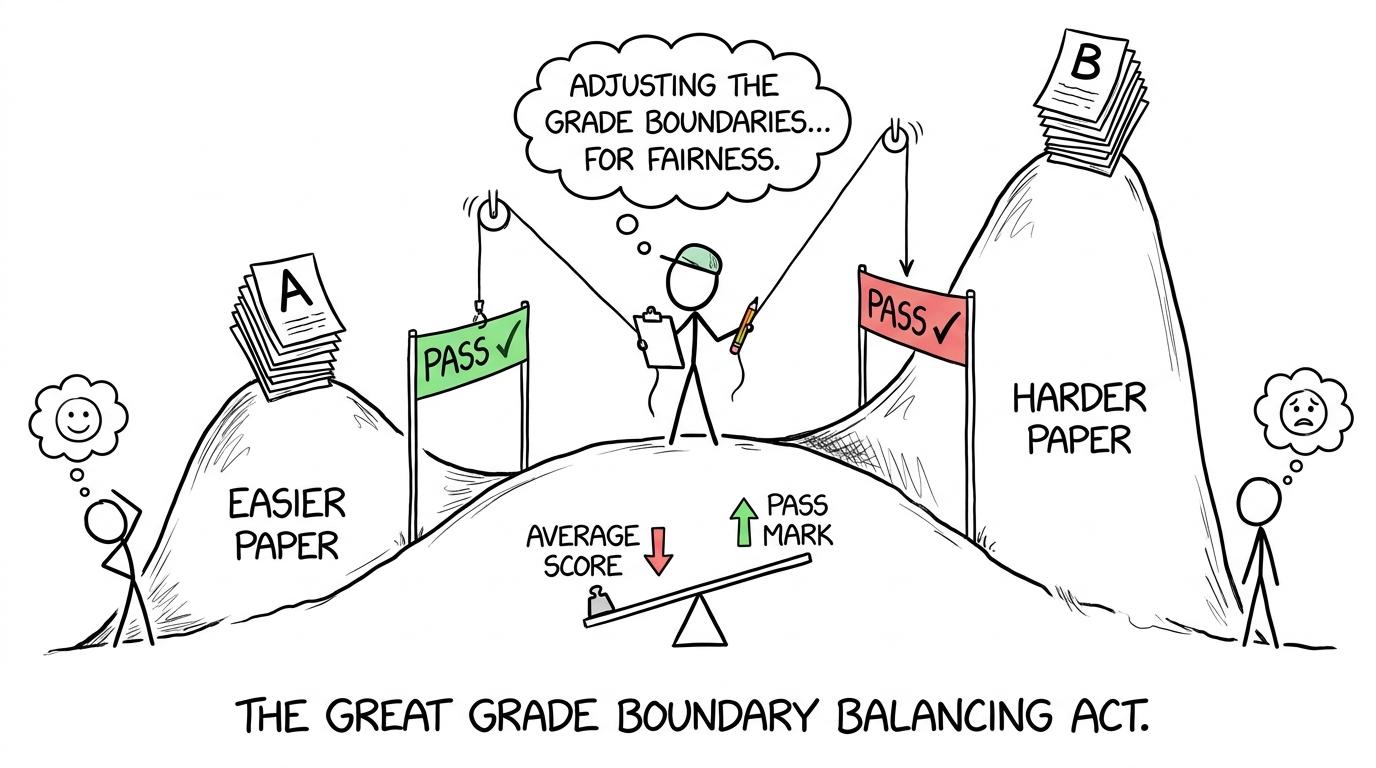 Two exam papers on different hills with adjusted finish lines
What the latest completed boundaries show
The latest completed summer series with published official boundaries is 2025. The figures below are historical evidence, not predictions for a future paper.
For AQA GCSE Italian in June 2025, the qualification maximum was 240240240. On foundation tier, the grade 555 boundary was 133133133; in June 2024 it had been 157157157. On higher tier, the grade 777 boundary was 135135135 in 2025, compared with 147147147 in 2024.
The percentage equivalents make the movement visible:
133240×100≈55.4%\frac{133}{240}\times100\approx55.4\%240133×100≈55.4% 157240×100≈65.4%\frac{157}{240}\times100\approx65.4\%240157×100≈65.4%A difference of roughly 101010 percentage points appeared at the foundation grade 555 boundary across those two series. That does not show that the grade became easier or that one cohort was automatically weaker. It shows why a mark must be interpreted in the context of the assessment taken.
For Pearson Edexcel GCSE Italian in June 2025, the overall table used a maximum subject mark of 280280280. The foundation grade 555 boundary was 210210210, while the higher grade 777 boundary was also 210210210. The identical number does not make the tiers equivalent: students sat different papers, had different available grades and were judged through separate tier routes.
Always identify the board before reading a boundary table. AQA and Edexcel assessments have different structures and mark totals, so their numerical boundaries should never be compared without context. OCR or Eduqas boundaries from unrelated qualifications are not substitutes for your Italian specification.
Foundation and higher tier change what the table means
Current AQA and Edexcel GCSE Italian qualifications offer foundation and higher tiers. Students take all four assessments at the same tier.
Foundation tier makes grades 111 to 555 available. Higher tier normally makes grades 444 to 999 available, with a narrow grade 333 safety net for candidates who fall just below the grade 444 boundary. A lower higher-tier mark can otherwise result in an unclassified outcome.
This is why searching for “the Italian grade 555 boundary” is incomplete. You need:
- the exam board and specification;
- the exam series and year;
- foundation or higher tier;
- the overall qualification boundary rather than a notional paper boundary.
The same principle applies in maths. Before using GCSE maths past papers for every major board, check the logo, specification and tier rather than treating every mark total as comparable.
How to use old boundaries without misleading yourself
Historical boundaries are best treated as a range, not a promise. Record your raw or scaled total, look at several relevant years and notice whether your performance remains near the same grade across different papers.
If one old table places you just above a target, do not revise to sit exactly on that line. Build a margin. The future paper may suit you differently, marking may expose weaknesses your mock missed and the eventual boundary is unknown while you are revising.
A useful review routine is:
- complete a paper under realistic conditions;
- mark it strictly using its own mark scheme;
- compare the result only with the matching historical boundaries;
- identify whether marks were lost through knowledge, accuracy, timing or interpretation;
- practise the weakest skill before attempting another paper.
Maths students can use exactly this process with Edexcel GCSE maths past papers and mark schemes. MathsGenie's guide to starting GCSE past papers at the right time also explains how to progress from mini tests to complete timed papers.
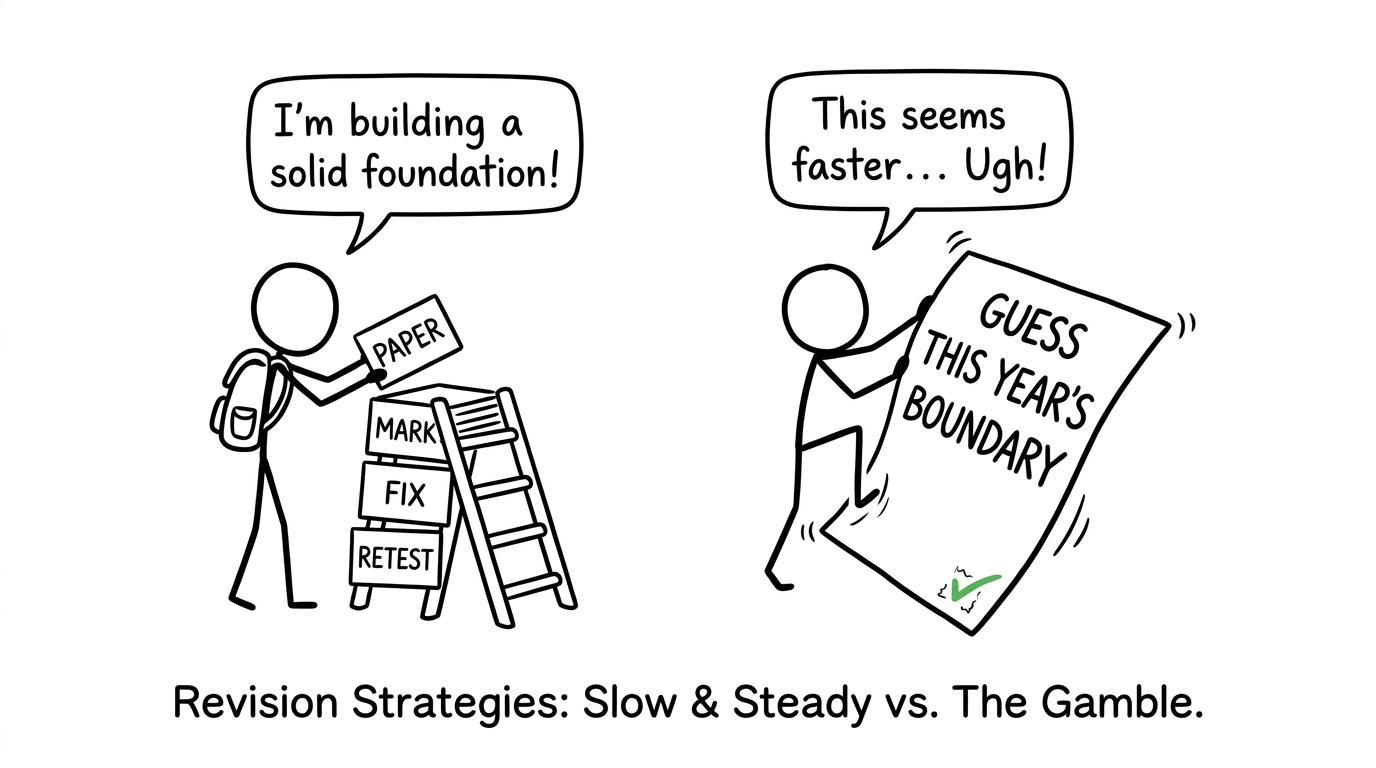 One student builds a revision ladder while another guesses a boundary
Common mistakes when reading Italian grade boundaries
Treating one percentage as a permanent grade
A percentage has no permanent GCSE Italian grade attached to it. Use the boundary for the correct board, tier and series.
Adding raw component marks when scaling is required
If components have different raw totals but equal qualification weightings, a simple raw-mark sum can distort the result. Follow the board's published scaling information.
Using notional paper boundaries as final grades
Notional boundaries describe what performance on one component might resemble. The qualification grade comes from the overall subject total.
Comparing AQA with Edexcel directly
Different maximum marks and assessment designs make the raw figures incomparable. Convert to percentages only for cautious context, not as proof that one board is easier.
Revising towards last year's exact threshold
Past boundaries are retrospective. They cannot tell you the mark required this year before awarding takes place.
Thinking boundaries are chosen to force a fixed quota
There is no predetermined quota of GCSE grades. Statistical evidence informs awarding, but senior examiners also examine the quality of work around possible boundaries.
Focus on controllable marks, not an unknowable line
Grade boundaries are designed to absorb differences in paper difficulty. Your revision should do something different: reduce the number of marks you leave behind.
For maths, use the MathsGenie GCSE revision hub to combine revision lessons, practice questions, worksheets, mini tests, past papers, predicted papers, mark schemes and video solutions. If percentages make boundary tables harder to interpret, revisit percentage change revision before analysing your results.
Then turn intentions into a schedule with the free MathsGenie revision planner. Do not try to guess a future boundary. Build enough understanding, accuracy and exam experience that small annual movements matter less.
A grade boundary is a line drawn after the race. Your job now is not to predict its exact position. It is to keep collecting marks.











