

GCSE History 20 Minute Study Routine
GCSE history 20 minute study routine: build lasting recall, practise exam skills and fit calm, focused revision around maths and a busy school week.
There is a familiar trap in GCSE History revision. The subject feels so large that a short session seems pointless, so you postpone it until you have a free evening. That evening rarely arrives. Eventually, revision becomes an exhausting attempt to relearn an entire topic at once.
A gcse history 20 minute study routine offers a calmer answer: retrieve knowledge for 666 minutes, connect and explain it for 666 minutes, practise an exam skill for 666 minutes, then use the final 222 minutes to check your work and choose tomorrow’s task. It is short enough to fit beside maths revision, homework and school, but purposeful enough to improve both knowledge and exam technique.
The goal is not to cover everything today. It is to return tomorrow.
Your 20-minute history revision checklist
Use the same structure each day so that you spend less time deciding and more time revising:
- Minutes 000 to 666: retrieve key facts without looking at notes.
- Minutes 666 to 121212: connect those facts through cause, consequence, change, continuity, similarity or significance.
- Minutes 121212 to 181818: apply your knowledge to one exam-board-specific question or plan.
- Minutes 181818 to 202020: check against notes, guidance or a mark scheme and record one gap.
Before starting, choose one narrow target. “Medicine” is too broad. A specific development, factor, source skill or question type is manageable.
You will also need your school’s topic list or current specification. AQA, Edexcel, OCR and Eduqas offer different topic choices and paper structures, so revise the content and question formats that apply to your course rather than borrowing a generic checklist.
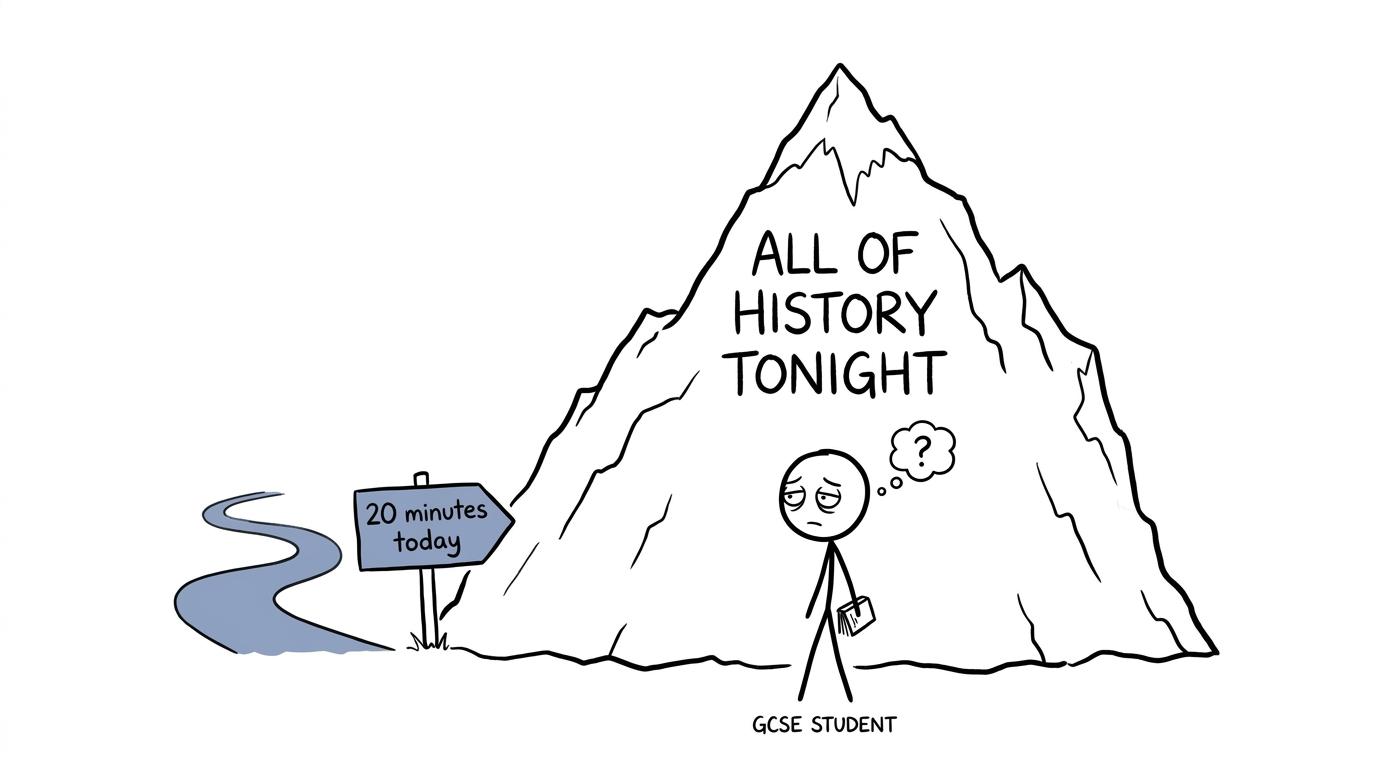 A student choosing a small daily path instead of climbing the entire history mountain
Why a short daily routine can work
The value of 202020 minutes comes from repetition, not magic. Five weekday sessions produce:
5×20=100 minutes 5 \times 20 = 100\text{ minutes} 5×20=100 minutesThat is more than an hour and a half of focused History revision each week, without requiring an all-nighter. More importantly, the sessions are separated. Each return asks your memory to recover information after a gap instead of simply recognising words that are still fresh on the page.
Recognition can be misleading. A paragraph may look familiar while you read it, yet disappear when a question asks you to explain two consequences. Retrieval exposes that difference early. You discover what you can produce without support and what still needs attention.
This principle also helps students balancing History with maths. MathsGenie’s guide to stopping GCSE maths content from being forgotten uses the same broad rhythm: retrieve, practise, check and revisit. The subject changes, but the habit remains useful.
Minutes 0-6: retrieve before you reread
Close the textbook and begin with a prompt. You might write everything you remember about one event, reconstruct part of a timeline, define several key terms or answer questions from flashcards.
Keep the task narrow enough to finish. Useful retrieval prompts include:
- What were the main causes of this development?
- Which people, institutions or groups were involved?
- What changed, and what remained similar?
- What evidence would support an explanation?
- Which details did I forget last time?
Only check your notes after making a genuine attempt. Struggling briefly is not evidence that the routine has failed. It is the moment the routine becomes informative.
Use two colours when checking: one for accurate recalled knowledge and one for missing or confused details. The second colour becomes tomorrow’s starting point. This creates a revision plan from evidence rather than mood, much like identifying gaps through MathsGenie’s weakest-topic routine.
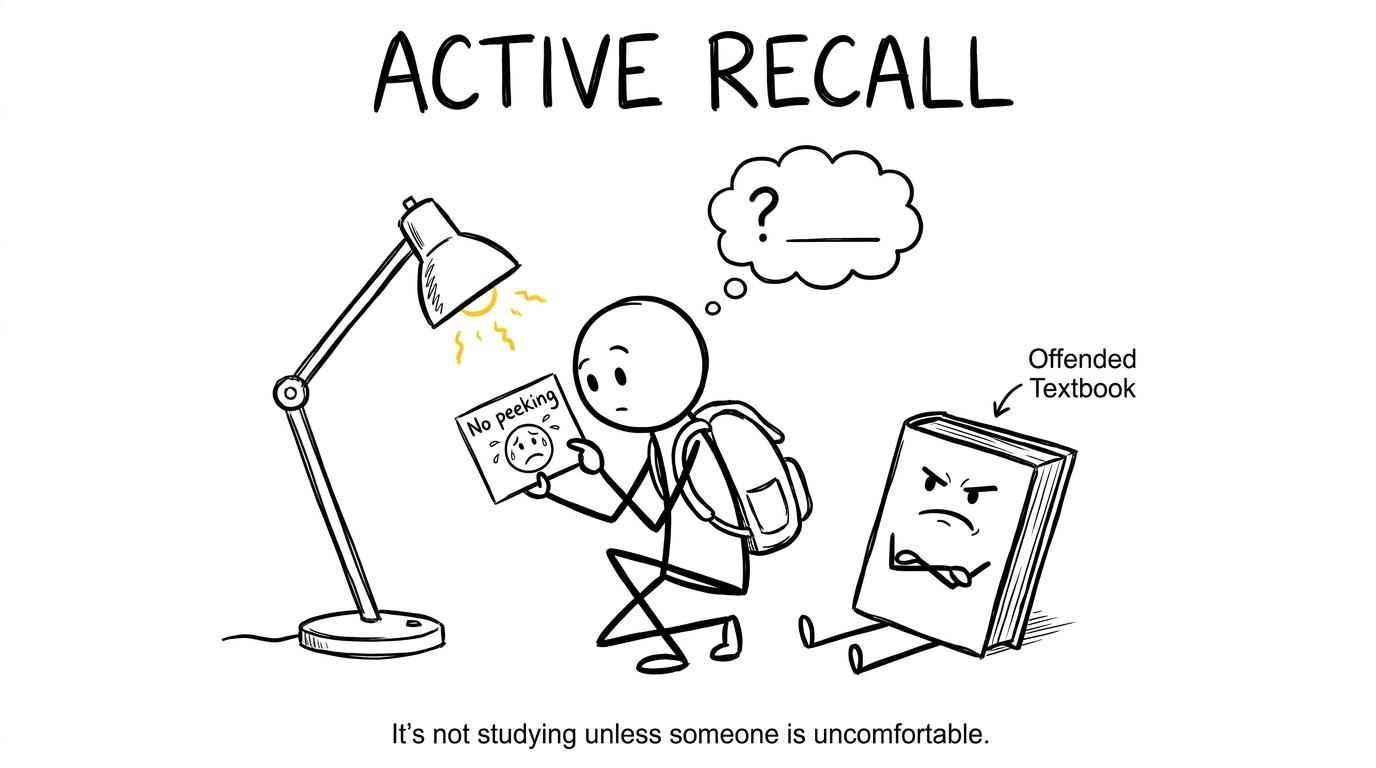 A determined student testing a nervous flashcard without peeking at the textbook
Minutes 6-12: turn facts into historical explanation
Knowing facts matters, but GCSE History does not assess memory alone. The common Ofqual-set assessment objectives require students to demonstrate knowledge and understanding, explain and analyse historical developments, evaluate contemporary sources, and make judgements about interpretations.
Across GCSE History qualifications, AO1 and AO2 each account for 35%35\%35% of the qualification, while AO3 and AO4 each account for 15%15\%15%. The exact distribution across papers and questions varies by specification. Your daily routine should therefore develop explanation and evaluation as well as recall.
Choose one connection and write it clearly:
- Cause: how did one factor produce or accelerate an event?
- Consequence: what changed because of it, and for whom?
- Change and continuity: what altered across the period, and what persisted?
- Significance: why did the development matter in its historical context?
- Similarity and difference: which precise features can be compared?
A useful self-check is: “Have I explained the link, or have I only placed two facts beside each other?” Words such as “because”, “therefore” and “this meant” can help reveal the relationship, but they do not create analysis by themselves. The reasoning after them must be historically accurate.
Minutes 12-18: practise one exam skill
The third block converts revision into something closer to exam performance. Select one task from your own exam board’s materials. In six minutes, you might:
- plan two developed reasons for an explanation question;
- annotate a source using relevant contextual knowledge;
- identify how two interpretations differ;
- plan evidence for and against a judgement;
- write one focused analytical paragraph;
- improve a previous answer using teacher feedback.
Do not attempt a full essay every day. The session is designed to isolate a skill. Longer timed answers and complete papers still matter, but they belong in a longer weekly slot.
Question wording matters. An answer that describes events may contain accurate knowledge yet fail to address a command asking you to explain, evaluate or judge. Copy the command word at the top of the page and make each point answer that instruction.
This is similar to short, targeted maths practice. On a busy evening, MathsGenie’s 202020-minute maths routine lets you maintain maths without consuming the time reserved for History. You can also use GCSE Maths mini tests when you need a compact, clearly bounded maths task.
Minutes 18-20: check and leave a trail
The final two minutes make tomorrow easier. Check your recall against trusted class materials and compare exam practice with the relevant mark scheme, model guidance or teacher feedback.
Record only three things:
- Secure: one detail or skill you used accurately.
- Gap: one fact, connection or exam habit that needs attention.
- Next: the exact prompt for tomorrow’s session.
“Revise Germany” is not an effective next step. “Retrieve the consequences from today’s lesson, then explain which was most significant” is specific enough to begin immediately.
Marking is where completed work becomes feedback. Maths students can build the same discipline through GCSE Maths revision resources, where revision material, questions and paper practice support a learn, practise and check cycle.
Build a weekly GCSE History routine
A daily structure works best when each day has a distinct purpose. Adapt the content to your specification and school timetable:
- Monday: retrieve chronology and essential knowledge.
- Tuesday: explain causes or consequences.
- Wednesday: analyse a source or interpretation.
- Thursday: plan a judgement question.
- Friday: revisit the week’s weakest area.
- Weekend: complete and mark one longer timed response when your schedule allows.
This pattern covers knowledge, second-order concepts and exam technique without pretending every task fits into 202020 minutes. The short sessions build the components; the weekend task asks you to assemble them under pressure.
Revisit weak content after a gap. A simple sequence could return to a topic after a few days and again the following week. Adjust the interval according to your recall: uncertain material should return sooner, while secure material can wait longer.
If maths also needs attention, avoid making both subjects compete for the same giant evening. Alternate concise sessions or place one before dinner and one afterwards. The MathsGenie guide to efficient GCSE maths revision can help you organise maths around focused topics rather than vague marathon sessions.
Adapt the routine when exams get closer
Early revision should build accurate knowledge and connections. As the exam approaches, shift more of the 202020 minutes towards retrieval under pressure and exam questions.
A sensible progression is:
When you are building knowledge
Spend more time on timelines, key features, vocabulary and causal links. Check against your specification so that gaps are visible.
When mocks are approaching
Keep retrieval, but use the application block for question plans, source evaluation and short timed paragraphs. Review marked school work to identify recurring weaknesses.
In the final weeks
Use some daily sessions to repair specific errors found in timed papers. Keep longer sessions for complete questions or papers, followed by careful marking. Do not replace sleep with an all-nighter. A tired reread of everything is less targeted than a short review of known gaps followed by rest.
The same principle applies across your timetable. If maths is the next exam, MathsGenie’s calm night-before plan helps prioritise a bounded task, checking and preparation rather than panic.
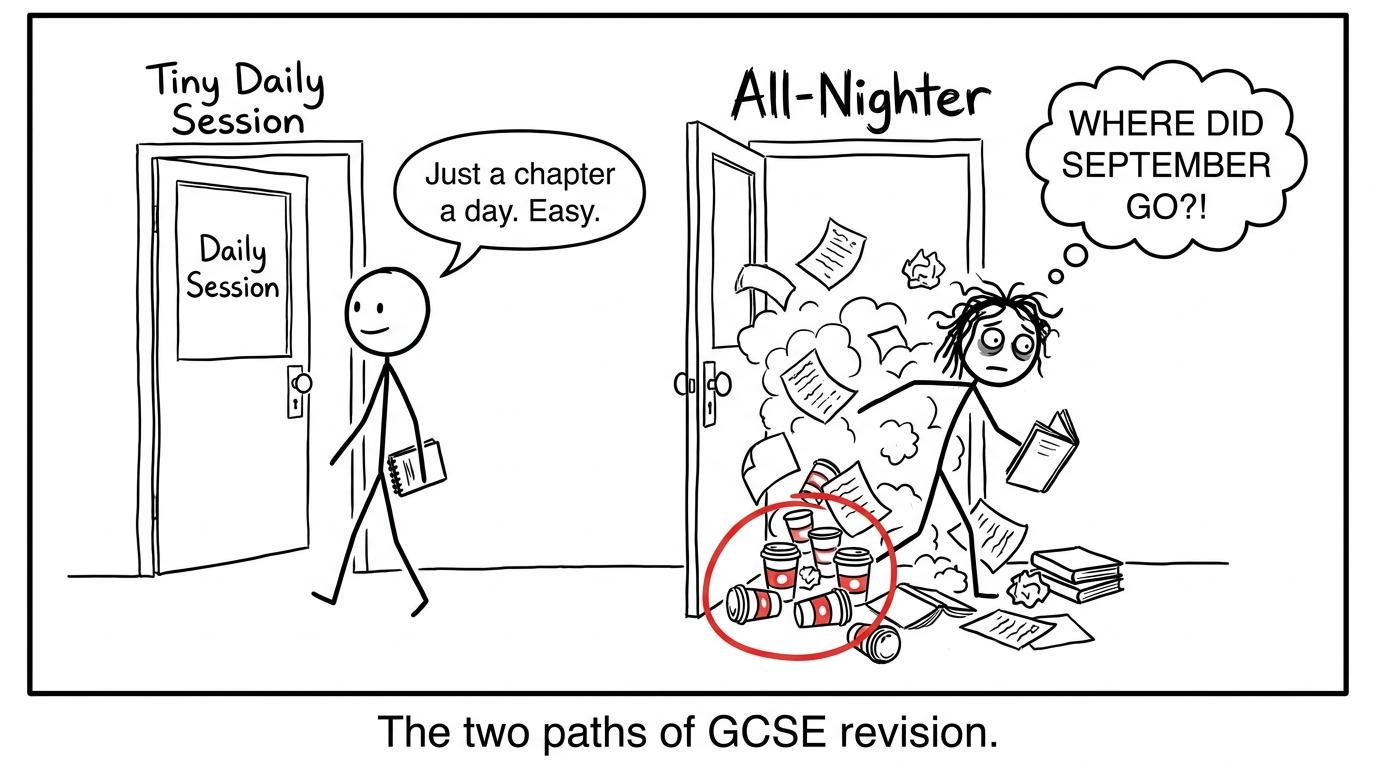 A calm daily-session door beside a chaotic all-nighter door
Common mistakes in a 20-minute study routine
Spending the whole session making resources
Beautiful flashcards and colour-coded timelines can feel productive, but creating them is not the same as remembering from them. Keep resources simple and spend most of the session retrieving or applying knowledge.
Choosing a topic that is too broad
A large label produces vague revision. Reduce it to one event, concept, factor, source skill or question type.
Looking at notes too soon
If the answer is visible, you are reading rather than retrieving. Attempt first, then check.
Revising facts without exam skills
Knowledge is essential, but students must also explain, analyse, evaluate and judge. Include a small application task each day.
Ignoring the mark scheme
Completing a question without checking it leaves uncertainty intact. Use the correct materials for your exam board and learn what the question rewards.
Treating one missed day as failure
A routine should survive ordinary life. Do not repay a missed session with an exhausting double session. Continue with the next planned 202020 minutes.
Make the next 20 minutes count
GCSE History becomes less intimidating when it stops being one enormous revision task. Retrieve one small area, explain one connection, practise one exam skill and record one next step. Then repeat.
That routine also protects time for maths. Use MathsGenie’s free GCSE Maths hub for revision lessons, practice questions, flashcards and exam-board resources. As your exams approach, combine topic work with mini tests, past papers, predicted papers, mark schemes and video solutions so that every maths session ends with useful feedback.
Start small today. Choose one History prompt, set a timer for 202020 minutes and leave tomorrow’s task ready before you stop. Consistency is quieter than an all-nighter, but it gives you far more chances to notice, correct and remember.










