GCSE Grade Different from Mocks? What to Do
GCSE grade different from mocks? Learn why results change, how to check marks and boundaries, and when to ask your school about a review of marking.

Opening a results envelope can make the months before it feel strangely distant. If you find a GCSE grade different from mocks, the result may be disappointing or confusing, but the difference does not automatically mean that something has gone wrong.
Mock grades are estimates based on one assessment, marked at one point in your course. Your final GCSE grade comes from your actual examination marks and the grade boundaries set after papers have been marked. First check your marks, speak to your school and confirm what the result means for your next step. Then consider whether there is evidence of a marking error.
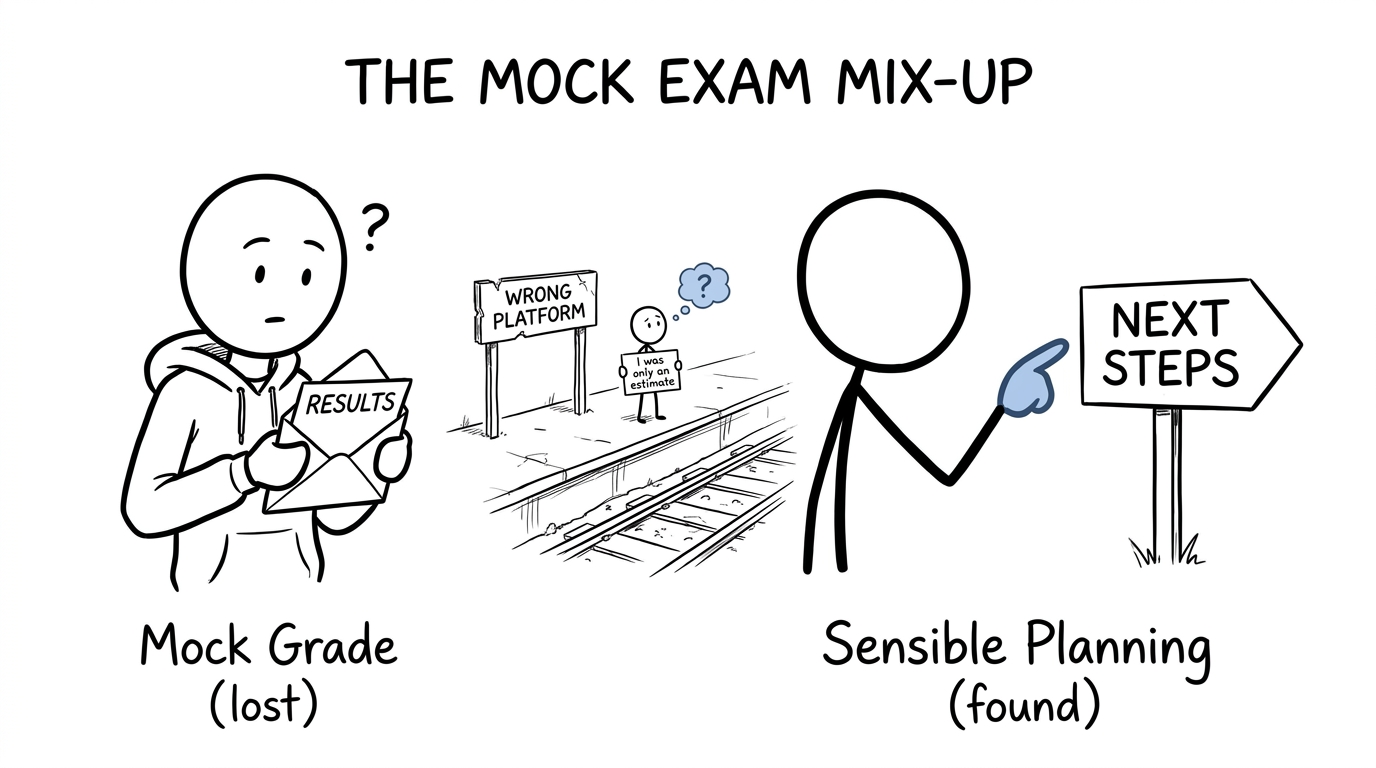 A mock grade waits at the wrong platform because it was only an estimate
Your results-day checklist
If your GCSE results and mock grades do not match, take these steps:
- Check the subject grade and individual paper marks.
- Confirm that you are comparing the same tier and specification.
- Ask how far your total mark is from the next grade boundary.
- Speak to your subject teacher or exams officer promptly.
- Ask whether your school can obtain your marked scripts.
- Discuss a clerical re-check or review of marking only when there is a reasonable concern.
- Check the entry requirements for your sixth form, college or course.
- Make a resit and revision plan if the grade will not change.
Why GCSE results can differ from mock grades
A mock is a snapshot, not a promise
A mock records your performance on a particular set of questions under particular conditions. Schools may use different papers, boundaries and marking approaches. Some mocks cover only the topics taught by that date, while others use a complete past paper.
Your final examination may also suit you differently. One student might meet several strong topics; another might lose marks through timing, unfamiliar wording or missing working. Neither result erases the other. They measure performance on different days.
Grade boundaries are set after marking
Exam boards such as Edexcel, AQA, OCR and Eduqas set grade boundaries after examining how students performed and reviewing the difficulty of the papers. Boundaries can therefore change from one series to another so that the standard required for a grade remains comparable.
Your school may have estimated mock boundaries using an earlier paper or its own internal evidence. A mark that produced grade 777 in a mock does not automatically produce grade 777 in the live series.
There is also no fixed quota limiting how many students can receive each grade. Your final result depends on your marks in relation to the published boundaries, not on whether too many other students passed.
The final papers tested a different mix of skills
GCSE maths specifications are broad. A mock could favour algebra and number, while the final papers place more pressure on geometry, probability or multi-step problem solving. Calculator technique, time management and showing enough working can also affect the mark.
To understand your pattern rather than guess at it, compare your experience with the resources for your board: Edexcel GCSE Maths revision, AQA GCSE Maths revision, OCR GCSE Maths revision or Eduqas GCSE Maths revision.
What to do when the final grade is lower
Find your total mark and boundary
Do not make a decision from the grade alone. Ask for your total mark and the official grade boundaries. Being one mark below a boundary feels very different from being much further away, although closeness by itself does not prove that the marking was wrong.
Your teacher may be able to inspect a copy of your script and compare it with the mark scheme. Maths marking often awards credit for valid methods even when the final answer is incorrect, so visible working matters. MathsGenie's guide to using GCSE mark schemes explains how method, accuracy and independent marks are commonly identified.
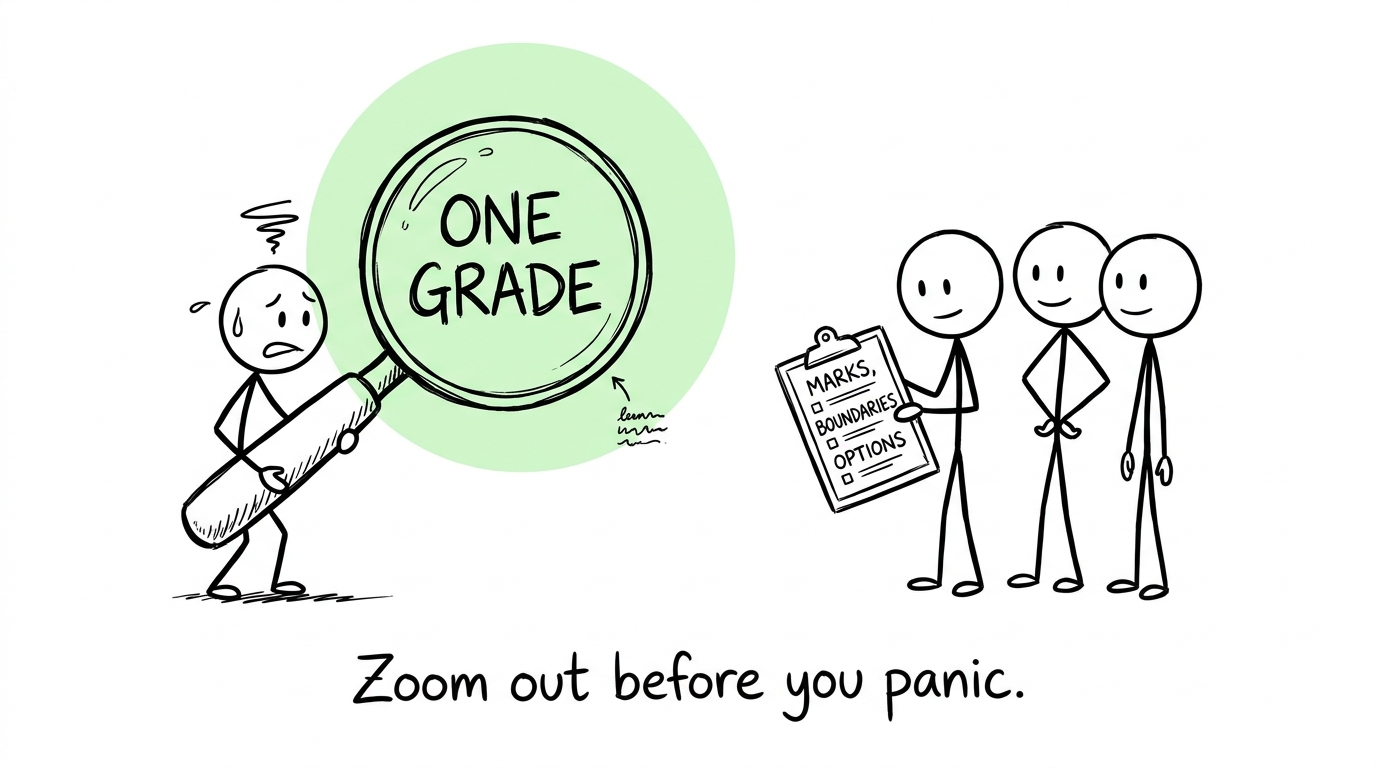 A student zooms in on one grade while everyone else checks the wider evidence
Speak to your school before requesting a review
A review of marking is not a fresh attempt to award extra marks. The reviewer checks whether the original mark scheme was applied correctly and corrects identified errors. A clerical re-check instead checks processes such as whether marks were recorded and totalled correctly.
For summer 2026 results, GCSE results day is Thursday 20 August. Under the current JCQ arrangements, requests for clerical re-checks and reviews of marking must reach awarding bodies by 24 September 2026. Your school may impose an earlier deadline, so contact its exams officer quickly.
Your centre will normally submit the request and must obtain your written consent. Your mark and grade can rise, remain unchanged or fall. Ask about the evidence, cost and possible outcomes before agreeing. Private candidates should contact the centre through which they entered or follow their awarding body's instructions.
Protect your next destination
If the grade affects a sixth-form, college or apprenticeship offer, contact the provider on results day. Explain that you are checking the result and ask whether it can still confirm your place, offer an alternative course or explain its deadline.
A lower maths grade may require a resit, particularly if you have not achieved grade 444. GCSE mathematics resits are available in November for eligible students aged at least 161616 by the relevant August deadline, as well as in the following summer. Your school or college can confirm the correct series and tier. Read what happens if you do not pass GCSE maths for a practical route forward.
If your final grade is higher than your mock
Take the win, but learn from it. The improvement may reflect better revision, stronger exam technique or a final paper that matched your strengths. It does not mean the mock was pointless. The mock may have revealed weaknesses early enough for you to repair them.
If you plan to take A Level maths, look beyond the headline grade and identify any fragile topics. Use the GCSE Maths revision hub to strengthen algebra, graphs and number skills before the new course begins.
Common mistakes after an unexpected result
- Assuming the mock must be more accurate: the final grade is based on the live assessments and official boundaries.
- Requesting a review only because the mark is close: proximity to a boundary is relevant, but a review corrects errors rather than awarding sympathetic marks.
- Forgetting that marks can fall: written consent is required because a review can lower, confirm or raise the result.
- Missing the school's deadline: centres often need requests before the awarding body's final date.
- Waiting for a review before contacting a college: protect your place or discuss alternatives immediately.
- Treating a resit as repeating the same revision: diagnose specific gaps using papers, mark schemes and topic practice.
Turn an unexpected grade into a clear next step
A result can change a plan, but it does not have to remove the destination. Check the evidence, meet the deadlines and make the next decision calmly.
If a resit is needed, use Edexcel GCSE Maths past papers or the appropriate board area to diagnose lost marks. Then build a focused routine with the MathsGenie revision planner, revision lessons, practice questions, mini tests, video solutions and predicted papers.
Start with the script and review-of-marking guidance from your school. Once the result is settled, let MathsGenie help you turn every remaining gap into something you can practise.